Showing posts with label health insurance marketplace. Show all posts

Thursday, May 05, 2022

If HHS cuts back short-term plans, they'd best be sure that the ARP subsidy boosts are extended

Subscribe to xpostfactoid 

 Alice Ollstein of Politico relays:

[HHS Secretary] Becerra says he's "in the midst of rulemaking" to crack down on skimpy health insurance plans that Democratic lawmakers and activists call "junk plans." No word on when that rule could come out, but it would undo the Trump admin's rule opening the door to more of those plans.

The "skimpy health plans" are so-called short-term limited duration (STLD) plans promoted and facilitated by the Trump administration. STLD plans are not ACA-compliant: they don't have to cover the ACA-mandated Essential Health Benefits (and usually don't provide coverage of most prescription drugs), and they are medically underwritten, meaning that applicants with pre-existing conditions can be charged more, denied coverage altogether, or offered coverage with the pre-existing condition excluded.

Wednesday, April 27, 2022

How not to explain ACA metal levels (and, I hope, how to)

Subscribe to xpostfactoid 

I have a post up at healthinsurance.org that aims to guide ACA marketplace shoppers in selecting the metal level (bronze, silver, gold, very occasionally platform) that works best for them. My opener was the product of a lot of trial and error:

When shopping for a health plan in the ACA marketplace, it’s important to recognize that while Bronze, Gold and Platinum plans have the same value no matter who is shopping, the value of Silver plans varies with income. Accordingly, the metal level that will best suit your needs is also likely to vary with income.

That basic fact is a given to anyone who's studied the marketplace and so may seem obvious. But it's counterintuitive, and it's the single most salient fact about metal level selection.  HealthCare.gov's guide to the metal levels all but completely obscures it (and many other guides follow suit):

Tuesday, April 05, 2022

ACA marketplace enrollment surged at high incomes in 2022

Subscribe to xpostfactoid 

Enrollment in the ACA marketplace has historically -- and appropriately -- been weighted toward people in low-income households. Lower income workers are less likely to have access to affordable employer insurance. While just 17% of the U.S. population is in households with income between 100 and 200% of the Federal Poverty Level (FPL), 52% of marketplace enrollees nationally had income in that range as of the end of the Open Enrollment Period (OEP) for 2021. In the twelve states that have still refused to enact the ACA Medicaid expansion, where most adults with income below 100% FPL have no access to subsidized insurance, more than half of enrollees have incomes below 150% FPL.

The American Rescue Plan Act, passed in March 2021, boosted premium subsidies in the ACA marketplace at every income level, removed the former income cap on subsidy eligibility (400% FPL), and made silver plans with strong Cost Sharing Reduction free at incomes up to 150% FPL, as well as much cheaper than previously in the 150-200% FPL income bracket (0-2% of income instead of roughly 4-6% for a benchmark silver plan).  During the emergency Special Enrollment Period that ran through half of 2021, fully 45% of enrollment in the 36 states then using the federal exchange, HealthCare.gov (where enrollment is dominated by the nonexpansion states) had income below 150% FPL. About 62% were below 200% FPL. Enrollment growth in OEP for 2021 (before the ARPA subsidy boosts were enacted) was also concentrated in nonexpansion states and heavily weighted toward low incomes in those states.

Given this history, as enrollment surged during the Open Enrollment Period for 2022, I was blithely confident that growth was concentrated at low incomes. I was wrong.  Texas health insurance broker Jenny Hogue was onto something:

In my little corner of Texas, its not the 100%'ers that moved back, its the people who were getting killed with the subsidy cap pre-ARPA. A lot of conversations started with "is it true I can get a subsidy if my wife and I make more than $70K?".

Friday, March 25, 2022

HealthCare.gov should tell 600,000 low-income bronze plan enrollees: switch to silver

Subscribe to xpostfactoid 

The message above, provided to shoppers on HealthCare.gov who estimate low incomes, isn't enough to keep a significant number of low-income enrollees out of bronze plans.

My last post focused on the stubborn persistence of significant bronze plan selection among low-income enrollees in the ACA marketplace in 2022, despite the fact that premium subsidy increases provided by the American Rescue Plan Act made the benchmark silver plan with strong Cost Sharing Reduction free to enrollees with incomes up to 150% FPL, and much cheaper than in previous years for those with incomes in the 150-200% FPL range.

Among enrollees with income between 100% and 150% FPL, 14% -- more than 600,000 -- selected bronze plans for 2022. While bronze plan selection at incomes in the 100-150% range did tick down a bit from the prior year, it remained higher than in any year prior to 2021.

President Biden's January 28, 2021 Executive Order 14009, “Strengthening Medicaid and the Affordable Care Act," declares, "it is the policy of my Administration to protect and strengthen Medicaid and the ACA and to make high-quality healthcare accessible and affordable for every American." Bronze plans obtained by people with income below 150% FPL do not advance that policy.

Bronze plan single-person deductibles average over $7,000, compared to under $150 for silver plans as enhanced by the CSR provided to enrollees with incomes up to 150% FPL. Annual out-of-pocket maximums in bronze plans generally exceed $8,000,* compared to an average of $1,208 in silver plans. 

600,000 bronze plan enrollees below the 150% FPL threshold is almost 600,000 too many.

CMS has given itself a tool to reduce this underinsured population. Last July it finalized, and this month it implemented, a rule creating "monthly special enrollment period" for enrollees with incomes up to 150% FPL -- effectively establishing continuous year-round enrollment for the lowest-income marketplace applicants. The rule not only allows the uninsured to enroll outside the annual Open Enrollment Period; it also allows current enrollees with income up to 150% FPL to switch to a silver plan. 

Wednesday, March 23, 2022

In ACA marketplace in 2022, too much underinsurance (bronze plan selection) at low incomes

Subscribe to xpostfactoid 


We have had plenty of time to celebrate the 21% surge in ACA marketplace enrollment, most likely triggered primarily by the major boosts to premium subsidies provided last March by the American Rescue Plan Act (ARPA). Now, with CMS's Public Use Files tracking marketplace enrollment for 2022 released on the ACA's 12th anniversary, it's time for some disappointment.  

In the 33 HealthCare.gov states, for which CMS provides detailed plan selection breakouts, the ARPA subsidy boosts did not reduce underinsurance as much as might have been expected during the Open Enrollment Period (OEP) for 2022.  That is, silver plan selection at low incomes (up to 200% FPL), where Cost Sharing Reduction (CSR) makes silver plans far and away the best value for almost all enrollees, modestly reversed a four-year slide, but not nearly as much as might have been expected. 

In HealthCare.gov states this year, 60% of enrollees had incomes below 200% FPL, and 80% of them selected silver plans. 

Enrollment by metal level at low incomes

HealthCare.gov states

100-150% FPL

Year

% bronze

% silver

2017

  9.2%

89.3%

2018

  9.9%

87.7%

2019

10.4%

88.3%

2020

12.1%

86.8%

2021

16.2%

82.7%

SEP 2021(0-150%)


93.0% (estimate)

2022

14.1%

84.9%

Tuesday, March 22, 2022

Good news alert: Web search for health insurance has been cleaned up

Subscribe (free) to xpostfactoid


ACA marketplace enrollment surged by 21% in 2022, from 12.0 million as of the end of the Open Enrollment Period for 2021 to 14.5 million in OEP 2022.  The primary cause was plainly the massive boosts to premium subsidies provided by the American Rescue Plan in March 2021 (witness the enrollment surge in the emergency Special Enrollment Period in effect when the boosted subsidies came into effect). Ramped-up federally funded enrollment assistance and advertising may also have helped.

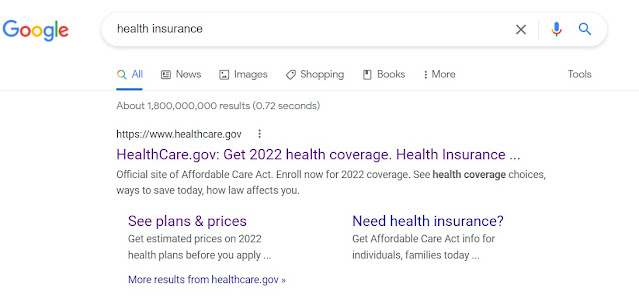
A less visible marketing measure may also have been a factor: the online search environment has been cleaned up.  Search today on Google for "health insurance" or "Obamacare" and HealthCare.gov, the federal exchange that serves 33 states, will top the search results. Search for "health insurance Nevada" and Nevada Health Link, the state-run ACA exchange, will be on top. The same is true for all of the 17 states (and D.C.) that run their own exchanges. There are some slight variations on Yahoo and Bing, but results there are also generally reliable. 


Monday, February 28, 2022

Whither the off-exchange individual market? Tea leaves in New Jersey

Subscribe (free) to xpostfactoid

Jersey City skyline

One open question created by the American Rescue Plan Act's boost to ACA marketplace subsidies is the extent to which off-exchange enrollment in ACA-compliant plans has migrated to the exchanges. A related question is how many people who would have been ineligible for subsidies and uninsured pre-ARPA (or insured in noncompliant plans) were drawn into the exchanges.

New Jersey, one of the few states that tracks off-exchange enrollment on a quarterly basis and has a large off-exchange enrollment cohort, will eventually provide an interesting sampling. Unfortunately, the off-exchange tally is at present only complete through Q4 2020. But the state's on-exchange enrollment reports provide some hints, explored below. 

Wednesday, February 09, 2022

In New Mexico, a Midas touch has a double edge

Subscribe to (free) xpostfactoid

Let's take one more look at enrollment results in New Mexico's ACA marketplace, where extreme silver loading rendered average lowest-cost gold plan premiums 14% lower than those of lowest-cost silver plans, and gold plans were available well below the cost of a benchmark silver plan statewide (excepting those for whom silver plans also were free, or had single-digit premiums).

The unadulterated good news was for enrollees with incomes above 200% of the Federal Poverty Level, more than two thirds of whom chose gold plans, while only about 13% choose bronze. That's a real advance.

The good news at incomes below 200% FPL was that just 4% chose bronze plans, which carry deductibles usually in the $7,000 range for an individual.  Most of those who selected bronze at low income levels may have been subsidy-ineligible, usually because of an employer's offer of insurance. That's generally the case for a small percentage of enrollees with incomes in subsidy range.

The not-so-good news is that 31% of enrollees with incomes in the 138-200% FPL range chose gold plans, although silver plans have a higher actuarial value than gold plans at incomes below 200% FPL, reflected most dramatically in annual maximum out-of-pocket cost (MOOP) caps that can't go higher than $2,900, vs. a maximum allowable MOOP of $8,700 for gold plans. 

Friday, February 04, 2022

In 2022, New Mexicans grabbed the gold in the ACA marketplace

Back in mid-October, I devoted a handful of posts (1, 2, 3) to New Mexico's great ACA marketplace experiment: instructing insurers to price silver plans as platinum-value in 2022 -- that is, as if no one with an income over 200% FPL would buy a silver plan. Below that income threshold, silver plans, enhanced by strong Cost Sharing Reduction (CSR), actually are platinum-equivalent, having an actuarial value of 94% (at incomes up to 150% FPL) or 87% at 150-200% FPL). The instructions were adhered to: throughout the state gold plans offered for 2022 were priced well below the benchmark silver plan.

The results were largely as planned, and can fairly be deemed a success. At incomes over 200% FPL, two thirds of enrollees chose gold plans, compared to 35% last year. At incomes in the 138-200% FPL range, comprising most enrollees eligible for strong CSR,  65% of enrollees chose silver plans -- and just 4% chose bronze, generally a bad choice for low income people, with single-person deductibles averaging about $7,000.  Among all enrollees, 57% chose gold plans.

Enrollment was up modestly, from 42,984 in Open Enrollment 2021 to 45,973 this year, a 7% increase. That's below the 11.5% average increase this year for states that have expanded Medicaid, as New Mexico has. But New Mexico launched a new state-based exchange, bewellnm, in the Open Enrollment Period for 2022, and that transition has often triggered enrollment losses for other states.

Here are the metal level choices broken out by income (courtesy of bewellnm, at the first link above):

Sunday, January 23, 2022

On climbing out of the ACA coverage gap


The latest quarterly estimates of health insurance coverage from the National Health Interview Survey (NHIS) show a drop in the uninsured rate for all ages from 9.7% in Q2 2021 to 8.9% in Q3. That's probably not statistically significant. The confidence intervals largely overlap;  quarterly rates bounce around quite a bit; they are "published prior to final data editing and final weighting"; and response rates have been affected by the pandemic.

That said, the changes among adults aged 18-64 in the lowest income segment -- those with incomes below the Federal Poverty Level -- may be worth pausing over:

Wednesday, January 19, 2022

Fixing the ACA’s Medicare Glitch

By Louise Norris and Andrew Sprung
-------------
It's my pleasure to team up in this post with Louise Norris, a health insurance broker and ACA chronicler extraordinaire at healthinsurance.org and verywell.com. At those two sites, Louise has effectively created a constantly updated encyclopedia of the ACA, covering a host of enrollment situations, regulations, marketplace features, and histories of each state marketplace. She has done similar work about Medicare at Medicareresources.org.

*          *          *

For most Americans, enrollment in Medicare is cause for celebration. At last: affordable, reliable insurance you can’t lose. Medicare enrollment can entail some complex determinations (do I qualify for any Medicare Savings Programs?) and decisions (Medigap or Medicare Advantage?) For many seniors, too, the burden of premiums and out-of-pocket expenses is heavy. Still, by American standards, Medicare is reliable and affordable.

For “near-elderly” couples (under age 65)  who are insured through the Health Insurance Marketplace established by the Affordable Care Act, however, the transition of the elder spouse into Medicare can bring sticker shock and extra expense. That’s because ACA premium subsidies are designed so that enrollees pay a fixed percentage of household income for the benchmark (second cheapest) silver plan in their area – and they pay the same percentage (reduced through 2022 by the American Rescue Plan enacted in March 2021) regardless of how many people need insurance. 

A couple that was paying 8% in premiums for a benchmark silver plan to cover both of them will still pay 8% of income when only one of them is covered in the marketplace. When one of them transitions to Medicare, they will pay the marketplace premium plus the Medicare premium. In the illustration below, they will pay somewhere between 11% and 14% of income in premiums to cover them both, depending on whether the Medicare enrollee opts to buy a Medigap policy.

Thursday, December 16, 2021

Swinging benchmarks, meaningful difference, market stability and market chaos

Subscribe (free) to xpostfactoid

My last post focused on the steep premium hikes that can hit ACA marketplace enrollees if they passively let themselves be auto-reenrolled in their current plan for the year following. In brief: if the benchmark (second cheapest silver) premium shrinks (say, because a new discount insurer enters the market), so does the subsidy. If the enrollee's current plan premium in turn increases, it's a double whammy. 

The major increase in ACA marketplace subsidies enacted when the American Rescue Plan Act (ARPA) passed in March 2021 does not alter this dynamic. If the benchmark silver plan is available to you for free -- as it is now for some two million enrollees -- and your silver plan premium exceeds the benchmark by $139 per month, you'll pay... $139 per month. Louise Norris shows an even more extreme example of a one-year premium increase for a subsidized enrollee.

In fact, large benchmark swings may be more common this year than in years past. Insurer participation in the ACA marketplace has surged this year, probably prompted by the ARPA subsidy boosts, which followed several years of price stability and profitability. CMS reports that the average enrollee has between 6 and 7 insurers to choose from in 2022, compared to between 4 and 5 in 2021 -- an increase of 44% if you take the midpoint (6.5 vs. 4.5).  Among the insurers expanding their footprint in 2022 are discounters Bright, Centene, Friday, and Molina. The average benchmark premium dropped 3% nationally, according to the Kaiser Family Foundation.

A parallel problem, adding to the confusion inherent in marketplace structure for those who do check out their options, is an overabundance of plan choice. In 2022, the number of plans available to the average marketplace enrollee soared from 61 to 108 -- a 77% increase. In Dallas, 164 plans are available on-exchange. In Miami, 263.

Friday, December 10, 2021

ACA enrollment gains in OE 2022 may just consolidate gains from the emergency SEP

CMS's Week 5 snapshot of ACA marketplace enrollment during the Open Enrollment season for 2022 shows an all-state enrollment increase of 8.5% over Week 5 for 2021, according to Charles Gaba's calculation. (Gaba adjusts the growth rate reported by CMS to account for the fact that this year's data reflects 34 days of enrollment, vs. 35 days at this point last year.)

While extrapolations in mid-OE are always dicey, that rate of increase has held fairly steady, and I'll venture to point out that gains in this range would basically consolidate the large enrollment increases effectuated during this year's emergency Special Enrollment Period, which ran from February 15 to August 15 on HealthCare.gov, the federal exchange, and for varying extended periods on 15 state-based exchanges. The emergency SEP was essentially a second Open Enrollment period.

The enrollment gains during the current OE, as during the emergency SEP and OE for 2021, are heavily concentrated in states that have not enacted the ACA Medicaid expansion and have a consequent "coverage gap" - -that is, no subsidized health insurance available for most adults with incomes below 100% of the Federal Poverty Level, the threshold for marketplace subsidy eligibility.  As reflected in the table below, 72% of net enrollment gains nationally from February through August of this year were in the nonexpansion states (excluding Wisconsin, which offers Medicaid to adults with incomes up to 100% FPL and so has no coverage gap). For that reason, I have focused on the nonexpansion states to compare apparent enrollment gains at present with those logged in the emergency SEP.  

Monday, December 06, 2021

Talk to me if you became self-employed during the pandemic

Last week I noted that the subsidy increases in the ACA marketplace provided last spring by the American Rescue Plan Act (ARPA) were well-timed to catch a surge in self-employment and small business formation triggered by the pandemic.

Thanks to the subsidy boosts, the ACA marketplace is much closer than ever before to fulfilling the ACA's foundational promise of freeing Americans from "job lock" -- dependence on employers for health insurance. 

I would like to speak to people who have become self-employed or started businesses since the pandemic struck and looked to the ACA marketplace (or Medicaid) for health insurance -- successfully or unsuccessfully. I would also welcome hearing from people who were already insured through the marketplace and experienced changes once the ARPA subsidies were enacted in April/May 2021 (or July, for those who qualified for free silver plans because they had received unemployment insurance income this year).

If you'd like to tell me your experience, please email me: adsprung at gmail. Please refer anyone whose experience you think might be relevant. Thanks!

Subscribe to xpostfactoid 


Friday, December 03, 2021

Pointing low-income ACA marketplace shoppers toward Cost Sharing Reduction

As I noted in my last post, the American Rescue Plan Act's boosts to ACA marketplace subsidies seem to have reversed a years-long slide in "CSR takeup" among low-income enrollees. That is, during the emergency Special Enrollment Period that ended this past August 15, about 90% of enrollees with incomes below 200% of the Federal Poverty Level selected silver plans and accessed strong Cost Sharing Reduction (CSR), up from about 77% in the last Open Enrollment period. CSR is available with silver plans only. At incomes up to 200% FPL, it raises the value of a silver plan to the rough equivalent of platinum at no extra cost to the enrollee.

The surge in silver selection at low incomes this spring and summer was only logical, since ARPA made a benchmark silver plan free at incomes up to 150% FPL, and available for no more than 2% of income at incomes up to 200% FPL ($25,520 for a single person in 2021).  At incomes below 200% FPL, CSR reduces deductibles and out-of-pocket maximums to a small fraction of those prevalent in bronze plans (the median deductible obtained by 2.1 million enrollees on HealthCare.gov during the SEP was $50; bronze deductibles average nearly $7,000).  Free bronze plans used to be a serious temptation at incomes between 150-200% FPL in particular; now, not so much.

Since bronze plans are now almost always "dominated" by silver plans at incomes up to 150% FPL, and almost always a poor choice up to  200% FPL, I thought I'd check the degree to which the ACA exchanges - -HealthCare.gov, now serving 33 states, and 18 state-based exchanges (including D.C.'s) steer low-income enrollees toward silver plans. 

Wednesday, December 01, 2021

ARPA subsidy boosts in ACA marketplace reduced underinsurance, reversing a 'slide to bronze' at low incomes

Subscribe to xpostfactoid 

When the premium subsidy enhancements for the ACA marketplace that became law when the American Rescue Plan passed were first published in early February of this year, my first thought was that no one with an income below 200% FPL should ever buy a bronze plan again:

If the subsidy enhancements become law while the emergency SEP [Special Enrollment Period, running from Feb. 15 to Aug. 15 on HealthCare.gov] is still open, bronze plan enrollment at incomes under 200% FPL should go to zero. At incomes up to 150% FPL ($19,140 for a single person), silver coverage will be free. At 200% FPL ($25,520 for a single person), benchmark silver will cost $43 per month. That expense doesn't feel like nothing at that income, but the average deductible for silver at that income level ($800) is about one ninth of the average bronze deductible ($6,921). The out-of-pocket maximum for bronze plans is usually close to the highest allowable, $8,550 for a single adult.  For silver at incomes up to 200% FPL, it's $2,850, and usually well below that, averaging $1,189 at incomes up to 150% FPL and $2,528 at 150-200% FPL. 

Well, those subsidy boosts did go into effect during the emergency SEP, helping to drive a major surge in off-season enrollment. Nationally, 2.8 million people newly enrolled in ACA marketplace plans from Feb. 15 to Aug. 15, 2.1 million of them in the 36 states using the federal exchange, HealthCare.gov. And while selection of plans at metal levels other than silver at low incomes did not go zero during the SEP, it did go way down, reversing a troubling trend.  The ARPA subsidies are reducing underinsurance.

Tuesday, November 30, 2021

Is the ACA marketplace catching a surge in entrepreneurship?


The Wall Street Journal's Josh Mitchell and Kathryn Dill report that the pandemic has triggered a surge in self-employment and small business formation:

The number of unincorporated self-employed workers has risen by 500,000 since the start of the pandemic, Labor Department data show, to 9.44 million....Entrepreneurs applied for federal tax-identification numbers to register 4.54 million new businesses from January through October this year, up 56% from the same period of 2019, Census Bureau data show.

That surge underscores the value and good timing of the boosts to premium subsidies for plans sold in the ACA Health Insurance Marketplace provided by the American Rescue Plan Act, enacted in March 2021. Those subsidy increases brought the ACA much closer to fulfilling its promise of providing affordable insurance to those who lose or leave their jobs and so lose access to employer-sponsored plans, which insure the majority of working age Americans.

Friday, November 26, 2021

Almost a quarter of all emergency SEP enrollees in ACA marketplace should have been in Medicaid

Subscribe to xpostfactoid

For years, we have had to infer what percentage of ACA marketplace enrollees in states that have refused to enact the ACA Medicaid expansion have incomes below 138% FPL -- the Medicaid eligibility threshold in expansion states. It's a very large percentage, but as CMS's enrollment reports usually break out income in increments of 50 FPL percentage points, e.g., 100-150% FPL, it has to be inferred.

Just once, in 2016, CMS did provide enrollment results by state for the 100-138% FPL income range as well as for the broader 100-150% FPL bracket. In nonexpansion states, the former was about 85% of the latter. For years since, I've used 85% as a benchmark to estimate down from 100-150% FPL for the "should-have-been-in-Medicaid" cohort.

The final enrollment report for the 2021 emergency Special Enrollment Period, which ran from Feb. 15 to Aug. 15 in the 36 HealthCare.gov states, provides a tantalizing hint: 33% of all enrollment in those states was in the 100-138% FPL bracket. (All nonexpansion states use HealthCare.gov.) But what percentage of those were in the 13 states that had not expanded Medicaid as of the SEP period? (I'm including Oklahoma, which opened the Medicaid expansion gate on July 1 of this year.) 

Wednesday, November 17, 2021

The broker's tale: Louise Norris on skewed incentives in the ACA marketplace


As noted in last week's post, the ACA exchanges rely heavily on health insurance brokers and agents to help people sort their options and enroll in ACA-compliant individual market plans. Almost half of enrollments on the federal exchange, HealthCare.gov, which currently serves 33 states, are enrolled by brokers and agents. The same is true for Covered California, the largest state-based exchange -- which, unlike HealthCare.gov,* has maintained a consistent commitment to making the marketplace work as designed since its launch in fall 2013.

The reliance on brokers was inevitable, given the complexity of marketplace offerings (check out the 221 plans on sale in Miami, the nation's largest ACA marketplace, in 2022) and the pre-existing pool of expertise, commercially funded, that brokers constituted prior to ACA launch.  And while brokers have played a vital role,** the ACA failed to align their incentives in such a way as to ensure that their participation would be an unmixed blessing. Among the problems:

  • Not all insurers that participate in the ACA exchanges pay commissions to brokers. Commissions have fluctuated quite a bit over the seven years of the marketplace's existence, as well as by state, region, and individual insurer.

  • The lightly regulated market for so-called Short Term Limited Duration plans fostered by the Trump administration (which rendered them neither short-term nor of limited duration, if there's a difference) pays much higher commissions than the ACA-compliant market, but serves few enrollees' best interests. STLD plans are medically underwritten, riddled with exclusions and coverage gaps, prone to balance billing, and pay as little as half of premium revenue to cover enrollees' medical claims. ACA-compliant plans are required to maintain a minimum "medical loss ratio" (MLR) of 80% -- that is, pay out at least 80% of premium revenue in claims.

How do ethical brokers deal with these conditions, and how could incentives be better aligned? To address those questions I queried Louise Norris, co-owner with her husband Jay Norris of a health insurance brokerage serving individual market customers in Colorado.

Monday, November 01, 2021

Premiums down, out-of-pocket costs up up up: The post-ARPA case for maximal silver loading

Subscribe to xpostfactoid

I have repeatedly made the case that CMS should follow the lead of several states and mandate strict silver loading* in the ACA marketplace-- that is, require insurers to consistently price gold plans below silver plans, since the average actuarial value of silver plans is higher than the mandated AV for gold plans (80% -- i.e., the plan is designed to cover 80% of the average enrollee's costs). 

In recent posts, I have spotlighted New Mexico's maximized mandatory silver loading: in 2022, the state required insurers to price silver plans as platinum-equivalent, since silver plans are platinum-equivalent for enrollees with incomes below 200% FPL ($25,7600 for an individual in 2022).  The regulation is designed to be a self-fulfilling prophecy: if gold plans are priced well below silver, no one with an income over 200% FPL should buy silver plans.  In 2022, gold plans are in fact priced well below silver plans throughout New Mexico.

Since silver loading began in 2018, the main case for maximizing it has simply been that the ACA marketplace has always been under-subsidized, and a state or CMS can alleviate high enrollee costs without help from Congress. That case may appear less urgent after the American Rescue Plan Act (ARPA), enacted this past March, sharply increased premium subsidies. The draft Build Back Better bill would extend those subsidy boosts through 2025.

But the case for strict silver loading remains strong. While ARPA reduced premiums, it did not reduce out-of-pocket costs, and these have risen relentlessly at each metal level, driven by medical inflation, which is always higher in the commercial market.  Strict silver loading is a way to roll back that rise for enrollees with incomes above 200% FPL; it's a kind of back-door CSR for enrollees above that income level. (Moreover, the BBB bill is not a done deal, 2025 is not the end of time, and strict silver loading would mitigate a far-from-unlikely expiration of the subsidy boost.)