Showing posts with label state-based exchanges. Show all posts

Monday, January 02, 2023

Looking Backward: 2023--2014 in the ACA marketplace

Dear xpostfactoid readers: All subscriptions are now through Substack alone (still free). I will continue to cross-post on this site, but I've cancelled the follow.it feed (it is an excellent free service, but Substack pulls in new subscribers). If you're not subscribed, please visit xpostfactoid on Substack and sign up!  


This morning I happened on a January 2014 post of mine that engaged the question of whether the ACA marketplace structure might foster productive state experimentation over time. Austin Frakt engaged the question and usefully compressed my forecast as follows:

First a ground pre-prepped for de facto compromise has been laid — in the state exchanges. […] [S]tarting in 2017, states can apply for waivers by submitting alternative plans that purport to meet the ACA’s coverage benchmarks (in 2011, Obama pronounced himself willing to move the waiver start date to 2014 []).  On the Medicaid front, the Obama administration has shown itself willing to accept a wide range [of] conservative experiment[s]; the same will doubtless prove true for the exchanges if any GOP-run states want to try.  The ACA might be viewed as a multi-state laboratory waiting to happen — with no need for knock-down-drag-out fights in Congress. Governors willing to deal in good faith can work quietly with HHS — or hand-in-glove, if a Republican becomes president in 2017.

It took a failed Republican repeal attempt and years of regulatory sabotage from the Trump administration to get us there (along with the 2017 start date for state "innovation waivers"), but we're at a point where state experiments are proliferating — in at least one blood-red state as well as in blue. Consider:

Tuesday, March 22, 2022

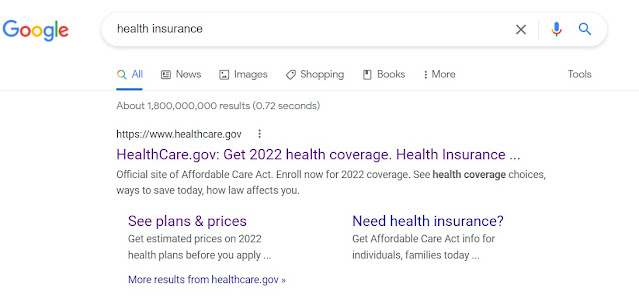
Good news alert: Web search for health insurance has been cleaned up

Subscribe (free) to xpostfactoid


ACA marketplace enrollment surged by 21% in 2022, from 12.0 million as of the end of the Open Enrollment Period for 2021 to 14.5 million in OEP 2022.  The primary cause was plainly the massive boosts to premium subsidies provided by the American Rescue Plan in March 2021 (witness the enrollment surge in the emergency Special Enrollment Period in effect when the boosted subsidies came into effect). Ramped-up federally funded enrollment assistance and advertising may also have helped.

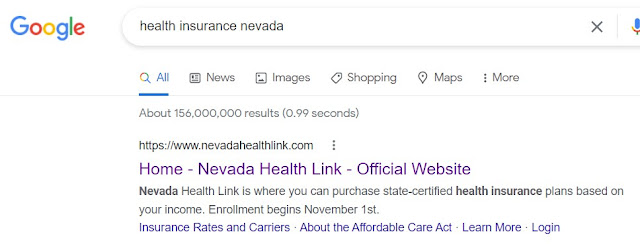
A less visible marketing measure may also have been a factor: the online search environment has been cleaned up.  Search today on Google for "health insurance" or "Obamacare" and HealthCare.gov, the federal exchange that serves 33 states, will top the search results. Search for "health insurance Nevada" and Nevada Health Link, the state-run ACA exchange, will be on top. The same is true for all of the 17 states (and D.C.) that run their own exchanges. There are some slight variations on Yahoo and Bing, but results there are also generally reliable. 


Saturday, March 12, 2022

Not your older sister's marketplace: Web awards for the ACA exchanges

Subscribe (free) to xpostfactoid

Whatever you think of the ACA marketplace as a means of providing health insurance to those who lack access to other sources, the exchanges themselves, viewed as online enrollment and information portals, have come a long way in recent years, with a few exceptions.*

Since 2020, six states  -- Pennsylvania, New Jersey, Nevada, Maine, New Mexico and Kentucky -- have left HealthCare.gov, the federal exchange now used by 33 states, and launched new state-based exchanges -- or, in the case of Kentucky, revived an SBE that had been killed by a Republican governor. All work pretty well with the exception of Kentucky's KyNect, which has some bugs to work out as it attempts to serve as a portal for multiple government benefits. 

Three of the new exchanges-- in PA, NJ and NV -- were designed by the tech vendor GetInsured, and are similar in many respects, notably a pretty user-friendly shop and compare tool that manages to display the handful of questions you need to answer to get price estimates on one page. GetInsured also designed exchanges for California and Idaho and revamped the shopping tool for Minnesota and Washington. In the pre-application plan preview stage, these exchanges all have a similar look and feel, both in the shop-and-compare question phase and in the display of available plans -- with the exception of Washington, which retains an archaic and confusing design in the latter. 

Thursday, May 21, 2020

C'mon, states: take the wraps off Medicaid

Subscribe to xpostfactoid via box at top right. You'll get 2-3 posts per week, mostly re ACA.

On the eve of the pandemic, about 13 million Americans were enrolled in ACA-compliant individual market health insurance plans. About 71 million were enrolled in Medicaid.

As job losses triggered by the pandemic exceeded 30 million, the Urban Institute forecast that at a 15% unemployment rate, among 17.7-30.0 million people losing access to employer-sponsored insurance, just under half would enroll in Medicaid and just under a quarter in marketplace or other private insurance.* Analyses by the Kaiser Family Foundation and Health Management Associates also show Medicaid to be the main vehicle for insuring those who lose access to employer-sponsored insurance.

Every ACA exchange, every state Medicaid agency, and arguably every state government website should be foregrounding an app that looks (and works) like this:


Sunday, March 22, 2020

Emergency Special Enrollment Periods in 12 state ACA marketplaces: How easy?

Subscribe to xpostfactoid via box at top right.

Update, 4/7/20: Early emergency SEP data collected by Charles Gaba indicates that states that require a phone call to begin the SEP application are seeing slower enrollment than states where an emergency SEP application can be completed online.

Twelve of the thirteen states (including D.C.) that run their own ACA marketplaces have announced emergency Special Enrollment Periods to help the uninsured get covered while the Coronavirus rages. Washington state was first to announce a SEP,  on March 10. CMS is "evaluating" following suit for the 38 states using the federal platform, HealthCare.gov. Idaho is the only holdout (and only red state) among the SBEs.

Kudos to the states that have taken the plunge. May it go smoothly operationally. Some began with some messaging confusion, e.g., info about the emergency SEP that seemed contradicted by older messaging about conventional SEPs, granted only to individuals for life changes such as job loss instead of to anyone seeking insurance. Most of those have been straightened out, but some mixed messaging lingers.  Below, a sampling of clear and not-so-clear home page messaging.

Wednesday, February 12, 2020

States seeking to reduce their uninsured populations must beware a Catch-22

By David M. Anderson, Charles Gaba, Louise Norris and Andrew Sprung
Note: this post is the third joint effort by David, Charles, Louise and me. Others here and here.
State policymakers have been prolific and creative in putting forward measures to strengthen their ACA marketplaces. Measures enacted since 2017 or in progress now include reinsurance programs, which reduced base premiums by an average of 20% in their first year in the first seven states to implement such programs; new or renewed state-based exchanges, which capture insurance user fees that can be used for advertising and outreach; state premium subsidies to supplement federal subsidies; and state-based individual mandates, which can provide funding for all of the above.
Policymakers must recognize, however, that these choices entail tradeoffs — and not just in budgetary constraints. Specifically, built into ACA marketplace architecture is a pricing dynamic that bedevils state attempts to improve ACA marketplace performance: reductions in premiums for unsubsidized enrollees tend to raise premiums for subsidized enrollees. Because premium subsidies are designed so that enrollees pay a fixed percentage of income for the benchmark (second cheapest silver) plan, premium increases also increase subsidies — and tend to increase the difference, or "spread," between the benchmark plan and cheaper plans.