Showing posts with label silver loading. Show all posts

Wednesday, July 01, 2026

Fleshing out the ACA marketplace's alleged phantom enrollees, Part 2

Note: Free xpostfactoid subscription is available on Substack alone, though I will continue to cross-post on this site. If you're not subscribed, please visit xpostfactoid on Substack and sign up.

Your income next year may be $14,000? Can you earn a little more?


It’s time for Part 2 of our close look at Brian Blase’s claims in The Persistent Obamacare Enrollment Fraud and its top-line claim (heavily relied on by CMS) that in 2026, 6.2 million enrollments were “improper.” To reiterate a few big-picture points from Part 1:

1. Blase rhetorically conflates what he’s branded as “the great Obamacare fraud” with enrollments he deems “improper” — that is, enrollments that may show some evidence that the applicant’s estimate of next-year income has been optimized to maximize subsidies. That segue is parroted by CMS in last week’s ASPE brief:

Enrollment that is improper or fraudulent is enrollment by individuals misstating their income to gain access to free plans. Phantom enrollees are unknowingly enrolled in free plans by brokers or auto enrolled. By our estimate, improper, phantom and fraudulent enrollment peaked at 5.6 million people in 2025.

2. The allegations of outright fraud — “phantom” enrollees signed up by brokers, who have no knowledge of their enrollment or no intent to use it— are chiefly based on an analysis of CMS data on ‘enrollees without claims’ (EWOC). This analysis, which ignores the high incidence of short-term enrollment in HealthCare.gov states, driven by year-round enrollment and by the Medicaid unwinding of 2023-2024 — has been effectively rebutted by Matt Fiedler (1, 2) and others. While broker fraud may have given some boost to EWOC, true “phantom” enrollments are small percentage of the enrollments branded as “improper.” As last week’s ASPE brief notes, “In 2025, CMS canceled coverage for 250,000 people enrolled without consent and identified 200,000 unauthorized plan switches.”

Tuesday, April 07, 2026

CSR forgone: Long- and short-term changes in the ACA marketplace

Note: Free xpostfactoid subscription is available on Substack alone, though I will continue to cross-post on this site. If you're not subscribed, please visit xpostfactoid on Substack and sign up. 

When considering how the most seismic changes in the ACA marketplace’s 13-year history have shaken out, it’s important to keep in mind that the market mainly serves very low-income people. Consider*:

  • 64% of all marketplace enrollees in 2026 had income in the 100-200% FPL range. In the U.S. population at large, just 15% were in that income range as of 2024.

  • 54% of all marketplace enrollment (12,487,037) in 2026 is in ten states that have refused to enact the ACA Medicaid expansion, where eligibility for marketplace subsidies begins at 100% FPL. In expansion states, Medicaid is available to all adult citizens and qualified noncitizens with income up to 138% FPL.

  • More than half of enrollment in nonexpansion states (6,543,435) is in an income bracket (100-138% of the Federal Poverty Level, or FPL) that would qualify those enrollees for Medicaid in expansion states. Those should-be-in-Medicaid enrollees account for 28% of all marketplace enrollment.

  • In 2026, 83% of silver plan enrollees nationally had income in the 100-200% FPL range, qualifying them for strong Cost Sharing Reduction (CSR) that raises the actuarial value (AV) of a silver plan to 94% (at incomes up to 150% FPL) or 87% (at income from 150-200% FPL). Nationally, the average AV obtained by silver plan enrollees was 88.6%, justifying the presumption now enforced by several states that silver plans should be priced at a roughly platinum level (90% AV), well above gold (80% AV).

With that low-income skew in mind, I’d like to examine both long-term enrollment trends and shifts in metal selection in 2026, the latter driven mainly (presumably) by expiration of the enhanced ARPA subsidies.

Trends include:

Monday, March 30, 2026

Republicans poised to steal gold from Texans

Note: Free xpostfactoid subscription is available on Substack alone, though I will continue to cross-post on this site. If you're not subscribed, please visit xpostfactoid on Substack and sign up. 


To fund Trump’s depraved, immoral and illegal assault on Iran, Axios reports that a Texas sage is proposing a fresh cut to ACA marketplace premiums:

House Budget Committee Chairman Jodey Arrington (R-Texas) is reviving an idea that was considered last year to fund Affordable Care Act payments known as cost-sharing reductions [CSR].

  • The Congressional Budget Office previously found the move would lower overall benchmark ACA premiums by 11% but result in 300,000 more uninsured people.

  • It would have the effect of cutting the subsidy amount that some enrollees receive, thereby increasing out-of-pocket premium costs, while saving the government over $30 billion.

That proposal would kill silver loading, which would have the most profound effects in Arrington’s Texas, where the pricing of silver plans at platinum levels mandated by statute renders gold plans far cheaper than silver plans and makes free bronze coverage available to almost all enrollees. Before Republicans in Congress seek to end the practice, the 1.7 million Texans in gold plans and likely 800,000-plus in zero-premium bronze plans might want a word.

Monday, February 02, 2026

How much will average monthly enrollment drop in the ACA marketplace in 2026?

Note: Free xpostfactoid subscription is available on Substack alone, though I will continue to cross-post on this site. If you're not subscribed, please visit xpostfactoid on Substack and sign up.

Downhill slope: gradual or steep?

While the ACA marketplace’s Open Enrollment Period (OEP) for 2026 is wrapping up with a relatively modest drop of about 5% from OEP 2025, marketplace observers expect the losses to deepen as the year progresses. That’s primarily for two reasons: 1) most subsidized enrollees are facing steep premium increases because the enhanced subsidies funded through 2025 have not been extended, and 2) a June 2025 CMS rule effectively ratified in HR1, the Republican megabill enacted last July, ended year-round enrollment for low-income enrollees.

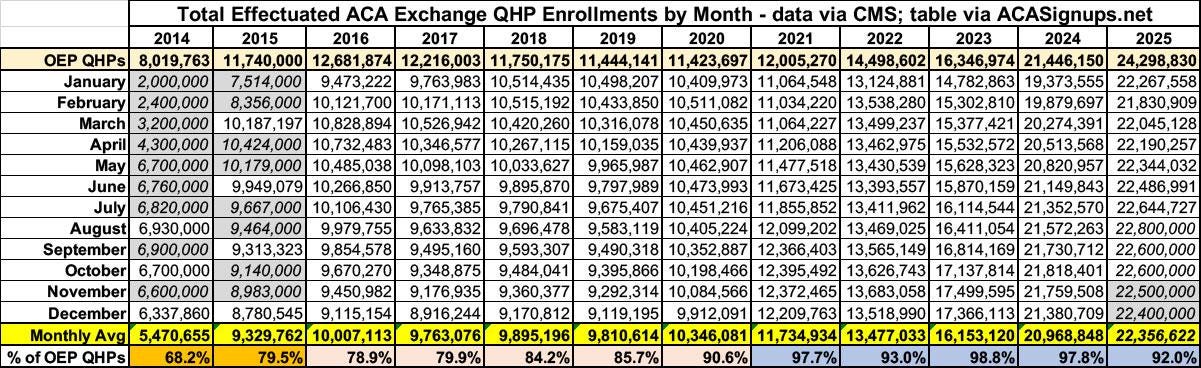
The most complete measure of enrollment in a given year is average monthly enrollment (AME), which takes into account both retention and the conditions under which people enroll when OEP is finished. The gap between enrollment* totals as of the end of OEP and AME has varied considerably over the marketplace’s 13-year existence. To scope out the likely range of enrollment losses through the full 2026 plan year, Charles Gaba has tabulated the OEP-AME gap for every plan year through 2025.

The gap shrank during the first Trump administration, both because enrollment barriers the administration threw up (shortened OEP, sharply reduced funding for enrollment assistance and marketing) weeded out less motivated enrollees, and because the advent of silver loading after Trump cut off direct CSR payments to insurers made zero-premium coverage newly available to millions, and people don’t tend to drop zero-premium coverage. The gap shrank further during the Biden years, as the enhanced premium subsidies enacted in March 2021 as part of the American Rescue Plan Act (ARPA) further expanded the availability of zero-premium (and low-premium) coverage, and as year-round enrollment for enrollees with income under 150% FPL was implemented in early 2022. (In 2025, 47% of all enrollment was at incomes below the 150% FPL threshold.) The Medicaid unwinding — that is, the resumption of Medicaid redeterminations and disenrollments in spring 2023 after a 3-year pandemic induced moratorium — reduced the OEP-AME gap to near-nothing in 2023 and 2024, as millions transitioned from Medicaid to the marketplace.


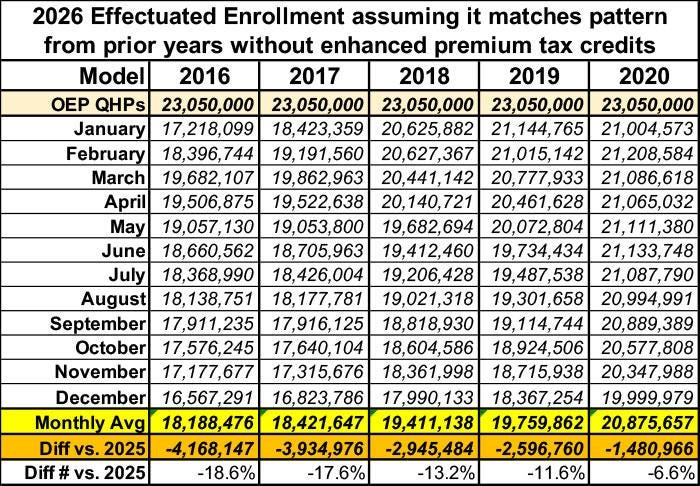
Gaba further uses the OEP/AME ratios in the pre-ARPA years to project a range of possible enrollment losses in 2026:

Of course we can’t know whether enrollment losses will be within this range. There are reasons to believe that attrition will exceed the 2016 peak (excluding 2014, when the marketplace was immature), but there are also mitigating factors. Let’s look at both sides of the equation.

Factors that may trigger major attrition

  1. Unprecedented net-of-subsidy premium hikes. Prior to OEP 2026, marketplace premium subsidies have never lost value (or rather, never lost more than a few of tenths of a percentage point, as the “applicable percentages” of income required for a benchmark silver plan at each income level were adjusted modestly for inflation in the years prior to enactment of the enhanced subsidies, and again in 2026). By KFF’s estimate, in 2026, net-of-subsidy premiums for a benchmark silver plan rose by an average of114% for the 92% of 2025 enrollees who were subsidy-eligible.

  2. Increased auto-reenrollment. In HealthCare.gov states, passive auto-reenrollment spiked from 30% of reenrollments in 2024 to 46% in 2025 (see public use files here). Many of those auto reenrollees may be unaware of the degree to which their premiums have spiked in 2026 (not only because of reduced subsidies, but because of annual shifts in the benchmark plan and its premium). If many of the auto-reenrollees have incomes below 150% FPL (as did more than half of enrollees in HealthCare.gov states in 2025), they will also have lost the ability to switch to a less expensive plan when they discover the premium spike. Which brings back to…

  3. No more monthly SEPs at low incomes. In February 2022, the Biden administration implemented a monthly Special Enrollment Period (SEP) for enrollees with income up to 150% FPL, for whom the enhanced subsidies created in March 2021 had rendered benchmark silver coverage free. Year-round SEPs have given average monthly enrollment a major boost, as Gaba’s tables show (2021 enrollment was boosted by a six-month SEP for all comers in the wake of the enhanced subsidies enacted in March of that year). As noted above, the year-round SEP also enabled passive reenrollees stung by an unexpected premium hike to switch into a less expensive plan. The current Trump administration ended the monthly SEP by administrative rule, effective last August, and the HR1 megabill effectively codified the rule by making subsidies unavailable for SEPs granted on the basis of low income.

  4. SEP verification. CMS’s Program Integrity Rule finalized in June 2025 tightened verification requirements for life changes (such as loss of employment) that trigger a SEP, requiring verification for 75% of SEPs beginning in 2026.

Factors that may mitigate attrition

  1. Silver loading. After Trump abruptly cut off direct reimbursement of insurers for the Cost Sharing Reduction (CSR) subsidies that attach to silver plans for low-income enrollees, most states allowed or encouraged insurers to price CSR directly into silver plans only. That raised benchmark premiums and therefore subsidies and raised the premiums for silver plans relative to bronze and gold plans, as CSR makes silver plans roughly platinum-equivalent for enrollees with income up to 200% FPL (i.e., for most silver plan enrollees). Silver loading made zero-premium bronze plans available to millions more enrollees than previously, boosting not only enrollment (by perhaps 5% in 2019) but retention. Logically speaking, silver loading should have made gold plans consistently cheaper than silver plans, as CMS noted in a December 2015 memo. While that did not happen, as insurers have various incentives to underprice silver plans, over time an increasing number of states have mandated more strict silver loading - -and in some cases, most notably in Texas — required insurers to price silver plans as if they are platinum (Arkansas, Illinois and Washington did this in advance of OEP 2026). Silver loading’s impact on gold premiums is consequently more intense in 2026 than in Trump 1.0 years — when, per Gaba’s table above, those effects probably had a major role in reducing attrition. In 2018, the average lowest-cost gold premium nationally was 109% of the benchmark (second cheapest) silver premium, whereas in 2026, lowest-cost gold on average is 98% of the benchmark. Cheap gold plans will have a particularly strong effect in Texas, where $0 premium gold plans will be available to about 2.5 million enrollees with income under 150% FPL, and to many older enrollees with income near 200% FPL. Zero premium bronze plans will be available to far more enrollees than that.

  2. Broker participation and public awareness. In the pre-ARPA era, when marketplace AME was stuck at around 10 million, the marketplace was hampered not only by subsidies that many found inadequate but also by widespread ignorance of marketplace offerings. For years, enrollment assistors told me that many people thought the program had been repealed (even in 2024), and Republican hostility to “Obamacare” remained a factor. While the first Trump administration did gut funding for nonprofit enrollment assistance, however, it also encouraged and marketed broker participation and continued the development of commercial e-broker platforms (a.k.a. enhanced direct enrollment, or EDE, platforms) that make brokers’ jobs much easier. As enrollment soared after the ARPA subsidies were implemented, so did broker participation, rising from 49,000 in 2018 to 83,000 in early 2024. While brokers’ too-easy access to enrollees’ accounts via EDE platforms sparked a plague of fraud and low-quality brokerage, broker outreach plainly reached deep into low-income areas, particularly in states that had refused to expand Medicaid, where marketplace subsidy eligibility begins at incomes of 100% FPL, as opposed to 138% FPL in expansion states (and again, CSR-enhanced silver coverage was available for free at incomes up to 150% FPL). In addition to providing sometimes-expert help, brokers have a strong motive to keep clients enrolled, and they have likely steered many clients into lower-premium plans to mitigate the impact of average net-of-subsidy premium hikes. In 2024, about 80% of enrollments in HealthCare.gov states were broker-assisted.

  3. Habit. Coverage is tough to lose, and about 12 million more people signed up for marketplace coverage in OEP 2025 than in OEP 2020. While many may drop coverage as higher premiums bite — or as they try to use plans with $8,000 deductibles — many more will do what they can stay covered.

So there you have it. I’m not going to venture a prediction. We’ll have a better sense of what AME is likely to look like when the first effectuated enrollment snapshot, showing paid-up enrollment as of February, is published in June or July. But that snapshot will not show the coverage drop for re-enrollees who have not paid their first premium, as enrollees are generally granted a 3-month grace period. CMS is currently publishing effectuated enrollment with a three-month lag as part of its monthly snapshots of Medicaid/CHIP enrollment, so we may have a clearer picture by June or July (a half-year effectuated enrollment snapshot usually comes out in the fall). Full AME for 2026 won’t be published until mid-2027, if current practice holds. But who knows where this country — and the marketplace — will be by then.

P.S. Any measure of coverage losses in the post-ARPA era (if it lasts more than a few weeks or months) should incorporate a loss in average actuarial value, as low-income enrollees exchange high-CSR silver for bronze or even gold plans. See my post on a proposed measure: Total AV for the whole marketplace. 

- - -

*Technically, “plan selections” tallied as of the end of OEP are not “enrollments,” as some will never be effectuated.

Thanks for reading xpostfactoid! Subscribe for free:


Sunday, December 21, 2025

To silver-load or not: Arkansas vs. New Jersey marketplace, 2026

Note: Free xpostfactoid subscription is available on Substack alone, though I will continue to cross-post on this site. If you're not subscribed, please visit xpostfactoid on Substack and sign up.

Does the NJ marketplace need a Huckabee-sting?

The looming expiration of the enhanced Premium Tax Credits in the ACA marketplace (ePTC) increases the salience of the extent to which different states encourage or enforce strict “premium alignment,” A.K.A. silver loading, the pricing of the full value of Cost Sharing Reduction (CSR) into silver plans.

Here, we’ll contrast current plan offerings in a state marketplace with some of the most extreme silver loading effects, Arkansas, with a state where the effects are among the weakest, New Jersey.

If you are unfamiliar with how silver loading works or why it exists, see the explanation at bottom.

To defend against the looming expiration of the enhanced ACA subsidies funded only through 2025, Arkansas implemented the nation’s strictest “premium alignment,” requiring insurers to price silver at 1.46 times what it would be priced at the baseline silver actuarial value of 70%. That is, Arkansas requires insurers to price silver plans as if all silver plan enrollees have income under 200% FPL and so obtain plans with actuarial value of 94% (the AV of CSR-enhanced silver for enrollees with income up to150% FPL) or 87% (silver AV for enrollees in the 150-200% FPL income bracket) — an average AV of 91%. For a convoluted tale of how Arkansas arrived at this point, see Charles Gaba.

Pricing silver as if all enrollees have income under 200% FPL is meant to be a self-fulfilling prophecy. A “CSR factor” like Arkansas’ ensures that gold plans will be cheaper than silver plans with the same provider network, making silver plans an illogical choice for enrollees with income over 200% FPL, since gold plans have a higher AV than silver for enrollees above that income threshold. That assumption has been borne out in the Texas marketplace, where in 2025, just 1% of the state’s 1.9 million silver plan enrollees had income over 200% FPL.* In 2025, 78% of silver plan enrollees in Arkansas obtained 94% AV or 87% AV. The average weighted AV for silver plan enrollees in the state was 86.8%. It’s not a great leap to assume average silver plan AV of 91% under the current pricing regime.

Thanks to this pricing formula for silver plans, Arkansas has the nation’s widest premium spread between the average lowest-cost bronze plan and the average benchmark (second cheapest) silver plan. On average, the premium for the lowest-cost bronze plan in Arkansas is just 57.8% of the benchmark silver premium. Gold coverage in Arkansas is also very cheap, averaging just 83.6% of the benchmark. On that front, Arkansas is tied with Pennsylvania for fourth-lowest in the nation.

Friday, November 07, 2025

A tincture of gold mitigation in the 2026 ACA marketplace

 Note: Free xpostfactoid subscription is available on Substack alone, though I will continue to cross-post on this site. If you're not subscribed, please visit xpostfactoid on Substack and sign up.

Trumpcare 2.0 is also gold-laden

Amidst the carnage wrought by the (still reversible) expiration of the enhanced subsidies in the ACA marketplace, one substantial mitigating factor has emerged: silver loading has reached a milestone. While net-of-subsidy premiums for benchmark silver plans will more than double for the average subsidized enrollee, the average lowest-cost gold plan will be priced below the benchmark (second-cheapest) silver plan for the first time.

That average masks a ton of variation: the average lowest-cost gold plan is priced below benchmark in only 20 states. But those states include Texas and now Florida, which together accounted for more than a third of all enrollees nationally (8.7 million). In total, average lowest-cost gold plans have premiums below benchmark in 20 states with 12.7 million enrollees, 52% of all enrollees nationwide. (In another 12 states, lowest-cost gold premiums average less than 105% of benchmark premiums.)

Thanks for reading xpostfactoid! Subscribe for free:

Wednesday, October 29, 2025

CMS: Buy the cheapest plan, and these subsidy cuts will only hurt a little

Note: Free xpostfactoid subscription is available on Substack alone, though I will continue to cross-post on this site. If you're not subscribed, please visit xpostfactoid on Substack and sign up

Heavy OOP burden 


You may have read KFF’s estimate that the average subsidized 2025 enrollee in the ACA marketplace will pay 114% more* for a benchmark silver plan in 2026, if the enhanced subsidies funded only through 2025 are allowed to expire. True!

You may also have read estimates that base (unsubsidized) premiums will rise 25% (from Charles Gaba) or 26% (from KFF). Also true!

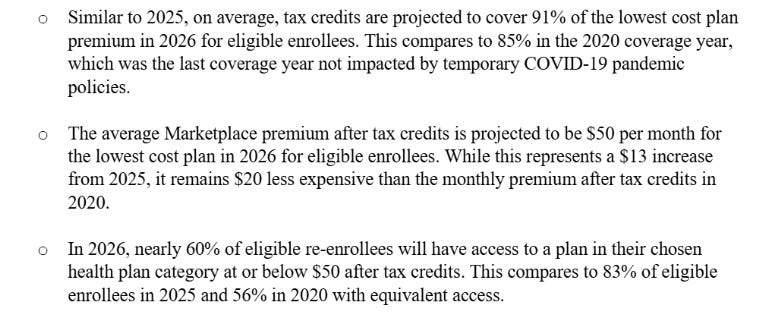
Now, as of today, you may read CMS’s proud assurance (via https://www.axios.com/2025/10/28/trump-open-enrollment-premium-prices-health-care-government-shutdownAxios) that things are not so bad:

These claims are doubtless also true! How can that be? Are premiums for subsidized enrollees going up 114% — or 35%? (i.e. from $37 to $50/month, per CMS**).

It depends, of course, on the plan you’re buying and what percentage of your actual medical claims it will cover. The KFF estimate is for the benchmark (second cheapest) plan — the one for which all subsidy-eligible enrollees pay a fixed percentage of income, which is being sharply reduced. The actuarial value of a silver plan varies with income, but for most enrollees it’s 94% or 87% (ratcheting down to 73% or 70% at income above 200% of the Federal Poverty Level (FPL).

Monday, August 04, 2025

In Texas Obamacare, a gold patch on the loss of enhanced subsidies

Note: All xpostfactoid subscriptions are now through Substack alone (still free), though I will continue to cross-post on this site. If you're not subscribed, please visit xpostfactoid on Substack and sign up.

CMS to Texas: Who told you to put the balm on?

 As expiration of the enhanced ACA premium subsidies created by the American Rescue Plan Act (ARPA) at the start of Plan Year 2026 looms, it’s worth considering the extent to which strict silver loading may mitigate the sharp premium increases resulting from reversion to the ACA’s original subsidy schedule. Here we’ll take a look at how a market in which gold plans are priced way below silver in 2025 is likely to play out in 2026.

Saturday, November 23, 2024

On the pending expiration of the ACA's ARPA subsidy enhancements

Note: All xpostfactoid subscriptions are now through Substack alone (still free), though I will continue to cross-post on this site. If you're not subscribed, please visit xpostfactoid on Substack and sign up.

ARPA subsidy boosts going, going...

I’d like here to highlight some factors that will affect how much ACA marketplace enrollment is likely to shrink if Republicans decline to extend the increases to ACA marketplace premium subsidies and eligibility first enacted by the American Rescue Plan Act (ARPA) in March 2021, and later extended through 2025 by the Inflation Reduction Act. I’ll assume no other major changes to the ACA (perhaps a dubious assumption).

The ARPA subsidy boosts made benchmark silver plan coverage free for enrollees with income up to 150% of the Federal Poverty Level (FPL), removed the ACA’s notorious income cap on subsidy eligibility (400% FPL), reduced the percentage of income required for a benchmark silver plan at all income levels between 150-400% FPL, and capped benchmark silver premiums at 8.5% of income for those with income above 400% FPL.

Since the Open Enrollment Period (OEP) for 2021, the last OEP before the ARPA subsidies took effect, ACA marketplace enrollment increased by 79% (9.4 million) through OEP 2024 (see Table 1 below). That enrollment growth was overwhelmingly concentrated at the 100-150% FPL income bracket, where silver coverage with strong Cost Sharing Reduction (CSR) is available for $0 premium, and in the ten states that have refused to date to enact the ACA Medicaid expansion. In those “nonexpansion” states, eligibility for marketplace subsidies begins at 100% FPL, whereas in the expansion states it begins at 138% FPL, the Medicaid eligibility threshold for almost all lawfully present adults.

The Urban Institute estimates that in 2025, the total number of people with subsidized marketplace enrollment (92% of total enrollment) will be 7.2 million higher than it would be without without the ARPA subsidy boosts. One might assume a similar drop in enrollment in years following 2025 if the ARPA enhancements expire. Urban further estimates, “In 2025…household net premiums will be lower by 50 to 100 percent for the lowest income groups under a policy of enhanced PTCs compared with a policy of original PTCs. Net premiums will be lower by about one-quarter for people with higher incomes who receive subsidized Marketplace coverage.” Reverse that for the effects of ARPA expiration.

Without venturing an overall estimate, I want to highlight the concentration of marketplace enrollment (and post-ARPA enrollment growth) at low incomes and the extent to which zero-premium coverage will still be available to low-income enrollees (albeit with lower actuarial value). I assume that Urban’s estimates of premium impact are for benchmark silver premiums, not premiums for plans actually selected, which will change if the ARPA enhancements expire.

Consider the following as to the makeup of current marketplace enrollment:


  • From OEP 2021 to OEP 2024, enrollment nationwide increased by 79%, from 12.0 million to 21.4 million.

  • 59% of that growth was in the 100-150% FPL income bracket, where benchmark silver coverage was rendered free by ARPA (see Table 1 below).

  • In 2024, 73% of enrollment in the 100-150% FPL income bracket was in the 10 nonexpansion states (78% if you count North Carolina, which enacted a Medicaid expansion on 12/1/23*). In 2024, 6.9 million enrollees in nonexpansion states (excluding NC) had income in the 100-150% FPL range.

  • In OEP 2021, enrollment was flat nationwide except for in the nonexpansion states, where it increased 10%. Since OEP 2020, enrollment growth in nonexpansion states has accounted for 74% of enrollment growth nationwide.

  • Before ARPA passed, the ACA’s income cap on subsidy eligibility was politically fraught, as the ACA’s guaranteed issue and Essential Health Benefits requirements raised premiums, and, after steep premium hikes in 2017 and 2018 ,several million subsidy-ineligible people were priced out of the market. Removing the income cap on subsidies went a long way toward fulfilling the ACA’s promise of “affordable care.” For all that, in 2024, enrollment of those who reported income higher than 400% FPL (i.e., expected premium subsidies) was 1.5 million, about 7% of total on-exchange enrollment. Another 856,000 enrollees did not report income and so paid full price (Table 1).

Keeping in mind the heavy concentration of ACA enrollment at low incomes, various factors will preserve some availability of zero-premium coverage for most enrollees with income up to 150% FPL, and often well beyond, or foster enrollment in other ways. These include:

Silver loading, Part I. In October 2017, Trump cut off federal reimbursement of insurers for providing the Cost Sharing Reduction (CSR) subsidies mandated by the ACA to low-income enrollees in silver plan. (His basis: while the ACA mandated this reimbursement, it left funding those reimbursements up to Congress, and Republican Congresses declined to do so. The Obama administration had found reimbursement funds in couch cushions.) CSR increases the value of a silver plan to a roughly platinum level for enrollees with income up to 200% FPL. The move had been anticipated, and most state regulators responded by allowing or encouraging insurers to price CSR directly into silver plans, since CSR is available only with silver plans. Since ACA income-adjusted premium subsidies are set to a silver benchmark, this “silver loading” led to sharp reductions in net-of-subsidy premiums for bronze and gold plans (and less often, for the one silver plan priced below the benchmark in each market). As a result, the Kaiser Family Foundation (KFF) calculated that beginning in 2018, most enrollees with income up to 150% FPL, and a good number with higher incomes, had access to $0 premium bronze plans.

Silver loading, Part II. As direct CSR reimbursement had been contested from the start, prior to Trump’s cutoff, analysts at CMS, the Urban Institute, and CBO had anticipated the effects of pricing CSR into silver premiums. All three analyses anticipated that gold plans would be priced below silver plans, because most silver plan enrollees have incomes qualifying for strong CSR, and silver plan enrollees on average therefore obtain higher actuarial value than gold plan enrollees. It mostly didn’t shake out that way, as insurers have strong incentives to underprice silver plans. In about fifteen states, however, varying by year, gold plans are available at premiums below benchmark silver, sometimes by regulatory or statutory requirement, and sometimes by insurer choice (usually of a dominant insurer). Most notably — and astonishingly — Texas enacted a law requiring marketplace insurers to price gold plans far below silver. (That makes sense, since 75% of enrollees in Texas have income below 200% FPL, and the average actuarial value of a silver plan in the state is over 90%, compared to 80% for gold plans.) Accordingly, Texas’s 2.2 million enrollees with income under 150% FPL will have access to $0 premium gold plans if the ARPA subsidy boosts expire, barring other changes.

Zero-deductible bronze plans. While median bronze plan deductibles were $7,200 for a single enrollee in 2023, bronze plans with $0 medical deductibles have become an increasingly common marketplace option. At low incomes, the premium is often $0 as well. These plans have their coverage traps, like a $3,000 drug deductible (usually not applicable to generics) or a $1,500 first-day hospital inpatient copay, but they can be attractive to healthy enrollees, or those willing to trade risk and out-of-pocket cost for a more expansive provider network and doctor visits not subject to the deductible.

Agent/broker commitment. The first Trump administration cut ACA marketplace advertising and nonprofit enrollment assistance, but they did cater to and encourage participation from agents and brokers — implementing a “help on demand” feature on HealthCare.gov, and encouraging development of commercial “enhanced direct enrollment” (EDE) platforms that streamline brokers’ work and organize their client files. Thanks in part to that support, along with the ARPA subsidy boosts and insurers’ re-commitment to the marketplace, broker registration with HealthCare.gov increased from 49,000 in 2018 to 83,000 in 2024. In OEP 2024, 78% of active enrollments in HealthCare.gov states (which includes all the nonexpansion states) were broker-assisted. This growing broker engagement has been something of a mixed bag, as the widespread availability of free coverage, coupled with inadequately controlled broker access to client data in EDE platforms, has led to a major outbreak of broker fraud and encouraged entry into the market of high-volume, high-speed call centers that likely provide poor service short of outright fraud. Broker participation will probably also be pared back as offerings become less affordable (assuming ARPA subsidy expiration) — e.g., if insurers also pull back and/or reduce broker commissions. But pre-ARPA, one of the marketplace’s chief limitations was the general public’s ignorance of what was on offer. Several years of broker outreach have probably increased awareness and the likelihood of being approached among those who may need coverage.

Year-round enrollment at low incomes. In early 2022, CMS implemented a rule enabling people with income under 150% FPL to enroll year-round, via permanent availability of a monthly “Special Enrollment Period.” The model here was Medicaid; the presumption is that circumstances change often for low-income people. As a result, the gap between marketplace enrollment totals as of the end of OEP and annual “average monthly enrollment” (AME) has narrowed considerably, and AME has grown even more dramatically than end-of-OEP totals (AME was 99% of OEP enrollment in 2023 and may have actually exceeded it in 2024, when the Medicaid unwinding sent a stream of newly uninsured people into the marketplace). This too has been something of a mixed bag, as the monthly SEP has facilitated broker fraud in the form of unauthorized plan-switching of enrollees. Year-round first-time enrollment could be maintained without providing a monthly SEP. More likely, the Trump administration will rescind the rule. (Originally, the rule was contingent on $0 premium silver coverage remaining available at incomes up to 150% FPL, but that condition was later withdrawn.)

A preview of low-income options in a post-ARPA marketplace

Pre-ARPA, enrollees with income up to 138% FPL paid 2% of income for a benchmark silver plan. We can preview what options may look like in this lowest income bracket by looking at what’s available to someone paying 2% of income for benchmark silver in the 2025 marketplace — that is, a single enrollee with an income of $30,000. That’s a shade under 200% FPL, and at that income, benchmark silver is currently $49/month.

Let’s look at what’s available for a single 40 year-old at this income in Houston and Miami. (You can replicate these results or look at other markets most easily via HealthSherpa’s plan shopper.) In Florida and Texas combined, as of the end of OEP 2024, 4.1 million enrollees had income in the 100-138% FPL range — about 60% of the 6.9 million enrollees in that income range nationwide.

In Houston in 2025 (zip code 77005), a single 40 year-old earning $30,000 would pay (as noted above) $49/month (1.94% of income) for the benchmark silver plan, which has a $500 deductible and a $3,000 out-of-pocket (OOP) maximum. That’s what enrollees with income up to 138% FPL will pay for benchmark silver if the ARPA subsidy boosts expire and there are no further changes. That premium could be prohibitive at a lower income (100% FPL in this year’s marketplace is slightly over $15,000/year). But in 2025, this same Houstonian also has access to two gold plans for $0 premium, as well as to a bronze plan with a $0 deductible for $15/month (and to the one silver plan below benchmark for $38/month). Both of the $0 premium gold plans are from Blue Cross, a desired brand in Texas, whereas the lowest-cost silver BCBS plan available to this person is $61/month.

Switch the scene to Miami (zip code 33134), and the 40-year old with the $30k income, paying 1.94% of income for the benchmark silver plan, does not have cheap gold available, nor any premium difference between the benchmark and lowest-cost silver (both $49/month). But this Miamian does have access to two $0 deductible bronze plans for $5 or $6/month — not to mention a ridiculous eleven zero-premium bronze plans with high deductibles.

The zero-deductible bronze plans both have OOP maxes of $9,200, whereas the two cheapest silver plans for enrollees with income under 150% FPL in Miami this year have OOP maxes of $1,800 and $2,000 respectively. Forgoing CSR vastly expands financial risk. Nonetheless, in two of the largest ACA markets for people with income that would put them in Medicaid in expansion states, no-premium or ultra low-premium options would be available if they had to pay 2% of income.

Zero premium, but more risk

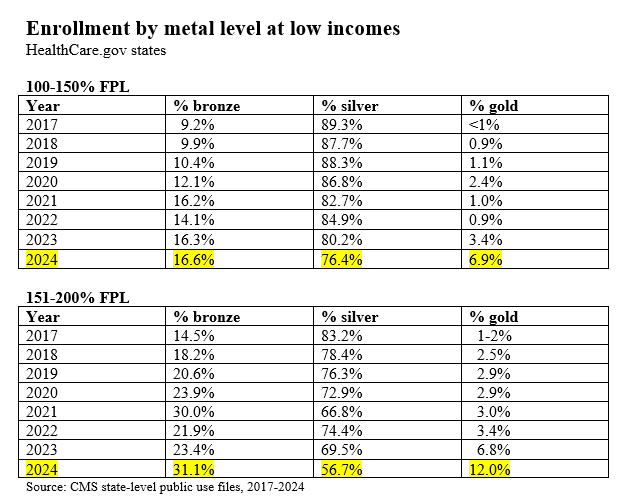
Expiration of the ARPA subsidy enhancements will exacerbate a negative long-term trend in marketplace coverage: reduced silver plan selection by enrollees with income low enough to qualify for strong CSR, which raises the actuarial value of a silver plan to 94% (at income up to 150% FPL) or 87% (at income from 150-200% FPL). That compares to 60-65% AV for enhanced bronze (the commonest bronze type now) or 80% for gold. Perhaps most damagingly, those who forgo strong CSR give up an OOP max that’s capped at $3,000, and averaged just $1,388 in 2024 at incomes up to 150% FPL), in favor of bronze and gold OOP maxes that usually top $7,000 and are often set at the maximum allowable $9,200.

At incomes up to 150% FPL, silver plan selection has dropped from 89% in 2017 to 76% in 2024 (see Table 2 below). At 150-200% FPL, silver selection has plummeted from 83% in 2017 to 57% in 2024. Competition among marketplace insurers to offer lowest-cost coverage has narrowed provider networks over time, and some enrollees may be forgoing CSR to access a lower level of coverage from an insurer with a more robust network. I look at such tradeoffs in specific markets here.

ARPA subsidy expiration will be a major blow to coverage availability for those who lack access to other affordable options. It will probably be combined with other blows: it may be coupled with a major Trump 2.0 effort to stand up and promote an alternative market of medically underwritten, lightly regulated plans, and/or, most damagingly, with major assaults on Medicaid eligibility and funding. “This won’t be the worst harm you suffer” is pretty cold comfort when staring down the barrel of an ignorant, cruel, corrupt government in formation. But the ACA marketplace proved resilient during the Trump 1.0 regime, and it may prove resilient once again.

Table 1: ACA Marketplace Enrollment Growth by Income, 2021-2024


Table 2: Silver Plan Selection at Incomes up to 200% FPL

CMS’s marketplace enrollment Public Use Files are available here.

Photo by cottonbro studio

Thanks for reading xpostfactoid! Subscribe for free:


Thursday, October 05, 2023

Enrollment at ages 65 and up in the ACA marketplace has nearly tripled since 2017

 Note: All xpostfactoid subscriptions are now through Substack alone (still free), though I will continue to cross-post on this site. If you're not subscribed, please visit xpostfactoid on Substack and sign up!

Medicare, no -- coverage, yes?


My last two posts (1, 2) investigated a practice, first countenanced and then codified by New Jersey insurance regulators, allowing ACA marketplace insurers to denude enrollees over age 65 of most of their coverage by presuming them eligible for Medicare unless they proved otherwise, e.g., by applying for Medicare while knowing they were ineligible. (Seniors who have not paid U.S. payroll taxes for at least 10 years or not been married to someone who has, e.g., many older immigrants, are not eligible for free Part A Medicare and are eligible for ACA marketplace subsidies if their income qualifies them.) Prompted by resulting mainstream news coverage, NJ’s Department of Banking and Insurance (DOBI) has ordered individual market insurers to cease this theft of coverage.

As DOBI disclosed that individual market insurers in the state have been presuming Medicare eligibility in senior enrollees at least since 2016, I took a look at how many enrollees might have been affected. Along the way, I noted a statistical oddity: by 2023, enrollment in the over-65 age group had more than doubled since 2017, from 3,943 to 8,929 (a precise age breakout is not provided for 2016). Total enrollment in all age groups in the state increased just 16% from 2017 to 2023, from 295,067 to 341,901.

That prompted me to look at national enrollment in the 65+ age group over the same span. Enrollment in this (small) age group has almost tripled since 2017, while overall enrollment is up 34%, from 12.2 million in 2017 to 16.4 million in 2023. The data source in the table below is CMS’s State-level Public Use Files.

Friday, June 16, 2023

In New Jersey's ACA marketplace, a "premium alignment" bill would turn gold plan pricing on its head

 Note: All xpostfactoid subscriptions are now through Substack alone (still free), though I will continue to cross-post on this site. If you're not subscribed, please visit xpostfactoid on Substack and sign up!

Gold skies, but almost no gold Obamacare, in New Jersey

On May 22, New Jersey state Senator Joseph Vitale, chair of the Health, Human Services, and Seniors Committee, introduced a bill (S3896) that mandates “premium alignment” — a.k.a. strict silver loading — in the state’s individual and small group health insurance markets. That is, insurers would be required to comply with the letter of the ACA statute that requires them to price plans at different metal levels in strict proportion to the actuarial value of each metal level. (Actuarial value refers to the percentage of the average enrollee’s costs the plan is designed to pay for, according to a formula promulgated by CMS.)

In effect, mandating that strict proportionality means pricing gold plans below silver plans with the same network (or, in New Jersey in the first year after enactment, roughly at par with silver plans, as explained below). That’s been the case since 2018, the first plan year after Trump cut off direct reimbursement of insurers for the value of Cost Sharing Reduction (CSR) subsidies, which attach to silver plans only. The cutoff induced most states to direct insurers to price CSR into silver plan premiums only, a practice that came to be known as silver loading. CSR raises the actuarial value of a silver plan to a roughly platinum level** for enrollees with income up to 200% of the Federal Poverty Level — — that is, for about 80% of on-exchange silver plan enrollees nationally (though far less in New Jersey, as discussed below). In 2023, the average actuarial value among silver plan enrollees on all ACA exchanges was about 87%, compared to 80% for gold plans.*

Friday, March 24, 2023

Too many low-income ACA marketplace enrollees are forgoing high-CSR silver

Note: All xpostfactoid subscriptions are now through Substack alone (still free), though I will continue to cross-post on this site. If you're not subscribed, please visit xpostfactoid on Substack and sign up!  

Today is the ACA’s 13th birthday, and CMS released its final enrollment report and detailed enrollment data for the 2023 Open Enrollment Period (OEP) in a celebratory vein. The good news: Enrollment nationally overall is up 13% year-over year and 36% since 2021, after two years with premiums subsidies substantially boosted by the American Rescue Plan Act of March 2021. (As I noted here when OEP was mostly completed, enrollment growth is heavily concentrated in the twelve states that had not enacted the ACA Medicaid expansion as of OEP 2023.) New enrollment increased by 21%.

In OEP 2022 — the first OEP in which there was no income cap on subsidy eligibility — enrollment growth was highest at high incomes. In marked contrast, this year it’s concentrated at low incomes. In the 33 states that use HealthCare.gov (which include all of the twelve states that haven’t expanded Medicaid), enrollment at incomes between 100% and 150% of the Federal Poverty Level (FPL) increased from 32% of all enrollment in 2022 to 37% this year, rising 20.4%, from 4,640,092 in OEP 2022 to 5,588,315 million in 2023.

Thursday, February 02, 2023

Why ACA marketplace enrollment surged at incomes above 400% FPL in 2022: A Houston illustration

Attention xpostfactoid readers: All subscriptions are now through Substack alone (still free). I will continue to cross-post on this site, but I've cancelled the follow.it feed (it is an excellent free service, but Substack pulls in new subscribers). If you're not subscribed, please visit xpostfactoid on Substack and sign up!  

In 2022, the first plan year in which the enhanced ACA marketplace subsidies created by the American Rescue Plan Act (ARPA) were available in the Open Enrollment Period, enrollment at incomes above 400% of the Federal Poverty Level more than doubled in the 33 states using HealthCare.gov. Pre-ARPA, enrollees with income above 400% FPL were ineligible for premium subsidies; ARPA removed that eligibility cap.

I have a post up at Healthinsurance.org that charts the enrollment increase at high incomes in HealthCare.gov states in 2022 and the ARPA impact on premiums at high incomes in Houston in 2023. Just to tease here, a couple of charts:

Monday, January 09, 2023

Evolving choice in the ACA marketplace

Dear xpostfactoid readers: All subscriptions are now through Substack alone (still free). I will continue to cross-post on this site, but I've cancelled the follow.it feed (it is an excellent free service, but Substack pulls in new subscribers). If you're not subscribed, please visit xpostfactoid on Substack and sign up! 

Over the years, I have devoted many posts to tracking the percentage of low-income ACA marketplace enrollees who avail themselves of the strong Cost Sharing Reduction (CSR) available with silver plans at incomes up to 200% FPL by choosing silver plans. TLDR: the percentage is high, but not high enough.

Since October 2017, I have also devoted many posts to tracking the effects of silver loading. In that month, recall, Trump cut off direct reimbursement of insurers for the value of CSR and thus ushered in silver loading era — that is, pricing the value of CSR directly into silver plans alone (since CSR is available only with silver plans), creating discounts in bronze and gold plans (see note at bottom*). Trends to watch have included

  • Silver plan selection at incomes above 200% FPL, where CSR is weak-to-nonexistent. TLDR: it fell off a cliff in 2018 and years following.

  • Gold plan selection at incomes above 200% FPL. TLDR: it’s far higher than pre-2018, but not high enough.

  • The relentless math that pushes most enrollees (including me) with income above 200% FPL into bronze plans (notwithstanding deductibles averaging more than $7,000), except in states where gold plans are priced below benchmark silver.

  • Gold plan selection at incomes over 200% FPL in states where gold plans are consistently available at premiums below that of the benchmark silver plan, either by state government design or through insurers’ pricing decisions. TLDR: Gold selection in those states very high, and roughly proportional to the degree of gold discount.

The broad parameters of rational choice in metal levels have been clear since 2018, and a majority of enrollees, albeit too small a majority, have hewn to them. Usually, the optimal choices are silver at incomes up to 200% FPL, bronze at incomes above 200% FPL, and gold where silver loading or insurer choice (often monopoly or dominant-insurer choice) make gold affordable. Two recent factors that have had an impact: 1) the American Rescue Plan Act’s subsidy boosts, which made silver an easier reach for some enrollees at all income levels, modestly boosting silver selection in 2022;  and 2) a growing trickle of states requiring insurers to price gold plans below benchmark.

Here is how metal level choice shook out in the 33 states using HealthCare.gov** (the federal exchange, as opposed to a state-based exchange) in 2022. For the first time, CMS in 2022 included income categories above 400% FPL, reflecting ARPA’s removal of the former 400% FPL income cap on subsidies. I have excluded enrollees with income below 100% FPL, where a relatively high percentage of unsubsidized enrollees somewhat scrambles choices. Those enrollees who did not report income are also excluded.

Friday, December 30, 2022

Healthcare access in the U.S.: 2022 in review

Dear xpostfactoid readers: All subscriptions are now through Substack alone (still free). I will continue to cross-post on this site, but I've cancelled the follow.it feed (it is an excellent free service, but Substack pulls in new subscribers). If you're not subscribed, please visit xpostfactoid on Substack and sign up! 

---

It's been a year of crosscurrents in the healthcare industry -- and of reporters exposing those crosscurrents, often with a ten- or twenty-year look-back. We have seen fantastic investigative reporting on hospitals unleashing hellhounds on indebted patients; hospital systems disinvesting in low income neighborhoods and shifting resources to wealthy ones; private equity degrading and pillaging selected healthcare industry segments (1, 2); hospitals prioritizing VIPs in the emergency room; and insurers finding synergies in what used to be conflicts. Provider consolidation continues apace; Medicare Advantage threatens to swallow fee-for-service Medicare, while its profit-maximizing methods are introduced into fee-for-service Medicare; and MA gaming of risk adjustment goes as yet unchecked, or rather inadequately checked. As for our response to Covid (oy), it’s not really my bailiwick, but see the note at bottom.

On the upside, the federal government got its first toehold in negotiating prescription drug prices; a national prohibition on most medical balance-billing went into effect; the FTC under Lina Khan challenged four hospital mergers; with federal prompting, the number of states providing or soon to provide a year of post-partum Medicaid enrollment rose to 34; CMS proposed a rule designed to smooth Medicaid enrollment on multiple fronts, including limiting renewals (and so, disenrollments) to once every twelve months; the ARPA boosts to ACA premium subsidies were extended through 2025, and marketplace enrollment is on track for a second consecutive year of double-digit growth; and the uninsured rate is at an all-time low (though threatened by the pending end of the moratorium on Medicaid disenrollments).

As in past years, xpostfactoid (and my writings elsewhere) focused mainly on the ACA marketplace, with some forays into Medicaid and Medicare, particularly on the causes and impact of Medicare Advantage’s accelerating gains in market share. As always, I closely examined ACA enrollment patterns, with special attention to the complexities that lead enrollees to suboptimal outcomes.

Below, a few posts from 2022 that went over biggest with…me. I’ve limited selections to the period before I ported xpostfactoid to Substack in late September, as the posts on that site are readily skimmed.

At The American Prospect
How the Texas Legislature Learned to Stop Worrying and Love the ACA Marketplace - 4/21/22
Ground zero for rooted reflexive hostility to the Affordable Care Act is Texas. Or was. While the state still wriggles, writhes and resists expanding Medicaid — which would cut its uninsured rate in half — this year the state legislature unanimously passed legislation that massively boosts subsidies in the ACA marketplace — with the cost borne entirely by the federal government. An amazing tale of bipartisan comity in…Texas.

At healthinsurance.org
Silver, Bronze, or Gold? Choosing a Metal Level in the ACA Marketplace - 4/25/22
The ACA marketplace purports to associate metal level with value. But Cost Sharing Reduction subsidies, which attach only to silver plans, make a hash of purported metal value. So, a guide to marketplace shopping in different income brackets. Relatedly…
Applying for ACA coverage? Know the ropes (between income levels) - 11/28/22
Understanding how small differences in projected income can have a large impact on your health plan costs can be key to obtaining affordable coverage.

At xpostfactoid 

In New Mexico, a Midas Touch has a double edge - 2/9/22
A look at the downside as well as the much bigger upside of a market in which gold plans are cheaper than silver.

In ACA marketplace in 2022, too much underinsurance (bronze plan selection) at low incomes - 3/23/22
In March 2022, the American Rescue Plan made silver plans with strong CSR free-to-low-cost at incomes up to 200% of the Federal Poverty Level. In 2022, too many low income enrollees bought bronze plans.

11 states where high-income marketplace enrollees went for cheap gold plans - 3/28/22
A look at markets where gold plans cost less than benchmark silver

The high-income surge in ACA marketplace enrollment - 4/7/22
ARPA’s removal of the income cap on ACA premium subsidies had its effect.

Is avoiding overpayment of Medicare Advantage plans beyond U.S. government capacity? - 6/3/22
A dive mainly into MedPAC complaints and proposals. See also “To whose advantage is Medicare Advantage? Parts 1 and 2 (here on Substack).

Average weighted actuarial value in the ACA marketplace - 7/20/22
It’s considerably lower than the average in employer-sponsored insurance, and down somewhat from 2016, thanks mainly to silver loading.

U.S. uninsured rate hits an all-time low - 8/3/22
I’d been expecting such a finding for about a year.

Democrats have twelve years of healthcare accomplishment to run on - 8/31/22
They do, really.
——

* Note: On the pandemic front, I am no expert, but I credit those who accuse the U.S. of having failed miserably to institute policies and messaging that would reduce Covid infections and fatalities, make resumption of normal activities safer, protect workers, and ease the stress on healthcare systems. Accordingly the U.S. has the highest Covid deaths per 100,000 ratio among peer nations. I lament failures to mandate paid sick leave and workplace safety measures; facilitate, incentivize, and in some cases mandate vaccine boosters; make rapid tests and N-95 masks widely available and free or close to free; institute widespread indoor air quality control; mandate indoor masking when cases spike; provide effective, unified, up-to-date public health messaging; and facilitate equitable global vaccine distribution. Above all, to my mind, the failure to appropriate fresh funds to fight Covid and prepare for future pandemics is unfathomable. You can blame Republicans for blocking requested funding, but neither Democrats in Congress nor the Biden administration fought hard enough to overcome resistance when they might.

On the plus side, legislation providing economic relief led to a near-miraculous economic recovery from the pandemic’s initial shock and prevented a surge in the uninsured rate. And the swift development of effective vaccines was miraculous. 

Thursday, October 27, 2022

Three cheer(ing) facts about the ACA marketplace for 2023

Subscribe (free) to xpostfactoid


HealthCare.gov posted available health plans and premiums in the ACA marketplace for 2023 this week. Many state-based exchanges also have their menus up. (So does commercial broker and Direct Enrollment platform HealthSherpa, the easiest place to check out plans and prices throughout HealthCare.gov states.)

On the whole, the markets are in good shape, albeit with some lead linings to bright puffy clouds. The ARPA-enhanced subsidies that boosted enrollment by 21% last year are still in place, thrown a three-year lifeline by the Inflation Reduction Act (though with Republican control of at least one house of Congress likely, their ultimate future is uncertain). Not only was enrollment up in 2022; retention was also good, at least through first payments, probably boosted by radically lower subsidized premiums (95% of those who selected plans in Open Enrollment had effectuated enrollment in February). 

Gold plans will be more affordable to more enrollees than ever this year, a boon to higher-income enrollees who don't qualify for the strong Cost Sharing Reduction that attaches to silver plans at incomes up to 200% of the Federal Poverty Level (FPL).  Insurers have newly entered several markets, though new offerings are more or less offset by the exit of Bright Health from 17 states (Louise Norris runs through market entries and exits nationwide here).

Three salient features of the national marketplace are outlined below. A caveat is that the first two deal in broad averages: prices and offerings vary widely by state, and often by county or even zip code.