Showing posts with label David Anderson. Show all posts

Wednesday, December 14, 2022

CMS moves to ease choice overload in the ACA marketplace

Meaningful difference?

In its proposed annual set of rule adjustments* for the ACA marketplace for 2024 released yesterday, CMS proposes strong action against one of the marketplace’s most counterproductive current features — the proliferation of plan offerings insurer with all-but-invisible differences between plans.

In many ACA markets, several insurers “spam” the marketplace, as Duke health insurance scholar David Anderson puts it, in this way. In such markets, picking a plan that will minimize your medical expenditures is like trying to pick the most cost-effective choice in your supermarket’s toilet paper aisle.

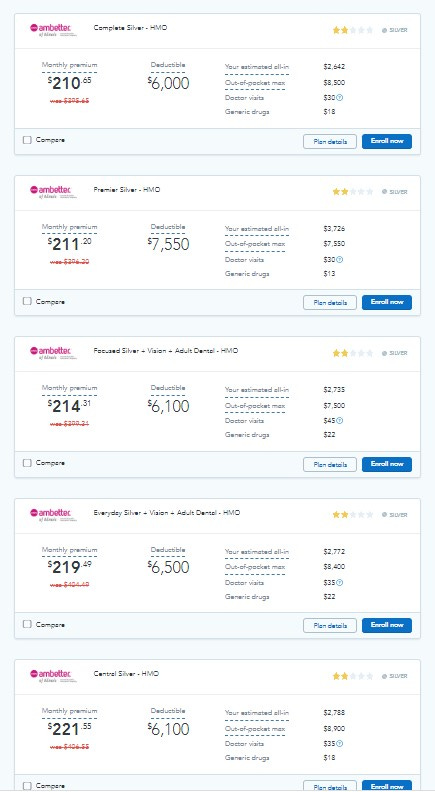
Here, for example, are the five cheapest Ambetter silver plans available in Chicago. (Quoted premiums** are for a single 40 year-old with an annual income of $40,000.)

Subscribe now

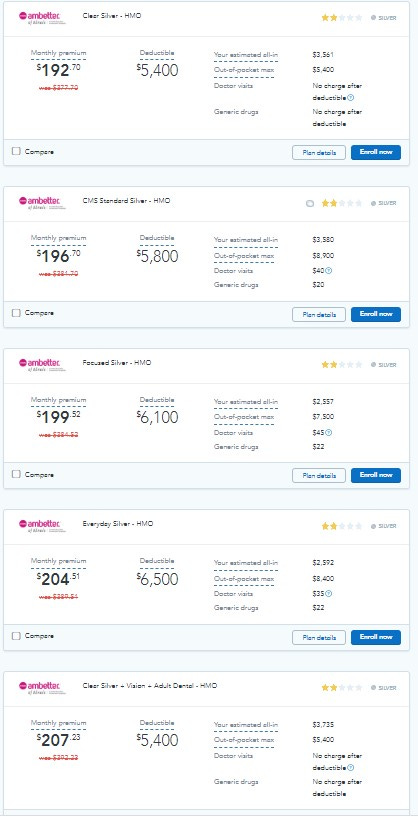
Here are the next five.

I will spare you the next five. That’s right — Ambetter has put up 15 silver plans in the Chicago marketplace.

As a rule, the cheapest insurers offering the narrowest networks are major offenders on this front. (Almost no major hospitals are in-network in Ambetter’s Chicago plans.) In many markets, their near-clone offerings render competitors’ products nearly invisible at the lowest price points. (That’s not quite the case here, as Oscar’s 12 silver plans and BCBS’s seven are interspersed with Ambetter’s at low price points.)

In the 33 states that use the federal exchange, HealthCare.gov, as well as in eleven of the 18 state-based marketplaces, plans with a standardized benefit structure — the same deductibles, copays, annual maximum out-of-pocket limits (MOOP) and services not subject to the deductible — are available at each metal level. Squint at the offerings displayed above and you’ll see that the second one is marked “standard.” But standard plans swim in a sea of non-standard competitors. While their benefit design may be optimal for average (not all!) applicants, they have nothing obvious to recommend them — not the lowest premiums, nor deductibles, nor MOOPs, nor standard copays.

With 137 plans on offer, Chicago is not the most chaotic marketplace in the country. In fact, it’s not too far off average. The average number of plans available to marketplace applicants in 2023 is 114, up from 26 in 2019, as CMS notes in its proposal to reduce this riot of unmeaningful choice. In Miami, the nation’s largest ACA marketplace, 224 plans are on offer.

How was this mass spamming of the marketplace allowed to metastasize? In 2015, CMS established a standard to ensure that that plans offered by the same insurer be “meaningfully” different. But the standard was toothless, as Anderson points out, and in advance of the plan year for 2019 the Trump administration’s CMS administrator, Seema Verma, did away with it entirely. The primary rationale, according to CMS’s account in this year’s proposed rule (pg. 230 here), was that the number of insurers participating in the exchange had shrunk in the Trump years (there was real anxiety about the possibility of “bare” rating areas where no insurers would participate). But it also reflected Verma’s was ideological commitment to proliferating choice in every health insurance market (including the choice of medically underwritten, lightly regulated, ACA-noncompliant plans).

While markets had indeed contracted after major premium spikes in 2017 and 2018 (the latter triggered by Republicans’ threatened repeal and the Trump administrtion’s regulatory assault on the marketplace), from 2019 forward ACA markets first stabilized and then expanded, with insurers returning to the marketplace and entering new states. The Biden administration has not reinstated (let alone strengthened) meaningful difference regulations — until now.

For 2024, CMS proposes to take a path forged by some state marketplaces and limit the number of nonstandard plans an insurer can offer in a given market. Specifically, the proposal (as summarized on this fact sheet) is

to limit the number of non-standardized plan options that issuers of QHPs can offer through Marketplaces on the Federal platform (including SBM-FPs) to two non-standardized plan options per product network type and metal level (excluding catastrophic plans), in any service area, for PY2024 and beyond, as a condition of QHP certification.

Theoretically, if an insurer offered three network types (HMO, EPO, PPO) at four metal levels, it could still offer 36 plans in one market. But that will not happen. PPO plans are rare in the marketplace, as are platinum plans. Note in the display above that Ambetter (a Centene brand), probably the most prolific spammer in the country, offers only HMO plans. In fact this regulation, if implemented as proposed, may increase meaningful difference among plans, as insurers seeking to differentiate themselves may be moved to vary their network types.

At present this rule is only “proposed.,” and so subject to a comment period, response, and possible revision or withdrawal. As an alternative, CMS floats a “meaningful difference” standard stronger than the previous one but less restrictive than the main proposal: Requiring that the deductibles offered by one insurer in a given metal level and network type vary by at least $1,000. That’s presumably harder to do than, say, offer a $20 copay for a primary care visit and $10 charge for generic drugs in one plan versus a $25 PCP visit and $5 generic drug charge in an alternative.

The primary proposal would require a major change in business model for some of the largest marketplace insurers — and, I think, a much improved choice architecture for prospective applicants. Here’s hoping that CMS follows through.

Update, 12/14/22: Over on Mastodon, David Anderson warns that considerably more than three network variations per insurer per metal level are conceivably allowable (and in the same exchange, Louise Norris points out that POS (Point of Service) networks are another network type). Putting up multiple networks, however, is much harder (and more substantive) than fine-slicing the odd co-pay to field a new plan. I would speculate, too, that incentivizing insurers to offer more PPOs might in fact be beneficial. Meanwhile, Charles Gaba, also surveying this proposed rule change, deploys the cultural reference that inevitably comes to mind when surveying the proliferation of plans: Robin Williams freaking out in the coffee aisle in Moscow on the Hudson. That’s more fun than my Honey Crisp-to-Mackintosh contrast. Charles also provides useful backstory on meaningful difference regulation, or the lack thereof.

- - -

* The annual rule updates are known as the Notice of Benefit and Payment Parameters. The full proposed rule for 2024 is available here.

** The display is from HealthSherpa, a commercial Direct Enrollment broker that displays all plans in all markets that use HealthCare.gov. 

Thursday, December 16, 2021

Swinging benchmarks, meaningful difference, market stability and market chaos

Subscribe (free) to xpostfactoid

My last post focused on the steep premium hikes that can hit ACA marketplace enrollees if they passively let themselves be auto-reenrolled in their current plan for the year following. In brief: if the benchmark (second cheapest silver) premium shrinks (say, because a new discount insurer enters the market), so does the subsidy. If the enrollee's current plan premium in turn increases, it's a double whammy. 

The major increase in ACA marketplace subsidies enacted when the American Rescue Plan Act (ARPA) passed in March 2021 does not alter this dynamic. If the benchmark silver plan is available to you for free -- as it is now for some two million enrollees -- and your silver plan premium exceeds the benchmark by $139 per month, you'll pay... $139 per month. Louise Norris shows an even more extreme example of a one-year premium increase for a subsidized enrollee.

In fact, large benchmark swings may be more common this year than in years past. Insurer participation in the ACA marketplace has surged this year, probably prompted by the ARPA subsidy boosts, which followed several years of price stability and profitability. CMS reports that the average enrollee has between 6 and 7 insurers to choose from in 2022, compared to between 4 and 5 in 2021 -- an increase of 44% if you take the midpoint (6.5 vs. 4.5).  Among the insurers expanding their footprint in 2022 are discounters Bright, Centene, Friday, and Molina. The average benchmark premium dropped 3% nationally, according to the Kaiser Family Foundation.

A parallel problem, adding to the confusion inherent in marketplace structure for those who do check out their options, is an overabundance of plan choice. In 2022, the number of plans available to the average marketplace enrollee soared from 61 to 108 -- a 77% increase. In Dallas, 164 plans are available on-exchange. In Miami, 263.

Wednesday, February 24, 2021

In Health Affairs: The Biden administration should complete the silver loading revolution

Subscribe to xpostfactoid

The Covid relief legislation making its way through Congress would vastly increase premium subsidies in the ACA marketplace for two years but would not touch out-of-pocket costs. Premium subsidies would still be set against a silver benchmark -- that is, designed to make the second-cheapest silver plan "affordable." At incomes over 250% FPL, silver plans have deductibles averaging $4816.

In Health Affairs, David Anderson and I have a post positing that the Biden administration can complement the subsidy boosts by requiring insurers to price gold plans below silver plans. That is, by requiring full "silver loading."

Monday, February 17, 2020

Bronze plans are terrible. Bronze plans are often the best choice.

Subscribe to xpostfactoid via box at top right

In discussion of the ACA marketplace (and health insurance generally), deductibles are often used as a stand-in for out-of-pocket costs. Now here cometh David Anderson to remind us that a plan's maximum out-of-pocket cost (MOOP) can be just as important -- and that the MOOP often does not particularly correspond to metal level.

The highest allowable MOOP at all metal levels is $8,150 (a travesty by international rich country standards).  Here is David's mapping of the range of MOOP for gold plans in HealthCare.gov states.  Dark green is $2,500 MOOP; dark red is $8,150.


As David points out, bronze plans will be a better deal for anyone who knows they'll hit the out-of-pocket max. As he's pointed out elsewhere (and in passing here), it takes a lot more spending to hit the high max in a gold plan -- say, $30,000 -- than in a bronze plan. That's because once you meet your deductible (likely to be relatively low in a gold plan with high MOOP), a high percentage of ensuing costs will be covered in a gold plan until the MOOP is reached, at which point coverage goes to 100% for ensuing costs (if you stay in network).

Monday, January 13, 2020

Juice it, Jersey: What silver loading anemia looks like

Subscribe to xpostfactoid via box at top right (requires only an email address; you'll get 2-3 emails per week on average)

I have noted before that New Jersey's implementation of an individual mandate and a reinsurance program in its ACA marketplace in 2019 illustrates the tradeoffs involved in reducing premiums in the ACA marketplace. In brief: unsubsidized premiums down, subsidized premiums up.

I have also noted that in New Jersey, silver loading is underpowered -- that is, it has produced weaker-than-average discounts in bronze plans and no discounts in gold plans, which accounted for an anemic 2% of enrollment in 2019.

Last week, David Anderson and Coleman Drake published a study indicating that the widespread availability of free bronze plans, a major byproduct of silver loading*, has had a particularly strong impact on enrollment.  The authors noted that this effect is conspicuously lacking in Jersey, and suggested a reason:
New Jersey restricts cost-sharing variation within metal levels. In 2019 New Jersey bronze plans were required to have an actuarial value of 64 percent—higher than the 58.5 percent minimum allowed by federal law. This regulation limited the financial exposure of existing enrollees by preventing them from selecting plans with higher cost sharing. However, it also limited the premium spread between the benchmark silver plan and bronze plans, which reduced the availability of zero-dollar premium plans in the state and thereby reduced enrollment. A trade-off thus exists between reducing enrollees’ financial exposure by increasing minimum actuarial value levels and increasing insurance coverage via the zero-price effect.

Friday, November 22, 2019

In Health Affairs: Silver loading goes into reverse, cont.

Subscribe to xpostfactoid via box at top right (requires only an email address; you'll get 2-3 emails per week on average)

A Health Affairs blog post by David Anderson, me, and Coleman Drake probes the likely impact of reduced silver loading effects in the ACA marketplace this year. In brief, there are fewer counties nationwide where plans below the benchmark are free to many enrollees, and fewer counties where gold plans cost less than benchmark silver. 

One profound impact may be where potential spreads are narrowest: between benchmark silver and the cheapest silver plan in each region.
The reduced silver spread, while small in dollars, may have a profound impact. At incomes up to 200 percent of poverty, the value of CSR—a free added benefit—exceeds the value of most bronze and gold plan discounts generated by silver loading. Accordingly, enrollees with incomes in the 100–200 percent of poverty range—56 percent of all enrollees in HealthCare.gov states in 2019—have mostly stuck to silver plans: According to Aron-Dine, 84 percent of enrollees in this income bracket selected silver in 2019, down slightly from 87 percent in 2017. In that same period, enrollees with incomes in the 200–400 percent of poverty range, for whom CSR is unavailable or negligible, took broad advantage of discounts in bronze and gold plans, reducing their silver selection from 60 percent in 2017 to 35 percent in 2019.

Wednesday, September 25, 2019

Unsubsidized? Buy bronze (probably)

Subscribe to xpostfactoid via box at top right (requires only an email address; you'll get 2-3 emails per week on average)

In a post yesterday, David Anderson clarified something I understood only vaguely: once a health plan enrollee meets her deductible, her incurred costs will reach the plan's annual out-of-pocket (OOP) maximum much more slowly in a plan with a high actuarial value (say, a plan covering 80% of costs) than in a low-AV plan (covering 60% of costs).

The ACA requires plans to cap enrollees' annual OOP costs at no more than $7,900. Most plans at all metal levels have OOP caps over $5,000, with the exception of silver plans enhanced by strong Cost Sharing Reduction CSR) subsidies available to low income enrollees.  By the standards of the U.S.'s peer countries, that's a grotesque amount of risk for an average person to assume, but that's the world we Americans have made ourselves.

Anderson plots the rate at which an enrollee's total incurred medical costs will hit the maximum allowable OOP max in  bronze, silver, and gold plans with these features:

Monday, May 13, 2019

Benefit cliffs in the ACA marketplace

Dave Anderson highlights an important weakness in the subsidy structure for the ACA marketplace. As income rises, the enrollee's share of the premium for a benchmark silver plan is subject to sudden and irregular bump-ups, which Anderson compares to jolts in marginal tax rates.  Take the case of a couple looking to buy a benchmark silver plan:
From $17,000 to$20,000 this couple pays an extra $2 per month for every thousand dollars more they earn a year.  Annually this is about a 2% marginal tax rate on the additional income.  And then there is a huge bump from $20,000 to $21,000.  The benchmark premium suddenly becomes $256 more expensive.  This is a 25% marginal rate...

And then the marginal rate drops again when the family increases their earnings from $21,000 to $22,000.  The marginal rate for this slice is now about 11%.  The marginal rate for couples earning under 300% FPL is in the mid-teens, and then there is a drop in the marginal rate to just under 10% for 300% to 400% FPL and then a potential massive spike as soon as someone earns over 400% FPL.
The spikes in out-of-pocket (OOP) costs this couple is exposed to as income rises are even more sudden -- and, I think, potentially damaging to family finances -- than the premium spikes. The main benefit cliff is formed by the sudden fadeaway of Cost Sharing Reduction (CSR) subsidies at 201% FPL, where the actuarial value of a silver plan drops from 87% to 73%.  CSR disappears entirely at 251% FPL, and the coverage offered by a benchmark silver plan with no CSR, which has an AV of 70%, is clearly underinsurance for those without significant financial resources.

Thursday, March 22, 2018

Elizabeth Warren roars at health insurers, but her ACA 2.0 offers them a pretty sweet deal

Elizabeth Warren loves to bash insurers. Yesterday, she introduced a bill* that would radically improve the health insurance offered in the ACA marketplace. Reading the preamble to the bill's one-page summary, you'd think that problems of access and affordability in U.S. healthcare are solely a product of insurance company greed.

Leaving aside various hat-tips to the ACA, here's the indictment:
...today, too many patients still have to battle with their insurance companies just to see a doctor or get a prescription filled. Insurance companies draw networks so narrow that patients struggle to find a doctor or get an appointment.1 Patients find out when they get a bill in the mail that they unwittingly relied on an outdated provider directory and now owe hundreds of dollars in unexpected costs for out-of-network care. Insurance companies can drop doctors from their network in the middle of the plan year with no notice, suddenly jack up out-of-pocket costs for a cancer or MS drug, or rip up a plan at the end of the year and leave new mothers or patients dealing with a serious health condition scrambling to maintain access to their doctor.

Monday, February 12, 2018

Health Policy Valentines 2018

Wait, no, this can't be my fifth year of #HealthPolicyValentines.* But yes: here is Love Knows No Repeal (2017),  Love in the Time of Obamacare (2016), love, 2015, and first love, 2014.

And who'd have thought we'd have at least two Trump-era V-days with the ACA unrepealed? But here we are...

Spite is served hot,
Revenge is served cold.
Trump cut off CSR,
We got cheap bronze and gold.

     *      *      *

Replace came up empty,
Repeal served up zeroes.
We love you, Little Lobbyists,
True national heroes.

     *      *      *

Heller was craven,
Capito, afraid.
Collins, McCain, Murkowski
saved our Medicaid.

*      *      *

Monday, January 08, 2018

Maryland ACA enrollment spotlights effects of Trump's CSR sabotage

Maryland announced late last week that its ACA marketplace enrollment for 2018 totaled 153,571, down 2.6% from 2017 -- a good result, given the shortened enrollment period, radically cut federal funding for enrollment outreach and advertising, and general confusion generated by administration sabotage.

Maryland reports, further, that African-American enrollment was up 12 percent, Hispanic enrollment up 10 percent, and enrollment in rural areas up around 10 percent. Those increases suggest that enrollment drop-off may be concentrated in the unsubsidized population, which has historically been high in wealthy Maryland -- 25% of on-exchange enrollment in 2017, compared to 16% nationwide.

That makes sense, considering that in Maryland a) premiums soared a weighted average 43.8%, according to Charles Gaba's blog, with much of the hike attributable to Trump's cutoff of CSR reimbursement, and b) Maryland insurers concentrated the added cost of CSR on on-marketplace silver plans, with cheaper silver plans available off-exchange.  Thus some unsubsidized 2017 enrollees may have been priced out by huge premium increases, and some may have moved off-exchange to find somewhat cheaper plans.

Steep as the average premium hikes were, the increase in the federal government's subsidy bill was even steeper, and that's worth looking at more closely:

Thursday, November 30, 2017

Late Days of Empire Edition: Health Wonk Review

We're addled on many fronts here in Trumpville, and this week's Health Wonk Review reflects that. We have snapshots of a country that continues to trail its peers in population health measures; an opioid vendor looking to short-circuit potential tobacco industry-level liability; an individual market for health insurance offering unaffordable plans to many of the unsubsidized, and freakish bargains to some of the subsidized; and, for a little futuristic relief, a human resources tech vendor that may chain healthcare data to a block, where it shall remain unaltered forever and ever.

At Workers' Comp Insider, Tom Lynch  looks at what the U.S. gets for spending 41% more on health care than our wealthy nation peers in the OECD and 81% more than the entire 35-nation OECD average. Spoiler: not much. We're "sort of like a big-market baseball team spending gazillions more for players than any other team, only to finish out of the running."

At Managed Care Matters, Joe Paduda notes that Purdue Pharma is trying to strike a deal to resolve all state claims relating to opioids. He warns:

Wednesday, October 11, 2017

States vary in their responses to CSR uncertainty


Note: this post is a joint effort with colleagues who have closely tracked the CSR chaos induced by Trump and Republicans in Congress. Dave Anderson is a former health insurance analyst, now a healthcare scholar at Duke, and a blogger at Balloon Juice; Charles Gaba is the fabled chronicler and analyst of ACA enrollment, marketplace pricing, and healthcare policy; Louise Norris is co-owner with her husband Jay of a health insurance brokerage for individual market customers, and a top source of marketplace information and analysis at her own blog (link in byline) as well as at healthinsurance.org and elsewhere.

Note 2 Today, the Maryland and California exchanges opened their plan preview tools for 2018, with premiums listed. California has implemented its planned CSR surcharge, adding 12.4% to the premium of silver on-exchange plans only. In some regions, the cheapest gold plan is cheaper than the cheapest silver.

Update, 10/14: David Anderson has mapped out the choices states have made to cope with CSR uncertainty (and now, CSR cutoff) here, and Charles Gaba is charting them here.

The open enrollment period for the 2018 ACA Marketplace that begins on November 1, 2017 is likely to confront enrollees with more challenges than any open enrollment since the troubled launch of the ACA Marketplace in October 2013. The time period is shorter, the outreach will be far less robust, and the pricing of plans will behave in ways that people do not expect.  Much of the pricing variance will be a result of choices that states and insurers have made in response to the uncertainty over whether the federal government will continue to reimburse insurers for the Cost Sharing Reduction (CSR) subsidies that insurers are legally obligated to provide to qualified exchange enrollees.  

Tuesday, August 15, 2017

Can Democrats afford to stand pat on the ACA?

A while back, I anticipated that Republicans would demand a steep price for passing legislation that would guarantee federal funding for the ACA marketplace's Cost Sharing Reduction (CSR) subsidies and possibly for a reinsurance program. I asked what Democrats should be willing to give up to secure those obviously necessary measures -- the first simply an end to sabotage, the second an individual market essential that Republicans bestowed liberally in their ACA replacement plans.

David Anderson counters that "this model of leverage is wrong" and that Democrats should be willing to give up...nothing.  The rationale is not "if you break it you own it" (i.e., Republicans will be blamed for market collapse),  but rather that forcing insurers to fund (and price for) the CSR subsidies as of 2018 would hand Democrats "an incredible policy victory."

Thursday, June 01, 2017

Alternative Facts, Alternative Realities Edition of Health Wonk Review

In a divided country and interconnected world, it often feels as if reality is fracturing before our eyes. When a spokesperson for the President asserts the administration's right to promulgate "alternative facts," it's a major challenge to convince a critical mass of people that verifiable facts are in fact verified. On the plus side, as ever more of the previously voiceless find or create a forum, we have the chance to see how differently a given law or trend may affect different people -- not alternative facts, but variant effects.  This week's Health Wonk blog reflects that variety, as well as battles over fact and interpretation.

First up is Harold Pollack in healthinsurance.org, tilting against alternative facts of the pure variety -- a.k.a. lies. In You can only lie about policy in Washington D.C., Pollack takes on four of Paul Ryan's assertions about the AHCA (delivered in short space) that the Congressional Budget Office (CBO) analysis of the bill directly contradict.  Most of them boil down to claims that the AHCA will make insurance and healthcare more affordable to more people, but Ryan also avers for the umpteenth time that the ACA marketplace is collapsing under its own weight.

At InsureBlog, conversely, Patrick Paule takes on CBO the old fashioned way -- with a factual critique rather than a go-team cry of fake news. Paule asserts "four reasons the CBO score is flawed."noting that CBO  1) pits AHCA individual market enrollment against CBO's 2016 baseline for the ACA, which overestimated enrollment by 4 million; 2) assumes that under current law, more states would embrace the ACA Medicaid expansion; 3) assumes (thanks to the MacArthur Amendment, allowing states to waive ACA coverage rules) that some health plan enrollees won't have comprehensive coverage, but does not define what coverage must be provided to make the cut; and 4) does not delve into the implications of its forecast that millions will voluntarily drop insurance in the absence of a mandate to obtain it.

Wednesday, April 05, 2017

Single payer by inches?

File this under Half-baked Ideas and What's a Blog For?....

Dave Anderson, Louise Norris and I were noodling about stability funds, reinsurance, high risk pools, and the probably minuscule chance that Republicans would demand something acceptable in exchange for coughing up some federal "stability" money for states without repealing the ACA when a thought emerged...

What if the federal government undertook to foot the bill for all truly catastrophic claims -- say, those over $200,000 a year -- for all insurers, paying Medicare rates for care?

For hospitals and doctors, that would mean status quo ante payments for patients already on Medicare; a severe haircut for patients covered by commercial insurance; but a corresponding bump-up for patients on Medicaid. The rate (Medicare plus or minus a bit) could be calibrated to net out even, or a bit less than even in exchange for giving providers the certainty of getting major claims paid.

The tradeoff would be reduced rates for commercial insurance in exchange for a universal tax increase -- say, added to the Medicare payroll tax. In FY 2015, the 2.9% Medicare tax yielded $234 billion, so perhaps every additional 1% would yield another $80 billion, adjusted for growth and inflation.  If the reinsurance brought down commercial rates, that should translate into lower premiums and out-of-pocket costs for employees and/or higher wages.