Showing posts with label ACA. Show all posts

Tuesday, November 25, 2025

Some bitter pills to swallow in Trump's ACA prescription

Note: Free xpostfactoid subscription is available on Substack alone, though I will continue to cross-post on this site. If you're not subscribed, please visit xpostfactoid on Substack and sign up

Raise that subsidy cap...

It may be a fool’s errand to write about reported features of a now-stayed Trump administration plan to extend the enhanced ACA premium subsidies for two years, with various conditions and haircuts imposed.

Since House hardliners have stayed the plan, it’s likely to get worse if it ever sees light of day. But as outlined in the various media reports, the pending plan is full of poison pills — or, shall we say, enrollment-inhibiting side effects. The features already floated raise a question we may well be confronted with: If Republicans do coalesce round a plan something like what’s been floated, would Democrats (most, some, a handful) get on board? Should they?

Let’s consider the constraints imposed on the enhanced subsidy schedule in the Trump outline.

Friday, May 16, 2025

With ARPA subsidies set to expire, a window on the ACA's off-exchange market

 Note: All xpostfactoid subscriptions are now through Substack alone (still free), though I will continue to cross-post on this site. If you're not subscribed, please visit xpostfactoid on Substack and sign up.


A press release from New Jersey’s Department of Banking and Insurance (DOBI) urging Congress to extend the enhanced ACA marketplace subsidies created by the American Rescue Plan Act (ARPA) in 2021, which are funded only through this year, led me to discover that DOBI has resumed quarterly tracking of off-exchange as well as on-exchange enrollment, after a long hiatus (1-2 years?). Reports are now available through Q2 2024.

In general, nationally, off-exchange enrollment data is spotty, and the off-exchange enrollment numbers in NJ open a window into how expiration of the ARPA-enhanced subsidies, which Republicans are unlikely to extend, may affect those with income above 400% FPL, the once and likely future cap on subsidy eligibility. In the Open Enrollment Period (OEP) for 2021, the last year with the 400% FPL cap on income eligibility, 43% of state enrollees in ACA-compliant plans were unsubsidized. In 2024, just 25% were unsubsidized. We will probably soon be back to 40%-plus.

Thursday, January 09, 2025

ACA fulfills early forecasts

Note: All xpostfactoid subscriptions are now through Substack alone (still free), though I will continue to cross-post on this site. If you're not subscribed, please visit xpostfactoid on Substack and sign up.

CBO inside

As we near the end of the ACA marketplace’s Open Enrollment Period (OEP) for 2025, CMS is out with a new enrollment snapshot showing 23.6 million plan selections. As OEP has another week to go in the 32 states using HealthCare.gov, and up to 23 days more in some state-based marketplaces, Charles Gaba estimates final enrollment at 24.2 million*, up about 13% over OEP 2024 — and just about double the 12.0 million total in OEP 2021. That was the last year before the Democratic Congress and the Biden administration changed the game by radically boosting premium subsidies and expanding eligibility for them as part of the American Rescue Plan Act (ARPA), enacted in March 2021 (and effective immediately during an emergency Special Enrollment Period that had started on February 15).

The ARPA subsidy increases made benchmark silver coverage with strong Cost Sharing Reduction free to enrollees with income up to 150% FPL; removed the 400% FPL cap on subsidy eligibility; and reduced the percentage of income required for the benchmark silver plan at all income brackets in between. Enacted as a pandemic measure lasting only through 2022, the enhanced subsidies were extended through 2025 by the Inflation Reduction Act, enacted in August 2022. If the Republican Congress declines to extend the ARPA subsidy boosts, OEP 2025 will stand as the marketplace’s high-water mark, and millions will drop coverage beginning in 2026 (7.2 million according to the Urban Institute’s estimate).

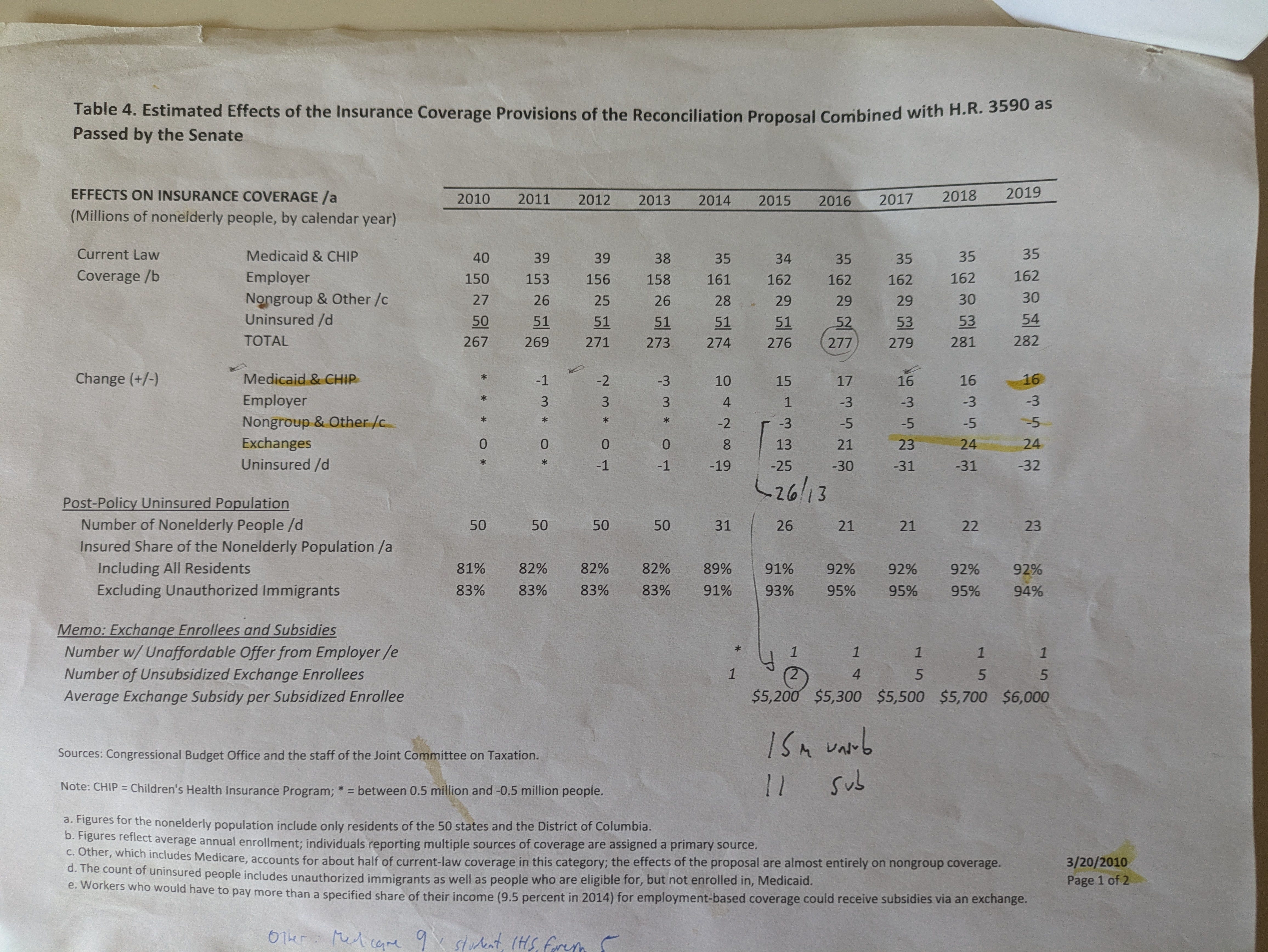
I have written more than once that the ARPA subsidy boosts brought the ACA within striking distance of fulfilling the mission expressed in its name (affordable coverage for all who lack access to pre-ACA sources of health insurance) and envisioned by its drafters — and by the Congressional Budget Office, e.g., in its final projection prior to enactment, on March 20, 2010. That is almost literally true now. Enrollment in the ACA’s core programs — the Medicaid expansion and the subsidized marketplace — is quite close to the 2010 CBO ten-year projections, albeit six years late (and just shy of four years after ARPA was enacted — when, in a sense, the clock restarted).


Top line, the CBO in 2010 was almost dead-on as to the ACA’s long-term effect on the uninsured rate, forecasting that 92% of the nonelderly U.S. population would be insured ten years in. That wasn’t true in 2019 (pre-pandemic, pre-ARPA), but it’s close to true now. The latest quarterly estimate from the National Health Interview Survey (NHIS), for Q2 2024, pegs the uninsured rate in the under-65 population at 9.1%. In 2010 CBO forecast 23 million uninsured as of 2019; the NHIS pegs the uninsured population (all ages) at 25.3 million in Q2 2024.**

I cannot locate the March 2010 CBO report on the ACA’s likely effects (updates from 2011 forward are readily available), so I’ll have to rely on an old printout. Forgive some old scribblings in the 2015 column.

Some notes as to the forecasts for 2019:

  • CBO anticipated the marketplace approaching full capacity with 23 million enrollees in 2017, its fourth year of operation, edging up to 24 million in 2018 and remaining at that level in 2019. Current enrollment is…24 million. (Add 1.8 million in the Basic Health Programs established in three states, which CBO did not anticipate — see the first note at bottom.)

  • CBO projected a net increase of 16 million in Medicaid enrollment from 2010 to 2019. There are a couple of ways to assess this projection. First, as of September 2019, total Medicaid enrollment was up 15.1 million from July-September 2013, the pre-ACA comparison point used by KFF.

  • Viewed another way, the total number of Medicaid enrollees rendered “newly eligible” by ACA expansion criteria (that is, adults with income up to 138% FPL who would not have been eligible by other criteria) was 16.6 million*** in June 2024 — the last month for which numbers are available. By that point, the “Medicaid unwinding” — resumption of disenrollments in May 2024 after a three-year pandemic-induced moratorium — was mostly over.

  • While getting the top line for increased Medicaid enrollment more or less right, CBO actually underestimated the ACA’s effects on Medicaid enrollment, as it expected the ACA expansion to be in effect in every state. In June 2012, the Supreme Court rendered the expansion optional for states, and initially only 24 enacted it. As of December 2019, 34 states had enacted the expansion; as of now, ten states, including Florida and Texas, still have not.

  • The persistence of “nonexpansion states” has inflated marketplace enrollment. In the ten remaining nonexpansion states, 5.8 million marketplace enrollees reported income in the 100-138% FPL range, which would have placed them in Medicaid had all states enacted the expansion.

  • In light of the points above, based on what it knew/assumed in 2010, CBO overestimated marketplace enrollment and underestimated Medicaid expansion (as about 6 million marketplace enrollees in nonexpansion states “ought” to be in Medicaid). Those misses more or less cancelled each other out as to the top line.

  • Medicaid enrollment increased by more than 20 million during the three-year moratorium on involuntary disenrollments enacted in March 2020 as part of the Families First Act, a pandemic relief bill. The “unwinding” — resumption of redeterminations and disenrollments — that began in spring 2023 was clumsy and cruel in many states, and too many children lost coverage. When the dust settled, however, enrollment was still 7.7 million higher in September 2024 than in March 2020, the eve of the pandemic, and the uninsurance rate may prove not to have risen. After a year-plus of unwinding, enrollment among those rendered eligible by ACA expansion criteria was up was 5.4 million higher in June 2024 than on the eve of the pandemic in March 2020.

  • CBO forecast a net drop in employer-sponsored insurance (ESI) of just 3 million over ten years. According the KFF’s annual survey based estimates, enrollment in employer-sponsored insurance was 3 million higher in 2010 (estimated at 157 million) than in 2024 (154 million). The labor force did increase by about 4.4 million from 2019 to 2024, perhaps suggesting a slight further shrinkage in ESI.

  • CBO also forecast a drop of 5 million from 2010 to 2019 in off-exchange “nongroup” insurance combined with “other” insurance — an opaque catch-all category that includes disability Medicare (about 7 million at present), student health plans, care at correctional facilities, and some other odds and ends. The drop was forecast to occur chiefly in off-exchange nongroup enrollment, and that drop was probably steeper than forecast, driven by a) a sharp rise in unsubsidized premiums in 2017-18, b) a steady fade-out of pre-ACA “grandfathered” and “grandmothered” (don’t ask…) plans, and c) by ARPA’s removal of the income cap on subsidies, which prompted a lot of new enrollment in the 400-600% FPL range. CBO probably underestimated the drop in off-exchange nongroup enrollment. In a 2019 brief, KFF estimated nongroup enrollment in 2011 (pre-ACA) at 10 million. By the first quarter of 2015, per KFF, off-exchange nongroup enrollment in ACA-compliant and noncompliant plans combined had dropped only modestly to 8.8 million, but after steep premium increases in 2017-2018 it plummeted to an estimated 3.3 million by Q1 2019. CBO estimates from June 2024 peg nongroup coverage bought outside the marketplace at a similar 3.1 million in 2024. That looks like a drop of about 7 million in off-exchange nongroup enrollment from the pre-ACA period to 2019 and beyond — perhaps 2 million more than forecast, though a lot of moving parts are involved.

It may seem somewhat dicey to compare 2025 totals to CBO’s 2010 projections for 2019. But I believe the comparison is instructive. The 2010 10-year forecast encompassed just six years of operation of the ACA’s core programs, which kicked off in January 2014 (though a few states started the Medicaid expansion early). Marketplace and Medicaid enrollment stalled, and in fact went into modest reverse, during the Trump years, until the pandemic struck. The ARPA subsidy enhancements, which have been in effect through four OEPs (2022-2025), represented a new beginning — and the premise here is that the enhanced subsidies enabled the marketplace to fulfill the function envisioned at the level envisioned.

ARPA made that fulfillment possible. In late 2009, as the ACA was writhing through multiple iterations in the Senate, it was plain to progressive advocates that the emerging subsidy schedule was inadequate to the marketplace’s purpose. In his 2011 book about the battle to pass the ACA, Richard Kirsch, national campaign manager from 2008-12 for Health Care for America Now (HCAN), an umbrella group formed by unions and progressive nonprofits to advocate for universal health care, took the inadequacy of the subsidies as a given:

In the President’s September address to Congress, the President not only made a concession on the public option. He also said, “the plan I’m proposing will cost around $900 billion over ten years.” Yet $900 billion was not enough money to make health care truly affordable to the uninsured. Why did the President make another, preemptive concession to the bill’s opponents, one that would significantly damage his core goal? An article co-authored by Robert Pear and The New York Times White House correspondent Jackie Calmes summarized the impact nicely: “The number suggests a political and fiscal calculation to avoid the sticker shock of the trillion-dollar threshold. But it probably means that Mr. Obama could fall short of his goal of providing universal coverage for all Americans because the lower cost may force lawmakers to reduce the subsidies needed to help more uninsured individuals and small businesses seeking coverage for employees.”...

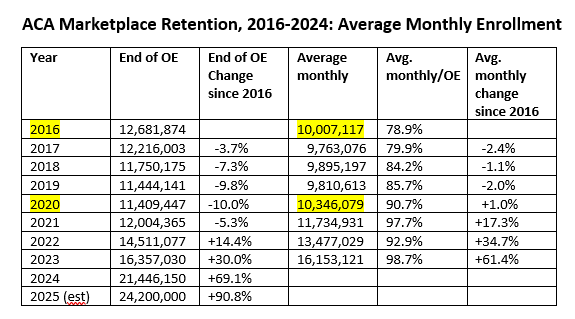
While the marketplace roughly met enrollment goals in its launch year, 2014, and enrollment increased substantially in 2015, CMS officials in the later Obama years knew that enrollment would not grow in line with CBO projections — and starting in OEP 2018, team Trump took steps to ensure that enrollment would not grow (e.g., gutting funding for enrollment assistance and outreach, shortening the OEP, and standing up an alternative market of ACA-noncompliant plans). Average monthly enrollment reached a peak in 2016 that would not be passed until the pandemic and resulting job layoffs stimulated off-season enrollment in 2020 (as highlighted in the Average Monthly Enrollment column below). In 2021, ARPA took over, and the rest is the history we’ve been examining.

Sources: Marketplace Open Enrollment Public Use Files and Full-Year and February Effectuated Enrollment tables, available via the 2024 Early Effectuated Enrollment Snapshot.

None of this is to suggest that the marketplace is an unproblematic program (and wait till team Trump 2.0 gets hold of it). I personally think that a market of private plans offered mostly by for-profit insurers paying modified commercial rates to providers and pushed by competition toward very narrow provider networks is a suboptimal way to offer health coverage to those who lack access to other sources of insurance. Out-of-pocket costs in the marketplace are way too high; networks are too narrow; and the proliferation of plan choices in each market, numbering over 100 on average in 2024, is nonproductive and bewildering. All that said, coverage is currently available and affordable to most of those who need it. That wasn’t true until ARPA, and it’s a BFD. It very likely won’t be true in 2026 or any time soon.

- - -

* Another 1.8 million people are enrolled in the Basic Health Programs offered in lieu of the ACA marketplace to low-income enrollees by New York, Minnesota and Oregon (1.6 million of them in New York*). BHPs, an alternative provided to states by the ACA statute, are standardized, Medicaid-like plans with low out-of-pocket costs. New York’s Essential Plan is technically no longer a BHP, as the state extended eligibility to enrollees with income up to 250% FPL in 2024. By statue, BHPs can only serve enrollees with income up to 200% FPL. New York reorganized the Essential Plan, preserving its federal funding, via an ACA Section 1332 “innovation waiver.”

** Since 2019, the population has grown by about 9.3 million, suggesting that if CBO’s estimate for that year had been on target and remained stable until now, another 760,000 people would be uninsured. So the modest gap between the CBO 2010 estimate and the current NHIS estimate of the absolute number of uninsured is roughly in line with the percentage gap.

*** CMS offers two measures of ACA expansion enrollment in Medicaid: those rendered eligible by ACA criteria (“Group VIII”), and those rendered newly eligible by those criteria. The distinction stems from a handful of states independently extending Medicaid eligibility to all adults with income up to a threshold of 100% FPL or higher; in those states, a number of Group VIII enrollees would presumably remain eligible if there were no ACA expansion. In June 2024, there were 20.9 million Group VIII enrollees, 16.7 million of them “newly eligible.”

- - -

Non sequitur: some writing from me in a different mode, for kids.

Thanks for reading xpostfactoid! Subscribe for free:

Saturday, November 23, 2024

If the ACA is not repealed

  Note: All xpostfactoid subscriptions are now through Substack alone (still free), though I will continue to cross-post on this site. If you're not subscribed, please visit xpostfactoid on Substack and sign up.


Trump said during the campaign that he would not work to repeal the Affordable Care Act. Of course, Trump’s promises are not worth the breath polluted by his utterance of them, and Republicans in Congress, flush with the Republican trifecta, are talking about block-granting Medicaid. that would probably go hand in glove with phasing out the ACA Medicaid expansion — the ACA’s most important and effective program, responsible for most of the drop in the uninsured rate achieved by the ACA.

But let’s undertake the dubious exercise of taking Trump at his word. Repealing and replacing (or, in the case of the Medicaid expansion, declining to replace) the ACA’s core programs may fail, as it did in 2017. Congress may take some hacks at the law, as they did in 2017 (remember the individual mandate? or the tax on insurers?) without changing the core subsidy structure of the ACA marketplace (minus the subsidy enhancements enacted in the American Rescue Plan, which expire in 2026) or entirely eliminating the Medicaid expansion. And the Trump administration may do much to reshape the marketplace administratively — as Trump 1.0 did, but much more. As I noted earlier this fall, JD Vance sketched out how Trump might, um, “build on” (that is, partially dismantle) the ACA marketplace.

Thanks for reading xpostfactoid! Subscribe for free:

Let’s look at the various means by which the Trump administration and Republican Congress might reshape the ACA’s core programs (Medicaid expansion and Marketplace) short of wholesale repeal.


Medicaid work requirements. Billed as a way to help “able-bodied” (read: unworthy, largely nonwhite) Medicaid enrollees discover the joys and dignity of wage labor, this Republican favorite is actually a means pushing eligible people off the rolls, as brief experiments in Trump 1.0 demonstrated. As the Kaiser Family Foundation never tires of documenting, a large majority of Medicaid expansion enrollees do work, and almost all the rest are otherwise constructively engaged, e.g., in school or caring for loved ones, or disabled. During Trump 1.0, CMS administrator Seema Verma enthusiastically promoted work requirements, inviting states to file waivers enacting them. While thirteen states had waivers approved, only Arkansas implemented them, with reporting requirements so onerous and so incompetently administered that the D.C. Circuit Court shut the program down after some 18,000 had been gratuitously disenrolled, holding that the waivers were unlawful because CMS failed to consider the impact on coverage, as required for Medicaid waivers. The pandemic then interrupted other states’ waiver plans, and the Biden administration removed approvals. Various court challenges were paused or dismissed as moot. Get ready for Round 2.

Medicaid de-expansion. The path on this front is laid out by the Trumpist Paragon Institute, headed by Brian Blase, who was on Trump’s NEC. The Paragon proposal, like the 2017 ACA repeal bills, would end the federal government’s 90% match rate (FMAP) for Medicaid enrollees rendered eligible by ACA criteria (eligibility for legally present adults (except recent immigrants) with income up to 138% of the Federal Poverty Level, reducing the FMAP to each state’s FMAP for other Medicaid programs, which ranges from 50% in the wealthiest (a.k.a. blue) states to 77% in Mississippi. The proposal would allow states to drop the eligibility threshold to 100% FPL, which would then be the starting point for marketplace subsidy eligibility, as it is now in the ten remaining states that have refused to implement the ACA expansion (Paragon notes gleefully that those states, which include Texas and Florida, will never enact the expansion under this proposal). In an extra swipe at wealthy (blue) states, Paragon would drop the minimum FMAP from 50% to 40%. This proposal nominally does not end the expansion, and allows states to avoid a “coverage gap” on the current Wisconsin model (Medicaid to 100% FPL, marketplace from 100% FPL). As the federal government pays 100% of marketplace premium subsidies, the shift of enrollees in the 100-138% FPL range offset a bit of the cost to states of the reduced match rate. But most states would probably find maintaining expansion at the reduced FMAP unsustainable — especially if the Republican Congress also imposes block grant funding or per capita caps on federal Medicaid spending, which would slow-strangle Medicaid over the course of a decade or two.

Undercutting the ACA marketplace. With Republicans in control of Congress, the enhanced premium subsidies enacted through 2022 by the American Rescue Plan Act and extended through 2025 by the Inflation Reduction Act are almost certainly dead. (Had Democrats won the House, they might have leveraged the expiration of Trump’s income tax cuts to preserve the ARPA subsidy boosts.) Those subsidy increases were doubtless the main cause of a 78% enrollment increase nationally from 2021-2024 and a 123% increase in the nonexpansion states, where the enhanced subsidies rendered benchmark silver coverage free for enrollees with income in the 100-150% FPL range. That means that the pre-ARPA income cap on subsidy eligibility, 400% FPL ($60,240 annually for a single person in 2024), will snap back into place, rendering ACA-compliant coverage unaffordable for several million people.

From there, a supercharged version of Trump 1.0’s parallel, ACA-noncompliant market will go to work to reduce the ACA marketplace to a sort of high risk pool. Vance sketched out how this might work, as I noted a few weeks ago. If more wholesale repeal/redesign does not happen, Trump 2.0 might

rebuild Trump 1.0’s alternative market of medically underwritten, ACA-noncompliant plans (so-called Short-Term Limited Duration, or STLD, plans*), and 2) prompting states to implement measures like the waiver concepts put forward by Trump’s former CMS administrator, Seema Verma. These “concepts” included 1) replacing ACA premium subsidies with a lump-sum health savings account that could be used to pay premiums for any plan; 2) inviting states to restructure the federal premium subsidy as they wished; 3) allowing states to grant premium subsidies for ACA-noncompliant plans; and 4) creating state high risk pools. Options 1 and 3 could effectively convert the ACA-compliant marketplace as we know it into a high risk pool of sorts, and in combination with option 4, could create the multiple stratified risk pools that Vance described in followup comments.

Verma’s waiver concepts plainly violated the ACA statute, as alternative state schemes outlined in an ACA Section 1332 “innovation waiver” proposal has to provide coverage at least as comprehensive as that stipulated in the ACA; provide coverage and cost sharing protections that are at least as affordable; and cover a comparable number of residents. Amending the waiver provision to allow Verma-esque concepts would be low-hanging fruit for a Republican Congress, and in fact was under negotiation after Republican repeal attempts failed in 2017.

Georgia made a brief attempt to take Verma up on her waiver concepts, filing a waiver proposal in late 2020 that would have eliminated a state-sponsored exchange, relying on commercial Enhanced Direct Enrollment (EDE) platforms commissioned by the federal government, and, in one early iteration, allow plans that did not include all Essential Health Benefits to be paid for with federal subsidies. That provision was cut from the submitted waiver, as it violates the ACA statute too plainly even for Trump 1.0’s administrators. But this may be the ACA’s future, if it has any future: some semblance of the ACA subsidy that can be used for ACA noncompliant plans — including, perhaps, medically underwritten plans. As those plans would be cheaper for healthy people, ACA-compliant marketplace enrollment might be reduced to those who would a) pay very little for comprehensive coverage because of low income and a favorable shakeout of price spreads, and/or b) those who know they need comprehensive coverage or who could not get a viable offer when subjected to medical underwriting.

The big enchilada, now as ever, is the ACA Medicaid expansion — and behind that, sustained federal funding for Medicaid programs generally. Perhaps Republicans will divide the baby, and cut the ACA expansion’s enhanced FMAP, say to 80% instead of 90% — and/or cut it disproportionately for states with higher per capita income. Under the best scenarios, the uninsured rate will rise substantially, and the individual market for health insurance will degrade considerably. Just one set of the many pillars of our society likely to come crashing down in coming months and years.

Update: It’s worth noting that when the Trump administration created an ACA-noncompliant market by extending the allowable limit of so-called Short-term, limited duration (STLD) plans to a full year, renewable twice, many states imposed or preserved strict limits of their own. (The STDL plans are medically underwritten, don’t have to cover the ACA’s ten Essential Health Benefits, and are not subject to medical loss ratio limits, e.g., the requirement to spend at least 80% of premiums on patients’ medical expenses.) As of this year, 14 states have either banned STDL plans outright or effectively regulated them out of existence, and others had either imposed other duration limits (often six months) or new coverage rules. If the ACA is not substantially repealed, state markets will doubtless diverge further in how they regulate and reshape coverage.

Update 2, 11/16/24: Charles Gaba, by means of Georgetown’s Edwin Park, runs down the more extreme scenario, Republicans enacting their proposals to destroy Medicaid

* Borrowing my last quick rundown of the Trump admin’s STLD program:

The Trump administration’s major initiative to “build on” the ACA marketplace after repeal failed was to stand up (by administrative rule in 2018) a parallel market of medically underwritten, lightly regulated plans by extending the allowable duration of already-existing so-called “short-term, limited duration plans” (STLD) to up to one year, renewable twice. The Obama administration had limited STLD duration to three months, though not until 2016. In combination with the Republican Congress’s zeroing out of the tax penalty for failing to obtain ACA-compliant insurance, the STLD market was an alternative for people who were priced out of the regulated ACA marketplace — as several million people were before the Biden administration removed the income cap on subsidy eligibility via the American Rescue Plan Act (ARPA) in March 2021. (The ARPA subsidy enhancements were temporary, and extended by the Inflation Reduction Act only through 2025.)

STLD plans can refuse access to people with pre-existing conditions or exclude coverage for the condition. They do not have to cover the ACA’s Essential Health Benefits and generally offer very limited prescription drug coverage, if any, and no substance abuse coverage. They are not subject to the ACA requirement to spend at least 80% of premiums on members’ medical bills (and on a few allowed other expenses) and have been reported to spend as little as 45% of premiums on claims. They do not have to offer a provider network and can pay providers what they deem appropriate, exposing enrollees to balance billing. They do not have to provide an annual out-of-pocket cost cap on covered benefits, though some do. They are much like the plans offered in the pre-ACA individual market.

Thanks for reading xpostfactoid! Subscribe for free:


Photo by Kaboompics.com 

Monday, May 09, 2022

John Roberts, James Joyce, the individual mandate, Medicaid Estate Recovery, and "affordable" care

Subscribe to xpostfactoid 


A good book about Ireland's history since 1958, Fintan O'Toole's We Don't Know Ourselves: A Personal History of Modern Ireland led me to a second attempt at James Joyce's Ulysses, which I stalled out on decades ago, somewhere after Leopold Bloom emerges from an outhouse. Further I plod. One thing I will say for Joyce's internal babble is it does make you somewhat more mindful -- inclined to track your own perceptions and fleeting thoughts. 

So it was that I caught one lightning round of associations at lunchtime today:

--  John Roberts -- trying to moderate Roe strike-down?

-- Roberts -- headed off one radical conservative decision by saving the ACA's individual mandate "as a tax." 

Wednesday, February 09, 2022

In New Mexico, a Midas touch has a double edge

Subscribe to (free) xpostfactoid

Let's take one more look at enrollment results in New Mexico's ACA marketplace, where extreme silver loading rendered average lowest-cost gold plan premiums 14% lower than those of lowest-cost silver plans, and gold plans were available well below the cost of a benchmark silver plan statewide (excepting those for whom silver plans also were free, or had single-digit premiums).

The unadulterated good news was for enrollees with incomes above 200% of the Federal Poverty Level, more than two thirds of whom chose gold plans, while only about 13% choose bronze. That's a real advance.

The good news at incomes below 200% FPL was that just 4% chose bronze plans, which carry deductibles usually in the $7,000 range for an individual.  Most of those who selected bronze at low income levels may have been subsidy-ineligible, usually because of an employer's offer of insurance. That's generally the case for a small percentage of enrollees with incomes in subsidy range.

The not-so-good news is that 31% of enrollees with incomes in the 138-200% FPL range chose gold plans, although silver plans have a higher actuarial value than gold plans at incomes below 200% FPL, reflected most dramatically in annual maximum out-of-pocket cost (MOOP) caps that can't go higher than $2,900, vs. a maximum allowable MOOP of $8,700 for gold plans. 

Sunday, May 30, 2021

Putting the "Affordable" in the Affordable Care Act: A role for the IRS

Subscribe to xpostfactoid

 After the boost to ACA marketplace subsidies enacted as part of the American Rescue Plan Act (ARPA), the largest remaining bar to affordable coverage for all but undocumented Americans (who are barred from any government help for coverage) may be the affordability threshold for employer-sponsored insurance. It's ridiculously high. The IRS can provide some relief now, without portentous rulemaking.

The ACA defines employer-sponsored insurance (ESI) as affordable if a plan providing Minimum Essential Coverage (MEC) as defined by the ACA costs less than 9.5% of income. That baseline is adjusted annually to account for inflation in premiums in excess of inflation in the consumer price index and currently stands at 9.83% of income.  MEC is equivalent to bronze-level coverage in the ACA marketplace, which typically means a single-person deductible in the $7,000 range. Those for whom an employer's offer of insurance is deemed affordable are ineligible for ACA marketplace subsidies (though not ineligible for Medicaid). KFF estimates that 3.5 million uninsured people are in this category.

Tuesday, February 02, 2021

Raised minimum wage creates an imperative to improve ACA marketplace subsidies at low incomes

Subscribe to xpostfactoid 

David Dayen flags a paper by UC-Berkeley economist Michael Reich that finds a budget impact from raising the minimum wage (which should render eligible for the reconciliation bill). The paper

found $65.4 billion per year in savings, through a combination of increased tax revenues on higher wages and reduced federal expenditures on safety net programs due to eligibility thresholds. 

As Dayen points out, the federal savings are not in themselves something to cheer about:

Increased taxes on higher wages still put a worker out ahead, to be sure. But reductions in federal benefits could create a treadmill effect, with the government taking away what the private sector is forced to pay out. As $15 an hour isn’t really a living wage in much of the country, clawing back benefits isn’t a perfect scenario. 

One of the benefits that some people will earn themselves out of as the minimum wage rises is Medicaid. Eligibility for Medicaid as expanded by the ACA is offered to adults with incomes up to 138% of the Federal Poverty Level ($1,468 per month for an individual, $1,303/month for a family of four). To date, 38 states plus D.C. have enacted or will soon enact the expansion, with the last two of those, Oklahoma and Missouri, scheduled to expand eligibility in July of this year.)

Wednesday, April 29, 2020

Insuring the newly uninsured: COBRA or ACA?

Subscribe to xpostfactoid via box at top right. You'll get 2-3 posts per week, mostly re ACA.

So what about fully funding COBRA for the millions or tens of millions of Americans who lose job-based coverage? That is, bail out everyone -- insurers, employers large and small, employees, and hospitals and doctors, who depend on the commercial insurance gravy train?

It's the most expensive way to keep the ranks of the uninsured from ballooning. It's also the least disruptive way.  Families USA, hardly a corporate water-carrying outfit, supports it.

Thought bubbles:

Thursday, December 19, 2019

Michael Bloomberg's healthcare plan eats its own tail

Subscribe to xpostfactoid via box at top right (requires only an email address; you'll get 2-3 emails per week on average)


Michael Bloomberg's just-released health coverage plan would do some good if enacted. It's introduced, however, with a false premise.

Deeming "a Medicare-like public option" the "first step," the plan outline pronounces:
A public insurance option would improve consumer choice and increase competition in the private insurance market, pushing down everyone’s premiums. People of modest means who buy the public option would be eligible for the same subsidies that would apply on the health insurance exchanges.
As students of the ACA marketplace know, however, within the marketplace structure, when base (pre-subsidy) premiums shrink, the premiums paid by subsidized enrollees tend to go up. That's because the subsidies are designed so that the enrollee pays a fixed percentage of income (rising with income) for the benchmark (second cheapest silver) plan. If you buy a plan that's cheaper than the benchmark, your subsidy goes further (and these days, thanks to silver loading*, may cover the whole premium). When premiums go down, price spreads between the benchmark and cheaper plans tend to shrink, reducing discounts for the cheapest silver plan and for bronze plans. If a public option reduces premiums, as Bloomberg promises, it will increase them more often than otherwise for subsidized buyers. Ditto for reinsurance, proposed to reduce premiums another 10%.

Monday, December 16, 2019

The Cadillac Tax: An idea whose time never came

Subscribe to xpostfactoid via box at top right (requires only an email address; you'll get 2-3 emails per week on average)

To the surprise of no one, it looks like the ACA's long-postponed Cadillac ax, an excise tax on employer-sponsored health plans that exceed a certain cost threshold,  is slated for legislative execution, along with the medical device tax.

Against the vociferous opposition of unions and employers, Obama fought to preserve the Cadillac Tax, a linchpin of the ACA's efforts to control healthcare costs. CBO estimates that repeal will cost the treasury $200 billion over ten years.

On one level, it's sad that Congress can't make taxes with powerful opponents stick. Medical device tax repeal is a dead giveaway.  But the Cadillac Tax was based on two false premises.

Wednesday, April 24, 2019

Medicare-X 2.0 deserves a second look

Subscribe to xpostfactoid via box at top right (requires only an email address; you'll get 2-3 emails per week on average)

As originally introduced by Senators Bennet and Kaine in October 2017, the Medicare-X Choice Act (summary here) placed a big fish --  a strong public option -- in a small pond, the ACA marketplace.

The "Medicare-X" public option would first be introduced into low-competition areas in the ACA marketplace, and then into all rating areas. The public plan would pay Medicare rates to providers, and providers who accept Medicare would be required to accept it. But in the first iteration, eligibility for subsidies adhered to ACA criteria, and the subsidies themselves were not improved. While it might improve affordability for the unsubsidized, its appeal to subsidized enrollees might be more limited, though the full Medicare provider network might be a powerful draw. As to premium, however,  I noted recently
By conforming to current ACA subsidy structure, Medicare-X runs afoul of the ACA paradox: measures that reduce unsubsidized premiums do not improve affordability for the two thirds of current individual market enrollees who receive subsidies. In fact, premium reductions often reduce discounts by compressing price spread between benchmark plans, against which subsidies are set, and cheaper plans, to which the subsidy can be applied.
The bill did phase in a small business buy-in, and that might be attractive, as the unsubsidized price might be a relative bargain for small businesses, and the provider network would be unbeatable. It might thus expand the small group market,  which enrolled an estimated 13.6 million people in 2016.

The update introduced this month (bill here, summary here) widens the pool of potential beneficiaries, combining measures that expand subsidy eligibility and reduce unsubsidized premiums -- potentially offsetting the cost of subsidizing more enrollees. It's a limited and cost-conscious expansion of benefits that might make the ACA work more as designed.

Toward universal coverage: A bestiary of Democratic healthcare bills

I have a post up at BlueWaveNJ that offers a framework for assessing more than a half dozen Democratic bills that would build on or replace the ACA to move the U.S. closer to universal healthcare. Here's the premise:
The extent to which these various bills address the demand for affordability can be viewed in two dimensions.

First is the degree to which they make coverage more affordable and reduce out-of-pocket costs for the ACA's original intended beneficiaries: those who lack access to other affordable insurance, mainly employer-sponsored insurance. Second is the degree to which they impact affordability for the 150-plus million current enrollees in employer plans.

A third question is the degree to which each bill reduces healthcare costs on a per person basis, including costs paid by government. Most (not all) Medicare expansion/public option bills increase the population enrolled in plans paying Medicare rates to healthcare providers, as opposed to much higher commercial rates. Most also establish some kind of drug pricing commission enabling Medicare to negotiate or regulate prescription drug prices.
The post, an updated and somewhat streamlined version of this one, overviews seven bills.  Hope you'll take a look.

Subscribe to xpostfactoid via box at top right (requires only an email address; you'll get 2-3 emails per week on average)

Sunday, February 24, 2019

X-factor in Medicare X: A silver plan discount?

Membership drive continues! Subscribe, via box on right (free, natch; requires email address only; you'll get ~ 2-3 emails per week) 

The Medicare-X Choice Act of 2017, introduced by Senators Bennet (D-CO), Kaine (D-VA) and Feinstein (D-CA), offers a more incremental and modest expansion of Medicare than more recently introduced Medicare expansion* bills such as the Medicare for America Act or the Choose Medicare Act.

When the bill was introduced, the last of the ACA repeal bills had just been defeated and the ACA marketplace was perceived as more fragile than it is at present. Insurers had recorded big losses in 2016 and jacked up their rates in 2017, which proved to be a year in which they returned to profitability in the individual market. The specter of "bare counties," in which no insurer participated, had just receded. The bill accordingly takes as its starting point a proposal Obama himself had floated in a 2016 JAMA article: A public option to be offered in counties where no private insurers, or just one, had opted to participate.  By 2023, however, "Medicare-X" would be offered in all counties in the individual market, and in 2024, in the small group market as well.

Medicare-X would create a public option within the ACA exchange, offering ACA-compliant coverage at ACA metal levels. It does not directly enrich ACA subsidies or expand eligibility for them. Unlike Medicare for America, Medicare-X does not allow a subsidized buy-in for employees if their employers offer ACA-compliant insurance. Nor does it touch Medicaid or existing Medicare programs.

Sunday, January 27, 2019

"They saw everything through the prism of healthcare" -- Pelosi at Health Action 2019

Pelosi at Health Action 2019

I've just started going through my notes from Health Action 2019, Families USA's annual conference, which is always a delight to me, as recounted here (for 2018) and here (2017). I'm reminded that in her 15 minute keynote, Nancy Pelosi actually said something of substance It's here, beginning at about 12:15 (my emphasis):
God truly blessed America with the activism of all of you. It made so much difference..we not only want the grass roots to mobilize, we want them to give us their view of what public policy should be, and how we message that public policy. That was our success in the last two years, because we would say, 'this is what we need to do, how does this translate to the people who are out there?' And they saw everything, the grassroots we were working with  -- including many of you --  through the prism of healthcare. If you want to talk about the tax bill, talk about healthcare...Republicans say about the tax bill, it doesn't really increase the deficit, but if it does, we'll take a trillion dollars out of Medicaid, we'll take a half a trillion dollars out of Medicare. So again, the point being, the effective messaging is what worked at the grassroots level, which encourages people to take advocacy action, to make the calls, to show up at the town halls, to do the sit-ins, all the activism that you know very well. So I'm here to say thank you in all of you. I hope again that you take satisfaction in all you do.

Sunday, November 18, 2018

How the ACA marketplace falls short of Medicare

When Americans turn 65, they're faced with a huge variety in Medicare offerings. In addition to or in place of the three parts of traditional, fee-for-service (FFS) Medicare, two of which require enrollee action to enroll, a typical enrollee may choose from among 10 distinct types of Medigap plan, each with a mandatory benefit structure, or from an average of 24 Medicare Advantage offerings that incorporate, with some tradeoffs, the benefits of  Medicare Parts A, B and D (hospital, medical  and prescription drug coverage). Low income enrollees may need often hard-to-find assistance, and a wheelbarrow full of financial documents, to access supplementary Medicaid or Medicare Savings Program (MSP) benefits that pick up all, most or some of their out-of-pocket costs.

Notwithstanding this Byzantine array of programs and choices, the generous national subsidization and fixed benefit structure of  FFM Medicare provide a stable backbone to the program. The bottom line is that 95% of the over-65 population has access to health insurance with an actuarial value a bit north of  80%  for something under $200 per month, with options that take AV up to 100% for up to about $400 per month. Step-ups for the wealthiest 5% of the eligible population are proportionate and affordable.  Roughly a sixth of some 45 million Medicare enrollees over age 65 are low income "dual eligibles" for whom Medicaid picks up much or all of out-of-pocket costs.

Wednesday, November 07, 2018

ACA probably saved, along with democracy

Below, the gist of an email I sent to a local advocacy group I'm involved with, the BlueWaveNJ healthcare committee. Links added here.
--
The election results are something of a Rorschach test for each of us, but the core fact is Dems taking the House and 6-7 governorships. The House win was not a certain thing by any stretch, -- and it means Republicans can't crush democracy, the rule of law....or the ACA. Or Medicaid. Or, next up, Medicare -- which Republicans still want to privatize. The U.S. healthcare system in all its dysfunctional glory has been spared massive despoilment.

While the fate of ACA rules guaranteeing access to individual market insurance for people with preexisting conditions drew all the passion, the battle over ACA repeal has always been fundamentally a funding battle - mainly over funding for Medicaid, which the Republican repeal bills would have cut by some $800 billion dollars. Overall, in 2017 Republicans tried to cut $1 trillion-plus in federal spending to provide access to affordable insurance, eviscerating ACA marketplace subsidies along with Medicaid. That appears to be off the table.  So do Republican plans to cut even more than that going forward (reflected in the 2019 House budget resolution).

Saturday, October 27, 2018

Bob Hugin, healthcare moderate?

I doubt it. The Republican candidate for Bob Menendez's New Jersey Senate seat, the past finance chair for Trump's New Jersey campaign, makes moderate noises about healthcare under cover of technocratic blather like paying for value and providing "health care, not sick care.". Someone needs to look beneath the hood and get him on the record as to what extent he'd support Republican healthcare priorities. In the North Jersey Record, I've posed some healthcare questions for him.

Hope you'll take a look: 3 healthcare questions for Bob Hugin

P.S. A more detailed look, with more background and a question about VA care, is here on the blog.

Wednesday, October 03, 2018

Framing the battle for the House in New Jersey: Healthcare!

At BlueWaveNJ, I've been part of a team that's produced print handouts to frame the healthcare debate in three battleground congressional districts:
  • NJ-3, where Obama admin alum Andy Kim is challenging Tom MacArthur, the "moderate" who brought the AHCA, Paul Ryan's ACA repeal bill, back from the dead with an amendment allowing states to re-introduce medical underwriting in the individual market.

  • NJ-7, where Tom Malinowski, Obama's former Assistant Secretary of State for Democracy, Human Rights and Labor, is challenging Leonard Lance, a relative moderate who voted against the AHCA after voting to "repeal, defund or dismantle" the ACA (his words) more than forty times.
  • NJ-11, where current House Budget Committee Chair Rodney Frelinghuysen is retiring, and Tea Party darling/state rep Jay Webber, a blood enemy of Planned Parenthood, is running against former Navy helicopter pilot and federal prosecutor Mikie Sherrill.
Of the three, Malinowski has the most detailed and thoughtful healthcare policy positions, including support for a broad Medicare opt-in plan like the Center for American Progress's  Medicare Extra plan. But the focus in each of these pieces is really on the Republican's buy-in  to Team GOP's recent attempts and current plans to dismantle existing healthcare programs -- the ACA, Medicaid, and, ultimately, Medicare -- and the Democrat's commitment to preserving what's already in place.

Below the fold, screenshots of each candidate contrast. At bottom, the front of each of these 5&8 "postcards." Going extra large for MacArthur, who's as responsible as anyone for repeal getting so close.

Wednesday, September 05, 2018

Bring back the PPACA!

A reader writes: 
It is two years out [from Trump's election] and every major press outlet uses "Obamacare." That just polarizes things.

They should have come up with a better name than Affordable Care Act. That does not even capture modified community ratings – guaranteed issue –essential benefits – private enterprise (the  Republican plan). This is why Medicare for All getting better polling. 
My first thought was, imagine trying to get across "guaranteed issue,"  "modified community ratings" and "essential health benefits" in a bill title. Then a near-forgotten set of syllables popped into my head: the Patient Protection and Affordable Care Act (PPACA). "Patient protection," of course, is all about guaranteeing access to comprehensive coverage to all who want it -- including people with pre-existing conditions, who constitute somewhere between a fifth and half the population.

Nancy Pelosi famously/infamously said "we have to pass the bill so that you can find out what's in it," and people do understand and like the protections for people with pre-existing conditions. A Kaiser Family Foundation poll released today makes that clear: