Showing posts with label coverage gap. Show all posts

Friday, March 29, 2024

Is there any remaining "upper coverage gap" in nonexpansion states?

 Note: All xpostfactoid subscriptions are now through Substack alone (still free), though I will continue to cross-post on this site. If you're not subscribed, please visit xpostfactoid on Substack and sign up.

What's left of the upper coverage gap?


For some years, the Kaiser Family Foundation (KFF) has published estimates of people in the “coverage gap” in states that have refused to enact the ACA Medicaid expansion — that is, uninsured people who would be eligible for Medicaid if the state enacted the expansion. (As of now, 10 “nonexpansion states” remain.) In some briefs, KFF has divided the estimate into two groups: uninsured below 100% FPL, who in most cases are ineligible for government-supported insurance in nonexpansion states, and uninsured in the “upper coverage gap” — those with income in the 100-138% FPL range, who are eligible for subsidized marketplace coverage.

KFF estimates of the uninsured are based on the Census Bureau’s American Community Survey, which generally lags ACA enrollment data by two years. In April 2021, I noted that marketplace enrollment at 100-138% FPL in nonexpansion states in 2020, laid beside KFF’s estimates of uninsured in that cohort as of 2019, indicated that a bit more than half of those eligible for marketplace coverage in this income bracket had enrolled in plans. In a followup post, I noted that enrollment gains in 2021 at 100-138% FPL (a 17% increase in the 12 nonexpansion states then remaining) should be making inroads on the uninsured population in the upper coverage gap.

At the time of that writing, the American Rescue Plan Act (ARPA) had just rendered benchmark silver coverage with Cost Sharing Reduction free at incomes up to 150% FPL, and an emergency Special Enrollment Period, which extended through August 15, 2021, was just gathering steam. Since then, enrollment at 100-138% FPL (85% of which is in the remaining nonexpansion states) has more than doubled, from 3.3 million as of the end of the Open Enrollment Period (OEP) for 2021 to 6.9 million in OEP 2024.

Just last month, KFF updated its estimates of the uninsured in the coverage gap, including the upper coverage gap (100-138% FPL). The estimate, again, is based on the American Community Survey and only goes through 2022. Since that point, enrollment gains the 100-138% FPL income bracket exceedin fact, more than double KFF’s 2022 estimate of uninsured in the bracket. Enrollment figures below are from the Marketplace Open Enrollment Period Public Use Files, 2022 and 2024.

Saturday, April 08, 2023

The "upper coverage gap" in nonexpansion states has shrunk dramatically

Note: All xpostfactoid subscriptions are now through Substack alone (still free), though I will continue to cross-post on this site. If you're not subscribed, please visit xpostfactoid on Substack and sign up!  

coverage gap

It has been gratifying if frustrating to watch the number of states that have refused to enact the ACA Medicaid expansion (after the Supreme Court rendered the expansion optional to states in 2012) dwindle from 26 in 2014 (when the ACA’s core coverage programs launched) to 10 today.*

Those ten remaining nonexpansion states include Texas and Florida — two population behemoths that between them account for more than 60% of the 1.9 million uninsured people estimated by the Kaiser Family Foundation (KFF) to be in the “coverage gap” — eligible neither for Medicaid (available in expansion states to adults with income up to 138% of the Federal Poverty Level) nor for subsidized marketplace coverage (for which eligibility begins at a minimum income of 100% FPL in nonexpansion states). The arc of Medicaid expansion history may be bending toward justice, but for the poor uninsured it’s far too long.

The American Rescue Plan Act (ARPA) included an enticement to nonexpansion states to enact the expansion — a temporary but lucrative increase in the federal share of Medicaid costs for nonexpansion enrollees in any state that enacts the expansion. So far, only North Carolina has (provisionally) taken advantage of that incentive.

The lingering coverage gap, in which nearly two million uninsured adults with income below the poverty line remain mired with no federal help toward health coverage, has led some advocates to resurface an old proposal: Allow states to expand Medicaid eligibility only to incomes up to 100% FPL, rather than the statutory 138% FPL threshold now in effect in 38 states (with two more states, South Dakota and North Carolina, slated to join within the year). Such an expansion would be cheaper for states, since the federal government funds 100% of marketplace premium subsidies, versus a mere 90% of costs for Medicaid expansion enrollees. 

Monday, April 25, 2022

The "upper coverage gap" in nonexpansion states has likely shrunk dramatically since 2019

Subscribe to xpostfactoid 

In early 2021, the Kaiser Family Foundation published an updated analysis of the ACA coverage gap -- that is, the plight of low-income adults shut out of Medicaid in the twelve states that have refused to enact the ACA Medicaid expansion. While focused mainly on adults with income below 100% of the Federal Poverty Level -- those who qualify for no government help obtaining health insurance in nonexpansion states -- the analysis also included an estimate of the number of uninsured in the 100-138% FPL income range in each of these states. 

That population, which would be eligible for Medicaid had these states enacted the expansion, is eligible for premium subsidies in the ACA marketplace. In this income range, silver plans are enhanced by Cost Sharing Reduction that raises the actuarial value of a silver plan to 94%. Until March 2021, a benchmark silver plan cost 2% of income for enrollees with income up to 138% FPL. Nonetheless, KFF estimates indicated that almost half of adults in this income range in nonexpansion states were uninsured as of the end of the 2020 Open Enrollment Period.

Enrollment in this income bracket in nonexpansion states has surged since OEP 2020, however. It* increased by 17% during OEP 2021, doubtless spurred by the pandemic and its disruptions to employment and income (including supplemental unemployment income that may have pushed many people over the 100% FPL eligibility threshold).  It surged by another 24% in 2022, this time spurred in part by subsidy increases provided through 2022 by the American Rescue Plan, which made benchmark silver coverage free at this income level.

Wednesday, March 02, 2022

A clarification re year-round marketplace enrollment at incomes below 150% FPL

Subscribe (free) to xpostfactoid


This is an update concerning the new "monthly Special Enrollment Period" -- effectively, year-round enrollment - -that CMS has implemented on HealthCare.gov for applicants with incomes below 150% FPL (currently $19,140 for an individual, $32,580 for a family of four).* 

In a prior post about the monthly SEP, I emphasized that the vast majority  (88%) of enrollees with incomes below the 150% FPL threshold are in states that have refused to enact the ACA Medicaid expansion, and that one effect may be to reduce the "coverage gap" in those states -- that is, the lack of subsidized coverage available to adults with incomes below 100% FPL, the minimum threshold for marketplace subsidy eligibility. During the pandemic, marketplace enrollment has increased by leaps and bounds in nonexpansion states -- it's up 45% in two years -- and half the enrolment in those states is at incomes below 150% FPL. Noting that subsidy eligibility is based on an applicant's estimate of future income, and that income is notoriously difficult to predict for low earners, I outlined a regulatory question posed by the rule establishing the monthly SEP:

Sunday, January 23, 2022

On climbing out of the ACA coverage gap


The latest quarterly estimates of health insurance coverage from the National Health Interview Survey (NHIS) show a drop in the uninsured rate for all ages from 9.7% in Q2 2021 to 8.9% in Q3. That's probably not statistically significant. The confidence intervals largely overlap;  quarterly rates bounce around quite a bit; they are "published prior to final data editing and final weighting"; and response rates have been affected by the pandemic.

That said, the changes among adults aged 18-64 in the lowest income segment -- those with incomes below the Federal Poverty Level -- may be worth pausing over:

Thursday, December 30, 2021

The ACA as pandemic safety net, Chapter 2 (2021)

Subscribe (free) to xpostfactoid


As xpostfactoid is devoted mainly to tracking the implementation and metamorphosis of the Affordable Care Act, for the past two years I've focused mainly on ACA programs' performance as a safety net during the pandemic, as millions of people lost job-based health coverage for varying lengths of time. 

In 2020, the uninsured rate appears to have remained basically flat, though pandemic-related surveying challenges rendered Census and NHIS findings somewhat tentative. In 2021, the uninsured rate may actually prove to have downticked a bit, once the data is in. By kludgy American standards, the health insurance safety net -- Medicaid and the ACA marketplace -- have performed well, bolstered by several doses of emergency legislation and administrative action:

  • The Families First Act, which added six percentage points to the federal government's share of Medicaid costs -- contingent on states pausing Medicaid "redeterminations" and disenrollments for the duration of the COVID-19 emergency (still in effect).
  • Belated ACA Medicaid expansions that went live in Idaho, Utah and Nebraska in 2020 and in Oklahoma and Missouri in 2021.

Monday, December 20, 2021

If BBB remains blocked and ARPA subsidies go poof, what can CMS do to mitigate the damage?

Subscribe (free) to xpostfactoid

In the wake of Manchin's weekend declaration that he won't vote for the Build Back Better bill,  I am sure I'm not alone in choosing to hope that this is not game over, that some fragments of Biden's domestic agenda will become law. Still, it's time to face the strong possibility that the major temporary subsidy boosts in the ACA marketplace enacted in the American Rescue Plan Act will expire, and that the marketplace will revert to its under-subsidized pre-ARPA state in 2023.

It's time, then, to recall the various ways the administration can boost affordability in the marketplace without legislation, leaving coverage less affordable than it is now, but more affordable than it was before March 2021, when ARPA was enacted. 

Tuesday, November 09, 2021

HealthSherpa shows how to shrink the coverage gap

Subscribe to xpostfactoid

As I have noted repeatedly (1, 2, 3) the ACA's notorious coverage gap -- the unavailability of subsidized insurance for adults with incomes below 100% FPL in states that have refused to enact the ACA Medicaid expansion -- is exacerbated by ignorance. 

Few low income applicants in the 11 remaining "gap" states* know that they must estimate a minimum income for the coming year to qualify for coverage. HealthCare.gov, the application venue for all applicants potentially subject to the gap, does not spell out in the application or in the plan preview tool that a minimum income is required. People who are told that they do not qualify for aid because their income is too low are rightly incredulous.

Since fall 2018, however (during Open Enrollment for 2019), HealthSherpa, a commercial online health insurance brokerage used by thousands of brokers, has spelled out that vital information. 

Sunday, October 31, 2021

Open enrollment 2022! Marketplace loaded for bear, but bear traps remain

Subscribe to xpostfactoid

Open enrollment in the ACA marketplace begins tomorrow. This will be the first OE season - -and hopefully, not the last - -in which the enhanced subsidies created by the American Rescue Plan (ARPA) are in place. It's a season of hope -- and also worry. Some thoughts below.

1. All systems go? The marketplace, which never reached half the enrollment projected by CBO in 2010, is in some senses loaded for bear this fall. Thanks to ARPA, silver plans with strong Cost Sharing Reduction (CSR) are now free for people with incomes up to 150% FPL ($19,320 for an individual); cost no more than 2% of income at incomes up to 200% FPL; and cost no more than 8.5% of income (without CSR) for any enrollee who lacks access to other affordable insurance. 

Navigator organizations, which operated on a shoestring (if at all) during the Trump years, their federal funding cut from $63 million in 2016 to $10 million in 2018 and years following, have been granted $80 million for 2022. Florida's chief navigator organization, Florida Covering Kids and Families, started with 120 navigators in 2013 but was down to 50 in OE for 2020, with just 25 in the off-season. This OE, they've got 200 navigators in place. (Federal navigator funding, derived from user fees charged to insurers selling in the marketplace, only applies to the 33 states still using HealthCare.gov, the federal exchange. State exchanges fund their own outreach through user fees they retain.)

Thursday, October 21, 2021

If Democrats fail to enhance the ACA or remove the coverage gap, what can the Biden administration do?

Subscribe to xpostfactoid


As the extent to which Senators Manchin, Sinema, and other corporate Democrats will eviscerate the original outline of the Build Back Better bill sinks in, it's time to consider the once-unthinkable: what if Democrats fail to extend the enhanced ACA marketplace subsidies enacted in the American Rescue Plan Act (ARPA) in March?  And what if -- which was always uncertain -- they fail to plug the coverage gap in states that have refused to expand Medicaid?

Friday, August 13, 2021

On staying out of the coverage gap: expert advice

Subscribe to xpostfactoid

I have a post up on healthinsurance.org addressing a subject near my heart: how to help more people avoid the "coverage gap" in states that have refused to enact the ACA Medicaid expansion.  That is, how to avoid being denied any help paying by estimating next year's income at a level below 100% of the Federal Poverty Level.

Eligibility for subsidized coverage (now free at incomes in the 100-150% FPL range, e.g., for anyone just over the eligibility threshold) is based on an estimate of next year's income. A lot of variables go into such estimates, especially for people with low incomes, who are often self-employed or work variable and unpredictable hours, or rely on tips, or do seasonal work. In this piece, brokers and enrollment counselors who have been at work since the ACA marketplace launched explain in detail how to maximize a good-faith estimate when necessary.

In many, many cases, failing to qualify for subsidized coverage is a matter of ignorance. The application does not tell you that there's a minimum income threshold you need to cross. Accordingly, the first step in helping low-income people seeking coverage is to spell out the minimum qualifying income:

This point can't be emphasized enough, according to Shelli Quenga Director of Programs at the Palmetto Project, a nonprofit health insurance brokerage in South Carolina.  "You need to know what amount you're shooting for," Quenga says. "You need to know where that line is. HealthCare.gov does not tell you."

Paradoxically, the application does recognize income uncertainty, and in fact positively invites applicants to take it into account:

Friday, July 23, 2021

A Wisconsin window on the ACA coverage gap in pandemic time

Subscribe to xpostfactoid

To pick up a thread from deep in the prior post...

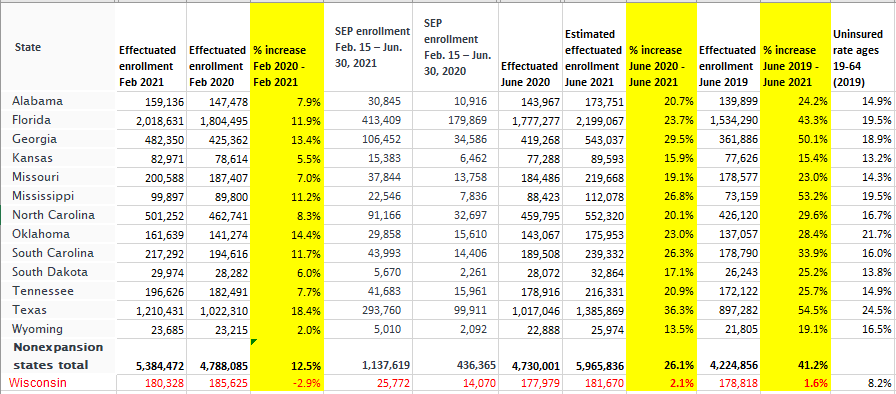
In Wisconsin, ACA marketplace enrollment as of June 30, 2021 had increased by less than two percentage since June 2019. In the other thirteen states that had not enacted the ACA Medicaid expansion as of June 30 of this year, enrollment increased by 41% over the same period.

What's the matter (or rather, what's right) with Wisconsin?

    Enrollment in nonexpansion states, 2019-2021

     Sources: CMS, Early Effectuated Enrollment Snapshot, 20202021SEP enrollment 7/14/21; KFF
     See the prior post for an explanation of how June 2021 enrollment is estimated.

A lot of factors affect marketplace enrollment, which varies widely by state. But the most salient factor would appear to be the fact that Wisconsin has no "coverage gap." 

Saturday, July 17, 2021

A huge increase in low-income ACA marketplace enrollment in nonexpansion states

Subscribe to xpostfactoid

This is a postscript to my last post tracking massive SEP enrollment in nonexpansion states from February 15-June 30 of this year.  

I want to try to take the full measure of the enrollment surge in nonexpansion states at the lowest subsidy-eligible income level -- first in Open Enrollment season for 2021, and then in the emergency Special Enrolment Period (SEP) launched by the Biden administration on Feb. 15. This week, CMS reported SEP enrollment through June 30.

(This post is all numbers; please see the last post (and its backlinks to past posts ) for context, definitions, explanations.)

By my estimate, enrollment at the 100-150% FPL income level in 13 nonexpansion states (Wisconsin excluded*) in OE 2021 and the SEP for the Feb. 15-June 30 period combined exceeded 2020 enrollment in those two periods by almost 800,000.  That would be an increase of about 29%.

Monday, June 28, 2021

Nudging people out of the coverage gap, cont.

Subscribe to xpostfactoid

In my last post, I noted that on May 5 CMS finalized a rule that patches a bit of the coverage gap afflicting low-income people in 13 remaining states that have refused to implement the ACA Medicaid expansion.

In those states, eligibility for ACA premium subsidies begins at incomes above 100% of the Federal Poverty Level (FPL). State residents with incomes below that threshold who do not qualify for Medicaid under the states' restrictive criteria get no government help to pay for coverage. Some 2 million adults are in this gap.

Sunday, April 11, 2021

In nonexpansion states, what percentage of near-poor adults (100-138% FPL) enroll in marketplace coverage?

Subscribe to xpostfactoid

Update, 5/4/21: New data via the CMS state-level public use files for 2021 shows that enrollment at 100-138% FPL in nonexpansion states increased dramatically in 2021. See this post for an update.

In a brief estimating how many people remain in the "coverage gap" -- uninsured poor adults in states that have refused to enact the ACA Medicaid expansion -- the Kaiser Family Foundation also sheds a sidelight on a question I've been pondering.

It's this: In nonexpansion states, what percentage of those in the 100-138% FPL income bracket, who would be eligible for Medicaid had their states enacted the expansion, enroll in the marketplace coverage that's available on relatively favorable terms?

In expansion states, eligibility for marketplace subsidies begins at 138% FPL; people below that income level are eligible for Medicaid. In nonexpansion states, marketplace subsidy eligibility begins at 100% FPL. People with incomes in the 100-138% FPL income range, who "should" be in Medicaid, can purchase a benchmark silver plan with strong Cost Sharing Reduction for 2% of income, or a maximum of $29 per month at the high end. The actuarial value of silver at that income level is 94%; the average deductible is around $200, and the average annual out-of-pocket maximum is about $1100.

Tuesday, March 31, 2020

CARES Act may reduce ACA "coverage gap" in states that refused Medicaid expansion

Subscribe to xpostfactoid via box at top right. You'll get 2-3 posts per week, mostly re ACA.

The enhanced unemployment benefits provided by the CARES Act, the emergency COVID-19 relief bill signed into law on March 27, count as income for those seeking subsidized health insurance in the ACA marketplace (the income does not count in consideration of Medicaid/CHIP eligibility).

As I noted last week, that's going to vastly reduce premium subsidies and likely wipe out Cost Sharing Reduction subsidies for many newly unemployed people who seek coverage.  On the plus side, however, the rush of temporary income should also narrow the "coverage gap" in states that have refused to enact the ACA Medicaid expansion, including Florida and Texas.