Showing posts with label HealthSherpa. Show all posts

Wednesday, July 10, 2024

Egregious fraud, quasi-fraud, and not-quite-fraud in ACA marketplace brokerage

Note: All xpostfactoid subscriptions are now through Substack alone (still free), though I will continue to cross-post on this site. If you're not subscribed, please visit xpostfactoid on Substack and sign up.

Do they print $6,400 bills?

The outbreak of large-scale agent fraud in the ACA marketplace, in which agents have switched marketplace enrollees from one plan to another without their authorization or in some cases their knowledge, or have newly enrolled people without their consent or knowledge, has agents and the trade groups that represent them up in arms. There are multiple good reasons for this: their clients are harmed (as the plans they think they’re enrolled in are cancelled), the integrity of the marketplace as a whole is compromised — and their own incomes are denuded, as their commissions are terminated in favor of a new agent of record.

Much of the unauthorized (or inadequately authorized) plan-switching and enrollment appears to be straight-out fraud, along the lines alleged in a putative class action (Conswallo Turner et al. v. Enhance Health, LLC et al.): Leads generated by ads that misrepresent marketplace premium subsidies as cash benefits, fed to agents in call centers who obtain the minimal personal information needed (name, D.O.B. and state*) to switch the enrollee’s plan (or newly enroll her) with a new agent listed as the Agent of Record, without the enrollee’s understanding or consent. (CMS requires agents to obtain consent before acting on an account, and recently clarified that mere check-box consent is “likely not be sufficient to meet…new requirements,” but that soft prohibition seems to have been honored largely in the breach.)

Egregious fraud is happening. But the ease with which agents can alter or create an account on an EDE and collect a commission, coupled with the millions of people eligible for multiple zero-premium plans, further coupled with ads that are misleading to varying degrees, suggests a broader gray area in which some agents may be misleading marketplace enrollees to varying degrees.

Tuesday, December 26, 2023

The commercial para-universe to the ACA exchanges keeps expanding

Note: All xpostfactoid subscriptions are now through Substack alone (still free), though I will continue to cross-post on this site. If you're not subscribed, please visit xpostfactoid on Substack and sign up!

Georgia looking peachy to web-brokers


More or less simultaneously with CMS’s announcement that 15.3 million people had enrolled in health plans via HealthCare.gov through December 15, HealthSherpa announced that 6.1 million of those enrollments were effected through its platform.

I’d like to revisit what that market share tells us about how people are getting coverage through the ACA marketplace today. For background, a couple of points from a recent post:

  • According to a CMS presentation to brokers, in HealthCare.gov states in 2023, 71% of active enrollees (new enrollees and active renewers) were assisted by brokers. 74% of new enrollees — 2.2 million out of 3.0 million — were broker-assisted. HealthCare.gov states accounted for 75% of total enrollment. In total, brokers enrolled 6.8 million of the 9.6 million who actively enrolled. (Of the 2.5 million who were passively re-enrolled, I don’t know how many were broker-assisted, initially, or in plan year 2023.)

  • In HealthCare.gov states, brokers rely heavily on commercial Direct Enrollment (DE) or Enhanced Direct Enrollment (EDE) platforms, which can process enrollments with subsidies (EDE directly; DE via a redirect to hc.gov for the application processing and then a return to the DE platform for plan selection). 81% of active broker-assistance enrollments are via DE or EDE, according to the CMS presentation. In 2023, more than half of enrollments on HealthCare.gov, excluding auto re-enrollments, were via DE/EDE (5.5 million). By my count of 62 EDE entities, thirteen are web brokers, the rest are insurers. The dominant EDE is HealthSherpa, which just announced that it has already processed 2 million enrollments for 2024. In 2023, HealthSherpa claimed to have accounted for 35% of HealthCare.gov state enrollments; the company seems on track to exceed that share this year.

HealthSherpa’s preferred metric for its market share in states using HealthCare.gov (the federal platform, used by 32 states) is its percentage of active enrollments -- that is, new enrollees and re-enrollees who update their accounts and make a deliberate choice of plan. Those who are passively auto re-enrolled are not credited to the platform that initially enrolled them. If OEP 2024’s auto re-enrollment percentage matches that of 2023, (21%), the 15.3 million enrollment total includes 3.2 million auto re-enrollees. That leaves HealthSherpa with just about a 50% share of active enrollment in HealthCare.gov states through December 15.

Friday, December 08, 2023

Still growing: OEP 2024 in the ACA marketplace

  Note: All xpostfactoid subscriptions are now through Substack alone (still free), though I will continue to cross-post on this site. If you're not subscribed, please visit xpostfactoid on Substack and sign up!


CMS’s Week 5 snapshot for the 2024 Open Enrollment Period (OEP) in the ACA marketplace shows 7.3 million active enrollments (new enrollments and active re-enrollments) — a stunning 39% year-over-year increase, according to Charles Gaba’s swift compilation. The snapshot is through December 2 for 32 states using HealthCare.gov and through November 25 for 19 state-based marketplaces (SBMs). New enrollment is up 44%, and active re-enrollment is up 37%, per Gaba. (Passive auto re-enrollment is reported at different times by different exchanges, and some SBM auto re-enrollment tallies are included separately in the snapshot.)

For the year-over year comparison, Gaba has helpfully adjusted for an extra day included in the 2023 Week 5 snapshot. His breakdowns for different state groupings — HealthCare.gov states vs. SBMs, and states that have enacted the ACA Medicaid expansion — are below, in simplified format, and followed by a few observations.

    OEP Week 5: 2023 vs. 2024


Monday, January 02, 2023

Looking Backward: 2023--2014 in the ACA marketplace

Dear xpostfactoid readers: All subscriptions are now through Substack alone (still free). I will continue to cross-post on this site, but I've cancelled the follow.it feed (it is an excellent free service, but Substack pulls in new subscribers). If you're not subscribed, please visit xpostfactoid on Substack and sign up!  


This morning I happened on a January 2014 post of mine that engaged the question of whether the ACA marketplace structure might foster productive state experimentation over time. Austin Frakt engaged the question and usefully compressed my forecast as follows:

First a ground pre-prepped for de facto compromise has been laid — in the state exchanges. […] [S]tarting in 2017, states can apply for waivers by submitting alternative plans that purport to meet the ACA’s coverage benchmarks (in 2011, Obama pronounced himself willing to move the waiver start date to 2014 []).  On the Medicaid front, the Obama administration has shown itself willing to accept a wide range [of] conservative experiment[s]; the same will doubtless prove true for the exchanges if any GOP-run states want to try.  The ACA might be viewed as a multi-state laboratory waiting to happen — with no need for knock-down-drag-out fights in Congress. Governors willing to deal in good faith can work quietly with HHS — or hand-in-glove, if a Republican becomes president in 2017.

It took a failed Republican repeal attempt and years of regulatory sabotage from the Trump administration to get us there (along with the 2017 start date for state "innovation waivers"), but we're at a point where state experiments are proliferating — in at least one blood-red state as well as in blue. Consider:

Tuesday, March 22, 2022

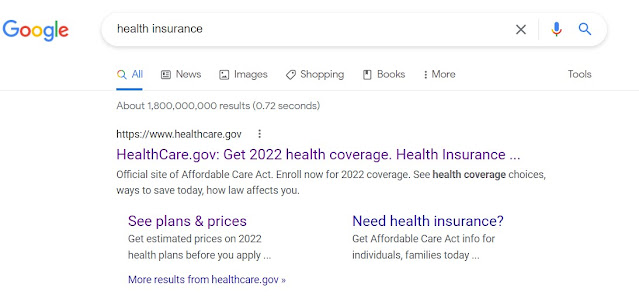
Good news alert: Web search for health insurance has been cleaned up

Subscribe (free) to xpostfactoid


ACA marketplace enrollment surged by 21% in 2022, from 12.0 million as of the end of the Open Enrollment Period for 2021 to 14.5 million in OEP 2022.  The primary cause was plainly the massive boosts to premium subsidies provided by the American Rescue Plan in March 2021 (witness the enrollment surge in the emergency Special Enrollment Period in effect when the boosted subsidies came into effect). Ramped-up federally funded enrollment assistance and advertising may also have helped.

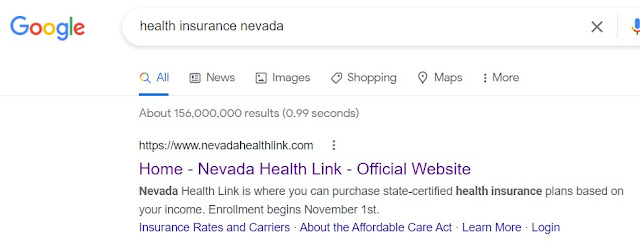
A less visible marketing measure may also have been a factor: the online search environment has been cleaned up.  Search today on Google for "health insurance" or "Obamacare" and HealthCare.gov, the federal exchange that serves 33 states, will top the search results. Search for "health insurance Nevada" and Nevada Health Link, the state-run ACA exchange, will be on top. The same is true for all of the 17 states (and D.C.) that run their own exchanges. There are some slight variations on Yahoo and Bing, but results there are also generally reliable. 


Friday, November 19, 2021

Signposting likely Medicaid eligibility without muddling the message

Subscribe to xpostfactoid

The Missouri Medicaid expansion  -- mandated by referendum, denied funding by the state legislature, and enacted only after the Missouri Supreme Court so ordered -- is off to a slow start, with the administration of Republican Governor Mike Parson declining to do much outreach. Enrollment of those rendered newly eligible by ACA expansion criteria began on October 1.

News of the slow start led me to check whether HealthCare.gov has been retooled to tell Missouri visitors who use the site's see plans and prices tool that they're likely eligible for Medicaid if they input an income below the eligibility threshold. HealthCare.gov is not the primary means by which people enroll in Medicaid, but it's a "no wrong door" channel.

Yes, HealthCare.gov has has been updated. That's not surprising -- it's had to absorb about a dozen late Medicaid expansions.  But the check underscored to me that messaging on the site for those likely eligible for Medicaid (in all expansion states) could be clearer.  

Here's what you see if you input an income below the eligibility threshold (here, $17,000 for a solo applicant in zip code 63111 in St. Louis): 

Tuesday, November 09, 2021

HealthSherpa shows how to shrink the coverage gap

Subscribe to xpostfactoid

As I have noted repeatedly (1, 2, 3) the ACA's notorious coverage gap -- the unavailability of subsidized insurance for adults with incomes below 100% FPL in states that have refused to enact the ACA Medicaid expansion -- is exacerbated by ignorance. 

Few low income applicants in the 11 remaining "gap" states* know that they must estimate a minimum income for the coming year to qualify for coverage. HealthCare.gov, the application venue for all applicants potentially subject to the gap, does not spell out in the application or in the plan preview tool that a minimum income is required. People who are told that they do not qualify for aid because their income is too low are rightly incredulous.

Since fall 2018, however (during Open Enrollment for 2019), HealthSherpa, a commercial online health insurance brokerage used by thousands of brokers, has spelled out that vital information. 

Wednesday, June 09, 2021

The second-biggest health insurance exchange in the U.S. is...

Subscribe to xpostfactoid

Almost from the (extremely rocky) inception of the ACA marketplace in fall 2013, CMS encouraged the development of commercial Direct Enrollment (DE) platforms. These were websites hosted by commercial brokers and health insurers themselves that could collect income and other eligibility data and send it to the federal exchange, HealthCare.gov, which would determine subsidy eligibility and then send the application back to the private platform for completion of the enrollment process.  During Open Enrollment for 2019, CMS began approving brokers for Enhanced Direct Enrollment, EDE, which enabled commercial brokers to complete the whole transaction. At present there are 43 approved EDE platforms interfacing with HealthCare.gov, mostly hosted by health insurers.

The Trump administration encouraged DEs and EDEs, in keeping with its general enthusiasm for commercial brokers and hostility toward the federally established nonprofit Navigator program, for which it gutted funding -- not to say the government-run exchanges.  EDE promotion also dovetailed with the Trump CMS's development of a parallel ACA-noncompliant market of medically underwritten, lightly regulated "short-term limited development" (STLD) plans (which the administration rendered neither short-term nor of limited duration unless state governments make them so). Brokers that deploy DEs or EDEs can sell and promote STLD plans, though not on the DE/EDE platform per se. Development of the DE/EDE program had begun in the Obama administration, however.

Tuesday, May 05, 2020

ACA enrollment in a pandemic: What we know so far

Subscribe to xpostfactoid via box at top right. You'll get 2-3 posts per week, mostly re ACA.

Roughly 30 million Americans have filed jobless claims in the last six weeks. Slightly fewer than half that number may have also lost health insurance, according to an analysis by the Economic Policy Institute.*

The Urban Institute estimates that 59% of those in industries most vulnerable to job loss who lose job-based coverage will have access to government-supported insurance -- Medicaid, CHIP, or the ACA marketplace. How many accept the help is a different question.

The SEP imperative

The answer may depend in part on how wide the ACA online exchanges open the door. Normally, the uninsured can seek coverage only during a limited Open Enrollment Period (Nov. 1 - Dec. 15 in the federal exchange, longer in the 13 state-based exchanges), unless a change in life circumstances during the off-season renders them newly eligible. In that case they are granted a Special Enrollment Period (SEP). Applying for a SEP adds steps to the already complicated ACA enrollment process. Under normal circumstances, an applicant has to upload or mail in proof of loss of coverage, or proof of another SEP trigger, such as marriage.

Friday, October 25, 2019

Oscar throws a wild card into the 2020 ACA marketplace

Subscribe to xpostfactoid via box at top right (requires only an email address; you'll get 2-3 emails per week on average)

Re the premise of my prior post -- that discounts in bronze and gold plans will be weaker in the 2020 ACA marketplace:  I've stumbled on a wild card, and it's pretty wild. Let's start where we did yesterday:
CMS has published ACA marketplace premiums for 2020.  The top-line news is that premiums have dropped 3-4%.  The key point for subsidized enrollees (69% of the ACA-compliant market) is that silver loading has gone into reverse -- and consequently there will be fewer discounted plans available. That's because benchmark silver plan premiums -- the second-cheapest silver plan in each market, which determines subsidy size -- have dropped more sharply (-4%)  than average premiums for the cheapest plan at each metal level (-3%).
Okay, so discounts stemming from silver loading* may be reduced on average, and in particular, discounts in cheapest silver may be the most impaired. Now for the wild card: Oscar is offering a $0 deductible bronze plan in Florida and Texas (and maybe elsewhere, but those two states account for a quarter of all ACA marketplace enrollment). In Miami, for a 40 year-old at an income of $17,300 -- about 140% FPL -- it's zero premium too; at $24,900 income (just below 200% FPL) it's $79/month.

Tuesday, April 19, 2016

What kinds of health plans are unsubsidized buyers choosing? A hint from HealthSherpa

Recently, I posted a series of comparisons of the health insurance obtained in the ACA marketplace by enrollees who were a) unsubsidized, b) subsidized, and c) heavily subsidized (i.e. with access to strong Cost Sharing Reduction (CSR) subsidies). In brief, the weighted average actuarial value of plans obtained by subsidized buyers was 81.4%, compared to 68.9% for the unsubsidized.  The perhaps more significant contrast was between those with incomes under 200% of the Federal Poverty Level, where CSR is strong, and everyone else. Average AV for buyers below 200% FPL was 86.3%. Subsidized buyers over 200% FPL obtained coverage only marginally richer than did unsubsidized buyers.

In that post I posited, tentatively, that the 1.4 million unsubsidized buyers who obtained plans on HealthCare.gov might stand in as a proxy for the estimated 9.6 million out-of-marketplace buyers of ACA-compliant plans.  While every buyer on HealthCare.gov and in the 12 state-run marketplaces is tabulated, the out-of-marketplace market is something of a black box.

Now I have a sliver of corroboration from HealthSherpa, a commercial online broker with a sleek interface and easy enrollment process. HealthSherpa is one of dozens of e-brokers authorized to process subsidized marketplace applications, which it does via a dedicated interface on HealthCare.gov (as do other brokers). According to co-founder Ning Liang, HealthSherpa has enrolled some 500,000 people in marketplace plans to date (since 2014). HealthSherpa sells in the 38 states using HealthCare.gov,and recently added  Liang sent me metal level selection data from the most recent 100,000 enrollees, all for 2016.

One surprise is that the vast majority of the 100,000, 88%, are subsidized enrollees. Finding one's way to HealthSherpa implies a certain degree of web savvy, and probably also relative youth, and most young enrollees are subsidy-eligible. So we are dealing with an unsubsidized sample of just 11,812, and all are buying plans available in the ACA marketplace, as opposed to ACA-compliant plans offered exclusively outside the marketplace.

All that said, the metal level selections of the HealthSherpa sample are pretty close to those of the unsubsidized HealthCare.gov enrollees. Here are the numbers for unsubsidized buyers from HealthSherpa:

Thursday, September 18, 2014

If you answer the first question wrong on healthcare.gov, no soup(sidy) for you

Back in April, when the ACA's extended open season was finally over, surveys conducted by McKinsey & Co. and PerryUndem (for EnrollAmerica) indicated that most of the still-uninsured were eligible for ACA subsidies (or Medicaid, in expansion states) but didn't know it. In fact, McKinsey found that two thirds of subsidy-eligible respondents who visited healthcare.gov but did not enroll were not aware of their eligibility -- and so had no idea how much health insurance would actually cost them.

I have an article up at The New Republic (my first there) examining why so many of the uninsured remain unaware of what the ACA has to offer them. In all fairness, the first answer must be that knowledge penetration takes time -- the CBO always projected a 3 to 4-year path to full takeup.

Friday, August 15, 2014

"What's a subsidy?" -- It's hard to reach the uninsured

Back in May, I noted a remarkable finding in a McKinsey survey of those who bought or sought health insurance in the individual market during the ACA's first open season:  Most of those who failed to obtain coverage were eligible for subsidies but did not know they were eligible. Two thirds of subsidy-eligible respondents who visited healthcare.gov but did not enroll were not aware of their eligibility -- and so had no idea how much health insurance would actually cost them.

Those findings are corroborated in a survey conducted at about the same time (April 10-28), commissioned by EnrollAmerica and conducted by PerryUndem Research/Communication. I just happened on this because HuffPost's Jeffrey Young cited the results in a story about the challenges of meeting signup targets in ACA year 2. Ignorance among the uninsured remains perhaps the greatest barrier (excepting the refusal of about half the states to accept the law's Medicaid expansion).

The EnrollAmerica survey drew responses from 671 new enrollees and 853 people who remained uninsured. 60% of those who remained uninsured said they wanted insurance. Only 21% of those who did not try to enroll knew that financial help was available to low-to-moderate income buyers -- and only 38% of those tried but failed to enroll were aware of this basic fact.

Perhaps even more remarkably, only 56% of those who did enroll in coverage knew that the law gives financial help to low- and moderate-income buyers. At the same time, 75% of enrollees, including 69% of those who enrolled online, said that the signup process was easy. Perhaps in this one regard it was a bit too easy, i.e., it was not hammered home that your friendly federal government was subsidizing your purchase.

Thursday, July 10, 2014

Bypassing healthcare.gov, revisited

Just a brief teaser here, as I work to finish a reported story about different approaches to improving the shopping experience at healthcare.gov and getting essential information to users.

I have caught up again with HealthSherpa, which began life as one of the first ACA comparison shopping sites to spring up while Healthcare.gov was dysfunctional last fall, then went on to become a licensed broker and go live last February as one of the first third-party sites to start enrolling people in subsidized ACA plans. As I reported at the time (or rather, added some explanation to an initial report by the Washington Post's Brian Fung), HHS licensed a number of brokers to develop "web-based entities" -- that is, their own dedicated interfaces on the government site -- and HealthSherpa did so.

Now, co-founder Ning Liang tells me that the company has completed almost 2,000 applications and  continues to streamline the process. Liang claims that a solo applicant can now complete an application in 3-5 minutes --  and a family plan applicant in 10-15 minutes.  HealthSherpa has made this possible partly by reducing the lag time following each completed question, and partly by eliminating redundancies. One key streamlining is that a user goes directly from the shop-around process, where one enters personal info and gets price quotes with plan summaries, to the application process, rather than starting over as on healthcare.gov. The info entered in the shop-around process is ported into the application process.

Monday, March 31, 2014

A correction in NYT ACA coverage

The New York Times has an excellent front-page story by Abby Goodnough today detailing the "blessings and hurdles" that various people seeking health insurance in Kentucky have encountered under the Affordable Care Act. A key point in one of the marquee narratives did not compute, however.

A certain David Elson, 60, was reported in today's print editions to earn $22k and be eligible for cost-sharing subsidies that would lower his deductible -- but also unable to pay his first monthly premium, reduced via a monthly subsidy of $250 to $350.  In fact, a 60 year-old nonsmoker anywhere in the country earning $22k should be able to access a silver plan for around $100 per month, with Cost Sharing Reduction (CSR) reducing the deductible to under $1000 per month.

Thursday, February 27, 2014

HealthSherpa claims to shorten ACA signup process, subsidy application included

HealthSherpa, one of the first ACA comparison shopping sites to spring up while Healthcare.gov was dysfunctional, has now gone live as an online broker selling the Qualified Health Plans (QHPs) offered on Healthcare.gov. Several hundred applications have already been initiated on HealthSherpa, according to co-founder Michael Wasser, who handles the site's day-to-day operations.

For those seeking only to comparison-shop for QHPs available given the shopper's location, household membership and income level, HealthSherpa offers a process slightly more streamlined than Healthcare.gov's "see plans before I apply" feature, which has been working quite well since late December.

More importantly, HealthSherpa now enables a shopper to initiate the buying process on its site.  And the company claims to have streamlined that process as well, even for customers who are applying for federal subsidies. The average customer, Wasser claims, "will save 20 minutes on an hour if they use Health Sherpa over Healthcare.gov."*

The Washington Post's Brian Fung reported the new functionality on 2/26. It was unclear to me, however, how HealthSherpa could streamline the subsidy application, since all ACA subsidy applications must still be processed through Healthcare.gov. Wasser explained that HealthSherpa has worked with HHS to develop its own dedicated interface on Healthcare.gov, to which a buyer starting at HealthSherpa is jumped. According to Wasser, 20-30 companies have arranged with HHS to establish such interfaces, called web-based entities, but HealthSherpa believes that theirs is the only one live at present.

Monday, November 25, 2013

Bypassing HealthCare.gov, cont

In prior posts, most recently here, I have explored the possibility that shoppers for health insurance on the ACA exchanges might bypass the still-balky HealthCare.gov with the help of information-only comparison sites ValuePenguin and HealthSherpa. Customers ineligible for a federal subsidy can already easily get all the information they need on these sites and then enroll directly with an insurer. For those whose incomes entitle them to subsidies, however, the subsidy application has been the roadblock, as it must be submitted directly to the federal government, either through HealthCare.gov or via phone or print application.

That may be about to change. Kaiser Health News' Julie Appleby reports, "Insurers and the Obama administration are testing fixes to healthcare.gov designed to allow insurers and web-based brokers to directly enroll consumers who qualify for subsidies under the health law."  It appears, though that the fixes require insurers themselves to route the customer's application through HealthCare.gov -- that is, in the 36 states that have forced the federal government to run their exchanges.  Direct insurer processing of the subsidy application is still only an ask:

Tuesday, November 19, 2013

Low-tech glitches on HealthCare.gov

I get that fixing HealthCare.gov dysfunction is a massively complex tech project.  But there are informational flaws on the site -- sins of omission and commission -- that would be easy to fix. I've encountered two.

For the first, call me stupid. There's a hole either in my tech savvy or my reading about ACA implementation -- or both.  But stupidity is rarely rare, and the designers of heatlhcare.gov should have anticipated my need for one really basic piece of information.

From October 1 to November 15, I tried to create a login at healthcare.gov at least 40 times.  For perhaps too long, I assumed that my failure was just the core failure of the site. Gradually, recently, it dawned that whatever the site's functional failures, most people by now could at least log in -- and were encountering further glitches when they tried to complete applications (see comments on this HHS posting). So I went on live chat and quickly learned the cause of failure: if you've blocked access to pop-ups, you have to turn off the pop-up blocker. I did so, and lo, my login is created.

Wednesday, November 13, 2013

Working around healthcare.gov: summary

To distill the takeaway from my last two posts (1, 2): anyone with computer access seeking to buy insurance on the ACA exchanges can easily get all the information they need to select a plan while bypassing healthcare.gov by visiting window-shopping sites ValuePenguin and HealthSherpa, as well as the individual insurers' sites once one has honed in on a single plan or a handful of top contenders.

Both sites prompt you for your location (zip code or state/county), the number and ages of people in your household, and your household income, and then give you specific quotes for all the exchange plans in your area. These quotes incorporate your subsidy if you qualify for one.  ValuePenguin provides plan details, and HealthSherpa provides contact information for each plan, including the identifying name of the plan in question. I appear to have gotten inaccurate price information in one location (Essex County, NJ) from HealthSherpa, but not from ValuePenguin, and the two provide identical price info at other locations I tested. The information on the two aggregator sites can in any case easily by checked against the insurers' own sites. The big insurers, if not all exchange participants, also offer subsidy calculators on their websites.

The catch is that as of now, the actual subsidy application has to be processed by the federal government, and the application process through the healthcare.gov website has proved broken for many if not most users (I have not been able to establish a login myself). You can, however, apply over the phone by calling the number listed at healthcare.gov and providing information orally, or you can ask the phone rep for a print application, which they'll mail. I reached a live person quickly, and he was ready to take a subsidy application from me, or so he said. Once you have an application case number, which can be sent by email if you apply over the phone, an insurer will let you apply for a specific plan, but you cannot seal the deal until the subsidy application comes through. 

The great unknown, I believe, is whether the federal government can process a phone or print application in reasonable time.  If so, the process need not be particularly onerous even if you cannot apply through the healthcare.gov site.

P.S. Healthcare.gov should be able to perform the ValuePenguin/HealthSherpa function even if you can't log in.  It does not provide age-specific price information, however -- at least, it hasn't in my three attempts. And it sends you to the Kaiser Family Foundation  for a subsidy calculator.  The Kaiser calculator is a great tool, and has been around for a while, but it doesn't provide plan-specific information.

Sunday, November 10, 2013

A private-market patch for the ACA?

About ten years ago, I used LendingTree.com to refinance my house. On the website, I punched in various vital statistics -- perhaps more than I'd be comfortable submitting today -- and, as advertised, received four bids from mortgagers.  Each sent offer details, I believe all by email.  Parsing the offers -- points, fees, etc. -- took some time, as with any comparison shopping for a financial product.  The small bank I went with gave me some heartburn by not approving the loan within the rate lock period, but they did extend that period, and I did get the loan at the advertised rate, within the estimated costs. It wasn't as easy as buying a camera on Amazon, but it was within reasonable expectation.

About seven years ago, I helped my older son, then 23, buy health insurance on New Jersey's bare-bones individual market exchange. There were basically three choices. AmeriHealth looked best, and they sent us a plan summary  -- I think three options at different price points.  We settled on not-terrible coverage -- at least, not terrible on paper, to my reasonably informed eye -- for about $180 a month.

Months ago, the Kaiser Family Foundation put up a provisional ACA cost calculator: punch in the number of people in your household, their ages, family income, and zip code, and get an estimate of the price of a silver or bronze plan, with and without the subsidy you qualify for, if any. It does not provide information for specific plans,however.

Now, it seems, there's a private-market, state-specific improvement, with pricing for actual plans and contact info for the insurers offering them:
I gave this a whirl, putting in my zip code, ages for my wife and me, and various income estimates. It works. There are no plan details (other than plan type -- HMO or EPO or POS), and I haven't called the insurers whose plans are quoted [update - see next post], but I would assume that they will send plan details if asked. [Update: per below, another site, ValuePenguin, appears to give more accurate price quotes, at least in New Jersey -- as well as plan details. Most insurers' websites do, too.]