Monday, February 27, 2023

A broker briefing on OEP 2023 in the ACA marketplace

Note: All xpostfactoid subscriptions are now through Substack alone (still free), though I will continue to cross-post on this site. If you're not subscribed, please visit xpostfactoid on Substack and sign up!   

ACA marketplace enrollment is up 13% nationally in 2023; 19% in the 33 states using the federal exchange, HealthCare.gov states; 23% in states that have not expanded Medicaid (all of which use HealthCare.gov), and 32% in Texas. Who’s buying in? In advance of the detailed enrollment data that CMS typically releases in spring, I spoke to health insurance brokers based in Texas and New Jersey.

High-income enrollees entering the marketplace

I touched base first with Dallas-area health insurance broker Jenny Hogue, president and CEO of KG Health Insurance, who had noted on Twitter in late 2021 that a number of higher-income people who had been priced out of the ACA marketplace before the American Rescue Plan Act removed the income cap on subsidy eligibility were buying in. Jenny’s perceptions were borne out by 2022 enrollment data, which showed enrollment at income over 400% FPL had more than doubled year-over-year in HealthCare.gov states, including Texas. I wanted to know if the surge was continuing this year.

Monday, February 13, 2023

Legislative and administrative love (and its opposite): Health Policy Valentines 2023

Note: All xpostfactoid subscriptions are now through Substack alone (still free), though I will continue to cross-post on this site. If you're not subscribed, please visit xpostfactoid on Substack and sign up!  


I can’t believe that this my tenth year offering up #HealthPolicyValentines — a tradition kicked off by Emma Sandoe, the country’s leading Medicaid enthusiast, in 2012, when she was a CMS spokesperson. Emma is now a Medicaid official in North Carolina, no doubt deeply invested in a not-so-funny legislative rom-com as the state House and Senate struggle to align not-quite-compatible bills to enact the ACA Medicaid expansion. The NC House may deliver the ultimate #HealthPolicyValentine this week, passing its expansion bill on V-Day itself.

I have no such substantive gifts to offer, but I can celebrate some goodies served up by legislators (federal and state) and administrators in the last year. Let the doggerel begin.

* * *

Roses are red,
Violets are blue.
I got no surprise bills
in 2022.

Roses are expensive,
Dandelions are free.
I'll get no surprise bills
in 2023.

In the U.S., alas,
there’s always an asterisk,
so an ambulance remains
a major financial risk.

* * *

Progress is fragile,
progress is slow,
but the uninsured rate’s
at an all-time low.

Alas, costs keep rising
so we needn't ask why
the underinsured rate's 
at an all-time high.

* * *

Congress showered cash
but states must play their part (um…)
to provide young moms and babes
a year’s coverage postpartum.

* * *

Love to CMS
for reducing the immensity
of Medicare Advantage
coding intensity.

* * *

Love (and its opposite) in the states

In New Mexico, for sure,
but I didn't expect this:
Strict silver loading
enacted in Texas.

* * *

Some states will be cruel,
some states will be kind
when the starting whistle blows
for the Medicaid unwind.

* * *

100% FPL
is the cruelest of gates,
but Obamacare's on fire
in nonexpansion states.

Perhaps those excluded
have grown sick of rejections
and learned to adjust
their income projections.

* * *

In our founding fathers’ house
there’ll be one more mansion
when NC enacts
the Medicaid expansion.

* * *

New Jersey got it done --
that is, built the apparatus
to cover kids regardless
of immigration status.

* * *

New York,
defrosting pork,
and seasoning it well,
will cook the Essential Plan
to 250 FPL

* * *

Glutton for punishment? Browse my Health Policy Valentines archives: Flowers in the graveyard (2022), Institutional edition (2021), But love grows old and waxes cold (2020), The Water is Wide: Health Policy Valentines (2019),  HPV (2018), Love Knows No Repeal (2017),  Love in the Time of Obamacare (2016), love, 2015, and Romance of the Rose, Health Policy Edition (2014).

Thursday, February 02, 2023

Why ACA marketplace enrollment surged at incomes above 400% FPL in 2022: A Houston illustration

Attention xpostfactoid readers: All subscriptions are now through Substack alone (still free). I will continue to cross-post on this site, but I've cancelled the follow.it feed (it is an excellent free service, but Substack pulls in new subscribers). If you're not subscribed, please visit xpostfactoid on Substack and sign up!  

In 2022, the first plan year in which the enhanced ACA marketplace subsidies created by the American Rescue Plan Act (ARPA) were available in the Open Enrollment Period, enrollment at incomes above 400% of the Federal Poverty Level more than doubled in the 33 states using HealthCare.gov. Pre-ARPA, enrollees with income above 400% FPL were ineligible for premium subsidies; ARPA removed that eligibility cap.

I have a post up at Healthinsurance.org that charts the enrollment increase at high incomes in HealthCare.gov states in 2022 and the ARPA impact on premiums at high incomes in Houston in 2023. Just to tease here, a couple of charts:

Saturday, January 28, 2023

How deep is public support for a broad public option in health insurance?

Attention xpostfactoid readers: All subscriptions are now through Substack alone (still free). I will continue to cross-post on this site, but I've cancelled the follow.it feed (it is an excellent free service, but Substack pulls in new subscribers). If you're not subscribed, please visit xpostfactoid on Substack and sign up!  

In polling about U.S. healthcare, the prospect of a “public option” for health insurance, open to all Americans regardless of whether they have access to employer-sponsored insurance, generally scores high. Here is the top-line response to a Kaiser Family Foundation tracking poll conducted in January 2020:

Looking beneath the hood of that apparent relative consensus, a research team led by Adrianna McIntyre of Harvard’s Chan School of Public Health conducted a poll in November/December 2020 that probed attitudes toward government that underlie responses to health reforms including a public option — specifically, a Medicare buy-in for people under age 65. The researchers published an analysis* in Milbank Quarterly this month. While top-line results were similar to KFF’s, the researchers note:

An overwhelming majority of Democrats (86%) report believing that it is the government’s responsibility to ensure universal health insurance coverage; only 11% of Republicans hold the same view. Most Democrats (71%) also report that they would prefer a health insurance system run mostly by the government, while a similar share of Republicans (78%) would prefer a system based mostly on private health insurance. Two-thirds of Democrats (67%) believe the federal government should be more involved in health care in the future, but over half of their Republican counterparts (56%) believe it should be less involved. Prior work has also found that while a large majority of Democrats (65%) believe the government would do a better job than private health insurance plans at reducing the nation’s health care costs, significantly fewer Republicans (25%) hold that view.

Friday, January 20, 2023

What's going on in the state-based marketplaces, cont.

Attention xpostfactoid readers: All subscriptions are now through Substack alone (still free). I will continue to cross-post on this site, but I've cancelled the follow.it feed (it is an excellent free service, but Substack pulls in new subscribers). If you're not subscribed, please visit xpostfactoid on Substack and sign up!  
------

My last post put a spotlight on lagging enrollment growth in the ACA’s 18 state-based marketplaces (SBMs). Enrollment in the SBMs appears on track to drop 2.8% year-over-year, from 2022 to 2023, while enrollment in the 33 states using HealthCare.gov (FFM states) looks to increase by 19.6%. While enrollment growth throughout the pandemic years has been concentrated in states that have refused to enact the ACA Medicaid expansion, enrollment in the 21 FFM states that have expanded Medicaid is up 10.3% year-over-year — perhaps the most pointed contrast with the SBM states. Longer term, while growth in the current SBEs is up 6.4% since 2020, the all-state increase during those pandemic years is 43.3%.

Let me say at the outset before diving in below that I think in my last post I may have got the emphases wrong, in that greater market penetration in SBM states in years prior to the pandemic may be a major factor. As of 2021, the uninsured rates in the SBM states were significantly lower, not only than in states that have not expanded Medicaid as you would expect, but also than in expansion FFM states. The same is true of the Kaiser Family Foundation’s estimates of the percentage of subsidy-eligible state residents who enrolled in marketplace coverage in each state in 2020. Moreover, in 2022, drops in the state unemployment rate were steeper on average in SBM states than in FFM states. That suggests a reduced pool of people needing marketplace coverage. On the other hand, UI rates remain higher on average in SBM states than in FFM states.

With the exception of Idaho, the states running their own SBMs are “blue” states that have invested considerable effort, and often state funds, in making their marketplaces as affordable and accessible as possible. They have variously implemented state-funded supplemental subsidies, individual mandates (requiring state residents to obtain insurance or pay a penalty), reinsurance programs, public option plans, standardized plans, active oversight of participating insurers, and strict silver loading (requiring insurers directly or indirectly, to price gold plans below or on par with silver) — not to mention the trouble and expense of launching and administering an exchange.

Conditions in every state are different, and the SBEs, as noted in the prior post, outperformed the HealthCare.gov states during the pre-pandemic Trump years and had proportionately smaller uninsured populations going into the pandemic. Nonetheless, the weaker enrollment growth over several years in the SBEs is worth scrutinizing. If it persists, state governments intent on improving their marketplac

Saturday, January 14, 2023

What's going on in the state-based marketplaces?

Attention xpostfactoid readers: All subscriptions are now through Substack alone (still free). I will continue to cross-post on this site, but I've cancelled the follow.it feed (it is an excellent free service, but Substack pulls in new subscribers). If you're not subscribed, please visit xpostfactoid on Substack and sign up!  

While enrollment in the ACA marketplace as a whole in the Open Enrollment Period for 2023 is on pace to finish about 13% higher than in OEP 2022, enrollment in the eighteen states that run state-based marketplaces (SBMs) is on course to come in about 3% below the OEP 2022 total.

As my last post emphasized, enrollment growth throughout the pandemic has been overwhelmingly concentrated in states that have refused to enact the ACA Medicaid expansion. In those states, about 40% of enrollees would be eligible for Medicaid if their states had enacted the expansion, and the American Rescue Plan Act made a benchmark silver plan free to almost all of them. As of this past week’s enrollment snapshot, enrollment in the twelve current nonexpansion states is up 23% year-over-year.

But enrollment in twenty-one expansion states that use the federal HealthCare.gov platform is also up by 10%. That throws the apparent enrollment decrease (barring last-minute surges or Week 9 reporting lags) in the SBMs into sharp relief and has marketplace watchers scratching their heads. (See the bottom of this post by Charles Gaba for breakouts of 2023 enrollment to date by exchange type.)

In fact, throughout the pandemic years, enrollment growth in the states currently running their own marketplaces has collectively lagged far behind growth in the overall market. Enrollment in these eighteen states is up 6% since OEP 2020, compared to 43% for the marketplace as a whole.

Wednesday, January 11, 2023

ACA marketplace enrollment in nonexpansion states is up 73% since 2020

Dear xpostfactoid readers: All subscriptions are now through Substack alone (still free). I will continue to cross-post on this site, but I've cancelled the follow.it feed (it is an excellent free service, but Substack pulls in new subscribers). If you're not subscribed, please visit xpostfactoid on Substack and sign up!  

CMS dropped its next-to-last snapshot of ACA marketplace enrollment for 2023 today. Enrollment remains on pace for a 13% year-over-year increase.

Charles Gaba has year-over-year breakouts for each state as well as for HealthCare.gov states, state-based exchanges (SBEs), and states that have refused to enact the ACA Medicaid expansion (or, in the case of South Dakota, not yet enacted an expansion that will kick off this summer). Salient facts among those breakouts:

I don’t think we’ve fully fathomed the enrollment growth in nonexpansion states during the pandemic years. Since the end of the Open Enrollment Period for 2020, which ended December 15, 2019 in HealthCare.gov states (e.g., in all nonexpansion states), enrollment in the twelve states that have not enacted the expansion to date has increased by 73%. By the end of Open Enrollment on January 15, the increase will probably top 75%. Florida and Texas alone have added more than 2.4 million enrollees in those three years. The twelve states together have added 3.6 million enrollees and account for 55% of enrollment nationally.

Monday, January 09, 2023

Evolving choice in the ACA marketplace

Dear xpostfactoid readers: All subscriptions are now through Substack alone (still free). I will continue to cross-post on this site, but I've cancelled the follow.it feed (it is an excellent free service, but Substack pulls in new subscribers). If you're not subscribed, please visit xpostfactoid on Substack and sign up! 

Over the years, I have devoted many posts to tracking the percentage of low-income ACA marketplace enrollees who avail themselves of the strong Cost Sharing Reduction (CSR) available with silver plans at incomes up to 200% FPL by choosing silver plans. TLDR: the percentage is high, but not high enough.

Since October 2017, I have also devoted many posts to tracking the effects of silver loading. In that month, recall, Trump cut off direct reimbursement of insurers for the value of CSR and thus ushered in silver loading era — that is, pricing the value of CSR directly into silver plans alone (since CSR is available only with silver plans), creating discounts in bronze and gold plans (see note at bottom*). Trends to watch have included

  • Silver plan selection at incomes above 200% FPL, where CSR is weak-to-nonexistent. TLDR: it fell off a cliff in 2018 and years following.

  • Gold plan selection at incomes above 200% FPL. TLDR: it’s far higher than pre-2018, but not high enough.

  • The relentless math that pushes most enrollees (including me) with income above 200% FPL into bronze plans (notwithstanding deductibles averaging more than $7,000), except in states where gold plans are priced below benchmark silver.

  • Gold plan selection at incomes over 200% FPL in states where gold plans are consistently available at premiums below that of the benchmark silver plan, either by state government design or through insurers’ pricing decisions. TLDR: Gold selection in those states very high, and roughly proportional to the degree of gold discount.

The broad parameters of rational choice in metal levels have been clear since 2018, and a majority of enrollees, albeit too small a majority, have hewn to them. Usually, the optimal choices are silver at incomes up to 200% FPL, bronze at incomes above 200% FPL, and gold where silver loading or insurer choice (often monopoly or dominant-insurer choice) make gold affordable. Two recent factors that have had an impact: 1) the American Rescue Plan Act’s subsidy boosts, which made silver an easier reach for some enrollees at all income levels, modestly boosting silver selection in 2022;  and 2) a growing trickle of states requiring insurers to price gold plans below benchmark.

Here is how metal level choice shook out in the 33 states using HealthCare.gov** (the federal exchange, as opposed to a state-based exchange) in 2022. For the first time, CMS in 2022 included income categories above 400% FPL, reflecting ARPA’s removal of the former 400% FPL income cap on subsidies. I have excluded enrollees with income below 100% FPL, where a relatively high percentage of unsubsidized enrollees somewhat scrambles choices. Those enrollees who did not report income are also excluded.

Monday, January 02, 2023

Looking Backward: 2023--2014 in the ACA marketplace

Dear xpostfactoid readers: All subscriptions are now through Substack alone (still free). I will continue to cross-post on this site, but I've cancelled the follow.it feed (it is an excellent free service, but Substack pulls in new subscribers). If you're not subscribed, please visit xpostfactoid on Substack and sign up!  


This morning I happened on a January 2014 post of mine that engaged the question of whether the ACA marketplace structure might foster productive state experimentation over time. Austin Frakt engaged the question and usefully compressed my forecast as follows:

First a ground pre-prepped for de facto compromise has been laid — in the state exchanges. […] [S]tarting in 2017, states can apply for waivers by submitting alternative plans that purport to meet the ACA’s coverage benchmarks (in 2011, Obama pronounced himself willing to move the waiver start date to 2014 []).  On the Medicaid front, the Obama administration has shown itself willing to accept a wide range [of] conservative experiment[s]; the same will doubtless prove true for the exchanges if any GOP-run states want to try.  The ACA might be viewed as a multi-state laboratory waiting to happen — with no need for knock-down-drag-out fights in Congress. Governors willing to deal in good faith can work quietly with HHS — or hand-in-glove, if a Republican becomes president in 2017.

It took a failed Republican repeal attempt and years of regulatory sabotage from the Trump administration to get us there (along with the 2017 start date for state "innovation waivers"), but we're at a point where state experiments are proliferating — in at least one blood-red state as well as in blue. Consider:

Friday, December 30, 2022

Healthcare access in the U.S.: 2022 in review

Dear xpostfactoid readers: All subscriptions are now through Substack alone (still free). I will continue to cross-post on this site, but I've cancelled the follow.it feed (it is an excellent free service, but Substack pulls in new subscribers). If you're not subscribed, please visit xpostfactoid on Substack and sign up! 

---

It's been a year of crosscurrents in the healthcare industry -- and of reporters exposing those crosscurrents, often with a ten- or twenty-year look-back. We have seen fantastic investigative reporting on hospitals unleashing hellhounds on indebted patients; hospital systems disinvesting in low income neighborhoods and shifting resources to wealthy ones; private equity degrading and pillaging selected healthcare industry segments (1, 2); hospitals prioritizing VIPs in the emergency room; and insurers finding synergies in what used to be conflicts. Provider consolidation continues apace; Medicare Advantage threatens to swallow fee-for-service Medicare, while its profit-maximizing methods are introduced into fee-for-service Medicare; and MA gaming of risk adjustment goes as yet unchecked, or rather inadequately checked. As for our response to Covid (oy), it’s not really my bailiwick, but see the note at bottom.

On the upside, the federal government got its first toehold in negotiating prescription drug prices; a national prohibition on most medical balance-billing went into effect; the FTC under Lina Khan challenged four hospital mergers; with federal prompting, the number of states providing or soon to provide a year of post-partum Medicaid enrollment rose to 34; CMS proposed a rule designed to smooth Medicaid enrollment on multiple fronts, including limiting renewals (and so, disenrollments) to once every twelve months; the ARPA boosts to ACA premium subsidies were extended through 2025, and marketplace enrollment is on track for a second consecutive year of double-digit growth; and the uninsured rate is at an all-time low (though threatened by the pending end of the moratorium on Medicaid disenrollments).

As in past years, xpostfactoid (and my writings elsewhere) focused mainly on the ACA marketplace, with some forays into Medicaid and Medicare, particularly on the causes and impact of Medicare Advantage’s accelerating gains in market share. As always, I closely examined ACA enrollment patterns, with special attention to the complexities that lead enrollees to suboptimal outcomes.

Below, a few posts from 2022 that went over biggest with…me. I’ve limited selections to the period before I ported xpostfactoid to Substack in late September, as the posts on that site are readily skimmed.

At The American Prospect
How the Texas Legislature Learned to Stop Worrying and Love the ACA Marketplace - 4/21/22
Ground zero for rooted reflexive hostility to the Affordable Care Act is Texas. Or was. While the state still wriggles, writhes and resists expanding Medicaid — which would cut its uninsured rate in half — this year the state legislature unanimously passed legislation that massively boosts subsidies in the ACA marketplace — with the cost borne entirely by the federal government. An amazing tale of bipartisan comity in…Texas.

At healthinsurance.org
Silver, Bronze, or Gold? Choosing a Metal Level in the ACA Marketplace - 4/25/22
The ACA marketplace purports to associate metal level with value. But Cost Sharing Reduction subsidies, which attach only to silver plans, make a hash of purported metal value. So, a guide to marketplace shopping in different income brackets. Relatedly…
Applying for ACA coverage? Know the ropes (between income levels) - 11/28/22
Understanding how small differences in projected income can have a large impact on your health plan costs can be key to obtaining affordable coverage.

At xpostfactoid 

In New Mexico, a Midas Touch has a double edge - 2/9/22
A look at the downside as well as the much bigger upside of a market in which gold plans are cheaper than silver.

In ACA marketplace in 2022, too much underinsurance (bronze plan selection) at low incomes - 3/23/22
In March 2022, the American Rescue Plan made silver plans with strong CSR free-to-low-cost at incomes up to 200% of the Federal Poverty Level. In 2022, too many low income enrollees bought bronze plans.

11 states where high-income marketplace enrollees went for cheap gold plans - 3/28/22
A look at markets where gold plans cost less than benchmark silver

The high-income surge in ACA marketplace enrollment - 4/7/22
ARPA’s removal of the income cap on ACA premium subsidies had its effect.

Is avoiding overpayment of Medicare Advantage plans beyond U.S. government capacity? - 6/3/22
A dive mainly into MedPAC complaints and proposals. See also “To whose advantage is Medicare Advantage? Parts 1 and 2 (here on Substack).

Average weighted actuarial value in the ACA marketplace - 7/20/22
It’s considerably lower than the average in employer-sponsored insurance, and down somewhat from 2016, thanks mainly to silver loading.

U.S. uninsured rate hits an all-time low - 8/3/22
I’d been expecting such a finding for about a year.

Democrats have twelve years of healthcare accomplishment to run on - 8/31/22
They do, really.
——

* Note: On the pandemic front, I am no expert, but I credit those who accuse the U.S. of having failed miserably to institute policies and messaging that would reduce Covid infections and fatalities, make resumption of normal activities safer, protect workers, and ease the stress on healthcare systems. Accordingly the U.S. has the highest Covid deaths per 100,000 ratio among peer nations. I lament failures to mandate paid sick leave and workplace safety measures; facilitate, incentivize, and in some cases mandate vaccine boosters; make rapid tests and N-95 masks widely available and free or close to free; institute widespread indoor air quality control; mandate indoor masking when cases spike; provide effective, unified, up-to-date public health messaging; and facilitate equitable global vaccine distribution. Above all, to my mind, the failure to appropriate fresh funds to fight Covid and prepare for future pandemics is unfathomable. You can blame Republicans for blocking requested funding, but neither Democrats in Congress nor the Biden administration fought hard enough to overcome resistance when they might.

On the plus side, legislation providing economic relief led to a near-miraculous economic recovery from the pandemic’s initial shock and prevented a surge in the uninsured rate. And the swift development of effective vaccines was miraculous. 

Wednesday, December 28, 2022

ACA marketplace enrollment may be up 45% in the pandemic era

Dear xpostfactoid readers: All subscriptions are now through Substack alone (still free). I will continue to cross-post on this site, but I've cancelled the follow.it feed (it is an excellent free service, but Substack pulls in new subscribers). If you're not subscribed, please visit xpostfactoid on Substack and sign up!


CMS announced yesterday that enrollment through December 15 in ACA marketplace plans on HealthCare.gov, the federal exchange serving 33 states, is up 18% year-over year. That’s on top of a 27% year-over-year increase in HealthCare.gov states last year.

Enrollment growth in the pandemic era has been slower in the 18 states (including D.C.) that run their own state-based exchanges (SBEs). Last year, SBE enrollment growth was about 8%, and the all-state total increase (HealthCare.gov + SBEs) was 21%. If the 18% growth rate for HealthCare.gov states holds through the end of the Open Enrollment Period, and the ratio of SBE growth to HealthCare.gov growth matches last year’s, then total enrollment growth as of the end of OEP 2023 will come in at about 13.7%.

That would peg total enrollment as of the end of OEP at about 16.5 million. Charles Gaba, who’s been tracking SBE enrollment tallies as they come in (they lag HealthCare.gov’s), projects a range of 16.4-16.9 million (plus 1.1 million in New York and Minnesota’s Basic Health Programs).

A few notes about this continued strong enrollment growth:

Friday, December 23, 2022

No Surprises Act at the (nearly) one-year mark: How are we doing?

Note to subscribers: My apologies for double-subscribing you for some weeks while I tested the Substack platform. Substack is working well -- it does seem to be pulling in new (free) subscribers -- and I think it's time to cut the cord here. I will continue to cross-post on this site but will end the follow.it subscription (though I do appreciate its quality free service, which stepped in the breach when Google discontinued RSS).  I hope you will subscribe on Substack (the subscription will remain free) if you're not already subscribed. If you like visiting this site on your own, posts here will continue. Thanks for continuing to read, wherever.


For several years, I was fond of affirming that “surprise” bills — bills sent to insured patients by out-of-network providers working at in-network facilities — were the one systemic healthcare abuse so egregious that even Americans would not tolerate it forever.

This time two years ago, after several false starts, Congress stepped up and managed to include the No Surprises Act (NSA) in a spending omnibus. The bill did ban most surprise billing for emergency care and for scheduled procedures at in-network facilities. The law went into effect on January 1, 2022.

The one major loophole was ground ambulances. 911 ambulance dispatch is still pot-luck: an out-of-network (OON) service may arrive, and may bill you for more than your insurer is willing to pay. But emergency care — and essential “post-stabilization care” — is covered, whether the hospital is in-network or not, or whether the providers who treat the patient are in-network or not. In scheduled procedures at an in-network facility, ancillary providers in a scheduled procedure — the anesthesiologist, the pathologist, the assistant surgeon — cannot surprise-bill the patient. Air ambulances — among the most frequent and expensive balance billers — are covered by the law.

Pre-NSA, surprise billing in the U.S. was prevalent enough to potentially undermine virtually any commercial insurance. According to Kaiser Family Foundation estimates, for people in large employer plans, 18% of all emergency visits and 16% of in-network hospital stays had at least one out-of-network charge associated with the care in 2017. In some facilities and regions, percentages were far higher; in some emergency departments, virtually every provider was OON. Whole business models, including in national private equity-owned ER practices, were based in large part on billing patients at up to 11 times Medicare rates. The major private equity players blocked passage of national balance billing protection at least once.

As the NSA approaches its first birthday, I wondered how the new protections are working. Short answer: there’s not yet much data. CMS has established a national hotline and online form to handle patient complaints but has not yet published any analysis of data collected through the complaint line. 


There is some evidence, though, of “surprises” that didn’t happen. A joint survey* of insurers by America’s Health Insurance Plans (AHIP) and the Blue Cross Blue Shield Association released this past November found that more than 9 million claims from providers were subject to the protections of the law — that is, could have triggered balance bills to patients, though presumably not all OON providers in all cases would have sent such bills. The AHIP release notes that each service or procedure was counted as a separate claim, and that a single visit might result in multiple claims (but also in multiple balance bills).

Early impressions

Karen Pollitz, director of the Kaiser Family Foundation’s Program on Patient and Consumer Protections, pointed out to me that oversight of the NSA is largely reliant on complaints. Pollitz said she had heard second-hand that initially, a lot of the complaints that CMS fielded through the national hotline were about billing problems not covered by the law (and lord knows there are many, such as hospitals relentlessly suing patients, garnishing wages and putting liens on houses in pursuit of unpaid bills). That is, callers knew that there was a new law that provided some protection against onerous medical bills, but were unclear as to what those protections entailed. In more recent months, Pollitz has heard, calls have been more on point.

She added, “I gather that most complaints have been referred to other agencies in cases where CMS doesn’t have direct enforcement authority. Complaints are referred to the Department of Labor if the problem is with an employer-sponsored health plan, or to states if the problem is with a provider and the state has stepped up and said it will handle enforcement of providers.” (States can undertake provider enforcement, share it with CMS, or cede it entirely to CMS. On the insurer side, DOL has oversight over self-funded health plans, which insure the majority of people with employer-sponsored insurance.)

Patricia Kelmar, senior director of health care campaigns for the Public Interest Research Group, noted that in just the first nine months of the law, 9 million surprise bills have been prevented. “That's great news to millions of families that don't have to pay a balance bill that they couldn't avoid. That's a lot of money that stays in patients pockets - at their most vulnerable time dealing with a health issue.” More broadly, “It’s always hard to measure something that didn’t happen” (as Pollitz also pointed out). Kelmar said, however, that TV reporters who used to regularly spotlight surprise bills are a good informal source, and one such reporter told her that “calls have totally dropped off.”

Kelmar said that there’s a long way to go in generating public awareness of the new protections. “Do people know they have these protections? If they do get an illegal bill, will they know where to get help? It’s a huge challenge, as medical bills are very complex. Consumers don’t want to open them because, first, they’re usually bad news, and second, they’re hard to understand. We need a clearer billing system in which consumers aren’t afraid to open their medical bills. And we need to be very clear that certain entities shouldn’t be sending bills.”

She added that “CMS is only just beginning its public education campaign. We all have a long way to go to really help consumers.” On that front, Pollitz said that a KFF survey conducted last spring found that three quarters of the public hadn’t heard of the No Surprises Act or knew very little about it.

Kelmar looks to insurers to help increase awareness. She suggests that the insurer’s Explanation of Benefits (EOB) should spell out: “We’ve received these claims from the hospital, applied your insurance, and this is what you owe. Don’t pay more than this.”

I asked why insurers would want to do this. Kelmar said the incentive is strong: “If insurers help patients to identify a surprise bill, they can say ‘Don’t blame us.’ People generally don’t like their insurers, but they can turn that around by helping them avoid surprise bills.” She added that the law helps create a system in which more providers will come in-network.

Most states have Consumer Assistance Programs (CAPs), initially funded with federal grants established by the Affordable Care Act, that field consumer complaints about medical billing. In New York, the CAP hotline is run by nonprofit Community Service Society. Elisabeth Benjamin, VP of health initiatives at CSS, told me that because of awareness generated by the No Surprises Act, “We’ve seen an increase in the number of surprise billing calls. There’s more general awareness around medical debt and billing practices. Also, higher and higher levels of cost-sharing.” Anecdotally, Benjamin said she’d heard that the insurance division of New York’s Department of Financial Services was also getting more calls than pre-NSA about medical billing.

The NSA in action

Health Law Advocates, a nonprofit, provides legal assistance to Massachusetts residents who have problems accessing healthcare or health insurance, or problems with medical bills. While Massachusetts has a balance-billing protection law that predates the ACA, Wells Wilkinson, a senior staff attorney at HLA, says that the NSA has helped in some circumstances where Massachusetts law doesn’t reach.

Wilkinson described one case in which a Massachusetts resident was injured while out of state and treated in a hospital emergency room. He was confronted with two kinds of bills: “One set where the health plan completely denied coverage and he was billed for 100% of charges, and another in which the plan made a payment, and the provider balance-billed for the entire remaining billed cost.”

The layered bills — the patient received four EOBs from his insurer — arose from layered treatment. Initially, the patient went to the ER and was given some scans, but sent home (to a vacation condo) because this was during the pandemic and the hospital did not have an orthopedist on staff. The hospital said they would call after the orthopedist looked at the scans. Next morning, they called and —importantly for insurance purposes — told the patient “you’re not safe to travel” and that he should come in for treatment. The patient then underwent surgery in that hospital. The ‘not safe to travel’ determination was important because under the NSA, OON protections apply as long as ER treatment is necessary to stabilize the patient. If the patient can safely be transported to an in-network facility after stabilization, the protections no longer apply from that point on.

While the reason for the insurer’s 100% denial of what was clearly an emergency service remains inscrutable, Wilkinson says, “We were able to work with the health plan and get all costs eliminated except for small amounts of cost sharing. We also worked with the providers to notify them that they’re not allowed to balance bill for these types of emergency services.” Armed with legal assistance, this patient achieved an independent resolution without recourse to a filed complaint.

That choice underscores a dilemma, however, according to Wilkinson: “Get help from a regulator or try an appeal to the insurer first? One danger in reaching out for assistance: you might miss the insurer’s appeal deadline.”

Gaps and complications

Everyone I spoke to highlighted gaps** in the NSA’s protections — though with an implicit understanding that U.S. healthcare law and billing practices are byzantine and that the law takes a major bite out of patient exposures.

Benjamin at CSS noted that one common complaint that escapes the law’s protections is spurred by a doctor’s office erroneously telling the patient they’re in-network. Often this is a matter of imprecision — “The patient is told ‘we take Blue Cross,' but in fact the office doesn’t take the patient’s particular plan.”

More generally, imprecision with regard to network inclusion is a perpetual and multi-front problem. The PIRG consumer guide to NSA protections warns:

Ask: “Are you part of my plan’s network?”

Do not ask: “Do you take my insurance?”

Sometimes a provider says it will “take” your insurance but it is not in your insurance plan’s network. What the provider means is that it will send the bill to your insurance plan for you but will still charge you an out-of-network rate.

Pollitz at KFF worries about the allowances for OON billing for scheduled procedures, noting that those procedures may be diagnosed while a patient is in the hospital, under circumstances in which it’s difficult to refuse care or seek to ensure that care comes from in-network providers.

“The law says that you can be asked by an OON provider to waive your rights up to 72 hours in advance of scheduling a service. Or, if a service is scheduled less than 72 hours in advance, you have to be given notice — a paper to sign away your rights — no less than three hours in advance.”

“So let’s say you’re in the hospital and the attending doctor decides that morning that you should have an endoscopy — and by the way, the doctor performing the endoscopy is out-of-network.” Should you sign off? How many people will ask for an in-network endoscopist?

Financial pathologies with pathologists

Aside from failure to cover ground ambulances, perhaps the NSA’s largest gap is between the doctor’s office and the lab. While a patient is protected from surprise bills if a healthcare facility —e.g., a hospital, satellite emergency department, or ambulatory care facility — sends blood samples or other test data to an OON provider, there is no such protection if a doctor’s office does so.

I spoke to a cancer patient whose oncologist recently sent her blood sample out for genomic testing without her knowledge. She received an EOB stating that the genomic testing lab was OON and that she would be responsible for the full $5,800 charge. She has not yet been billed. The lab has since asked her permission to file an appeal to her insurer.

Prior to NSA passage, the patient underwent a bone marrow biopsy that was also processed by an OON provider. Her doctor said that the lab in question was the only one he knew of that performed that kind of test at all.

* * *

The NSA should cut the heart out of balance billing practices that not that long ago were endemic in the United States. Most of those who benefit from the law may never know it, as is often the case with good legislation. In early days at least, those who might benefit from it when its provisions are violated may not know to avail themselves of its protections. Over time, the steep fines that attach to violations — $10,000 per episode — should make compliance a norm. We might hope too that in coming years, gaps in the NSA’s protections will be filled.

Americans remain exposed to out-of-pocket healthcare costs that are almost inconceivable in other wealthy countries. But via the NSA, one major and sometimes all-but-unlimited source of financial exposure should be reduced to a shadow of its former self.

- - - - -

* The AHIP/BCBS survey also found that OON bills have submitted for arbitration are far in excess of the level predicted by federal agencies: 90,000 disputes were initiated bay September 30, whereas 17,000 had been predicted for the full year. Given the political clout of hospitals and physician groups, the bill was surprisingly tough on providers in its ground rules for arbitration that OON providers can initiate when they consider the payment offered by the patient’s insurer inadequate. The law emphasizes the “median contracted rate” — the average paid by insurers for the procedure in question in the region in question — as a factor for arbitrators to consider. Lawmakers apparently took to heart studies showing that arbitration rules established by states such as New York and New Jersey that gave more weight to the rates OON providers billed defenseless patients — their “usual and customary charges” led to arbitration awards of payment average about ten times Medicare payment rates. Federal rulemaking centered the median contracted rate more more aggressively, making it a benchmark to be set aside only when other factors offer a compelling case to set it aside. Providers have waged multiple court challenges, and in February 2022, in Texas Medical Association v. U.S. Department of Health and Human Services, et al., a Texas court struck down the rule’s presumptive reliance on the median contracted rate. An amended final rule issued this summer does not privilege the median contracted rate to the same extent as the prior iteration, but retains it as a default standard unless the physician submits factors the median contracted rate does not account for. More court challenges from providers’ groups are in the offing. While the outcomes may have a major effect on healthcare pricing, in this post I wanted to focus on the law’s effect on consumers.

** Last year, I flagged another potential problem with the NSA’s OON protections: In a tiered network, at what level is an OON facility covered?

Photo by A Koolshooter 

Sunday, December 18, 2022

In Washington State, a public option may get some traction

Cascade Care flowing more freely

When considering how states might improve their ACA marketplaces, it’s often struck me that Massachusetts’ ConnectorCare program, which predates the ACA, would be difficult for another state to replicate. That’s too bad, because ConnectorCare offers simpler and better coverage to enrollees with incomes up to 300% of the Federal Poverty Level than does a conventional ACA marketplace. (At incomes above 300% FPL, the Massachusetts marketplace conforms to ACA design.)

Washington state, however, is tacking toward a marketplace that shares some features with ConnectorCare: partial plan standardization, wraparound subsidies offered at low incomes, and a measure of state-imposed cost control. For 2023, those features may be starting to jell.

Wednesday, December 14, 2022

CMS moves to ease choice overload in the ACA marketplace

Meaningful difference?

In its proposed annual set of rule adjustments* for the ACA marketplace for 2024 released yesterday, CMS proposes strong action against one of the marketplace’s most counterproductive current features — the proliferation of plan offerings insurer with all-but-invisible differences between plans.

In many ACA markets, several insurers “spam” the marketplace, as Duke health insurance scholar David Anderson puts it, in this way. In such markets, picking a plan that will minimize your medical expenditures is like trying to pick the most cost-effective choice in your supermarket’s toilet paper aisle.

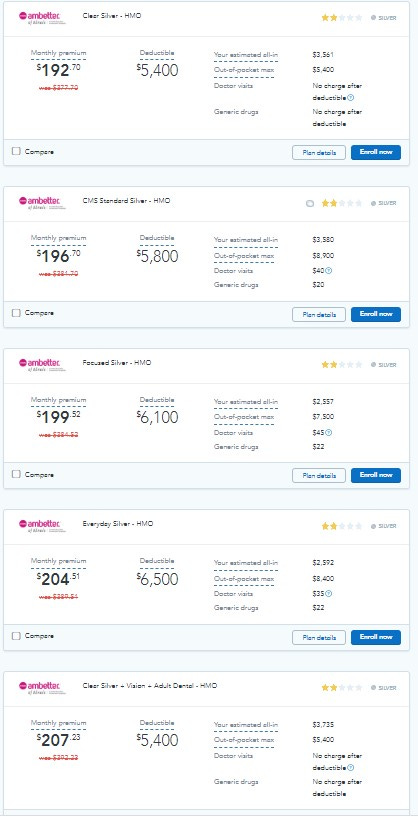
Here, for example, are the five cheapest Ambetter silver plans available in Chicago. (Quoted premiums** are for a single 40 year-old with an annual income of $40,000.)


Subscribe now

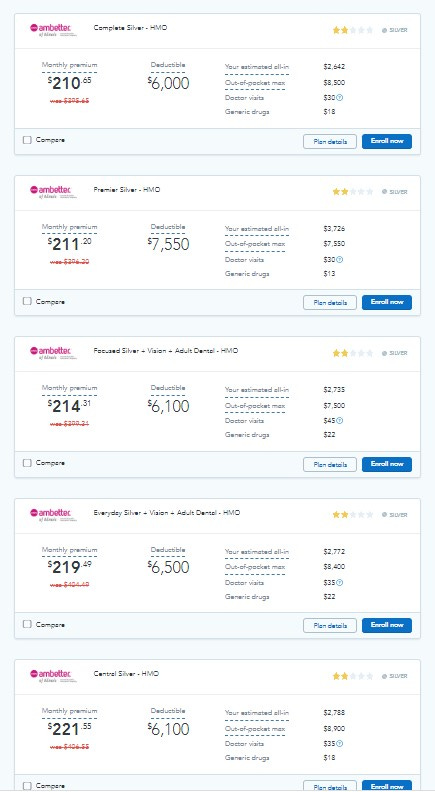
Here are the next five.

I will spare you the next five. That’s right — Ambetter has put up 15 silver plans in the Chicago marketplace.

As a rule, the cheapest insurers offering the narrowest networks are major offenders on this front. (Almost no major hospitals are in-network in Ambetter’s Chicago plans.) In many markets, their near-clone offerings render competitors’ products nearly invisible at the lowest price points. (That’s not quite the case here, as Oscar’s 12 silver plans and BCBS’s seven are interspersed with Ambetter’s at low price points.)

In the 33 states that use the federal exchange, HealthCare.gov, as well as in eleven of the 18 state-based marketplaces, plans with a standardized benefit structure — the same deductibles, copays, annual maximum out-of-pocket limits (MOOP) and services not subject to the deductible — are available at each metal level. Squint at the offerings displayed above and you’ll see that the second one is marked “standard.” But standard plans swim in a sea of non-standard competitors. While their benefit design may be optimal for average (not all!) applicants, they have nothing obvious to recommend them — not the lowest premiums, nor deductibles, nor MOOPs, nor standard copays.

With 137 plans on offer, Chicago is not the most chaotic marketplace in the country. In fact, it’s not too far off average. The average number of plans available to marketplace applicants in 2023 is 114, up from 26 in 2019, as CMS notes in its proposal to reduce this riot of unmeaningful choice. In Miami, the nation’s largest ACA marketplace, 224 plans are on offer.

How was this mass spamming of the marketplace allowed to metastasize? In 2015, CMS established a standard to ensure that that plans offered by the same insurer be “meaningfully” different. But the standard was toothless, as Anderson points out, and in advance of the plan year for 2019 the Trump administration’s CMS administrator, Seema Verma, did away with it entirely. The primary rationale, according to CMS’s account in this year’s proposed rule (pg. 230 here), was that the number of insurers participating in the exchange had shrunk in the Trump years (there was real anxiety about the possibility of “bare” rating areas where no insurers would participate). But it also reflected Verma’s was ideological commitment to proliferating choice in every health insurance market (including the choice of medically underwritten, lightly regulated, ACA-noncompliant plans).

While markets had indeed contracted after major premium spikes in 2017 and 2018 (the latter triggered by Republicans’ threatened repeal and the Trump administrtion’s regulatory assault on the marketplace), from 2019 forward ACA markets first stabilized and then expanded, with insurers returning to the marketplace and entering new states. The Biden administration has not reinstated (let alone strengthened) meaningful difference regulations — until now.

For 2024, CMS proposes to take a path forged by some state marketplaces and limit the number of nonstandard plans an insurer can offer in a given market. Specifically, the proposal (as summarized on this fact sheet) is

to limit the number of non-standardized plan options that issuers of QHPs can offer through Marketplaces on the Federal platform (including SBM-FPs) to two non-standardized plan options per product network type and metal level (excluding catastrophic plans), in any service area, for PY2024 and beyond, as a condition of QHP certification.

Theoretically, if an insurer offered three network types (HMO, EPO, PPO) at four metal levels, it could still offer 36 plans in one market. But that will not happen. PPO plans are rare in the marketplace, as are platinum plans. Note in the display above that Ambetter (a Centene brand), probably the most prolific spammer in the country, offers only HMO plans. In fact this regulation, if implemented as proposed, may increase meaningful difference among plans, as insurers seeking to differentiate themselves may be moved to vary their network types.

At present this rule is only “proposed.,” and so subject to a comment period, response, and possible revision or withdrawal. As an alternative, CMS floats a “meaningful difference” standard stronger than the previous one but less restrictive than the main proposal: Requiring that the deductibles offered by one insurer in a given metal level and network type vary by at least $1,000. That’s presumably harder to do than, say, offer a $20 copay for a primary care visit and $10 charge for generic drugs in one plan versus a $25 PCP visit and $5 generic drug charge in an alternative.

The primary proposal would require a major change in business model for some of the largest marketplace insurers — and, I think, a much improved choice architecture for prospective applicants. Here’s hoping that CMS follows through.

Update, 12/14/22: Over on Mastodon, David Anderson warns that considerably more than three network variations per insurer per metal level are conceivably allowable (and in the same exchange, Louise Norris points out that POS (Point of Service) networks are another network type). Putting up multiple networks, however, is much harder (and more substantive) than fine-slicing the odd co-pay to field a new plan. I would speculate, too, that incentivizing insurers to offer more PPOs might in fact be beneficial. Meanwhile, Charles Gaba, also surveying this proposed rule change, deploys the cultural reference that inevitably comes to mind when surveying the proliferation of plans: Robin Williams freaking out in the coffee aisle in Moscow on the Hudson. That’s more fun than my Honey Crisp-to-Mackintosh contrast. Charles also provides useful backstory on meaningful difference regulation, or the lack thereof.

- - -

* The annual rule updates are known as the Notice of Benefit and Payment Parameters. The full proposed rule for 2024 is available here.

** The display is from HealthSherpa, a commercial Direct Enrollment broker that displays all plans in all markets that use HealthCare.gov. 

Saturday, December 10, 2022

Do we want hospitals and doctors to take on risk?

See also on Substack

Getting incentives right is always hard


Merrill Goozner, the former editor of Modern Healthcare, has posted a three-part series surveying twelve years of healthcare payment reform projects seeded by the Affordable Care Act and overseen by the federal Center for Medicare and Medicaid Innovation (CMMI). Part 2 focuses on the one notable success among those projects: The welding in 2014 of Maryland’s state-wide all-payer system to a global budget for each hospital that rises slightly below the inflation rate annually. In 2019 the state further expanded the global budget sphere with a Total Cost of Care Model, which sets a per capita limit on Medicare total cost of care in Maryland and provides incentives for hospitals and doctors to coordinate care, reduce hospitalization rates and meet other quality measures.


Goozner notes that according to CMS analysis, “In the eight years since Maryland began global budgeting, the program has saved the federal government well over $1 billion compared to Medicare spending in other states.”


In Part 3, Goozner leans into the premise that not only uniform payment rates and global budgets are essential to effective healthcare cost control, but also “convincing providers to take on risk is key.” That is, providers must be on the hook if per-patient costs exceed targets.


I have a question about that.