Friday, July 22, 2022

A Midas touch on New Mexico's ACA exchange, revisited

Subscribe (free) to xpostfactoid

Kudos to health insurance analyst and advocate Stan Dorn and actuary Greg Fann for selling the New Mexico Office of the Superintendent of Insurance on strict silver loading in advance of Open Enrollment for 2022.   

In brief, the Superintendent required marketplace insurers to price silver plans on a par with platinum, since silver plans, thanks to Cost Sharing Reduction (CSR) subsidies, do have platinum-equivalent actuarial value for enrollees with incomes up to 200% FPL. The directive is meant to be a self-fulfilling prophecy: if gold plans are cheaper than silver plans -- and in New Mexico in 2022, gold plans were 10% cheaper on average -- no one with income over 200% FPL should buy silver plans, which have a lower AV than gold plans. In that case, the average AV for silver plan enrollees will indeed be platinum equivalent. 

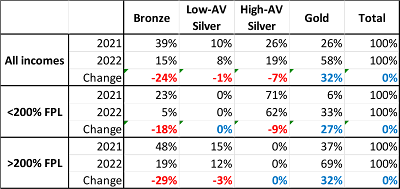
New Mexico didn't quite get there, but came close. In Health Affairs this week, Stan Dorn analyzed the results, spotlighting a massive decrease in enrollment in bronze plans, which have deductibles averaging more than $7,000:

Dorn argues forcefully that New Mexico's pricing directive should be adopted nationally, explaining in detail the flaws in CMS's risk adjustment formula for marketplace plans that favors silver plans, incentivizing insurers to underprice them, and urging a fix.

All that said, while metal level selection at incomes above 200% FPL in New Mexico is an unbridled triumph, there's a caveat to the drop in bronze plan enrollment at incomes below 200% FPL (the middle row above).  Bronze plan takeup at low incomes would have dropped significantly in any case -- and did drop nationally -- because the Open Enrollment Period for 2022 was the first (and possibly the only) OEP in which the premium subsidy enhancements provided by the American Rescue Plan were in effect. Those subsidy boosts made benchmark silver coverage free at incomes up to 150% FPL and available for 0-2% of income for enrollees in the 150-200% FPL range. In HealthCare.gov states, bronze plan selection dropped by 2 percentage points in the 100-150% FPL income range and by 8 percentage points at 150-200% FPL from OEP 2021 to OEP 2022. 

The bronze selection decrease at low incomes in New Mexico was much sharper. But far too many enrollees at income below 200% FPL switched into gold plans rather than silver, which have far lower out-of-pocket costs than gold plans at incomes below 200% FPL.  This is no knock on New Mexico pricing practices, but rather on presentation flaws on the newly minted state exchange, BeWellNM.  The New Mexico exchange does not emphasize the availability of CSR at low incomes. The display, uniquely among ACA exchanges, buries the annual out-of-pocket maximum for each plan (you have to go two clicks in from the top-line display for each plan to find the OOP max) -- and OOP max is where the silver advantage is sharpest, topping out at $2,900 for high-CSR silver compared to $8,700 for gold. 

Worst, the site has a malfunctioning total cost estimation tool, which apparently uses the unsubsidized premium to estimate "costs in a bad year," completely obscuring silver plans OOP max advantage.  (I described these flaws and their effects, with screenshots, in this post.)

The result: silver plan selection at incomes below 200% FPL was just 62% in New Mexico in 2022, compared to 81.5% nationally and 80% in the thirteen state-based exchanges that enroll people with incomes under 200% FPL and provide metal level choices broken out by income. (Those totals are based on my calculations from CMS's Public Use Files and omit the 1.6% of enrollees with income below 100% FPL). 

The 5% bronze selection in New Mexico at incomes below 200% FPL is a sterling accomplishment. But most of the 33% of enrollees in that income bracket who selected gold plans should be in silver. For some, getting a cheaper gold plan from a desired insurer might be worth the extra out-of-pocket exposure, which might be in the $5,000-6,000 range (as discussed here). But most would be better off in silver.

ACA metal level structure is confusing, as bronze, gold and platinum actuarial value is fixed at all incomes whereas as silver plans come with no less than four different AVs, depending on income.  The fact that silver plans can be worth more than gold -- as they are for slightly more than half of marketplace enrollees -- is deeply counterintuitive. Display matters. For enrollees with income under 200% FPL, silver plans should be displayed at the top of results. OOP maxes should always be clearly visible, and defined via mouseover. The availability of CSR and its impact should be heavily signposted. 

Gold plans should be consistently cheaper than silver plans nationally, as Dorn argues (and as David Anderson and I have also done). If metal levels are priced as in New Mexico, plans with an AV of at least 80% (gold) should be available at a premium at or below the benchmark against which subsidies are set. To maximize the value available, however, decision support on most exchanges also needs to be improved.

Update from Stan Dorn (click through for essential gif):

Replying to
...In yet another brilliant, creative NM policy innovation, they are labeling all high-AV products as “turquoise,” a favorite NM color that will easily signal the highest value options for each consumer

Subscribe (free) to xpostfactoid

Wednesday, July 20, 2022

Average weighted actuarial value in the ACA marketplace: about 77%

Subscribe (free) to xpostfactoid

How much exposure to out-of-pocket costs are ACA marketplace enrollees subject to, compared, say, to enrollees in employer-sponsored plans?

Exposure varies widely, according to income and metal level choice. The deductible for a marketplace enrollee with household income below 150% of the Federal Poverty Level ($19,320 for a single person) who selects a silver plan is likely to be zero (the median) or under $150 (the average), with an annual out-of-pocket maximum averaging about $1,200. For a single person with an income just over 250% FPL ($32,201), that silver plan will carry an average deductible over $4,700 (though many services, including doctor visits may not be subject to it) and an out-of-pocket max likely over $8,000. For a bronze plan enrollee at any income level, the deductible will probably top $7,000, with an out-of-pocket max near the highest allowable, $8,700.

What about actuarial value -- the percentage of the average enrollee's costs the plan is designed to cover? In employer-sponsored plans, AV averages 85-86%, according to the Kaiser Family Foundation. In the ACA marketplace, according to my calculations below, the average AV obtained by 2022 enrollees in 2022 was 77.4%. Marketplace AV ranges from 94% for silver plan enrollees in the lowest income category to 60% for bronze plans (and about 57% for the 0.6% of enrollees who select catastrophic plans, for which subsidies are not available).

Tuesday, July 12, 2022

How prevalent is underinsurance among ACA beneficiaries?

Subscribe (free) to xpostfactoid

Big rain, small umbrella


In a New York Times op-ed Aaron Carroll, a physician and highly reliable assessor of data (his Bad Food Bible sifts expertly through a lot of bullshit in dietary research) makes two incontrovertible points about U.S. healthcare:

1. Americans are burdened with uniquely high out-of-pocket costs that induce us to forego need as well as unneeded care.

2. The ACA partly replicated this gaping flaw in our healthcare system, inflicting ridiculously high deductibles and out-of-pocket maximums on a significant number of marketplace enrollees.

But the argument includes what I regard as a slight (and common) distortion of emphasis in his overview of marketplace enrollees' high out-of-pocket costs: 

The average deductible on a silver-level plan on the A.C.A. exchanges rose to $4,500 in 2021. If people tried to buy plans with a lower premium, at a bronze level, the average deductible rose to more than $6,000. Granted, some cost-sharing reductions are available for those who make less than 250 percent of the federal poverty line, but even after accounting for those, the average deductible was more than $3,100 for silver plans.

Monday, July 11, 2022

New Jersey enacts an easy enrollment program for the uninsured

Subscribe (free) to xpostfactoid

New Jersey Governor Phil Murphy today signed a bill  (A674/S1646) establishing an "easy enrollment" program for health insurance, the New Jersey Department of Banking and Insurance announced this afternoon (a press release just arrived by email; I can't find it online yet). Update! - here it is.

Maryland pioneered "check the box" programs like this, in which the state prompts uninsured residents to indicate an interest in getting insured and provides help (to the extent creaky state bureaucracies can manage it) with getting an application started. Here is the guts of the initiative in New Jersey:

Through this program, uninsured and underinsured residents can indicate their interest in coverage for themselves or a household member on their tax return or through unemployment insurance benefit claims, which will be shared with the New Jersey Department of Banking and Insurance.    

As required by the legislation, the department will create a system to analyze the data collected through tax returns and unemployment benefit claims to determine a resident’s eligibility for health insurance coverage and ability to receive financial help through Get Covered New Jersey and proactively connect with qualifying residents to help them enroll. The law also permits the department to work with the Department of Human Services to determine an individual’s eligibility for NJ FamilyCare and share data with the agency for that assessment.       

Several things to note here. First, the prompt to seek health insurance will appear not only on the tax return but on an unemployment benefit claim. The latter is very important, as it comes at a moment when the applicant's income has dropped dramatically, qualifying many for Medicaid. In states that have enacted the ACA Medicaid expansion (e.g., New Jersey), eligibility is based on monthly income (currently $1563 for an individual, $3,191 for a family of four). During the pandemic, Kentucky had the Dept. of uninsurance pass applicant data to the state Medicaid agency, helping to drive a 14% increase in Medicaid enrollment from February to July 2020.

Second, the department collecting the data will share the data with the Dept. of Banking and Insurance, which runs the state ACA exchange (GetCoveredNJ), and with the Dept. of Human Services, which runs NJ FamilyCare, the state Medicaid program. The departments can determine eligibility for NJ FamilyCare or for subsidized marketplace coverage, if the enrollee gives permission for the various departments to share information. The bill statement emphasizes interagency coordination:

The bill requires the Commissioner of Banking and Insurance, in coordination with the Commissioner of Human Services, the Commissioner of Labor and Workforce Development, and the State Treasurer to develop and implement systems, policies, and practices that encourage, facilitate, and streamline determination of eligibility for insurance affordability assistance and enrollment in minimum essential coverage to achieve the purposes of the program.

Finally, because New Jersey (unlike Maryland) is one of a handful of states that implemented a state individual mandate to obtain insurance after the federal mandate penalty was zeroed out, the uninsured tax filer has a strong incentive to check the box, as obtaining insurance will get the penalty for going uninsured waived. For most respondents, obtaining coverage should be either free or very low-cost. In New Jersey's ACA marketplace, supplemental state subsidies, in concert with the major federal boosts to marketplace subsidies provided by the American Rescue Plan Act (which will expire at the end of this year unless Democrats manage to extend them, benchmark silver coverage with strong Cost Sharing Reduction is effectively free, or very close to it, at incomes up to 200% of the Federal Poverty Level ($25,760 for an individual, $53,000 for a family of four). 

This is a good strong bill that should reduce the uninsured population in New Jersey, currently just shy of 700,000. Its impact will be blunted somewhat if Democrats fail to extend the ARPA marketplace subsidies. But its chief impact will probably be in Medicaid in any case, which is unaffected by the level of marketplace subsidization.

Subscribe (free) to xpostfactoid


Thursday, July 07, 2022

A "Manchin trim" for the ARPA subsidy boosts to Obamacare?

Subscribe (free) to xpostfactoid

A high-end haircut for the ARPA subsidies?

It's been reported in the last week or two that Manchin may be open to negotiating a bill that would raise about $1 trillion in new revenue over ten years and devote about half of that to new spending. Yesterday, the Washington Post's Greg Sargent reported that $200 billion of that new spending may be allocated to extending the American Rescue Plan Act's increases in ACA marketplace subsidies (which expire at the end of 2022):

If around $300 billion of that [$500 billion in new spending] went to funding the transition to clean energy, through tax incentives and other means — a key part of BBB that Manchin appears open to — that would leave around $200 billion for expanded ACA subsidies.

Larry Levitt, executive vice president for health policy at the Kaiser Family Foundation, says it’s absolutely possible to fund the vast bulk of extended subsidies with that sum. The cost of extending all of them would be an estimated $220 billion, so getting that down to $200 billion, perhaps by shaving those subsidies for the highest-income people eligible, would be doable.

Welp. I have been assuming that with $500 billion over ten years reportedly on the table, a lot of competing priorities would be in the running. If $200 billion really does get allocated to extending the ARPA subsidies, then no problemo, as Larry Levitt suggests. But all these broad outlines (including the broadest, whether any deal gets done) are very uncertain, and I assume a smaller sum (if any) may be allocated to enhancing a version of the ARPA subsidy boosts. 

Thursday, June 30, 2022

In New Jersey, some protections from abortion criminalization and liability

Subscribe (free) to xpostfactoid

The New Jersey legislature has passed two bills designed to mitigate the state criminalization of abortion and state-authorized vigilante fascism enabled by the Supreme Court.

A3974 bars extradition from New Jersey for any "crime" as defined in other states that "relates to reproductive health services."

A3975* Bars New Jersey abortion providers and facilitators from disclosing any communication from those seeking reproductive services and any information obtained by examination. In particular, providers are barred from providing information or expending effort "in furtherance of any interstate investigation or proceeding seeking to impose civil or criminal liability upon a person or entity for receiving, providing, or abetting reproductive health services. It also provides that professional licensing boards in the state cannot penalize any provider for providing reproductive health services barred in another state if those services are legal in New Jersey.

The budget that goes to Governor Murphy for signature today includes $5 million for abortion provider training, $5 million for clinic security, $10 million for facility upgrades, etc. and $10 million more than allocated last year to family planning services. 

What did not pass, though some of its provisions and variations of those provisions are reflected in the items above, was a bill  (A4350/S2918) that would have mandated that health plans cover abortion (most in the state do), provided free abortions to the uninsured and undocumented, criminalized intimidation of those seeking or providing abortions, and provided even more robust legal protections to those seeking or providing abortion in the state. 

The language in the two bills described above, protecting out-of-state abortion recipients from extradition or disclosure of information to fuel criminal investigations or civil suits brought by vigilantes or other state governments, throws into sharp relief the patchwork hellscape of sexual fascism unleashed by the Supreme Court. 

--

* I earlier summarized a superseded version of this bill. Apologies for the error. 

Subscribe (free) to xpostfactoid

Tuesday, June 28, 2022

Good news rescinded: Online search for health insurance is again a trackless wasteland

Subscribe (free) to xpostfactoid


Earlier this month, Kaiser Health News reporter Bram Sable-Smith told the tales of people who had searched for health insurance online last fall and ended up snared by an unscrupulous health care sharing ministry selling illusory health coverage.  These shoppers had clicked on "lead generator" websites advertising health insurance, which in turn referred them to unscrupulous brokers selling the junk product.

Such stories are not new and all too common, but this one caught my eye because I myself reported back in March that web search for health insurance had been substantially cleaned up in advance of Open Enrollment last fall.  Search for "health insurance" or "health insurance [any state]," I wrote, and either HealthCare.gov (the federal exchange) or the appropriate state-based exchange will top the results. 

A major driver of the improvement, I wrote, was a change in policy at Google, which unfolded in two states. First, in May 2020, Google a posted a policy update stating that the company would l no longer allow ads for documents and/or services that can be obtained directly from a government or a delegated provider (a company that has been officially entrusted or assigned by a government). Then, in June 2021, Google applied this policy to health insurance, stating in an update that entities advertising health insurance must be a licensed provider (e.g., broker) registered to provide ACA-compliant plans in all locations where they do business. I was told that a parallel policy for web search was implemented shortly afterward, and I noted Yahoo and Bing appear to have followed suit.

While I extensively tested the basic premise (ACA exchanges will top search results for health insurance), I'm sorry to report both that I apparently missed some loopholes and that the search landscape has more recently degenerated. It is no longer the case that an ACA exchange will reliably top search results for "health insurance," alone or with a state name added (e.g., "health insurance Oklahoma"). I am not sure what's changed and why, and will look for answers. But a few notes:

Saturday, June 25, 2022

Triage: A dedicated source of funding to extend the ARPA subsidy boosts (if all else fails)

Subscribe to xpostfactoid 

The increases to premium subsidies in the ACA marketplace provided through 2022 by the American Rescue Plan Act (ARPA) have been a policy success, helping to boost marketplace enrollment by 21% this year.  During Democrats' long, weary negotiations over the Build Back Better bill in the fall, extension of those subsidies (first permanently, then, foolishly, for just 3 years) was taken as a given.  Even when BBB negotiation collapsed, failure to extend the subsidies seemed unthinkable...until it didn't.  

By May, it began to seem that Joe Manchin might not allow any Democratic priorities to pass via a reconciliation (bypassing the filibuster, and requiring all Senate Democrats to be on board). More recently, there's been a pulse -- apparently serious negotiations for a stripped-down bill possibly including climate investments, repeal of Republican tax cuts, empowering Medicare to negotiate prescription drug costs, and, maybe maybe, extension of the ARPA subsidy boosts for marketplace coverage.

Most recently, Manchin has made vaguely sympathetic but equivocal noises about extending the subsidy boosts, which are not a priority for him (the ACA Medicaid expansion insures about ten times as many West Virginians as the ACA private plan marketplace). And as Politico's Adam Cancryn outlines, his maunderings have left Democrats trying to squeeze them in with a dilemma.

Manchin hath decreed that a) any programs included in the reconciliation package be permanent, rather than sunsetting after a fixed number of years, and b) half the money raised through tax increases go to deficit reduction, leaving about $500 billion over ten years for all spending priorities. CBO estimated the 10-year cost of permanent extension of the ARPA subsidies at $210 billion. Prescription drug pricing reforms are projected to raise somewhere over $100 billion, depending on how they're structured. The three-year cost of ARPA subsidy extension, per CBO, is $74 billion. But, per Manchin rules...no temporary programs!

Given this Catch-22, it may be worth thinking about ever-present but studiously ignored (rightly, on the extra-Manchin merits) policy option: Fund the ARPA-level subsidies by funding the marketplace's Cost Sharing Reduction (CSR) subsidies in the original, statutory way, directly reimbursing insurers for their CSR costs.  CSR reduces out-of-pocket costs for low income enrollees (a slight majority of enrollees) who select silver plans.

Friday, June 17, 2022

Why Manchin may let the ACA subsidy boosts die


Alarm bells are gonging for the possibility that even if Joe Manchin deigns to dictate to Democrats the terms of a reconciliation bill he'll vote for that includes some fragment of Democrats' spending priorities, it may not include extension of the boosts to ACA marketplace subsidies provided through 2022 in the American Rescue Plan Act. 

Charles Gaba relays reports from one paywalled site (Inside Health Policy) via another:

When a Punchbowl News reporter asked Thursday... whether a reconciliation deal is expected soon, Pelosi’s response was, “It’s alive.”

“There are certain concerns we have about subsidies in the health care bill and the rest, which may or may not be in the negotiations,” she said.

...President Joe Biden included drug pricing reform in an inflation-fighting proposal released over the weekend -- but his plan did not mention the enhanced ACA credits, raising some eyebrows.

..Democrats had counted on drug price controls to pay for the enhanced ACA subsidies, but Manchin recently said the subsidies did not come up in his talks with the White House.

Friday, June 03, 2022

Is avoiding overpayment of Medicare Advantage plans beyond U.S. government capacity?

Subscribe to xpostfactoid 

In the telling of MedPAC (the Medicare Payment Advisory Commission, a Congressional agency), the premise governing the government's creation and support of Medicare Advantage, and predecessor private Medicare programs, has always functioned as a kind of slipknot.

The premise is that by managing care efficiently, private insurers will serve Medicare enrollees more cheaply than does FFS Medicare while improving (or at least not worsening) outcomes -- and also pass a good portion of the savings to enrollees in the form of reduced out-of-pocket costs and additional services.

MA plans do serve enrollees more cheaply, in the sense that they pay out less to providers per enrollee. They also pass about $2,000 in annual savings to members in the form of reduced out-of-pocket costs and added coverage, such as (variously limited) dental, hearing and vision care.

What they don't do -- ever -- is save the government (i.e., taxpayers) money, at least not in an absolute sense. By MedPAC's estimate, covering enrollees through MA currently costs about 104% of the cost of covering the same enrollees through traditional fee-for-service (FFS) Medicare.  

Saturday, May 28, 2022

Will Medicare Advantage swallow fee-for-service Medicare?

Subscribe to xpostfactoid 

Medicare Advantage, the private-plan alternative to traditional fee-for-service (FFS) Medicare, is threatening to swallow the program. MA enrollment has been growing by leaps and bounds and is projected to surpass 50% of total Medicare enrollment by next year.

That raises the danger, as J. Michael McWilliams points out in Health Affairs, that traditional fee-for-service (FFS) Medicare will lose its capacity to serve as a reliable benchmark for MA pricing.  At present, the federal government pays MA plans a per-enrollee fee that's based, with regional variations and a complex array of adjustments, on the per-enrollee cost of FFS Medicare.  Thanks to that tether, MA plans pay providers roughly what FFS Medicare pays them. And FFS Medicare pays rates set by the federal Center for Medicare and Medicaid Services, albeit with arguably too much influence from powerful physician groups* that help set Part B (physician) rates.

Friday, May 20, 2022

ACA on the rocks

Subscribe to xpostfactoid 

Today Politico sounded an alarm that's been rising in Democratic policy circles: Democrats are walking right into an Obamacare fiasco of their own making. That is, if their lawmaking capacity is so paralyzed that they fail to extend the major boosts to ACA marketplace subsidies provided by the American Rescue Plan Act through 2022.

Politico's Adam Cancryn and Megan Messerly warn concisely:

The scenario has alarmed vulnerable lawmakers and White House allies, who have privately warned senior Democrats in recent weeks that the issue could cost Democrats control of the Senate and decimate their hard-earned reputation as the party of health care.

Politico does report some talks between Manchin and Democratic leadership. At this point, whether ARPA subsidies get extended appears to boil down to whether Manchin and/or Sinema simply want to destroy Democrats' electoral prospects -- now, and given the Republican drive to suppress votes and doctor vote counts, maybe forever. At the Washington Post's Plum Line, Greg Sargent is doubtful that Manchin will let any meaningful legislation pass.

As the clock ticks, I feel compelled to add my popgun to the salvo of increasingly desperate progressive healthcare groups and individuals begging Democrats to find a way to break the Manchin-Sinema blockade and extend the marketplace subsidy boosts provided by the American Rescue Plan. 

Monday, May 16, 2022

Hi diddley dee, it's HDHP for me

Subscribe to xpostfactoid 

Welp, after 25 years of employer-sponsored health coverage provided by a hospital, my wife and I are enrolled in ACA marketplace coverage, effective June 1.

I have a post pending  up at healthinsurance.org outlining how, as an older couple with enough savings to cover the annual out-of-pocket maximum, we were pushed relentlessly by the marketplace benefit structure (and the U.S. tax code) to enroll in a high deductible bronze plan linked to an HSA. 

Monday, May 09, 2022

John Roberts, James Joyce, the individual mandate, Medicaid Estate Recovery, and "affordable" care

Subscribe to xpostfactoid 


A good book about Ireland's history since 1958, Fintan O'Toole's We Don't Know Ourselves: A Personal History of Modern Ireland led me to a second attempt at James Joyce's Ulysses, which I stalled out on decades ago, somewhere after Leopold Bloom emerges from an outhouse. Further I plod. One thing I will say for Joyce's internal babble is it does make you somewhat more mindful -- inclined to track your own perceptions and fleeting thoughts. 

So it was that I caught one lightning round of associations at lunchtime today:

--  John Roberts -- trying to moderate Roe strike-down?

-- Roberts -- headed off one radical conservative decision by saving the ACA's individual mandate "as a tax." 

Thursday, May 05, 2022

If HHS cuts back short-term plans, they'd best be sure that the ARP subsidy boosts are extended

Subscribe to xpostfactoid 

 Alice Ollstein of Politico relays:

[HHS Secretary] Becerra says he's "in the midst of rulemaking" to crack down on skimpy health insurance plans that Democratic lawmakers and activists call "junk plans." No word on when that rule could come out, but it would undo the Trump admin's rule opening the door to more of those plans.

The "skimpy health plans" are so-called short-term limited duration (STLD) plans promoted and facilitated by the Trump administration. STLD plans are not ACA-compliant: they don't have to cover the ACA-mandated Essential Health Benefits (and usually don't provide coverage of most prescription drugs), and they are medically underwritten, meaning that applicants with pre-existing conditions can be charged more, denied coverage altogether, or offered coverage with the pre-existing condition excluded.

Wednesday, April 27, 2022

How not to explain ACA metal levels (and, I hope, how to)

Subscribe to xpostfactoid 

I have a post up at healthinsurance.org that aims to guide ACA marketplace shoppers in selecting the metal level (bronze, silver, gold, very occasionally platform) that works best for them. My opener was the product of a lot of trial and error:

When shopping for a health plan in the ACA marketplace, it’s important to recognize that while Bronze, Gold and Platinum plans have the same value no matter who is shopping, the value of Silver plans varies with income. Accordingly, the metal level that will best suit your needs is also likely to vary with income.

That basic fact is a given to anyone who's studied the marketplace and so may seem obvious. But it's counterintuitive, and it's the single most salient fact about metal level selection.  HealthCare.gov's guide to the metal levels all but completely obscures it (and many other guides follow suit):

Monday, April 25, 2022

The "upper coverage gap" in nonexpansion states has likely shrunk dramatically since 2019

Subscribe to xpostfactoid 

In early 2021, the Kaiser Family Foundation published an updated analysis of the ACA coverage gap -- that is, the plight of low-income adults shut out of Medicaid in the twelve states that have refused to enact the ACA Medicaid expansion. While focused mainly on adults with income below 100% of the Federal Poverty Level -- those who qualify for no government help obtaining health insurance in nonexpansion states -- the analysis also included an estimate of the number of uninsured in the 100-138% FPL income range in each of these states. 

That population, which would be eligible for Medicaid had these states enacted the expansion, is eligible for premium subsidies in the ACA marketplace. In this income range, silver plans are enhanced by Cost Sharing Reduction that raises the actuarial value of a silver plan to 94%. Until March 2021, a benchmark silver plan cost 2% of income for enrollees with income up to 138% FPL. Nonetheless, KFF estimates indicated that almost half of adults in this income range in nonexpansion states were uninsured as of the end of the 2020 Open Enrollment Period.

Enrollment in this income bracket in nonexpansion states has surged since OEP 2020, however. It* increased by 17% during OEP 2021, doubtless spurred by the pandemic and its disruptions to employment and income (including supplemental unemployment income that may have pushed many people over the 100% FPL eligibility threshold).  It surged by another 24% in 2022, this time spurred in part by subsidy increases provided through 2022 by the American Rescue Plan, which made benchmark silver coverage free at this income level.

Thursday, April 21, 2022

How Republican lawmakers in Texas made their peace with (don't call it) Obamacare

Subscribe to xpostfactoid 

 ...not entirely, as they still refuse to enact the ACA Medicaid expansion, which would have the largest impact.  But still, remarkably, the Texas legislature unanimously passed a bipartisan bill designed to improve the state's ACA marketplace. I have told the political tale in The American Prospect.

Specifically, the enacted bill directs the Texas Department of Insurance to undertake 'focused rate review' of plans offered in the marketplace -- a decade after ceding that function to CMS. It directs the Department to “focus its rate review in a manner that uniformly maximizes the benefits of silver loading, making coverage more affordable.” That is, to make gold plans cheaper than silver, and increase discounts in bronze plans.

The rub-your-eyes aspect of this, to my mind, is that the bill's Republican sponsor in the Texas House, Tom Oliverson, now talks about the ACA marketplace in terms that Max Baucus might have envisioned certain Republican senators using in 2009, when he and other Democratic old bulls of the Senate dreamed of a bipartisan bill: 

Monday, April 18, 2022

Auto-upgrading in Covered California

Subscribe to xpostfactoid 

Player piano
Music auto-enrolled

Back in early March, looking at Covered California's enrollment breakouts before CMS released detailed marketplace enrollment data for all states, I expressed some disappointment that the enhanced subsidies provided by the American Rescue Plan  Act did not have a stronger impact on silver plan selection at low incomes. 

Under ARPA, the two cheapest silver plans in any rating area are free at incomes up to 150% FPL. At incomes up to 150% FPL, Cost Sharing Reduction (CSR), available only with silver plans, reduces the silver plan single-person medical deductible to $75 in California's standardized plans, compared to $6,300 for ordinary bronze plans (with a $500 drug deductible) and $7,000 for HDHP bronze. The out-of-pocket maximum for silver plans at this income level is $800, versus $8,200 for bronze and $7,000 for HDHP bronze. Silver benefits at this income level. are also superior to gold plans (OOP max $8,200) and platinum plans (OOP max $4,500).

In Open Enrollment 2022, 10% of California enrollees* in the 138-150% FPL category chose metal levels other than silver.  While that may seem like a modest percentage, it's not when you consider the extent to which CSR at this income level increases silver plan value beyond that of plans offered at any other metal level, including platinum. In California in 2022, silver selection at this income level was three percentage points higher than in 2021 and just one percentage point higher than in 2020.

The lack of a strong increase in silver plan selection when silver plans were available free is all the more surprising in light of a fact I didn't know when I wrote the prior post. In advance of Open Enrollment for 2022, Covered California, the state exchange, implemented a new policy, enabled by the ARPA subsidy boosts, whereby

Bronze enrollees eligible for the highest level of cost-sharing subsidies are autorenewed in a silver plan — allowing them to access cost-sharing assistance — with the same insurer and provider network for a $0 premium, if available.

Sunday, April 17, 2022

Placeholder: silver loading in Texas

Subscribe to xpostfactoid 

I've had a pretty long blogging hiatus, and that's in part because I've been working on a longer piece about Texas -- Texas! -- passing a law directing the state department of insurance to take on active rate review in the ACA marketplace and in fact "focus its rate review in a manner that uniformly maximizes the benefits of silver loading."  

Mirabilis! The law has been fleshed out in a proposed rule, and in 2023 gold plans in Texas will be priced well below silver plans. 

Thursday, April 07, 2022

The high-income surge in ACA marketplace enrollment: nonexpansion state edition

Subscribe to xpostfactoid 

Enrollment in the ACA marketplace increased by 21% in the Open Enrollment Period for 2022, compared to OEP 2021. The main cause was almost surely the boost to premium subsidies provided through 2022 by the American Rescue Plan Act, which reduced the percentage of income required to buy a benchmark silver plan in every income category and removed the income cap on subsidy eligibility, formerly 400% of the Federal Poverty Level (FPL).

My last post focused on the income distribution of the enrollment increases. In percentage terms, increases were concentrated at high incomes, though the raw number of new enrollees in the 100-150% FPL, by far the largest income bracket, was far higher than in higher brackets. In this post, we'll add the distribution in the twelve states that still have not enacted the ACA Medicaid expansion, where half of enrollees have incomes in the 100-150% FPL range. Those twelve states account for slightly more than half of ACA marketplace enrollment, as some 40% of their marketplace enrollees would be in Medicaid had these states enacted the expansion.

Tuesday, April 05, 2022

ACA marketplace enrollment surged at high incomes in 2022

Subscribe to xpostfactoid 

Enrollment in the ACA marketplace has historically -- and appropriately -- been weighted toward people in low-income households. Lower income workers are less likely to have access to affordable employer insurance. While just 17% of the U.S. population is in households with income between 100 and 200% of the Federal Poverty Level (FPL), 52% of marketplace enrollees nationally had income in that range as of the end of the Open Enrollment Period (OEP) for 2021. In the twelve states that have still refused to enact the ACA Medicaid expansion, where most adults with income below 100% FPL have no access to subsidized insurance, more than half of enrollees have incomes below 150% FPL.

The American Rescue Plan Act, passed in March 2021, boosted premium subsidies in the ACA marketplace at every income level, removed the former income cap on subsidy eligibility (400% FPL), and made silver plans with strong Cost Sharing Reduction free at incomes up to 150% FPL, as well as much cheaper than previously in the 150-200% FPL income bracket (0-2% of income instead of roughly 4-6% for a benchmark silver plan).  During the emergency Special Enrollment Period that ran through half of 2021, fully 45% of enrollment in the 36 states then using the federal exchange, HealthCare.gov (where enrollment is dominated by the nonexpansion states) had income below 150% FPL. About 62% were below 200% FPL. Enrollment growth in OEP for 2021 (before the ARPA subsidy boosts were enacted) was also concentrated in nonexpansion states and heavily weighted toward low incomes in those states.

Given this history, as enrollment surged during the Open Enrollment Period for 2022, I was blithely confident that growth was concentrated at low incomes. I was wrong.  Texas health insurance broker Jenny Hogue was onto something:

In my little corner of Texas, its not the 100%'ers that moved back, its the people who were getting killed with the subsidy cap pre-ARPA. A lot of conversations started with "is it true I can get a subsidy if my wife and I make more than $70K?".

Friday, April 01, 2022

CMS's invitation to low-income bronze enrollees to switch to silver

Subscribe to xpostfactoid 

About 620,000 ACA marketplace enrollees with income in the 100-150% FPL range have enrolled in bronze plans. Having just implemented continuous year-round enrollment for people with income up to 150% FPL, CMS is openly -- in fact expressly -- inviting these bronze plan enrollees to switch to silver. I have a post at healthinsurance.org amplifying this invitation:

At incomes up to 250% FPL, Silver plans are enhanced by cost-sharing reduction, which reduces out-of-pocket costs. CSR is particularly strong at incomes up to 150% FPL, where it reduces the average deductible to $146 and the average annual out-of-pocket maximum – the most an enrollee will pay for in-network care – to $1,208. Bronze plans – in prior years usually the only free option – have deductibles averaging $7,051 and OOP maxes usually in the $7,000-8,700 range.

The post further notes that CMS rulemaking is explicitly tailored to steer low-income enrollees into silver plans, quoting the finalization of the rule establishing the year-round enrollment at income up to 150% FPL:

Monday, March 28, 2022

11 states where higher-income ACA marketplace enrollees went for cheap gold plans

Subscribe to xpostfactoid 

(Program note: the second part of this post looks at 11 states where gold plan selection was highest in 2022. If you've no use for my musings on what ACA markets should look like, skip down to the subhead "Top gold plan markets in 2022" below.)

Having spent much of Saturday looking into gold plan selection in the ACA marketplace in 2022 (it's at a record level), I found myself musing on Sunday morning that an ideal metal level distribution, in very broad outline, would be silver for low income, gold for the middle class, and bronze for the wealthy.

Silver at low incomes, because Cost Sharing Reduction (CSR), available only with silver plans, is such a huge value-add for enrollees with incomes up to 200% FPL, rendering silver plans roughly platinum-equivalent at no additional cost to the enrollee. Silver plans are now free for enrollees with incomes up to 150% FPL and available for no more than 2% of income up to 200% FPL. They should be the near-universal choice up to that threshold (alas, they're not).

Friday, March 25, 2022

HealthCare.gov should tell 600,000 low-income bronze plan enrollees: switch to silver

Subscribe to xpostfactoid 

The message above, provided to shoppers on HealthCare.gov who estimate low incomes, isn't enough to keep a significant number of low-income enrollees out of bronze plans.

My last post focused on the stubborn persistence of significant bronze plan selection among low-income enrollees in the ACA marketplace in 2022, despite the fact that premium subsidy increases provided by the American Rescue Plan Act made the benchmark silver plan with strong Cost Sharing Reduction free to enrollees with incomes up to 150% FPL, and much cheaper than in previous years for those with incomes in the 150-200% FPL range.

Among enrollees with income between 100% and 150% FPL, 14% -- more than 600,000 -- selected bronze plans for 2022. While bronze plan selection at incomes in the 100-150% range did tick down a bit from the prior year, it remained higher than in any year prior to 2021.

President Biden's January 28, 2021 Executive Order 14009, “Strengthening Medicaid and the Affordable Care Act," declares, "it is the policy of my Administration to protect and strengthen Medicaid and the ACA and to make high-quality healthcare accessible and affordable for every American." Bronze plans obtained by people with income below 150% FPL do not advance that policy.

Bronze plan single-person deductibles average over $7,000, compared to under $150 for silver plans as enhanced by the CSR provided to enrollees with incomes up to 150% FPL. Annual out-of-pocket maximums in bronze plans generally exceed $8,000,* compared to an average of $1,208 in silver plans. 

600,000 bronze plan enrollees below the 150% FPL threshold is almost 600,000 too many.

CMS has given itself a tool to reduce this underinsured population. Last July it finalized, and this month it implemented, a rule creating "monthly special enrollment period" for enrollees with incomes up to 150% FPL -- effectively establishing continuous year-round enrollment for the lowest-income marketplace applicants. The rule not only allows the uninsured to enroll outside the annual Open Enrollment Period; it also allows current enrollees with income up to 150% FPL to switch to a silver plan.