Showing posts with label risk adjustment. Show all posts

Wednesday, May 10, 2023

Can the risk adjustment gravy train for Medicare Advantage be slowed or stopped? A conversation with Richard Kronick

Note: All xpostfactoid subscriptions are now through Substack alone (still free), though I will continue to cross-post on this site. If you're not subscribed, please visit xpostfactoid on Substack and sign up!

This past March, as in many Marches previous, MedPAC’s annual report to Congress found that a) the federal government is paying Medicare Advantage plans more than it would pay to cover the same enrollees in traditional, fee-for-service Medicare; b) that excess payment is widening (from 104% in 2022 to 106% this year); c) almost all the excess payment (almost 5 percentage points) stems from a risk adjustment system that enables MA plans inflating their enrollees’ risk scores, and d) the risk score gap between MA enrollees and FFS enrollees is also widening.

Sum it all up, and risk adjustment stands out as the engine by which MA is swallowing FFS Medicare. 2023 is the first year in which more Medicare enrollees are enrolled in MA than in FFS. MedPAC raises the possibility that in some counties at least FFS may no longer serve as a reliable benchmark for CMS’s capitated payment rates to MA plans. Those benchmarks - -which, according to MedPAC, also require adjustment — are the tether that hold MA provider payment rates close to those set by FFS Medicare. That tether is basically the only effective control on provider payment rates.

A modest proposal: Revenue-neutral risk adjustment in MA

MA insurers’ inflation of their enrollees’ risk scores is so obvious and pervasive that CMS is statutorily required to shave a minimum of 5.9% off of MA risk scores. It’s not enough. MedPAC estimates that in 2022 MA risk scores exceeded the scores that MA enrollees would be ascribed in FFS Medicare by 10.8%. In November 2021, Richard Kronick, a former CMS official and current professor at UCSD, and F. Michael Chua, also of UCSD, pegged the MA coding excess at 20% — almost double the MedPAC estimate — and estimated that the resulting overpayments would total $600 billion from 2023 to 2031 if not adjusted.

Thursday, March 09, 2023

Why are certain U.S. healthcare system dysfunctions not endemic in other countries? Or are they?

 Note: All xpostfactoid subscriptions are now through Substack alone (still free), though I will continue to cross-post on this site. If you're not subscribed, please visit xpostfactoid on Substack and sign up!  


I’ve just finished reading the eminent healthcare economist Uwe Reinhardt’s last and posthumously published book: Priced Out: The Economic and Ethical Costs of American Health Care. Reinhardt passed away at age 80 in November 2017; the analysis in Priced Out of the Affordable Care Act and Republicans’ failed 2017 repeal/replace attempts continues to within months of his lamented death from sepsis.

The book, a characteristically caustic and ironic overview of the politics and economics of healthcare delivery in the United States, brings into sharp focus the core themes of Reinhardt’s scholarship and writing. Key takeaways:

  • Republicans want to ration healthcare by ability to pay, but they won’t say it. The U.S. is the only developed country in the world that does not explicitly commit to providing equal access to healthcare for all (with some allowance for concierge service on a pay-for basis for the wealthy, which Reinhardt regarded as tolerable).

  • The U.S. multi-payer system, in which each insurer negotiates its own prices, is insanely wasteful. Reinhardt pegged the cost of all the wrangling between providers and payers at close to $200 billion per year.

  • It’s the prices, stupid*: Prices for medical services and drugs that are more than double norms in peer countries are also attributable in large part to our divide-and-conquer multi-payer system.

  • No single-payer soup for you, U.S.: While Reinhardt helped design a well-regarded single payer system in Taiwan, and regarded single payer as one viable model for universal healthcare, he repeatedly asserted that the U.S. political system was too corrupt to manage it: industry would use its funding leverage to demand unsustainably high payment.

While these themes were familiar to me from Reinhardt’s prior writings (e.g., regular contributions to the New York Times’ old Economix blog) a few throwaway lines made me wonder why some U.S. dysfunctions that are not solely attributable to our failure to standardize prices are not shared by peer countries, or at least not to the same degree. 

Friday, July 22, 2022

A Midas touch on New Mexico's ACA exchange, revisited

Subscribe (free) to xpostfactoid

Kudos to health insurance analyst and advocate Stan Dorn and actuary Greg Fann for selling the New Mexico Office of the Superintendent of Insurance on strict silver loading in advance of Open Enrollment for 2022.   

In brief, the Superintendent required marketplace insurers to price silver plans on a par with platinum, since silver plans, thanks to Cost Sharing Reduction (CSR) subsidies, do have platinum-equivalent actuarial value for enrollees with incomes up to 200% FPL. The directive is meant to be a self-fulfilling prophecy: if gold plans are cheaper than silver plans -- and in New Mexico in 2022, gold plans were 10% cheaper on average -- no one with income over 200% FPL should buy silver plans, which have a lower AV than gold plans. In that case, the average AV for silver plan enrollees will indeed be platinum equivalent. 

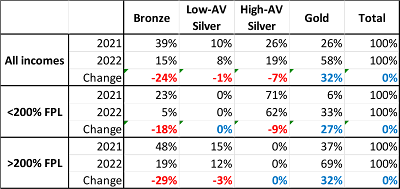
New Mexico didn't quite get there, but came close. In Health Affairs this week, Stan Dorn analyzed the results, spotlighting a massive decrease in enrollment in bronze plans, which have deductibles averaging more than $7,000:


Dorn argues forcefully that New Mexico's pricing directive should be adopted nationally, explaining in detail the flaws in CMS's risk adjustment formula for marketplace plans that favors silver plans, incentivizing insurers to underprice them, and urging a fix.

All that said, while metal level selection at incomes above 200% FPL in New Mexico is an unbridled triumph, there's a caveat to the drop in bronze plan enrollment at incomes below 200% FPL (the middle row above).  Bronze plan takeup at low incomes would have dropped significantly in any case -- and did drop nationally -- because the Open Enrollment Period for 2022 was the first (and possibly the only) OEP in which the premium subsidy enhancements provided by the American Rescue Plan were in effect. Those subsidy boosts made benchmark silver coverage free at incomes up to 150% FPL and available for 0-2% of income for enrollees in the 150-200% FPL range. In HealthCare.gov states, bronze plan selection dropped by 2 percentage points in the 100-150% FPL income range and by 8 percentage points at 150-200% FPL from OEP 2021 to OEP 2022. 

The bronze selection decrease at low incomes in New Mexico was much sharper. But far too many enrollees at income below 200% FPL switched into gold plans rather than silver, which have far lower out-of-pocket costs than gold plans at incomes below 200% FPL.  This is no knock on New Mexico pricing practices, but rather on presentation flaws on the newly minted state exchange, BeWellNM.  The New Mexico exchange does not emphasize the availability of CSR at low incomes. The display, uniquely among ACA exchanges, buries the annual out-of-pocket maximum for each plan (you have to go two clicks in from the top-line display for each plan to find the OOP max) -- and OOP max is where the silver advantage is sharpest, topping out at $2,900 for high-CSR silver compared to $8,700 for gold. 

Worst, the site has a malfunctioning total cost estimation tool, which apparently uses the unsubsidized premium to estimate "costs in a bad year," completely obscuring silver plans OOP max advantage.  (I described these flaws and their effects, with screenshots, in this post.)

The result: silver plan selection at incomes below 200% FPL was just 62% in New Mexico in 2022, compared to 81.5% nationally and 80% in the thirteen state-based exchanges that enroll people with incomes under 200% FPL and provide metal level choices broken out by income. (Those totals are based on my calculations from CMS's Public Use Files and omit the 1.6% of enrollees with income below 100% FPL). 

The 5% bronze selection in New Mexico at incomes below 200% FPL is a sterling accomplishment. But most of the 33% of enrollees in that income bracket who selected gold plans should be in silver. For some, getting a cheaper gold plan from a desired insurer might be worth the extra out-of-pocket exposure, which might be in the $5,000-6,000 range (as discussed here). But most would be better off in silver.

ACA metal level structure is confusing, as bronze, gold and platinum actuarial value is fixed at all incomes whereas as silver plans come with no less than four different AVs, depending on income.  The fact that silver plans can be worth more than gold -- as they are for slightly more than half of marketplace enrollees -- is deeply counterintuitive. Display matters. For enrollees with income under 200% FPL, silver plans should be displayed at the top of results. OOP maxes should always be clearly visible, and defined via mouseover. The availability of CSR and its impact should be heavily signposted. 

Gold plans should be consistently cheaper than silver plans nationally, as Dorn argues (and as David Anderson and I have also done). If metal levels are priced as in New Mexico, plans with an AV of at least 80% (gold) should be available at a premium at or below the benchmark against which subsidies are set. To maximize the value available, however, decision support on most exchanges also needs to be improved.

Update from Stan Dorn (click through for essential gif):

Replying to
...In yet another brilliant, creative NM policy innovation, they are labeling all high-AV products as “turquoise,” a favorite NM color that will easily signal the highest value options for each consumer

Subscribe (free) to xpostfactoid

Friday, June 03, 2022

Is avoiding overpayment of Medicare Advantage plans beyond U.S. government capacity?

Subscribe to xpostfactoid 

In the telling of MedPAC (the Medicare Payment Advisory Commission, a Congressional agency), the premise governing the government's creation and support of Medicare Advantage, and predecessor private Medicare programs, has always functioned as a kind of slipknot.

The premise is that by managing care efficiently, private insurers will serve Medicare enrollees more cheaply than does FFS Medicare while improving (or at least not worsening) outcomes -- and also pass a good portion of the savings to enrollees in the form of reduced out-of-pocket costs and additional services.

MA plans do serve enrollees more cheaply, in the sense that they pay out less to providers per enrollee. They also pass about $2,000 in annual savings to members in the form of reduced out-of-pocket costs and added coverage, such as (variously limited) dental, hearing and vision care.

What they don't do -- ever -- is save the government (i.e., taxpayers) money, at least not in an absolute sense. By MedPAC's estimate, covering enrollees through MA currently costs about 104% of the cost of covering the same enrollees through traditional fee-for-service (FFS) Medicare.  

Sunday, February 28, 2021

Does mandatory maximum silver loading require a risk adjustment fix?

Subscribe to xpostfactoid

I want to address a somewhat technical issue concerning regulatory action to require that gold plans in the ACA marketplace be priced below silver plans -- that is, regulatory action on the state or federal level mandating maximal silver loading.

Gold plans should be priced below silver plans because silver plans --on average -- carry a higher actuarial value than gold plans. "Actuarial value" refers to the percentage of the average enrollee's costs covered by the plan, according to a formula created by CMS (that formula could use adjustment, but that's another story). Gold plans have an AV of 80%, plus or minus a few percentage points. Silver plans have a baseline AV of 70%, but that's only for enrollees with incomes above 250% of the Federal Poverty Level (FPL). Below that threshold a secondary subsidy, Cost Sharing Reduction (CSR), available only with silver plans, boosts AV to 73%, 87%, or 94%, rising as income falls.  Most silver plan enrollees obtain AV of 94% or 87%.

Tuesday, July 10, 2018

Sabotage triage: New Jersey's instructions to individual market health insurers

It's hard to keep up with Trump administration sabotage of the ACA marketplace. Credit New Jersey's Dept. of Banking and Insurance (DOBI) with doing what it can to help health insurers cope.

In light of CMS's abrupt and capricious suspension of risk adjustment payments* to marketplace insurers in response to what should have been a minor legal glitch, DOBI has moved the deadline for individual market insurers to file rate requests from tomorrow (July 11) to July 18. DOBI has also instructed insurers to take two contingencies into account: the possibility that risk adjustment payments will remain suspended, and the likelihood that CMS (yes, the same CMS that planted the risk adjustment IED late last week) will approve the state's waiver application for federal funding for a reinsurance program, submitted on July 2.

The guidance issued today instructs insurers to file rate requests that a) assume risk adjustment payments will continue for 2019, and b) do not take the possibility of reinsurance into account. But insurers are also instructed to a)  discuss the potential impact on rates if risk adjustment payments were to be discontinued for 2019, and b) file alternative rates that assume the reinsurance program will be in place in 2019, under the terms proposed in the state's waiver application.

Thursday, September 08, 2016

The World Turned Upside Down: Risk adjustment and its discontents

In Kimberly Leonard's US News story about the quest to bring more young adults into the ACA marketplace, this input from Caroline Pearson of Avalere Health made my head spin:
Pearson says another phenomenon is contributing to the problem: Insurers don't receive adequate help in paying for this population from the government.

"There is an adverse incentive to aggressively recruit younger healthier people because insurers aren't being compensated adequately for them," she says, adding that this is something the administration could address without Congress.
That's counterintuitive, in that healthy young adults famously cost far less to insure that sicker older adults (or sicker younger ones, but the odds are with the young, as Leonard points out).  Indeed, a longstanding complaint about the marketplace from conservatives such as Avik Roy is that the oldest enrollees can only be charged three times as much as the youngest adult participants, compared to a prior industry norm of 5-to-1.  That is, conservatives argue that marketplace premiums should be lower for young adults, and higher for older ones.

The marketplace, however, is a tended garden, not a wilderness, and its plants are pruned by government shears, a.k.a. risk adjustment. In an email, Pearson explains what kind of compensation she was alluding to: