Showing posts with label Medicaid expansion. Show all posts

Friday, June 20, 2025

Republicans make the "abled-bodied" vulnerable

Note: All xpostfactoid subscriptions are now through Substack alone (still free), though I will continue to cross-post on this site. If you're not subscribed, please visit xpostfactoid on Substack and sign up. 

Community engagement requirements for the "able-bodied"


Republican legislators who wrote the Medicaid provisions of their monstrous megabill are acting on a simple belief: low-income nonelderly adults who lack access to affordable employer-sponsored health insurance should not have access to affordable health coverage.

While their $900 billion* in cuts to federal spending on Medicaid over ten years will hurt all classes of Medicaid enrollees, the cuts are aimed primarily at low-income adults insured through the ACA Medicaid expansion — that is, adults under age 65 who are not recognized as disabled by the federal government (though many have varying degrees of disability**). Some cuts not aimed directly at the ACA expansion population target states that have enacted the expansion.

Provider tax cut aimed at expansion states

The major new spending cut added by the Senate Finance Committee to the House package last week is a case in point. Section 71120 would sharply reduce the revenue that Medicaid expansion states derive from “provider taxes,” a financial maneuver, allowed for decades, that all states except Alaska employ to boost Medicaid revenue and fund services. Under current law, states are allowed to hold taxed healthcare providers “harmless” if the taxes don’t exceed 6% of revenue — that is, they can boost payment to an amount equivalent to the revenue collected. Since the federal government pays its standard Medicaid share of the resulting new spending, varying from 50-77% by state, states can use the federal share to further boost spending. Most such taxes are imposed on nursing homes (46 states) and hospitals (45 states).

That financial maneuver is a classic American “kludge” — a workaround chronic Medicaid underfunding initiated by state governments and accepted by CMS. A responsible legislature looking to end such haphazard, convoluted funding mechanisms might replace the revenue from them, built into state budgets, with a more rational funding source. The House bill put a ban on new provider taxes, leaving current arrangements in place. The Senate Finance Committee takes a deep slice out of the revenue, cutting current taxes — but only for Medicaid expansion states. For those states, the “safe harbor” under which hospitals and other providers can be held harmless is cut by 0.5% per year from the current 6% until it hits a floor of 3.5% (nursing homes are exempted from the lower threshold).

As Georgetown’s Edwin Park notes (citing KFF data), at present 18 expansion states imposes taxes on hospitals above the 3.5% future safe harbor, and some of those states explicitly earmarked that revenue*** to fund the state’s share of the cost of enacting the ACA Medicaid expansion— potentially endangering maintenance of the expansion in those states if this provision is enacted. At the same time, six of the ten nonexpansion states (Alaska, Kansas, Mississippi, South Carolina, Tennessee and Texas) impose taxes on hospitals greater than 3.5% and would be exempt from this cut.

Sunday, May 04, 2025

In the drive to gut Medicaid, spotlight on Jeff Van Drew (NJ-2)

Note: All xpostfactoid subscriptions are now through Substack alone (still free), though I will continue to cross-post on this site. If you're not subscribed, please visit xpostfactoid on Substack and sign up.

Pink tie/weak MAGA?

See updates for 5/6/25 and 5/7/25 at bottom.

I have an op-ed in NJ.com questioning whether Rep. Jeff Van Drew (R-NJ-2) will hold to his promise to “protect” Medicaid for his constituents, including those covered via the ACA Medicaid expansion.

Van Drew, a formerly Democratic House representative in South Jersey who went MAGA and switched parties, has been something of a fulcrum in the Republican House drive to pass legislation cutting hundreds of billions of dollars in federal Medicaid funding (he’s at least a frequent source in reports on that struggle).

On the one hand, Van Drew has more than 165,000 Medicaid/CHIP enrollees in his district, including more than 50,000 low-income adults covered via the ACA Medicaid expansion. Unlike most Republicans, when he vows to “protect” Medicaid, he includes “low-income families” — i.e., the ACA expansion population — in the groups to be protected. And yet, he voted for the resolution targeting hundreds of billions of dollars in cuts to Medicaid over ten years. And there are signs he will go along with essentially repealing the expansion - -that is, cutting federal funding for it enough to make it fiscally impossible for states to continue.

The op-ed spotlights the contradictions in Van Drew’s words and deeds concerning Medicaid and encourages constituents (and perhaps reporters) to press him about those contradictions. I hope you’ll give it a read.

Wednesday, September 18, 2024

Waiting for Vance's Hillbilly ACA elegy

Note: All xpostfactoid subscriptions are now through Substack alone (still free), though I will continue to cross-post on this site. If you're not subscribed, please visit xpostfactoid on Substack and sign up.

Does Vance have a Hillbilly ACA Elegy for us?

10/2/24: See post-debate update at bottom.

My last post focused on JD Vance’s sketch of a “concept of a plan” for “building on” the ACA in a second Trump administration. Vance’s remarks on Meet the Press last Sunday seem to promise a more sweeping version of the alternative market of medically underwritten, ACA-noncompliant health plans established by the first Trump administration.

Here I want to focus on a bit of purported family history that Vance injected into his paean to Trump’s alleged improvements to the ACA. This is to encourage political journalists to ask Vance exactly what he’s referring to in the highlighted section below.

Wednesday, August 03, 2022

U.S. uninsured rate hits an all-time low; Biden's HHS takes a victory lap; xpostfactoid claims prepostfactoid credit

Subscribe (free) to xpostfactoid

Record broken!

Biden's HHS took something of a victory lap yesterday, announcing that the national uninsured rate -- 8.0% for all ages --  was at an all-time low in the first quarter of 2022. Since the fourth quarter of 2020, the uninsured rate has dropped by 2.7 percentage both for ages 18-64 and for children, according to the ASPE* brief.

The brief is based on quarterly updates from the National Health Interview Survey. Those updates are notoriously bouncy, but the change over the time frame selected is clearly statistically significant. 

The brief asserts: "These gains in health insurance coverage are concurrent with [mustn't claim causality, now...] the implementation of the American Rescue Plan’s enhanced Marketplace subsidies, the continuous enrollment provision in Medicaid, several recent state Medicaid expansions, and substantial enrollment outreach by the Biden-Harris Administration in 2021- 2022."

I must note that I've been something of a canary in the coal mine on this front, first speculating that we might be approaching an uninsured low in April 2021; wondering whether the 2021 Special Enrollment Period coupled with the ARPA subsidy boosts might have got us there by late August 2021; and parsing the NHIS quarterly data in light of the 2022 marketplace enrollment surge in January 2022.

Ultimately, I noted in the January post, the enrollment math, if not the survey data, told a fairly simple story:

Friday, June 17, 2022

Why Manchin may let the ACA subsidy boosts die


Alarm bells are gonging for the possibility that even if Joe Manchin deigns to dictate to Democrats the terms of a reconciliation bill he'll vote for that includes some fragment of Democrats' spending priorities, it may not include extension of the boosts to ACA marketplace subsidies provided through 2022 in the American Rescue Plan Act. 

Charles Gaba relays reports from one paywalled site (Inside Health Policy) via another:

When a Punchbowl News reporter asked Thursday... whether a reconciliation deal is expected soon, Pelosi’s response was, “It’s alive.”

“There are certain concerns we have about subsidies in the health care bill and the rest, which may or may not be in the negotiations,” she said.

...President Joe Biden included drug pricing reform in an inflation-fighting proposal released over the weekend -- but his plan did not mention the enhanced ACA credits, raising some eyebrows.

..Democrats had counted on drug price controls to pay for the enhanced ACA subsidies, but Manchin recently said the subsidies did not come up in his talks with the White House.

Tuesday, September 28, 2021

Rapid marketplace enrollment growth in nonexpansion states, revisited

Subscribe to xpostfactoid

I don't know whether ACA marketplace observers have fully fathomed the extent to which the nonexpansion states drove the enrollment surge during the emergency Special Enrollment Period that ran from Feb. 15 to August 15 on HealthCare.gov -- and indeed, over the past two years.

Also not fully fathomed: the extent of total enrollment growth in all states during the pandemic.

Thursday, August 26, 2021

Is the uninsured rate flat since 2019, or down a bit?

Subscribe to xpostfactoid

See 8/31 update from NHIS survey at bottom

The Urban Institute, in an analysis of results from its own ongoing Heath Reform Monitoring Survey, found that the uninsured rate among adults aged 19-64 did not change significantly from March 2019 to April 2021. 

That's at least a backhanded tribute to the U.S.'s kludgy health insurance safety net as bolstered by the Affordable Care Act. Big picture: in Urban's estimate, as a result of the pandemic, employer-sponsored insurance  fell by 3 percentage points (from 65% to 62.3%) in the survey period, while insurance through public programs (mainly Medicaid) increased by 4 percentage points (from 13.6% to 17.5%). 

You could read these results as a paean to the ACA Medicaid expansion (which Republicans almost repealed in 2017). In states that have expanded Medicaid, Urban found that the uninsured rate actually dropped two percentage points for people with incomes below 138% FPL, the Medicaid eligibility threshold. According to CMS, total Medicaid enrollment (including children) increased by 11 million -- 15.6% -- from February 2020 to March 2021.  Enrollment among adults rendered eligible by the expansion increased by about double that rate.

Urban recorded a much more modest and ambiguous impact for the ACA marketplace -- though the huge enrollment surge during the emergency Special Enrollment Period open from February 15 through August 15 of this year, turbo-charged by subsidy increases enacted in the American Rescue Plan, which appeared on HealthCare.gov on April, was mainly missed by Urban's study period. I'll return to that in a bit.

I speculated in May that the U.S. uninsurance rate might be at an all-time low, powered by huge gains in Medicaid enrollment, significant gains in marketplace enrollment, and relatively modest losses in employer-sponsored insurance during the pandemic. My methods (and math) are far less sophisticated than Urban's, and this is not to question their results (no source ever has a really complete picture of insurance in the U.S.).  That said, a few comments and caveats below.

Saturday, July 17, 2021

A huge increase in low-income ACA marketplace enrollment in nonexpansion states

Subscribe to xpostfactoid

This is a postscript to my last post tracking massive SEP enrollment in nonexpansion states from February 15-June 30 of this year.  

I want to try to take the full measure of the enrollment surge in nonexpansion states at the lowest subsidy-eligible income level -- first in Open Enrollment season for 2021, and then in the emergency Special Enrolment Period (SEP) launched by the Biden administration on Feb. 15. This week, CMS reported SEP enrollment through June 30.

(This post is all numbers; please see the last post (and its backlinks to past posts ) for context, definitions, explanations.)

By my estimate, enrollment at the 100-150% FPL income level in 13 nonexpansion states (Wisconsin excluded*) in OE 2021 and the SEP for the Feb. 15-June 30 period combined exceeded 2020 enrollment in those two periods by almost 800,000.  That would be an increase of about 29%.

Thursday, July 15, 2021

More than half of all ACA SEP enrollment is in nonexpansion states

Subscribe to xpostfactoid

CMS announced yesterday that ACA marketplace enrollment during the emergency Special Enrollment Period (SEP) that began on February 15 had passed 2 million by June 30. That's more than triple the total enrolled in the same period of 2019, the last year unaffected by the pandemic. By that standard, the emergency SEP, coupled with the subsidy boosts in the American Rescue Plan (ARP), has produced more than a million excess off-season enrollments. Mid-year on-exchange enrollment is certainly at an all-time high.

Let's look again (as I did in June) at emergency SEP enrollment in states that as of June 30* had not  enacted the ACA Medicaid expansion. In those states, eligibility for marketplace subsidies begins at an income of 100% FPL (as opposed to 138% FPL in expansion states), and more than a third of enrollees in normal times have incomes below 150% FPL -- which, as of ARP passage in March, now qualifies them for a free benchmark silver plan with low cost-sharing. 

As in the prior SEP report on enrollment through May 31, SEP enrollment in 13 nonexpansion states (excluding Wisconsin, which has no coverage gap**) accounts for 75% of enrollment in the 36 states that use the federal exchange, HealthCare.gov. These 13 states account for more than half of SEP enrollment nationally.  SEP enrollment in these states is more than quadruple enrollment in the same period in 2019, exceeding that year's total by more than 860,000.

Monday, July 12, 2021

Democrat to voters: "Friend, this past year, we saw just how important Medicaid expansion was to hard-working..."

Subscribe to xpostfactoid

Terry McAuliffe, once and would-be future governor of Virginia, is running on the ACA Medicaid expansion (which opponent Glenn Youngkin opposed) and building on the ACA.  Here's the lead in a weekend email to supporters: 

Friend, this past year, we saw just how important Medicaid expansion was to hard-working Virginians and to folks across the country. Before COVID-19 hit, 394,000 Virginians were enrolled in Medicaid. Now? It’s over 550,000.

That’s over 150,000 Virginians who had coverage during the worst global public health crisis in recent history because of Medicaid expansion. But our work is not over.

700,000 Virginians - including 100,000 children - don't have access to health insurance. We NEED to continue to expand coverage to make sure every single Virginian has great health care.

The language there is a little sloppy -- over 550,000 Virginians (562,530 if you're keeping score at home, up 43% since March 1, 2020)  were rendered eligible for Medicaid by the ACA expansion criteria.  In total, 1.86 million people in the state are enrolled in Medicaid, up from 1.54 million on March 1, 2020, an increase of 20%.  

That safety net performance at a time of mass (if partially temporary) unemployment and mortal danger to health is something for Democrats to be proud of, especially since they scripted the moratorium on Medicaid disenrollments (in the Families First Act of March 2020) that's largely enabled the increase. They should all run on it. Remember, Republicans came within a breath of repealing the ACA's core programs, chief among them the Medicaid expansion.

Monday, February 22, 2021

Medicaid enrollment likely reaches 81 million in January

Subscribe to xpostfactoid 

Chart updated 3/3/21

This is an update to my recent post estimating total national Medicaid enrollment at upwards of 80 million through December, up from 71.2 million in February 2020, the last month before the pandemic struck the economy.

I've added December updates from four states -- including the big one, California -- to the sample, as well as adding Nebraska, which enacted the ACA Medicaid expansion beginning in October. As I forecast, continued relatively slow growth in California drops the full-sample rate of increase by about two and a half percentage points.  

As always, the official CMS tally for all states, currently stuck in September, is likely to show a somewhat smaller increase than my sample. For September, my sample showed an increase of 9.7% over February, while CMS currently shows a 9.4% increase in the same period.  Conservatively, then, I'll posit that CMS will show a 12.5% increase from February through December 2020, which would put national enrollment at 80.1 million.  (The sample consists of states for which I can find monthly enrollment reports.)[Update, 4/5/21: CMS's preliminary November total shows an increase of 11.6% since February, as I forecast on New  Year's Eve, compared to the 12.0% increase for the same period charted in my sample below.*]

Wednesday, September 02, 2020

Pandemic Medicaid enrollment powers into August

Subscribe to xpostfactoid

Update, 10/4: see this post for 32-state enrollment through August (California included).

Update, 9/27: I'd like to venture a top-line estimate for Medicaid enrollment through August.  In the 25 states I can track through August (I've added Mississippi), enrollment is up 10.5% Aug-Feb. In tracking through July, California's near-flat enrollment drops total growth Feb-July by 1.9% percentage points. Assuming continued weak growth in CA in August, let's assume 8.6% enrollment growth since February. According to CMS's February tally, that would peg total enrollment through August at 77,293,798 -- call it 77.3 million, up about 6 million from February. (Preliminary August numbers for California are in, and they show a drop, which will probably be adjusted up to a very modest increase, based on recent history.)
      Of course, enrollment growth in the twenty states not tracked below could be different from the that of the tracked states. It's just occurred to me that I can tally the growth in those states through May, the last month tallied by CMS, and compare it to growth through May in the states tracked below. Then again, growth in many states surged after May -- but by definition this near-real-time tracking is tentative. Stay tuned. [Update: increase through May for the 20 states not included in my July chart is essentially identical to the 50-state increase excluding California -- 3.6% vs 3.7%. As of May, California pulled down the national average to 3.2%, from 3.7% excluding California. That's a 13.5% decrease in the increase, to put it awkwardly. Shaving the same percentage off the 10.5% August increase recorded for 25 states below suggests a 9.1% national increase since February and a national total upwards of 77.6 million enrolled in Medicaid.

Update, 9/22: California wrecks the average for July. Minus California, states below are up 8.8% through July; CA knocks that down to 6.9%. California has also posted a raw total for August that's below July's, but that total will doubtless be adjusted up, as July's has been. Also, South Dakota is up 1.3% July to August.
      The California monthly totals below were supplied by the state Dept. of Health Care Services. Raw totals recorded in two public state databases (1, 2) are slightly different from these totals. California deems the data preliminary for a full 12 months, and the state's monthly totals have changed considerably in the period in which I've been tracking. Growth remains surprisingly low, however.

Earlier updates at bottom.

------
Original post: (9/2/20): A handful of states have posted Medicaid enrollment totals as of the end August (or, in the case of New York, as of mid-August or beyond*). The main takeaway is that growth in Medicaid enrollment triggered by the pandemic does not appear to be slowing down.  In the states charted below, enrollment grew by 1.5% from June to July. In the four states that have reported through all or most of August below, enrollment also increased 1.5% over the prior month. [Update 9/4: Minnesota up 1.2%; 5 states up 1.4% July-August.]

The sustained Medicaid enrollment growth five months after the first pandemic-induced lockdowns  should not be a surprise. As I've noted before, Medicaid enrollment is a lagging indicator. A United Hospital Fund study found that in the Great Recession of 2007-2009, Medicaid enrollment in New York peaked seven months after unemployment peaked. Robin Rudowitz of the Kaiser Family Foundation tells me that Medicaid enrollment continued to climb nationwide after the Great Recession officially ended, and that state Medicaid directors whom Kaiser surveyed at the end of April anticipated increases extending throughout the year.

Pandemic Medicaid Enrollment in 31 States (updated 9/30)
February through July or August 2020
Expansion states in blue; nonexpansion states in red; Medicaid to 100% FPL in purple
Totals as of the end of each month


Tuesday, August 18, 2020

Has Medicaid enrollment reached 77 million? (updated)

Update, 9/2: Four states post reports in recent days that bring totals through August. Discusson in  this post. 

Update, 8/27: Texas has reported June enrollment, and it's up 9% since February.  June chart below is updated. Most recent July chart, last updated 8/23, is unchanged.

One note about the apparent flat enrollment in California: the percentage of Medi-Cal enrollment that is Latinx, 50% in 2018, is about double the national average. The Trump administration's changes to the public charge rule, suspended though the new rule is, are likely continuing to chill enrollment among legally present noncitizens, and the effect may be particularly strong in California.

8/24/20:  Today the big addition is California enrollment through June. The state is a major outlier among expansion states, in that enrollment is up just 1.1% since February (after a slight dip in March). Adding CA dropped the all-state enrollment increase from February through June from 7.0% to 5.6%. The weak growth is apparently a mystery to state officials and advocates. I'll have more to say about that later in the week. [Update, 9/1: California has now published a raw total for July that shows a drop of 74,000. I had noted the July drop in this database, but as California is notoriously slow to account for retroactive liability, the July total is likely to be adjusted up.]  

Subscribe to xpostfactoid

Pandemic Medicaid Enrollment in 29 States 
February through June 2020 (as of 8/27)
Expansion states in blue; nonexpansion states in red; Medicaid to 100% FPL in purple


California totals include about 850,000 enrollees in programs not counted by CMS, e.g., enrollees funded without a federal match rate. (As noted in the 8/23 update below, CMS state tallies now run through May 2020. The monthly totals for California listed above may yet be published online; they were sent to me. They are roughly congruent with eligible individuals tracked in this database.

UPDATED  9/2/20
Pandemic Medicaid Enrollment in 23 States 
February through July or August 2020
Expansion states in blue; nonexpansion states in red; Medicaid to 100% FPL in purple


Wednesday, August 12, 2020

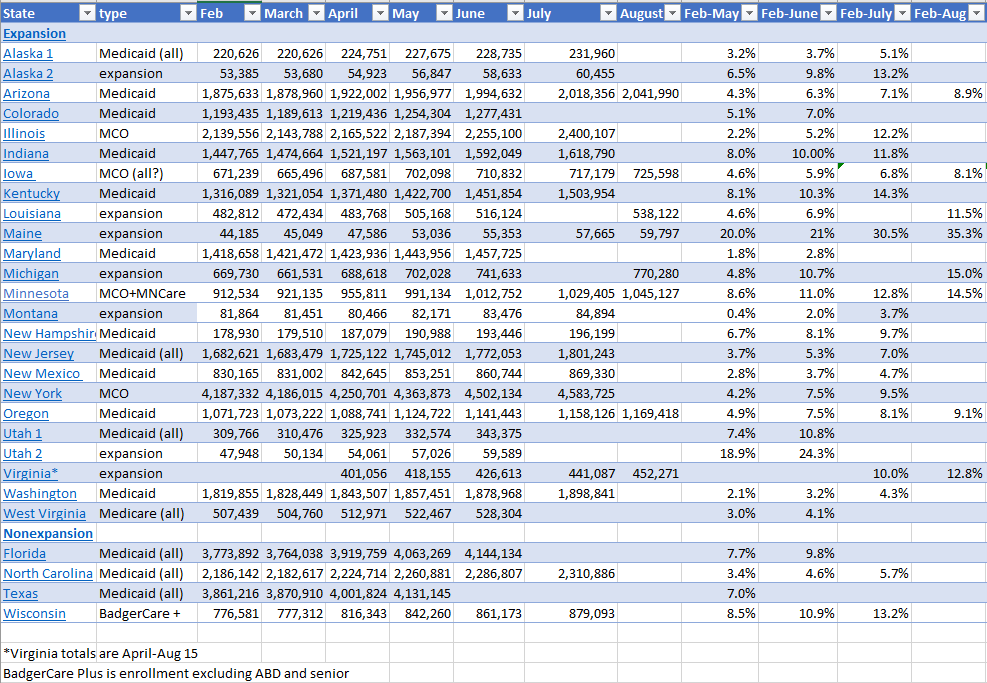
Medicaid enrollment in a pandemic: 26-state snapshot

Subscribe to xpostfactoid

Update through 9/2 here

Update, 8/19: See this post for a somewhat cleaner comparison through July, reconciling states' different schedules for tallying and methods of labeling a given month.

Update, 8/15: Illinois Medicaid enrollment surged 6.4% from June to July and is up almost 10% since May. Enrollment in Indiana is up 11.8% since February. Of the twelve expansion states below that have reported enrollment in all or most Medicaid programs through July (excluding tallies for expansion population only), the average increase since February is 9.2%. 
---
It's time for a fresh post on pandemic Medicaid enrollment, instead of piling updates on my prior snapshot. While I'm focused primarily on states that enacted the ACA Medicaid expansion, I've started to also track nonexpansion states and will keep adding them as I find data.  I have a bunch of URLs to pick through, thanks to a very helpful overview of enrollment in 33 states through May and June  by Chris Frenier, Sayeh S. Nikpay, and Ezra Golberstein.

To review some basic context: the Urban Institute forecast that nationally just shy of half* of those who lose access to employer-sponsored insurance will enroll in Medicaid if severe unemployment lasts for "several months to a year." At 15% unemployment, Urban projects that between 8.2 million and 14.3 million people will enroll in Medicaid, an increase of 11%--20% over total enrollment in early 2020, or 16%--28% over the total of enrollees under age 65.   While the current national unemployment rate has dipped officially to 10%, it's likely to spike again as our public health failures lead to renewed shutdowns and our legislative failures result in cutoffs or sharp reductions in relief benefits.

Note that some of the the tallies below are for the ACA Medicaid expansion only -- that is, adults with incomes under 138% of the Federal Poverty Level. The federal government pays 90% of the cost for enrollees rendered eligible by the expansion. It's not surprising that the expansion population tallies reflect faster growth, since a large percentage of the nation's children were enrolled in Medicaid or CHIP pre-pandemic, enrollees over age 65 are in Medicare and usually not reliant on employer-sponsored insurance, and those eligible for disability Medicaid are also likelier to have been enrolled pre-pandemic.

       Medicaid enrollment in 26 states, February - August 2020
Medicaid enrollment in the Covid-19 pandemic

Wednesday, August 05, 2020

In a devilish pandemic, Medicaid expansion is Utah's cave up in the hills

Subscribe to xpostfactoid

In 2018, voters in Utah passed a referendum to enact the ACA Medicaid expansion, which would make Medicaid available to adults with incomes up to 138% of the Federal Poverty Level. Utah's Republican legislature and governor writhed, twisted, and enacted a partial expansion, to 100% FPL, effective in April 2019. When the federal government rejected a waiver to apply the ACA's 90% federal match rate to that limited expansion population, the state went to Plan B -- full expansion -- effective Jan 1, 2020. A work requirement was suspended in April 2020 in response to the pandemic.

Good timing. As the pandemic struck, jobless claims in Utah rose from 40,500 in February to 166,300 in April before falling back to 85,700 in June. The unemployment rate went from 2.5% to a peak of 10.4% in April to 5.1% in June. Medicaid enrollment responded:

Friday, July 03, 2020

Where is Medicaid enrollment surging? A June update

Click here to subscribe to xpostfactoid

7/9/20 -- see updates at bottom re strong July enrollment growth in Minnesota and Kentucky

A month ago, I spotlit a handful of states in which Medicaid enrollment was surging in response to the mass job losses triggered by the Covid-19 pandemic. Here, an update.

To review the context for enrollment growth recorded so far: the Urban Institute has forecast that if 15%* unemployment lasts for "several months to a year," between 8.2 million and 14.3 million people would enroll in Medicaid, an increase of 11%--20% over total enrollment in early 2020, or 16%--28% over the total of enrollees under age 65.  Joan Aiker and Tricia Brooks of Georgetown have tracked enrollment in 22 states that have reported through May and found an average increase of 5% over February.

Notes below track enrollment logged in June or as of July 1.  While the Georgetown scholars are tracking both expansion and nonexpansion states, I've limited myself to expansion states where growth is particularly strong.

As of the end of May, both Kentucky and Minnesota had reported increases exceeding 10% since February. I don't have an update yet for either. Among states with new data:

Saturday, April 18, 2020

Smooth the path to Medicaid enrollment for the newly uninsured

Subscribe to xpostfactoid via box at top right. You'll get 2-3 posts per week, mostly re ACA.

As tens of millions of Americans lose job-based health insurance, the heavyweight in reducing the ranks of the newly uninsured is going to be Medicaid -- at least, in the 36 states that have enacted the Medicaid expansion  (and if Democrats don't push through a 100% COBRA subsidy). Medicaid will far outweigh the ACA marketplace for several reasons:
  • Medicaid eligibility is based on monthly income, whereas marketplace subsidy eligibility is based on annual income. Mid-year, marketplace subsidies are therefore weakened by income earned year-to-date.
  • The average normal unemployment benefit nationally is $378 per week* -- close to the Medicaid eligibility threshold in expansion states for a single person ($1468/month) and well below the threshold for any larger family. 
  • The extra $600/week UI benefit provided for up to 4 months by the CARES Act does not count as income for Medicaid eligibility purposes, but it does count toward subsidy eligibility in the ACA marketplace. 

Tuesday, April 07, 2020

Squinting at likely new Medicaid and marketplace enrollment as job losses accelerate

Subscribe to xpostfactoid via box at top right. You'll get 2-3 posts per week, mostly re ACA.

Charles Gaba has used early enrollment data from state-based ACA marketplaces that have opened up emergency Special Enrollment Periods to hazard an estimate: If HealthCare.gov, the federal exchange that handles ACA marketplace enrollment for 38 states, were to open a no-strings attached emergency SEP for sixty days, about a million more people than usual would enroll in marketplace plans in those two months.

That's based on a rough quadrupling of normal off-season enrollment in 3 states (Maryland, Colorado, Minnesota) that have opened emergency SEPs that enable applicants to complete an application online, more or less as they would during the yearly Open Enrollment season. (In 3 states that require emergency SEP applicants to initiate the application with a phone call (Connecticut, Washington, Nevada), enrollment is up just 22-35%.) As of 2015, about 6,000 people per day were enrolling via HealthCare.gov in nine months outside of Open Enrollment season. An extra 18,000/day for 60 days (assuming an easy, wide open SEP) would come to 1,080,000 additional new enrollees.

A few further observations:
  • Process matters: The difference in states that enable online applications vs. those that require a phone call to begin the process appears dramatic, though data is scarce at this point (12 SBEs, including California and New York, have opened emergency SEPs; just six have released any data).  That said, HealthCare.gov, for which CMS refused to open an emergency SEP, requires those who lose job-based coverage to verify the date they lost coverage in writing before they can enroll in a marketplace plan.  With 10 million newly unemployed in a two-week period, that could cause an administrative train wreck.

  • More than two months? While an emergency Special Enrollment Period must maintain the perception that enrollment isn't open year-round, so that people don't wait until they get sick to enroll, a continuing crisis is likely to lead to continuing extensions, as has already happened in many states.

  • Early days yet: Shelli Quenga, Director of Programs at the Palmetto Project in North Charleston, South Carolina, said last week that her agency was so far busiest helping people get food stamps: "people have to eat every day, so they think more about their food benefits than they do about their health benefits." That's a typical sequence of concerns, according to Quenga.

  • Early days, Part B: While enrollment from the 10-odd million newly unemployed as of April 2 hasn't fully gotten going, the tidal wave of job losses probably hasn't peaked yet.

  • Medicaid will matter more: Gaba reports that in Maryland, SEP enrollment from March 16 through April 6 totaled 8,454 in Medicaid (which is open year-round) and 5,735 in the marketplace. [Update, 4/23/20: MNSure, the Minnesota ACA exchange, announced SEP enrollment numbers yesterday that showed a similar percentage of users, 60%, applying for either Medicaid or MinnesotaCare, a Medicaid-like "basic health program' available to applicants in the 139-200% FPL income range.] The CARES Act, signed into law on March 27, will likely further skew enrollment toward Medicaid. As I've noted previously, the $600/week extra unemployment benefit the new law provides for up to four months counts as income for the purpose of calculating ACA marketplace subsidies, but not toward Medicaid eligibility. Up to $10,200 of extra income will disqualify many marketplace applicants for secondary Cost Sharing Reduction subsidies and render others ineligible for premium subsidies, or else will sharply reduce those subsidies. 
One widely circulated projection, from Health Management Associates, foresees up to 35 million Americans losing job-based coverage, with a mid-range estimate of 23 million, which comes to an unemployment rate of 17.5%.  Health Management foresees enrollment in ACA-compliant private plans remaining more or less flat, as some marketplace enrollees switch to Medicaid. In the mid-range estimate, Medicaid enrollment grows by some 17 million as the uninsured population rises from 29 million to 34-35 million.

I had missed the likelihood of people shifting from marketplace to Medicaid. The differing tax treatment should accelerate that too. At the same time, the unemployment income boost should newly qualify some people in states that have refused the ACA Medicaid expansion for marketplace coverage by raising their countable household income over 100 % FPL.

Related:
ACA enrollment train wreck coming
Our emerging public option: Medicaid
CARES Act may reduce coverage gap in states that refused to expand Medicaid
Enhanced unemployment benefit will skew marketplace enrollment
Emergency special enrollment periods in 12 states: How easy?
How about an emergency Special Enrollment Period for the ACA marketplace?

Wednesday, April 01, 2020

Our emerging public option: Medicaid

Subscribe to xpostfactoid via box at top right. You'll get 2-3 posts per week, mostly re ACA.

Axios's Bob Herman notes that "Medicaid will be a lifeline for droves of Americans affected by the coronavirus pandemic."
The program will pick up many people who lost their income and their health insurance together, as well as people who lost jobs that didn't provide health insurance, and potentially some people who are still working and need medical care but aren't insured.
Indeed it will. As of early this year, about 72 million Americans were enrolled in Medicaid's various programs. Based on an old rule of thumb from Georgetown's Edwin Park that I've cited before, enrollment (including CHIP)  could reach 85 million or more by the time the pandemic subsides:

Tuesday, March 24, 2020

Unemployed alert: When NOT to seek health insurance through the ACA marketplace

Subscribe to xpostfactoid via box at top right. You'll get 2-3 posts per week, mostly re ACA.

The expected economic fallout from the coronavirus pandemic is shocking. Morgan Stanley forecasts that the unemployment rate will approach 13% next quarter. We're talking Depression.

That onrush will put enormous strain on the enrollment infrastructure established by the ACA for the private plan marketplace and Medicaid, at a time when our healthcare infrastructure will also be under tremendous strain and flux. Thank God the core ACA programs, Medicaid expansion and the subsidized marketplace, are intact and funded. But the enrollment machinery is balky.

I am particularly concerned about one complication that could flummox a lot of newly uninsured people: the mismatch between marketplace and Medicaid income assessments. While subsidy eligibility and subsidy size in the marketplace is determined on the basis of annual income, Medicaid eligibility is determined on the basis of monthly income.  While the HealthCare.gov application prompts applicants to report both estimated annual and current monthly income, and should find Medicaid eligibility on the basis of monthly income if it's below the threshold, several experienced enrollment assisters have told me that in this circumstance they prefer to apply directly through a state Medicaid office or website.*


It also suggests that some people may actually have a choice of marketplace or Medicaid, since a newly unemployed person, or a self-employed person whose income drops abruptly, has to estimate income for the year. Let's say you're a single adult whose job pays $4,000 per month,and you're laid off at the beginning of April, when you've earned $12,000 to date. Estimate your income for the full year at $17,000, and you're on Medicaid. Estimate it at $18,000, and you're in the marketplace, and eligible for the highest level of Cost Sharing Reduction, which will put your deductible in the $0-500 range. A benchmark silver plan will cost you $56 per month at that income.  At a $20,000 annual income, the benchmark premium will go to $77/month and the deductible (under the second strongest CSR level level) will probably be in the $500-1000 range.

Because the ACA Medicaid expansion established no asset test for Medicaid eligibility -- anyone in a household with income under 138% of the Federal Poverty Level qualifies -- high earners could become Medicaid-eligible even if their year-to-date income at the time of unemployment exceeds the threshold for subsidy eligibility in the marketplace (400% FPL, or $49,960 for an individual, $103,000 for a family of four). That assumes no unemployment insurance income, or a level below Medicaid eligibility.  High self-employed earners may find themselves in this category if their sources of income dissolve. [Update, 4/26: The CARES Act renders the self-employed and others not ordinarily eligible for unemployment benefits eligible -- and adds a $600/wk extra UI benefit for up to four months. See note at bottom.]

The experience of people I've helped apply for Medicaid suggests that enrollment is often slow and balky. State Medicaid offices and enrollment websites will likely be flooded with new applicants. A lot will depend on the prevailing attitude in a given state government. In a disaster, states can seek Medicaid waivers to streamline eligibility determinations -- essentially to enroll anyone who declares an income that renders them eligible, and suspending eligibility redeterminations for the duration of the crisis.* In recent years states have gone the other way, stepping up their technological ability to detect income increases that disqualify people from Medicaid.

So the question now for state governments is what do you want to do? Minimize your uninsured population during a pandemic, or minimize state expenditure on Medicaid?

In a pandemic, you want low income people on Medicaid.** No premium, no cost sharing, no balance billing, no muss no fuss once you've located providers who accept the insurance. In fact we should always want low income people on Medicaid -- say, to 200% FPL. But that's a tale for a different day, unless the pandemic changes our legislative dynamics beyond recognition.

Related: Uninsured in a pandemic? Seek help -- it's likely available
----
*  Update, 4/26: I had originally written that HealthCare.gov might not recognize Medicaid eligibility based on current monthly income if the actual or estimated annual income exceeded the annual eligibility threshold. That was an error -- though several experienced navigators told me that they prefer applying directly through state Medicaid departments in this circumstance.

One further complication: The CARES Act, the Covid-19 relief bill signed into law on March 27, provides a $600/week boost to ordinary unemployment income for up to four months, which comes to a maximum of $10,200. This income counts in the determination of marketplace subsidy eligibility but does not count toward Medicaid eligibility. While CMS has promised to enable HealthCare.gov to recognize the extra $600/week unemployment benefit as income for marketplace purposes while discounting it when determining Medicaid eligibility, that capability is not yet in place.

** On March 22, the president declared a national emergency under the Stafford Act. That clears the way for states to seek Section 1135 Medicaid waivers, which enables these measures, among others:
- Temporarily suspend prior authorization requirements;
- Extend existing authorizations for services through the end of the public health emergency;
- Modify certain timeline requirements for state fair hearings and appeals;
- Relax provider enrollment requirements to allow states to more quickly enroll out-of-state or other new providers to expand access to care, and
- Relax public notice and submission deadlines for certain COVID-19 focused Medicaid state plan amendments, enabling states to make changes faster and ensure they can be retroactive to the beginning of the emergency. 
 CMS has encouraged Section 1135 waivers, and in fact published blanket waivers available for the asking; 13 states have had such waivers approved.  But a different kind of waiver -- a Section 1115 waiver -- is required to ease eligibility procedures. Under a Section 1115 waiver, New York after 9/11 offered four months of Medicaid coverage to eligible New York City residents through a simplified application. After Hurricane Katrina, via a Section 1115 waiver, evacuees unable to provide documentation were allowed to self-attest to Medicaid eligibility criteria.