Tuesday, November 30, 2021

Is the ACA marketplace catching a surge in entrepreneurship?


The Wall Street Journal's Josh Mitchell and Kathryn Dill report that the pandemic has triggered a surge in self-employment and small business formation:

The number of unincorporated self-employed workers has risen by 500,000 since the start of the pandemic, Labor Department data show, to 9.44 million....Entrepreneurs applied for federal tax-identification numbers to register 4.54 million new businesses from January through October this year, up 56% from the same period of 2019, Census Bureau data show.

That surge underscores the value and good timing of the boosts to premium subsidies for plans sold in the ACA Health Insurance Marketplace provided by the American Rescue Plan Act, enacted in March 2021. Those subsidy increases brought the ACA much closer to fulfilling its promise of providing affordable insurance to those who lose or leave their jobs and so lose access to employer-sponsored plans, which insure the majority of working age Americans.

Sunday, November 28, 2021

From verb to noun, on the rebound

Subscribe to xpostfactoid

Some time early in our relationship, my wife set down a plate or cup in front of me and said with indulgent and somewhat satiric glee, "you sit down an have an enjoy."

I thought that was hysterical for some reason, and it's been a watchword in our house for 40 years. I often try to fathom why it seems so funny, and get a grip on the intuition that led Cindy to manufacture a noun, enjoy, by accenting the first syllable of a common verb. My lingering association is with "escape" in Arlo Guthrie's Alice's Restaurant, below (reproducing Guthrie's pronunciation):

Friday, November 26, 2021

Almost a quarter of all emergency SEP enrollees in ACA marketplace should have been in Medicaid

Subscribe to xpostfactoid

For years, we have had to infer what percentage of ACA marketplace enrollees in states that have refused to enact the ACA Medicaid expansion have incomes below 138% FPL -- the Medicaid eligibility threshold in expansion states. It's a very large percentage, but as CMS's enrollment reports usually break out income in increments of 50 FPL percentage points, e.g., 100-150% FPL, it has to be inferred.

Just once, in 2016, CMS did provide enrollment results by state for the 100-138% FPL income range as well as for the broader 100-150% FPL bracket. In nonexpansion states, the former was about 85% of the latter. For years since, I've used 85% as a benchmark to estimate down from 100-150% FPL for the "should-have-been-in-Medicaid" cohort.

The final enrollment report for the 2021 emergency Special Enrollment Period, which ran from Feb. 15 to Aug. 15 in the 36 HealthCare.gov states, provides a tantalizing hint: 33% of all enrollment in those states was in the 100-138% FPL bracket. (All nonexpansion states use HealthCare.gov.) But what percentage of those were in the 13 states that had not expanded Medicaid as of the SEP period? (I'm including Oklahoma, which opened the Medicaid expansion gate on July 1 of this year.) 

Friday, November 19, 2021

Signposting likely Medicaid eligibility without muddling the message

Subscribe to xpostfactoid

The Missouri Medicaid expansion  -- mandated by referendum, denied funding by the state legislature, and enacted only after the Missouri Supreme Court so ordered -- is off to a slow start, with the administration of Republican Governor Mike Parson declining to do much outreach. Enrollment of those rendered newly eligible by ACA expansion criteria began on October 1.

News of the slow start led me to check whether HealthCare.gov has been retooled to tell Missouri visitors who use the site's see plans and prices tool that they're likely eligible for Medicaid if they input an income below the eligibility threshold. HealthCare.gov is not the primary means by which people enroll in Medicaid, but it's a "no wrong door" channel.

Yes, HealthCare.gov has has been updated. That's not surprising -- it's had to absorb about a dozen late Medicaid expansions.  But the check underscored to me that messaging on the site for those likely eligible for Medicaid (in all expansion states) could be clearer.  

Here's what you see if you input an income below the eligibility threshold (here, $17,000 for a solo applicant in zip code 63111 in St. Louis): 

Wednesday, November 17, 2021

The broker's tale: Louise Norris on skewed incentives in the ACA marketplace


As noted in last week's post, the ACA exchanges rely heavily on health insurance brokers and agents to help people sort their options and enroll in ACA-compliant individual market plans. Almost half of enrollments on the federal exchange, HealthCare.gov, which currently serves 33 states, are enrolled by brokers and agents. The same is true for Covered California, the largest state-based exchange -- which, unlike HealthCare.gov,* has maintained a consistent commitment to making the marketplace work as designed since its launch in fall 2013.

The reliance on brokers was inevitable, given the complexity of marketplace offerings (check out the 221 plans on sale in Miami, the nation's largest ACA marketplace, in 2022) and the pre-existing pool of expertise, commercially funded, that brokers constituted prior to ACA launch.  And while brokers have played a vital role,** the ACA failed to align their incentives in such a way as to ensure that their participation would be an unmixed blessing. Among the problems:

  • Not all insurers that participate in the ACA exchanges pay commissions to brokers. Commissions have fluctuated quite a bit over the seven years of the marketplace's existence, as well as by state, region, and individual insurer.

  • The lightly regulated market for so-called Short Term Limited Duration plans fostered by the Trump administration (which rendered them neither short-term nor of limited duration, if there's a difference) pays much higher commissions than the ACA-compliant market, but serves few enrollees' best interests. STLD plans are medically underwritten, riddled with exclusions and coverage gaps, prone to balance billing, and pay as little as half of premium revenue to cover enrollees' medical claims. ACA-compliant plans are required to maintain a minimum "medical loss ratio" (MLR) of 80% -- that is, pay out at least 80% of premium revenue in claims.

How do ethical brokers deal with these conditions, and how could incentives be better aligned? To address those questions I queried Louise Norris, co-owner with her husband Jay Norris of a health insurance brokerage serving individual market customers in Colorado.

Tuesday, November 16, 2021

Happy day(s) are here again?

Subscribe to xpostfactoid

As Biden's poll numbers sag, complaints are rife in my liberal Twitter bubble that the media casts current economic news in a bad light, with inflation trumpeted ahead of other pretty good fundamentals on the employment and growth front. 

We all think the refs are biased against us, and maybe they are. But with those complaints furnishing some corner of my mind, I just happened on a Wall Street Journal home page, which, if only momentarily, snapshots some pretty good economic (and geopolitical) news on balance. Take it for what it's worth. (Flashback: "green shoots" of spring 2009, oy gevalt...)

Thursday, November 11, 2021

Under Biden, HealthCare.gov maintains its Trump era tilt toward commercial insurance brokers

Subscribe to xpostfactoid

11/19: See update at bottom:  Healthcare.gov put out an email today that leads with nonprofit assisters

Obtaining health insurance from publicly supported programs in the U.S. is a complex process, necessarily supported by a variegated ecosystem of enrollment assisters.  For people under age 65, nearly 50,000 commercial health insurance brokers and agents are registered (as of 2020), along with about 30,000 nonprofit enrollment assisters (as of 2016), many of the latter supported by federal or state funding.

Enrollment of the under-65 population that lacks access to employer-sponsored insurance depends on both commercial and nonprofit assisters, who have different and to some extent complementary strengths and weaknesses. 

Tuesday, November 09, 2021

HealthSherpa shows how to shrink the coverage gap

Subscribe to xpostfactoid

As I have noted repeatedly (1, 2, 3) the ACA's notorious coverage gap -- the unavailability of subsidized insurance for adults with incomes below 100% FPL in states that have refused to enact the ACA Medicaid expansion -- is exacerbated by ignorance. 

Few low income applicants in the 11 remaining "gap" states* know that they must estimate a minimum income for the coming year to qualify for coverage. HealthCare.gov, the application venue for all applicants potentially subject to the gap, does not spell out in the application or in the plan preview tool that a minimum income is required. People who are told that they do not qualify for aid because their income is too low are rightly incredulous.

Since fall 2018, however (during Open Enrollment for 2019), HealthSherpa, a commercial online health insurance brokerage used by thousands of brokers, has spelled out that vital information. 

Monday, November 01, 2021

Premiums down, out-of-pocket costs up up up: The post-ARPA case for maximal silver loading

Subscribe to xpostfactoid

I have repeatedly made the case that CMS should follow the lead of several states and mandate strict silver loading* in the ACA marketplace-- that is, require insurers to consistently price gold plans below silver plans, since the average actuarial value of silver plans is higher than the mandated AV for gold plans (80% -- i.e., the plan is designed to cover 80% of the average enrollee's costs). 

In recent posts, I have spotlighted New Mexico's maximized mandatory silver loading: in 2022, the state required insurers to price silver plans as platinum-equivalent, since silver plans are platinum-equivalent for enrollees with incomes below 200% FPL ($25,7600 for an individual in 2022).  The regulation is designed to be a self-fulfilling prophecy: if gold plans are priced well below silver, no one with an income over 200% FPL should buy silver plans.  In 2022, gold plans are in fact priced well below silver plans throughout New Mexico.

Since silver loading began in 2018, the main case for maximizing it has simply been that the ACA marketplace has always been under-subsidized, and a state or CMS can alleviate high enrollee costs without help from Congress. That case may appear less urgent after the American Rescue Plan Act (ARPA), enacted this past March, sharply increased premium subsidies. The draft Build Back Better bill would extend those subsidy boosts through 2025.

But the case for strict silver loading remains strong. While ARPA reduced premiums, it did not reduce out-of-pocket costs, and these have risen relentlessly at each metal level, driven by medical inflation, which is always higher in the commercial market.  Strict silver loading is a way to roll back that rise for enrollees with incomes above 200% FPL; it's a kind of back-door CSR for enrollees above that income level. (Moreover, the BBB bill is not a done deal, 2025 is not the end of time, and strict silver loading would mitigate a far-from-unlikely expiration of the subsidy boost.)

Sunday, October 31, 2021

Open enrollment 2022! Marketplace loaded for bear, but bear traps remain

Subscribe to xpostfactoid

Open enrollment in the ACA marketplace begins tomorrow. This will be the first OE season - -and hopefully, not the last - -in which the enhanced subsidies created by the American Rescue Plan (ARPA) are in place. It's a season of hope -- and also worry. Some thoughts below.

1. All systems go? The marketplace, which never reached half the enrollment projected by CBO in 2010, is in some senses loaded for bear this fall. Thanks to ARPA, silver plans with strong Cost Sharing Reduction (CSR) are now free for people with incomes up to 150% FPL ($19,320 for an individual); cost no more than 2% of income at incomes up to 200% FPL; and cost no more than 8.5% of income (without CSR) for any enrollee who lacks access to other affordable insurance. 

Navigator organizations, which operated on a shoestring (if at all) during the Trump years, their federal funding cut from $63 million in 2016 to $10 million in 2018 and years following, have been granted $80 million for 2022. Florida's chief navigator organization, Florida Covering Kids and Families, started with 120 navigators in 2013 but was down to 50 in OE for 2020, with just 25 in the off-season. This OE, they've got 200 navigators in place. (Federal navigator funding, derived from user fees charged to insurers selling in the marketplace, only applies to the 33 states still using HealthCare.gov, the federal exchange. State exchanges fund their own outreach through user fees they retain.)

Tuesday, October 26, 2021

Albuquerque vs. Miami, or platinum vs. silver benchmark in the ACA marketplace

Subscribe to xpostfactoid

A week ago, I put a spotlight on ACA marketplace plan offerings for 2022 in New Mexico, which has essentially implemented a platinum benchmark. That is, regulators have instructed insurers to price silver plans as if all enrollees have incomes below 200% of the Federal Poverty Level. Below that threshold, silver plans, enhanced by Cost Sharing Reduction (CSR) do have actuarial values comparable to those of platinum plans. Under these new pricing guidelines, some half-dozen gold plans are priced well below the benchmark (second cheapest) silver plan, and no one with an income above 200% FPL should buy silver.

While New Mexico is a very small market, this pricing scheme could and should be implemented nationwide. That possibility has implications -- or should have implications -- for Democrats' negotiations over the healthcare provisions to be included in the Build Back Better bill. 

Today, then, I want to compare what's available to buyers with incomes above 200% FPL in Albuquerque and in a market with a more typical pricing structure. Miami fits that bill. There, the lowest-cost gold plan is priced 8% above the benchmark silver plan. That's right at the average spread between lowest-cost gold and benchmark silver nationally during the silver loading era (2018-2021), according to KFF.

Thursday, October 21, 2021

If Democrats fail to enhance the ACA or remove the coverage gap, what can the Biden administration do?

Subscribe to xpostfactoid


As the extent to which Senators Manchin, Sinema, and other corporate Democrats will eviscerate the original outline of the Build Back Better bill sinks in, it's time to consider the once-unthinkable: what if Democrats fail to extend the enhanced ACA marketplace subsidies enacted in the American Rescue Plan Act (ARPA) in March?  And what if -- which was always uncertain -- they fail to plug the coverage gap in states that have refused to expand Medicaid?

Tuesday, October 19, 2021

New Mexico models a platinum benchmark for the ACA marketplace

Subscribe to xpostfactoid


I'd like to delve a bit deeper into the metal level pricing in New Mexico's 2022 marketplace (discussed in the previous post), since it's a potential model for the whole country. Plans available for 2022 can now be previewed on New Mexico's new state-based exchange, bewellnm.

For 2022, the state's insurance department instructed insurers to price silver plans as if they have platinum value. That's because, for enrollees with incomes up to 200% FPL, silver plans do have platinum value, thanks to the Cost Sharing Reduction (CSR) subsidies available to low income enrollees, which attach to silver plans only. Most silver plan enrollees in New Mexico have incomes below 200% FPL, and the pricing instructions are meant to be a self-fulfilling prophecy: if gold plans cost less than silver, then no one with an income over 200% FPL will buy silver plans. Since premium subsidies are set to a silver benchmark, gold will be available below benchmark, i.e. below the level deemed affordable by ACA criteria.

Thursday, October 14, 2021

bewellnm launches with *really* cheap gold plans; some confusion at low incomes likely

Subscribe to xpostfactoid


New Mexico's newly minted state-based ACA exchange, bewellnm, has launched plan preview shopping for 2022.

What's noteworthy: uniquely, the New Mexico Office of the Superintendent of Insurance has instructed insurers selling in the state individual market to price silver plans on the assumption that no one who does not qualify for strong Cost Sharing Reduction (CSR)-- that is, no one with an income above 200% of the Federal Poverty Level -- will buy silver.  In other words, silver plans must be priced more or less as if they're platinum* -- since they are in fact platinum-equivalent at incomes below 200% FPL.  Platinum plans (which are almost nonexistent) have an actuarial value (AV) of approximately 90%. CSR brings silver plan AV to 94% for enrollees with income up to 150% FPL, and 87% for those in the 150-200% FPL income range.

This is meant to be a self-fulfilling prophecy: if gold plans (approximately 80% AV) are priced below silver plans, no one who doesn't get the high CSR value should buy silver. Silver plans for enrollees who don't qualify for CSR (income above 250% FPL) have an AV of 70%; those who qualify for negligible CSR (income 200-250% FPL) get an AV of 73%.   Why buy silver if it offers a lower AV than gold -- -but costs more?

In Albuquerque in 2022 (zip code 87107), gold is priced well below silver, as planned. For a 40 year-old ineligible for subsidies (income $100,000**), the lowest-cost gold plan costs $288 per month; the lowest-cost silver plan is $320 per month. Six gold plans, with deductibles ranging from $750 to $2300, are cheaper than the cheapest silver plan, which has a deductible of $5450.  The second cheapest (benchmark) silver plan, at $337/month, has a deductible of $4250. Who would buy silver in these circumstances?

Tuesday, October 12, 2021

In which the Kaiser Family Foundation moves to quell a PhRMA disinformation campaign

Subscribe to xpostfactoid

The Kaiser Family Foundation (KFF) appears to have taken steps prevent PhRMA from using its polling in a disinformation campaign. 

In response, PhRMA has accused KFF of politicizing its research. That's like Donald Trump accusing an opponent of lying to the public (or rigging the vote count).

What KFF did do -- amend its survey questions about empowering Medicare to negotiate prescription drug prices -- is interesting. Let's step back and review how KFF typically structures questions regarding public policy options.

In its questionnaires, KFF will ask whether a respondent favors an initiative -- say, subsidizing children's lemonade stands. 90% approve! It will follow up with a question that raises the possible negative effects -- say, increasing neighbors' likelihood of developing Diabetes from all that liquid sugar.  Approval will drop, a little or a lot.

Tuesday, October 05, 2021

Wonder of wonders: National balance billing protection for consumers that (probably) won't increase healthcare costs

Subscribe to xpostfactoid

The federal government* delivered some rare good news on the healthcare cost control front with release last week of the second part of interim final rule governing implementation of the No Surprises Act, which will protect Americans from the most egregious forms of balance billing (excepting ground ambulances!) beginning on January 1, 2022. The No Surprises Act was part of the broad-based bipartisan budget deal signed into law by Trump in late December 2020.

The good news concerns the ground rules for arbitration of out-of-network bills, which either the provider or the insurer can initiate if they can't agree on a price within 30 days. As in New York, New Jersey and other states that have passed laws protecting patients from balance billing, it's "baseball arbitration," in which the arbitrator must rule in favor of one party's proposed price, rather than splitting the difference. What matters is the standard by which the arbitrator must judge the competing bids. A summary published by CMS provides the upshot:

Tuesday, September 28, 2021

Rapid marketplace enrollment growth in nonexpansion states, revisited

Subscribe to xpostfactoid

I don't know whether ACA marketplace observers have fully fathomed the extent to which the nonexpansion states drove the enrollment surge during the emergency Special Enrollment Period that ran from Feb. 15 to August 15 on HealthCare.gov -- and indeed, over the past two years.

Also not fully fathomed: the extent of total enrollment growth in all states during the pandemic.

Friday, September 24, 2021

Even with balance-billing protection, a tiered network may cause tears

Subscribe to xpostfactoid


My last post involved a close look at the severely tiered provider network in the silver plans sold in the ACA marketplace by Independence Blue Cross, the dominant insurer in Philadelphia and southeastern Pennsylvania.  On a second look, a thought occurred to me: tiered networks that place go-to hospitals in higher tiers put an asterisk of sorts on balance-billing protections for emergency care, including those due to come online nationally when the No Surprises Act takes effect on January 1.

Under the No Surprises Act, emergency care is billed at in-network rates whether or not the hospital or facility is within the provider network of the patient's health plan. But what exactly is an "in-network rate" in a tiered network? Depends on the tier.

Independence's HMO plans sold in the ACA marketplace have three tiers. Its second-cheapest silver offering on Pennie, Pennsylvania's ACA exchange, the Keystone HMO Silver Proactive plan, posts a deductible of $0. But that's in Tier 1 only. For enrollees with incomes too high to qualify for Cost Sharing Reduction (CSR),* Tiers 2 and 3 have a deductible of $6,000 for an individual and $12,000 for a family. 

Tuesday, September 21, 2021

Independence Blue Cross sells only 24-carat gold plans in Philadelphia and surrounding counties

Subscribe to xpostfactoid

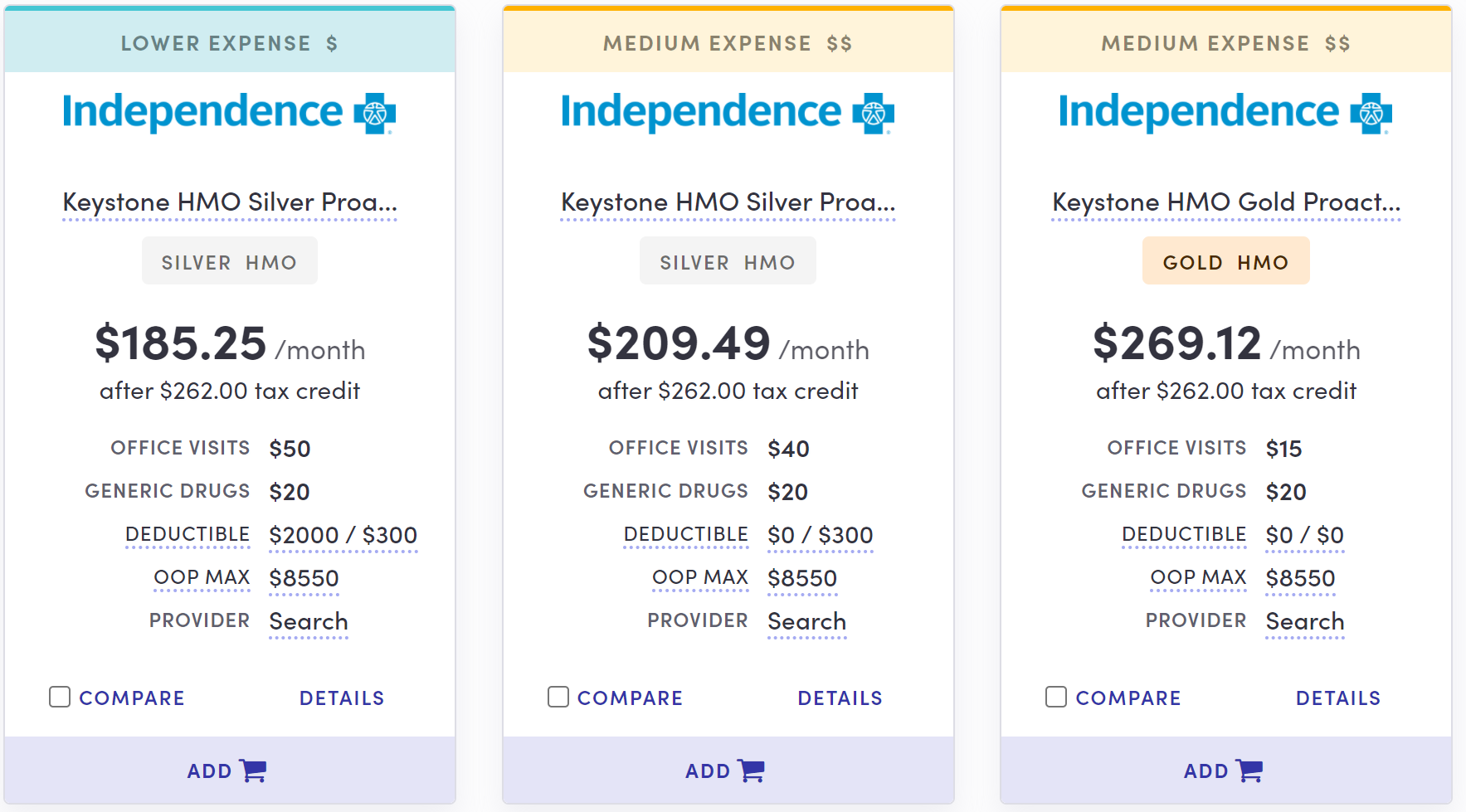
What is wrong with this picture?

These health plan quotes, taken from the health plan comparison tool provided on Pennie, Pennsylvania's online ACA marketplace, show the lowest-cost silver and gold plans offered in Philadelphia by southeastern Pennsylvania's dominant insurer to a 40 year-old with an income of $38,000.  (Premiums are net of a federal subsidy of $262 per month.) 

In the pricing of its lowest-cost gold plan, Independence Blue Cross, issuer of the Keystone health plans listed above, is an outlier, in that its lowest cost gold plan is priced well above its lowest cost silver plans. That's not how it's supposed to work in Pennsylvania.

Thursday, September 16, 2021

Notes from the SEP: On record marketplace enrollment in August 2021

Subscribe to xpostfactoid

CMS today released a final enrollment report for the emergency Special Enrollment Period that ran in HealthCare.gov states from Feb. 15--Aug. 15 this year, and for mostly comparable lengths in the 15 state-based marketplaces. 

The top line: 2.8 million new enrollments nationally in that period. A few quick notes:

  1. Effectuated enrollment in August 2021, 12,199,393, is up 14.6% over 2020, the previous high (10,642,088*), and 22% over enrollment in August 2016, the peak prior to 2020.  Caveat: off-exchange enrollment in ACA-compliant plans dropped by about 3 million from 2016 to 2019, according to KFF estimates. On-exchange enrollment is about 2.2 million above the August 2016 total.

  2. While 2.8 million people newly enrolled in marketplace coverage during the SEP, total enrollment has risen by only 900,000 since February, when effectuated enrollment stood at 11.3 million.  That's steeper attrition than I anticipated when I estimated total enrollment at 12.7 million through July.