Showing posts with label Independence Blue Cross. Show all posts

Friday, September 24, 2021

Even with balance-billing protection, a tiered network may cause tears

Subscribe to xpostfactoid


My last post involved a close look at the severely tiered provider network in the silver plans sold in the ACA marketplace by Independence Blue Cross, the dominant insurer in Philadelphia and southeastern Pennsylvania.  On a second look, a thought occurred to me: tiered networks that place go-to hospitals in higher tiers put an asterisk of sorts on balance-billing protections for emergency care, including those due to come online nationally when the No Surprises Act takes effect on January 1.

Under the No Surprises Act, emergency care is billed at in-network rates whether or not the hospital or facility is within the provider network of the patient's health plan. But what exactly is an "in-network rate" in a tiered network? Depends on the tier.

Independence's HMO plans sold in the ACA marketplace have three tiers. Its second-cheapest silver offering on Pennie, Pennsylvania's ACA exchange, the Keystone HMO Silver Proactive plan, posts a deductible of $0. But that's in Tier 1 only. For enrollees with incomes too high to qualify for Cost Sharing Reduction (CSR),* Tiers 2 and 3 have a deductible of $6,000 for an individual and $12,000 for a family. 

Tuesday, September 21, 2021

Independence Blue Cross sells only 24-carat gold plans in Philadelphia and surrounding counties

Subscribe to xpostfactoid

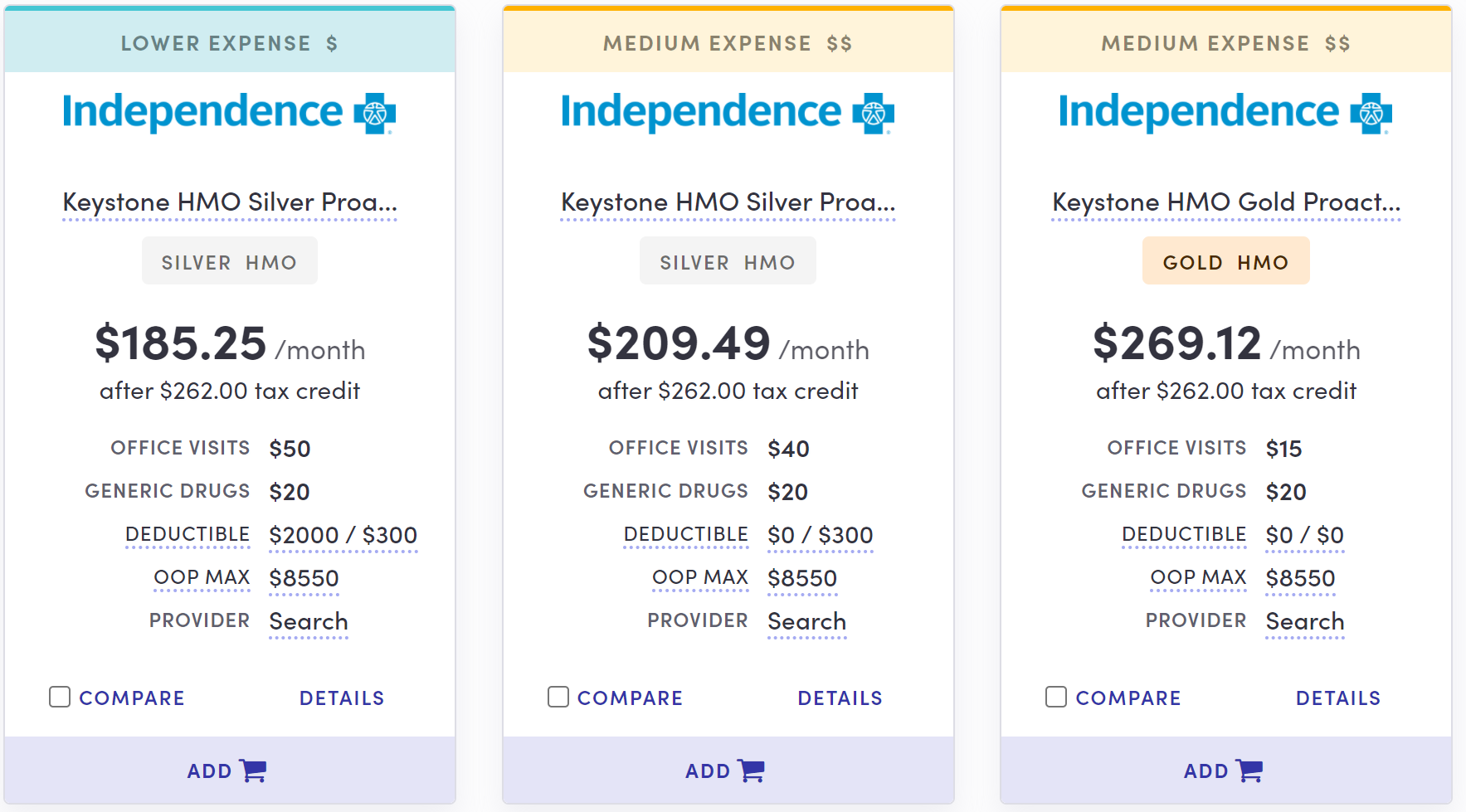
What is wrong with this picture?

These health plan quotes, taken from the health plan comparison tool provided on Pennie, Pennsylvania's online ACA marketplace, show the lowest-cost silver and gold plans offered in Philadelphia by southeastern Pennsylvania's dominant insurer to a 40 year-old with an income of $38,000.  (Premiums are net of a federal subsidy of $262 per month.) 

In the pricing of its lowest-cost gold plan, Independence Blue Cross, issuer of the Keystone health plans listed above, is an outlier, in that its lowest cost gold plan is priced well above its lowest cost silver plans. That's not how it's supposed to work in Pennsylvania.

Wednesday, June 06, 2018

About that victory lap, PA Insurance Department....

Yesterday, the Pennsylvania Insurance Department proudly announced that insurers in the state's ACA-compliant individual market requested premium increases averaging 4.9% -- compared to 30.6% last year.

Insurance Commissioner Jessica Altman took a victory lap:
Altman attributes the minimal increases to Pennsylvania’s competitive market and the department’s efforts to maintain enrollment in the individual market despite the federal government’s efforts to shorten the ACA’s open enrollment period and curtail enrollment outreach, while working to achieve affordability for consumers. The Insurance Department launched an outreach campaign to make up for a lack of marketing from the federal government during the 2018 open enrollment season.

The department also worked to make coverage more affordable for more consumers by mitigating the number of individuals subject to premium increases when the federal government eliminated cost-sharing reduction reimbursements. As a result, 396,725 Pennsylvanians selected health plans on the exchange in 2018, only a small decline from the previous year.
It may well be true that state action helped minimize enrollment losses and so stabilize the market to a degree. But on the top line at least, that "small decline" was not so small. CMS enrollment figures show a 9% drop in marketplace enrollment in Pennsylvania in 2018 -- compared to 4% nationwide and 5% in the 39 states (including PA) that use the federal exchange, HealthCare.gov.

Tuesday, April 24, 2018

A free silver plan with a $0 deductible...What's not to like?

I have been fond of noting that notwithstanding the complexity of health insurance, most enrollees in the ACA marketplace seem to get the most consequential choice right: metal level. In particular, most people eligible for strong Cost Sharing Reduction (CSR), which is available only with silver plans, chose silver and access it.

This year, subsidized enrollees' responses to the anomalous discounts generated by Trump's cutoff of federal funding for CSR (see note at bottom if you're unfamiliar with this) reinforce this narrative. In some states where the cheapest gold plans are cheaper than the cheapest silver, gold enrollment quadrupled or tripled. In the 200-250% FPL income band, where CSR is negligible, silver enrollment fell off a cliff in states where "silver loading" the cost of CSR generated large bronze/gold discounts (on HealthCare.gov, silver selection in this income band dropped from 68% in 2017 to 53% in 2018).

But when it comes to plan complexity, there are layers within layers -- literally, in the form of tiers. While I was working on a post about rational choice in Pennsylvania, where CSR takeup remained fairly strong even as gold enrollment more than tripled to 27% of total enrollment, I came across a mystery.

Tuesday, January 19, 2016

You've heard of narrow networks? Get ready for narrow deductibles

As deductibles and co-pays in health plans sold in the ACA marketplace continue to rise, HHS has stressed the fact that many plans offer significant services, such as doctor visits and drugs, that are not subject to the deductible.

In Southeast Pennsylvania (which includes Philadelphia), Independence Blue Cross offers a silver HMO plan that almost turns the whole concept of a deductible on its head. For a buyer who does not qualify for cost sharing reduction subsidies, the deductible is $1,500 -- relatively modest for a silver plan sold on the exchanges. But most services are not subject to the deductible. Here's the basic deal (for an unsubsidized 40 year-old in Philly):