Showing posts with label health insurance. Show all posts

Saturday, December 21, 2024

Paul Krugman asks whether health insurance is purely parasitical; doesn't quite answer

Note: All xpostfactoid subscriptions are now through Substack alone (still free), though I will continue to cross-post on this site. If you're not subscribed, please visit xpostfactoid on Substack and sign up.


Paul Krugman, noting that most U.S. healthcare spending is filtered through private insurers, takes aim (in his new post-NYT retirement Substack) at private health insurance in the U.S.:

Let me offer a somewhat, but only somewhat, caricatured view of U.S. health care: It’s a system in which taxpayers bear the cost of major medical care, but this taxpayer money flows through private companies that take a cut, spend a lot on administration, and do their best to deny care to people who need it.

His argument as to whether private insurers add value is sketched in lightly, and focused entirely on Medicare Advantage:


What service do private insurers provide in return for the tolls they in effect collect on a largely taxpayer-financed system? Medicare Advantage plans generally offer more extensive coverage than traditional Medicare. But there doesn’t seem to be any clear evidence that this is because private insurers provide efficiency gains the public sector doesn’t. What happens instead is that Medicare Advantage plans appear to be able to game the system sufficiently that they receive more taxpayer funding per enrollee than traditional Medicare spends on recipients in equivalent health…So you could make the case that at this point private health insurance is, in large part, a parasitical racket.

You could make that case, but leading with “you could” is a pretty equivocal way to make it. My take on the evidence (adapted from my comment on Krugman’s post) is below. The first point is a footnote to Krugman’s overview of private insurance’s share of U.S. healthcare spending.

1) Most Medicaid coverage is now also administered through private insurance companies (MCOs). Per KFF, 74% of Medicaid enrollees are in MCOs.

2) According to a KFF literature review, including a review of enrollee satisfaction surveys, Medicare Advantage enrollees are about as satisfied as traditional Medicare enrollees. By all accounts, problems in MA tend to come when you need serious care (especially post-acute care) — and denials appear to be on the increase. According to a Senate investigative report (inspired by reporting from STAT’s Bob Herman and Casey Ross), coverage denials from UnitedHealthcare MA plans for acute care more than doubled between 2020 and 2022 after the company adopted an AI tool (owned by UHC subsidiary NaviHealth, and also used by Humana and CVS Aetna) to assess claims.

3) Insurers "save" healthcare spending by denying not only needed but unneeded care -- and it's difficult to parse out the proportions of each. Surveys indicate that MA plans do encourage people to get screenings and so may prevent more acute care down the road. According to the KFF literature review, “The analyses consistently found that Medicare Advantage enrollees had higher utilization of preventive services and lower utilization of post-acute care and home health services.”

4) Some healthcare economists (e.g., Austin Frakt) find evidence that Medicare Advantage treatment protocols "spill over' into traditional Medicare and so save money there.

5) Private companies (MACs) also administer traditional Medicare, but with a very broad coverage grant and few coverage denials. MACs have no incentive to deny coverage.

6) In countries that deliver universal healthcare through private insurers, such as Germany and Japan, major medical insurers must be nonprofit. Germans can opt out of the nonprofit Statutory Health Insurance system into private plans, as 11% of the population did in 2019. But the government sets provider payment rates for private plans and limits premium increases. In Japan, as in many countries that deliver universal coverage through private plans, supplemental insurance can be for-profit.

7) In the U.S. whatever money insurers save by managing (denying) care is swamped by overpaying providers, which happens because we have no uniform payment rates, so providers divide and conquer. In the case of Medicare Advantage, where providers are paid Medicare rates or less, the savings are negated by payment formulas that overpay MA plans on a capitated basis, via a) a ridiculous risk adjustment system that incentivizes massive gaming, b) over-generous payment benchmarks, and c) bonus payments based on quality ratings that don't measure quality effectively.

8) Private insurers probably do have the capacity or potential to add administrative and care management value. But in the U.S., profit skews the incentives. In fact, it skews incentives for providers as much as for insurers. Almost all participants (e.g., those owned by giant insurers or private equity) are geared toward revenue maximization ("nonprofit" or not).

P.S. My own two-part assessment of Medicare Advantage (from 2022) starts here.

Thanks for reading xpostfactoid! Subscribe for free:

Photo by Arthur Uzoagba 


Saturday, September 04, 2021

Viewing the uninsured rate through foggy lenses

Subscribe to xpostfactoid
Medicaid card

Snapshots of the health insurance status of the U.S. population are blurry.

When you look at the CMS tally of Medicaid enrollment increase since the pandemic struck, it seems, simply, that the increase swamps most estimates of the number of people that lost employer-sponsored insurance. Other factors are at work, of course. But the one large number is considerably larger than the other large number.

But official Medicaid enrollment totals may not be an entirely reliable measure of how many people are actually covered by Medicaid, and know themselves as such -- particularly during this pandemic, when disenrollments have been paused since March 2020. State Medicaid agencies are, to varying extents, blind beasts.

I know a young man who, during a year of transition, lived in two states and worked at three jobs, with a period of unemployment. At different points in the year he applied for Medicaid in two (blue) states and received rejection notices. From both of those states, months later (and months apart), while insured through a new employer, he was sent managed Medicaid membership cards and informed that he'd be enrolled since shortly after his application was completed.  In both states, it took some doing and some time to get himself disenrolled.

Wednesday, August 12, 2020

Medicaid enrollment in a pandemic: 26-state snapshot

Subscribe to xpostfactoid

Update through 9/2 here

Update, 8/19: See this post for a somewhat cleaner comparison through July, reconciling states' different schedules for tallying and methods of labeling a given month.

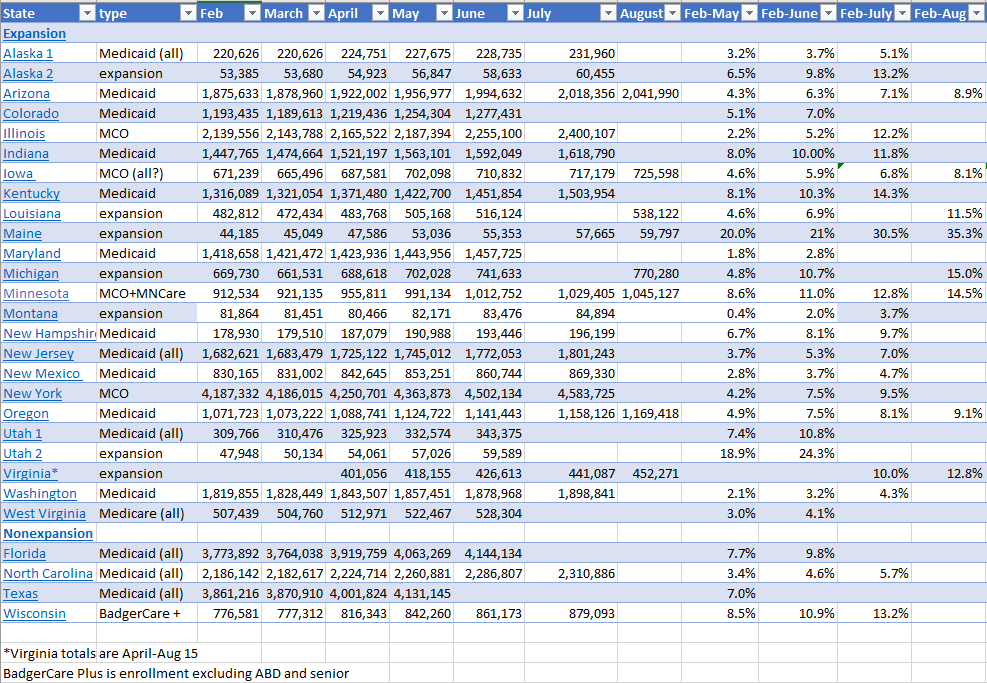
Update, 8/15: Illinois Medicaid enrollment surged 6.4% from June to July and is up almost 10% since May. Enrollment in Indiana is up 11.8% since February. Of the twelve expansion states below that have reported enrollment in all or most Medicaid programs through July (excluding tallies for expansion population only), the average increase since February is 9.2%. 
---
It's time for a fresh post on pandemic Medicaid enrollment, instead of piling updates on my prior snapshot. While I'm focused primarily on states that enacted the ACA Medicaid expansion, I've started to also track nonexpansion states and will keep adding them as I find data.  I have a bunch of URLs to pick through, thanks to a very helpful overview of enrollment in 33 states through May and June  by Chris Frenier, Sayeh S. Nikpay, and Ezra Golberstein.

To review some basic context: the Urban Institute forecast that nationally just shy of half* of those who lose access to employer-sponsored insurance will enroll in Medicaid if severe unemployment lasts for "several months to a year." At 15% unemployment, Urban projects that between 8.2 million and 14.3 million people will enroll in Medicaid, an increase of 11%--20% over total enrollment in early 2020, or 16%--28% over the total of enrollees under age 65.   While the current national unemployment rate has dipped officially to 10%, it's likely to spike again as our public health failures lead to renewed shutdowns and our legislative failures result in cutoffs or sharp reductions in relief benefits.

Note that some of the the tallies below are for the ACA Medicaid expansion only -- that is, adults with incomes under 138% of the Federal Poverty Level. The federal government pays 90% of the cost for enrollees rendered eligible by the expansion. It's not surprising that the expansion population tallies reflect faster growth, since a large percentage of the nation's children were enrolled in Medicaid or CHIP pre-pandemic, enrollees over age 65 are in Medicare and usually not reliant on employer-sponsored insurance, and those eligible for disability Medicaid are also likelier to have been enrolled pre-pandemic.

       Medicaid enrollment in 26 states, February - August 2020
Medicaid enrollment in the Covid-19 pandemic

Tuesday, September 20, 2016

A few statistical anomalies in healthcareville

Struggling with a difficult post, I just made a little list in my mind of some statistical oddities I've stumbled across in the past year or so in the wonderful world of U.S.  health insurance. Some are mysteries, some are apparent errors, and some involve frames that may give the wrong impression. In no particular order:

1)  In 2016, CBO changed the way it counts Medicaid enrollees under age 65. No, there was not a surge of 16 million unanticipated enrollments, as reported more than once. Rather, CBO started counting "dual eligibles" under age 65 in the Medicaid total, along with enrollees in various limited benefit programs.  More here.

2. Oft-quoted stat: In 2017, the ACA marketplace may have only one insurer in almost one third of U.S. counties. Less quoted: 19% of the population lives in those counties. 72% of the population lives in counties with 3-8 insurers (Kaiser). This is not to sugar-coat bad news, but the effect of recent pullbacks on people should take priority over its effect on acreage.

Wednesday, November 04, 2015

Your health insurer may not want to control the cost of medical care

Two facts about the business of health insurance that must be obvious to practitioners and those who study the subject occurred to me recently.

First, if the cost of medical care goes up and the actuarial value of a health plan remains the same, consumers' out-of-pocket costs will go up.  87% of $5,000 is more than 87% of $4,000.

Second: A rise in the cost of medical care (theoretically) does not affect insurers' profit margins, since actuarial value and medical loss ratio stay the same. But the cost-hike does increase their revenue. They are, in a sense, reselling medical care to plan holders. Selling more expensive care is equivalent to selling more of it. If I sell you $120 in care and keep 20% of it, I earn more than if I sell you $100 worth and kept 20%.*

Thursday, September 17, 2015

The Census on health insurance gains: who got what and how?

This week the Census reported on changes in Americans' health insurance rates from 2013 to 2014, based on results of its two yearly surveys, the Current Population Survey and the American Community Survey. The two together show what is probably the most dramatic drop in the percentage of people without insurance since Medicare and Medicaid were implemented. The drop in the ranks of uninsured was steepest among the roughly one third of the population living in households with incomes under 200% of the Federal Poverty Level (FPL) -- where lack of insurance is most concentrated.

In my grand personal tradition of burying the lead, I discuss an apparent oddity in the data under the second subhead below. Feel free to skip! If you're well-versed in these matters, it may be no mystery to you.

The near-poor gain most

The ranks of the uninsured dropped more steeply for the near-poor than for those below the poverty line, and for the part-time employed than for the nonworking population,  The pattern does not hold for educational level: the uninsured rate dropped most for those without a high school diploma and next most for high school grads, with smaller drops at each level of educational attainment.

Monday, July 08, 2013

Who'll stop the hospital billing machine when you're "covered"?

My family gets its health insurance through my wife's employer, a multi-hospital system. Until this year, we have had in-network coverage only. Last fall, somewhat to my surprise, the hospital-insurer agreed to cover in full an operation out-of-network on grounds that no one in-network was qualified to do it. This was a wake-up call for me, and I insisted that this year we pay more for a plan that provides limited out-of-network coverage.While out-of-network coverage has substantial deductibles and limited co-pays, out-of-pocket expenses are capped at about $11,000 per individual. That strikes me as worthwhile catastrophic insurance if one of us gets seriously ill and needs to tap a top specialist outside the network. But our experience with the covered out-of-network operation we already had raises a question in mind about that out-of-pocket maximum -- for myself and for insured patients in general, particularly those buying on the new healthcare exchanges.

Here's the rub: while our insurer informed us that the operation would be covered in full, they were slow to pay some bills and paid some only in part. We then became targets of "balance billing" -- practices affiliated with the hospital where the operation occurred as well as the hospital itself dunning us for unpaid balances, often under threat of siccing a collections agency on us.

Thursday, May 31, 2012

Late pleadings for the ACA

For those who, like a besotted lover whose beloved's day to wed another fast approacheth, can't stop piling up arguments in favor of the constitutionality and necessity of the Affordable Care Act, a few eloquent doomed love notes:

1. Healthy twentysomething Mormon missionary can't buy coverage:
I hit the quarter-century mark on the eve of two adventures -- an LDS mission and life without health insurance.