Showing posts with label employer-sponsored insurance. Show all posts

Thursday, November 05, 2026

It costs WHAT per month? New immigrants eyeball employer offers of insurance

 Note: Free xpostfactoid subscription is available on Substack alone, though I will continue to cross-post on this site. If you're not subscribed, please visit xpostfactoid on Substack and sign up.

A lot of attention has rightly been paid to the Trump-era degradation of the ACA marketplace, where reduced subsidies (starting in Plan Year 2026) have harmed the subsidy-eligible, and a roughly 40% two-year increase in base premiums has slammed the subsidy-ineligible (e.g., those subjected to the restored income cap on subsidies).

It’s also no secret that employer-sponsored insurance is imposing increasingly untenable costs, especially on employees of small businesses and on low-income employees.

In my work with lawfully present immigrants, earning hourly wages in the $18-25 range, I’ve had a chance to witness what healthcare access in the U.S. looks like to unaccustomed eyes. Examples:

  • A married couple, both working as dental assistants for different practices: each is offered individual insurance starting at $400/month, and insurance for two at simply double that. Deductibles begin, if I remember right, at $2,500. They are healthy, and can’t imagine paying well over 10% of income for coverage that doesn’t kick in until they spend thousands more. They are uninsured.

Saturday, September 04, 2021

Viewing the uninsured rate through foggy lenses

Subscribe to xpostfactoid
Medicaid card

Snapshots of the health insurance status of the U.S. population are blurry.

When you look at the CMS tally of Medicaid enrollment increase since the pandemic struck, it seems, simply, that the increase swamps most estimates of the number of people that lost employer-sponsored insurance. Other factors are at work, of course. But the one large number is considerably larger than the other large number.

But official Medicaid enrollment totals may not be an entirely reliable measure of how many people are actually covered by Medicaid, and know themselves as such -- particularly during this pandemic, when disenrollments have been paused since March 2020. State Medicaid agencies are, to varying extents, blind beasts.

I know a young man who, during a year of transition, lived in two states and worked at three jobs, with a period of unemployment. At different points in the year he applied for Medicaid in two (blue) states and received rejection notices. From both of those states, months later (and months apart), while insured through a new employer, he was sent managed Medicaid membership cards and informed that he'd be enrolled since shortly after his application was completed.  In both states, it took some doing and some time to get himself disenrolled.

Wednesday, March 03, 2021

The Kaiser Family Foundation is trying to tell us something

Subscribe to xpostfactoid

The Kaiser Family Foundation is one of the most reliable and comprehensive source of healthcare data and analysis in the U.S. Its authority rests in part on maintaining an implicit policy neutrality, letting facts speak for themselves. But sometimes facts speak loudly, and that's the case with a remarkable brief detailing the extent to which the United States' failure to set payment rates for providers, or compel all payers to negotiate common rates, drives our out-of-control spending on healthcare, and our failure to provide affordable access to all.

The brief is an emperor-has-no-clothes declaration, aggregating facts well known to healthcare scholars and simply spotlighting the consequences of our collective failure -- unique among wealthy countries -- to curb the market (and political!) power of hospitals and doctors by forcing them to deal with all payers as a unit. It's a slingshot aimed at an industry Goliath preparing a nuclear arsenal of lobbying and propaganda against any initiative that aims to expand the footprint of government payment rates.

Wednesday, August 12, 2020

Medicaid enrollment in a pandemic: 26-state snapshot

Subscribe to xpostfactoid

Update through 9/2 here

Update, 8/19: See this post for a somewhat cleaner comparison through July, reconciling states' different schedules for tallying and methods of labeling a given month.

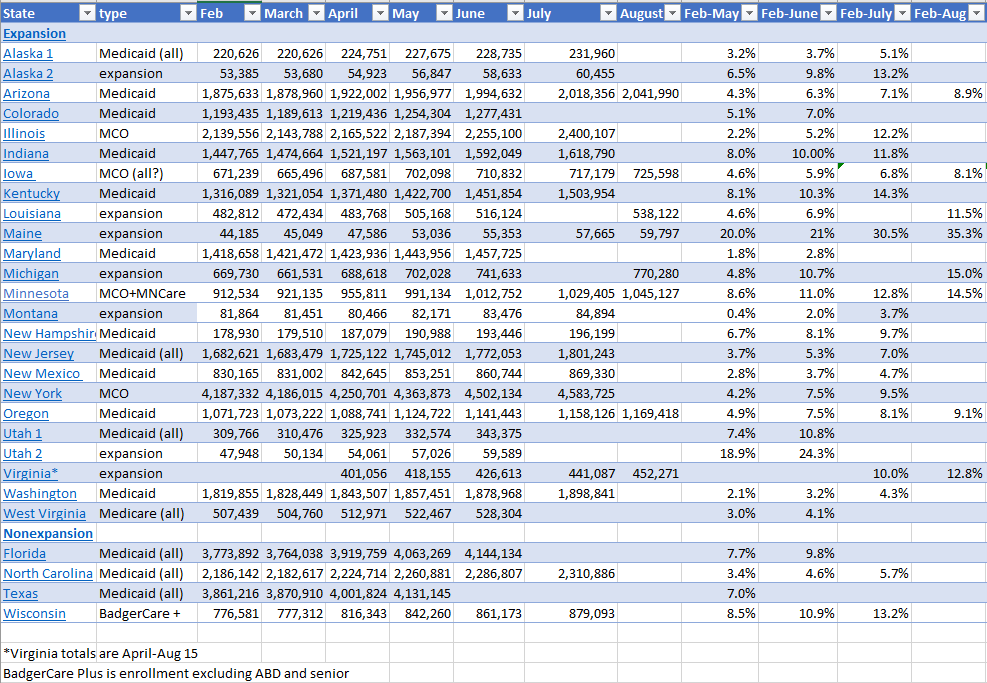
Update, 8/15: Illinois Medicaid enrollment surged 6.4% from June to July and is up almost 10% since May. Enrollment in Indiana is up 11.8% since February. Of the twelve expansion states below that have reported enrollment in all or most Medicaid programs through July (excluding tallies for expansion population only), the average increase since February is 9.2%. 
---
It's time for a fresh post on pandemic Medicaid enrollment, instead of piling updates on my prior snapshot. While I'm focused primarily on states that enacted the ACA Medicaid expansion, I've started to also track nonexpansion states and will keep adding them as I find data.  I have a bunch of URLs to pick through, thanks to a very helpful overview of enrollment in 33 states through May and June  by Chris Frenier, Sayeh S. Nikpay, and Ezra Golberstein.

To review some basic context: the Urban Institute forecast that nationally just shy of half* of those who lose access to employer-sponsored insurance will enroll in Medicaid if severe unemployment lasts for "several months to a year." At 15% unemployment, Urban projects that between 8.2 million and 14.3 million people will enroll in Medicaid, an increase of 11%--20% over total enrollment in early 2020, or 16%--28% over the total of enrollees under age 65.   While the current national unemployment rate has dipped officially to 10%, it's likely to spike again as our public health failures lead to renewed shutdowns and our legislative failures result in cutoffs or sharp reductions in relief benefits.

Note that some of the the tallies below are for the ACA Medicaid expansion only -- that is, adults with incomes under 138% of the Federal Poverty Level. The federal government pays 90% of the cost for enrollees rendered eligible by the expansion. It's not surprising that the expansion population tallies reflect faster growth, since a large percentage of the nation's children were enrolled in Medicaid or CHIP pre-pandemic, enrollees over age 65 are in Medicare and usually not reliant on employer-sponsored insurance, and those eligible for disability Medicaid are also likelier to have been enrolled pre-pandemic.

       Medicaid enrollment in 26 states, February - August 2020
Medicaid enrollment in the Covid-19 pandemic

Friday, March 06, 2020

Employer-sponsored insurance is deteriorating. What about fixing it rather than replacing it?

Subscribe to xpostfactoid via box at top right --->

Medicare for All's main political liability, as the presidential campaign has made clear, is loss aversion: most Americans are insured,  most are reasonably satisfied with their coverage, and a significant minority consider their top-drawer coverage a major asset. Americans also have ample cause to doubt their government's capacity to completely remake the country's healthcare system and serve as the sole source of major medical insurance to everybody.

At the same time, Medicare for All speaks to a current reality: employer-sponsored insurance (ESI), which covers the majority of Americans under age 65, is deteriorating, and Americans know it.  Kaiser Family Foundation tracking poll results released last week neatly capture the core household worries related to healthcare:
About two-thirds of Americans say they are either “very worried” (35%) or “somewhat worried” (30%) about being able to afford unexpected medical bills. This is larger than the share that say they are worried about affording a variety of expenses, including other types of health care costs as well as other household expenses. About half of insured adults say they worry about being able to afford their health insurance deductible (49%) and four in ten (40%) worry about being able to afford their premiums. More than four in ten adults overall worry about affording prescription drug costs (45%).

Thursday, September 26, 2019

Employer-sponsored insurance as we know it is unsustainable. Now what?

Subscribe to xpostfactoid via box at top right (requires only an email address; you'll get 2-3 emails per week on average)

Kaiser's 2019 Employer Health Benefits Survey, released yesterday, highlights a basic I noted a month ago (based on a Kaiser precursor report): employer-sponsored health insurance is deteriorating. Average family plan premiums have topped $20,000; average deductibles have topped $1,600. Family premiums have increased 54% over ten years. That's actually down from the previous ten years, when rates more than doubled. But the climb in excess of inflation has been relentless.

The system most consistently fails low income workers -- many of whom would be better off if the employer offered no insurance, rendering them eligible for ACA marketplace subsidies. KFF president Drew Altman lays out the basics:
  • Roughly 36 million American workers earn $25,000 per year or less — retail workers, personal care attendants, warehouse workers and many more.
  • Just 33% of workers at lower-wage firms offering health benefits are covered by their employer’s health benefits, well below the 63% share at other firms offering coverage.
  • These low-wage workers pay an average of $7,000 per year just toward the premium for a family plan.
  • Workers in low-wage firms also face much higher deductibles: a $2,679 annual single deductible, while at other firms, the average is $1,610.
My takeaways:

Tuesday, August 27, 2019

Healthcare reformers can't leave employer-sponsored insurance untouched

Subscribe to xpostfactoid via box at top right (requires only an email address; you'll get 2-3 emails per week on average)

Presidential candidates and other Democrats who want to patch or build on the ACA rather than create a substantially new system generally neglect, to varying degrees, an attendant problem: employer-sponsored insurance (ESI) is also in dire need of reform.

A Kaiser Family Foundation's report on large employer coverage released this month found that health spending by families in large employer plans has grown twice as fast as wages over the past decade. The employer share of costs in family coverage (premium plus out-of-pocket) has downticked only slightly:  it was 68% in 2008 and 66% in 2018.  But families and employers alike are tapped out: total costs increased 67% over those ten years. The total cost of large group coverage for a family of four now averages $22,000 per year. Reducing healthcare costs is among voters' top priorities.

Beyond the steady-but-high yearly increases recorded by Kaiser, yesterday NYT reporters Reed Abelson and Katie Thomas spotlighted a recent development that could be destabilizing: the proliferation of specialty drugs for rare diseases, which can carry price tags in the millions per patient per year. As Abelson and Thomas note, about 10% of the population is afflicted with rare diseases,  and more than half the drugs approved in 2018 targeted such diseases.

Saturday, June 22, 2019

Did the Trump administration just open a back door to to a massive "Medicare" buy-in?

Subscribe to xpostfactoid via box at top right (requires only an email address; you'll get 2-3 emails per week on average)

The Trump administration has potentially shaken up American health insurance markets by finalizing a new rule allowing employers of all sizes to fund employees' health insurance premiums in the individual market in lieu of offering them access to an employee-sponsored group health plans. They can do this by funding Health Reimbursement Arrangements (HRAs), currently used for medical expenses excluding premiums for individual market plans, to fund individual market premiums to any level they choose -- e.g., to roughly the percentage of premiums they currently contribute to group health plans.

Many healthcare scholars and stakeholders worry that the alternative will be particularly attractive to employers with older, sicker employees, or that large employers will find ways to send sicker employees to the individual market. As a defense against that, the rule stipulates that a given employee group (sliced various ways, e.g., part-time vs. full time) can't be offered a choice between a group health plan and the individual market -- the employer must offer either/or. The rule also suggests (pdf pg 9) that the narrow provider networks prevalent in the individual market would be more attractive to healthier than to sicker populations -- and presumably, such preferences would influence the choices employers offer.

The administration forecasts that over ten years, about 11 million people will access HRAs to enroll in individual market coverage, while the number of people covered in employer-sponsored plans will drop by about 7 million (current ESI enrollment is about 150 million). The impact on the individual market would be major, but on the employer group health market, relatively modest.

But the HRA rule potentially cracks the door for a future Democratic Congress and president to vastly expand access to public insurance within the current Affordable Care Act structure. Suppose the next Congress, enabled by a Democratic president, injects into the ACA marketplace a national public option, paying Medicare rates to providers or some adjusted version of them, and requiring providers who accept Medicare to accept the public option?

Monday, May 27, 2019

Medicare for all who want it: Potential and pitfalls

I have suspected for some time that the longest-lasting Democratic presidential candidates may converge on health care reform plans that enable any American to buy into a strong public option (probably deemed "Medicare") at an affordable price. That would include people whose employers offer coverage -- they would be subsidy-eligible if they opt into the public plan.

The existing bill that fits this description is the Medicare for America Act -- a bill that takes such an open-to-all public plan to its logical conclusion by phasing out Medicaid and revamping the Medicare currently available to seniors and the disabled -- and, crucially, adding long-term care insurance. The bill is rich in promise and not free from pitfalls, which I've been more or less live-blogging over the past couple of weeks. I thought I'd take some space here to index those posts, a step toward making something of a coherent whole of them (including some earlier posts). Here goes, then.

The plan that lets anyone buy into Medicare (3/21/19)
This overview at healthinsurance.org starts with my core question: Can Democrats bite off as much healthcare reform as Medicare for America encompasses? Might they pare it back to its core -- a public option buy-in for anyone who wants/needs it?

Medicare for America might let private insurance thrive (3/22/19)
The key condition is that healthcare providers would have to accept "Medicare" payment rates from commercial insurers.

Wednesday, May 15, 2019

Would Medicare for America phase out employer-sponsored insurance?

Subscribe to xpostfactoid via box at top right (requires only an email address; you'll get 2-3 emails per week on average)

It's often regarded as an open question whether the Medicare for America Act, were it to become law, would lead to a phase-out of private insurance. The bill makes a revamped Medicare available to anyone of any age who wants or needs it, with premiums adjusted by income even if the enrollee has access to employer-sponsored insurance.

The revamped "Medicare" is free to anyone whose household income is below 200% of the Federal Poverty Level (FPL) -- about 30% of the population. For those with incomes over 600% FPL, the premium is 8% of income. Those in the 200-600% FPL range will pay a sliding scale, topping out at 8%. Newborns are auto-enrolled, as are the uninsured. Employers can either pay an 8% payroll tax and direct their employees to the public program, or continue to offer their own health plans. Medicare Advantage continues alongside the public program.

I do not think the bill would kill of employer-sponsored insurance, though it would likely shrink the market to a kind of blue-chip perk for well compensated employees. ESI is likely to persist for several reasons:
  • The bill stipulates that medical providers have to accept "Medicare" payment rates (not identical to current rates, but based on them) from private insurers.

  • The employer tax exemption for health benefits persists. In fact, the ACA's "Cadillac Tax" on especially generous plan (long postponed) is repealed.

  • Most importantly, the 8% of income that affluent people would pay for the revamped "Medicare" is considerably more than many pay out-of-pocket for employer-sponsored insurance.
The average premium for family coverage in ESI was $19,616 in 2018, according the Kaiser Family Foundation's Employer Health Benefits Survey, with the employee footing $5,547, or 28%.  For a couple with one child earning $125,000 -- a shade over 600% FPL -- that's 4% of income.

Monday, April 15, 2019

Cold comfort for low income workers insured through their employers

Subscribe to xpostfactoid via box on right (requires only an email address; you'll get 2-3 emails per week on average)

The Kaiser Family Foundation and the Peterson Center on Health Care released a report yesterday showing that low income families enrolled in employer-sponsored health insurance (ESI) pay a much higher percentage of their income on premiums and out-of-pocket expenses than do higher income employees. That isn't surprising, though the percentage of income eaten up by healthcare is disturbing. Families in ESI earning up to 199% of the Federal Poverty Level (FPL) spend an average of 14% of income on healthcare, according to Kaiser's analysis of Census data. Families with at least one member in poor or fair health spend an average of 18.5% of income on healthcare.

What is somewhat surprising -- to me, anyway -- is that lower income families with ESI do not spend more in absolute terms than better-paid employees. I was under the impression that low income workers are often offered much skimpier insurance than higher income workers. That impression was at least partly derived from Kaiser's annual Employee Health Benefits Survey. Here's the contrast between employers with mainly low- vs. high-income employees from the 2018 survey:

Friday, March 22, 2019

Medicare for America might let private insurance thrive

Subscribe to xpostfactoid via box on right (requires only an email address; you'll get 2-3 emails per week on average)

The Medicare for America Act, soon to be updated and reintroduced by Reps Rosa DeLauro and Jean Schakowsky, is a true "Medicare for anyone" bill. Any employer can buy in* by paying 8% of payroll, and any individual can opt in and pay between $0 and 9.69% of income (on a siding scale) for a plan to be accepted by all providers who accept current Medicare -- i.e. virtually all providers.

While the bill allows employers to keep providing insurance and preserves Medicare Advantage in the individual market, some people appear to read the bill as a phase-out of private insurance.   Kirsten Gillibrand, for example, in a town hall earlier this week, touted a Medicare buy-in for anyone at "4-5% of income" and suggested, "Those insurers -- I don't think they're going to compete...over a couple of years, you're going to transition into single payer."

That would not likely be the case if Medicare for America were to become law, at least not in its current iteration. While low income workers would probably mostly end up in the public program, the bill creates conditions under which employers might still find a competitive advantage in offering top-drawer coverage to higher-paid workers. It also creates conditions under which Medicare Advantage and Medigap policies might compete.

Wednesday, February 06, 2019

How many might be loathe to trade employer-sponsored insurance for expanded Medicare?

In my last post, I stressed that a significant and politically powerful subset of the 156-odd million Americans who get health insurance through employers have coverage way better than the norm. Those with the most generous employer-sponsored coverage (ESI) might be averse to transitioning to a public plan with significant cost sharing -- say, to a plan with coverage comparable to a typical Medicare Advantage plan.

Out-of-pocket costs for enrollees in ESI have risen rapidly in recent years; premiums have risen more slowly, but steadily. Nonetheless, a lot of people have coverage a good deal more generous than the norms reported in the Kaiser Family Foundation's 2018 Employer Health Benefits Survey -- e.g., deductibles well below the $1,573 average for single coverage, and premiums well below the $99 per month average for single and $462/month average for family coverage.

The figures below**, taken from the Kaiser survey, highlight benefits enjoyed by insured employees with the most generous coverage.
  • For 12% of covered workers, the employer pays 100% of the premium for single coverage. Another 8% of workers in single coverage pay less than $500 per year. Just 3% of covered workers pay nothing for family coverage; another 4%, pay under $1500 annually.

Friday, October 05, 2018

For high out-of-pocket costs in employer plans, 3 shock absorbers

The Kaiser Family Foundation's annual Employer Health Benefits Survey was released this week. There are no big surprises. Premium growth remains relatively modest compared to the immediate pre-ACA era - 3% for single coverage and 5% for family -- though still outstripping wage growth. The percentage of workers covered by employer insurance is stable, as is total ESI enrollment, at 152 million. 79% of workers are offered coverage, and 76% take it up -- similar to last year.

Kaiser does emphasize continued rapid growth in deductibles: the average annual deductible has increased 53% in five years. That's a proxy for out-of-pocket costs continuing to rise. Here I want to quickly point out three partially mitigating factors.

1. Increase in HSAs and HRAs (Section 8) - the percentage of workers who hold these accounts dedicated to paying medical expenses, which are linked to high deductible health plans (HDHPs), spiked from 20% in 2014 to 29% in 2016 and has stayed at that higher level. Since employers generally fund these accounts, they partly offset high deductibles while also shrinking the employee's premium. In 2018, the average employer contribution to an HRA for a single person plan, $1149, outstripped the average employee share of the premium, $1142, and covered about half the average deductible, $2245. The average contribution to an HSA, $603, covered more than half the employee's average premium share, $1024, and about a quarter of the deductible. For family coverage, the average HRA employer contribution was $2288, and the average HSA contribution was $1073. HRA contributions are bigger because these accounts are "use it or lose it" for the employee -- whereas an employee owns an HSA, and contributions are tax-sheltered.

Tuesday, February 27, 2018

Hey Senator Warren, Medicare Extra fills your prescription

Last month, at the Health Access 2018 conference, Elizabeth Warren decried rising out-of-pocket costs required in employer-sponsored health plans and demanded that a new round of healthcare reform "require private insurers to be just as affordable as public insurers like Medicare and Medicaid.”  (I discussed the speech at some length here.)

That formulation struck me as problematic in several ways: 1) Medicaid and Medicare offer very different levels of affordability (except where they're merged for dual eligibles); 2) employer-sponsored insurance, on average, is "just as affordable" as Medicare and in fact provides better protection against crushing out-of-pocket costs than traditional Medicare; and 3) Warren bashed insurers alone for price-gouging without mentioning provider payment rates, which would have to be squashed down if commercial insurance were subject to stricter affordability mandates.

Perhaps, though, Warren had some inkling of the Medicare-for-all-who-need-or-want-it plan that was brewing at the Center for American Progress, released yesterday.

Friday, July 08, 2016

Commonwealth: Lower income ACA marketplace buyers get a tolerable substitute for employer-sponsored insurance

The Commonwealth Fund writeup* of its 2016 survey of adults under age 65 with health insurance stresses that lower income marketplace enrollees (under 250% FPL) pay premiums and deductibles comparable on average to those paid by enrollees in employer-sponsored plans.

Overall, survey results suggested, 57% of marketplace enrollees spend less than $125 per adult per month on premiums, compared to 60% in employer-sponsored plans. And among the 59% of marketplace enrollees with incomes under 250% FPL, 30% have per-person deductibles over $1,000, versus 26% at that income level in employer plans. At higher incomes, the discrepancy is sharper: 68% of marketplace enrollees over 250% FPL have deductibles over $1,000, compared to 42% of those in employer plans.

These survey findings track roughly with my own calculation that the weighted average actuarial value of a marketplace plan in the 38 states using HealthCare.gov  is 81.4%** -- quite close to various estimates of average AV in employer-sponsored plans, I also found, though, that the weighed average AV for Hc.gov enrollees with incomes under 200% FPL (not 250%)  was 86.3%. For those over 200% FPL, it was just 69.3%.

In my view, 200% FPL is a more useful dividing line for marketplace enrollees than 250% FPL -- because Cost Sharing Reduction (CSR) subsidies, while available up to 250% FPL, fall off a cliff at 201% FPL. CSR raises the actuarial value of a silver plan from a baseline of 70% to 94% for those up to 150% FPL, to 87% for those up to 200% FPL, but to just 73% for those in the 201-250% FPL range. To relate this to the Commonwealth survey: the average deductible for a silver plan at the weakest CSR level (200-250% FPL) is $2491.

Saturday, April 09, 2016

Is the ACA's drag on employer-sponsored insurance less than expected?

There seems to be an impression stalking the land that once upon a time (and for many years thereafter), the Congressional Budget Office forecast that the Affordable Care Act would strongly inhibit Americans' access to employer-sponsored insurance -- and that the forecast has not panned out. That's a misimpression.

In fact, since 2010 CBO has consistently forecast that the ACA would mildly inhibit the growth in access to ESI that would have taken place had the law never been passed. In all its annual ten-year forecasts, single years in which it forecast an actual drop in ESI enrollment form the year are rare -- and in fact, almost all such forecast one-year drops are for 2016..* From 2010 to 2016, moreover the only year in which CBO forecast that total ESI enrollment would be lower ten years ahead than in the present year was...this year. The current forecast has ESI at 155 million for 2016, dropping to 152 million by 2019 and staying at that level through 2026. In 2010, CBO forecast that ESI enrollment would be 159 million in 2019.

Why, then, the impression that CBO has reduced its estimates of ESI inhibition?  In one important, and relatively recent sense, it has. In 2013, CBO  ratcheted up its forecast of a drop in ESI this year, then pushed it up another notch in 2015. That cut was to be in tandem with a jump in enrollment in the ACA marketplace, always forecast for 2016. This was to be the year that the marketplace came of age and several million would presumably be sucked out of the employer-sponsored market -- presumably as employers of lower income workers came to recognize that their employees could do better in the ACA marketplace (which is broadly true for employees with household incomes below 200% of the federal poverty level). Again, every year since 2010, CBO has forecast an absolute drop in ESI this year. That apparently hasn't happened.

Tuesday, October 20, 2015

Who leaves employer-sponsored insurance on the table?

The Kaiser Family Foundation's latest estimate of the still-uninsured population in the U.S. includes about 4.8 million whose employers offer health insurance that they decline to buy.

Some are locked out by the ACA's so-called "family glitch," which denies marketplace subsidies to those for whom an employer's insurance offering would cost less than 9.5% of income for individual coverage, even if the family coverage offered by the employer costs far more than that. But many low income workers find even individual employer-sponsored insurance (ESI) unaffordable. Probably the bulk of Kaiser's estimated 4.8 million who forgo ESI could do well in the ACA marketplace if the ESI offer didn't disqualify them from subsidies.

The New York Times' Stacy Cowley has a good story that spotlights the plight of those who can't afford insurance offered by their employers:

Monday, September 28, 2015

"Are marketplace plans affordable?"

Last week the Commonwealth Fund released a report* comparing the experiences of people who bought health plans in the ACA marketplace to that of people who get health insurance through their employers. Commonwealth surveyed nearly 5,000 adults between March and May of this year, asking questions about their income, their insurance status, plan features, usage and affordability.

With respect to out-of-pocket costs, here's the top-line takeaway as framed in the Commonwealth press release:
Overall, larger shares of adults with marketplace plans had per-person deductibles of $1,000 or more than did those with employer plans (43% vs. 34%). The differences were widest among those with higher incomes: in this group, over half (53%) with marketplace plans had high deductibles, compared to about one-third (35%) with employer plans. In the survey, people with high deductibles were less confident than those with lower deductibles that they could afford needed care.
What's equally salient, in my view, is that the subsidized marketplace has narrowed the longstanding coverage gap between employer-sponsored insurance (ESI) and nongroup market insurance for lower-income buyers. Compare those with incomes under 250% of the Federal Poverty Level (FPL) to those with ESI:

Sunday, April 05, 2015

Why do more people say the ACA has harmed than helped them?

One ongoing frustration for ACA supporters in public opinion polling is the fact that the number of people say that the ACA has directly harmed them and their families consistently outstrips the number who say it has directly helped them.

Now that the ACA is directly subsidizing health insurance for about 20 million people, that particular perception has narrowed but not closed. Here's a graph from the Kaiser Family Foundation, which polls on this question regularly:


Since last May, the gap has narrowed from 24-14 to 22-19. But it's still there, and the question is where the perception (and/or reality) of direct harm comes from.