Thursday, September 16, 2021

Notes from the SEP: On record marketplace enrollment in August 2021

Subscribe to xpostfactoid

CMS today released a final enrollment report for the emergency Special Enrollment Period that ran in HealthCare.gov states from Feb. 15--Aug. 15 this year, and for mostly comparable lengths in the 15 state-based marketplaces. 

The top line: 2.8 million new enrollments nationally in that period. A few quick notes:

  1. Effectuated enrollment in August 2021, 12,199,393, is up 14.6% over 2020, the previous high (10,642,088*), and 22% over enrollment in August 2016, the peak prior to 2020.  Caveat: off-exchange enrollment in ACA-compliant plans dropped by about 3 million from 2016 to 2019, according to KFF estimates. On-exchange enrollment is about 2.2 million above the August 2016 total.

  2. While 2.8 million people newly enrolled in marketplace coverage during the SEP, total enrollment has risen by only 900,000 since February, when effectuated enrollment stood at 11.3 million.  That's steeper attrition than I anticipated when I estimated total enrollment at 12.7 million through July.

Friday, September 10, 2021

Dropping the Medicare age to 60 also requires...

Subscribe to xpostfactoid


130 House Democrats have co-sponsored a bill introduced on September 3 by Pramila Jayapal, the Improving Medicare Coverage Act, that would drop the Medicare eligibility age to 60 -- simply and cleanly, with Medicare offered on the same terms at age 60 as it now is at age 65, within six months of enactment. That's the headline. But the bill does something else that's arguably more consequential. 

Without other changes to Medicare, dropping the eligibility age to 60 would be a mixed blessing at best. That's because for 60-64 year-olds with income below 200% of the Federal Poverty Level ($25,520 for an individual, $34,480 for a couple in 2021), Medicare in its current form would be considerably more expensive than ACA marketplace coverage (as enhanced through 2022 by the American Rescue Plan Act in enacted in March) -- excepting for those who are dually eligible for Medicaid and Medicare. While just over a quarter of the U.S. population is in households with incomes below 200% FPL, about half of the uninsured have incomes below that threshold.  

Jayapal's bill changes the equation by making all Medicare enrollees with income below 200% FPL eligible for a new Medicare Cost Assistance Program that would zero out premiums, coinsurance and deductibles for Medicare Parts A (hospital)  and B (physician and outpatient), and also subsidize Part D prescription drug coverage (covering the entire Part D premium and reducing prescription copays to single-digit dollar amounts).  The bill would also move administration of these benefits from state Medicaid programs to Medicare, with the federal government assuming 100% of costs now shared with states.

Saturday, September 04, 2021

Viewing the uninsured rate through foggy lenses

Subscribe to xpostfactoid
Medicaid card

Snapshots of the health insurance status of the U.S. population are blurry.

When you look at the CMS tally of Medicaid enrollment increase since the pandemic struck, it seems, simply, that the increase swamps most estimates of the number of people that lost employer-sponsored insurance. Other factors are at work, of course. But the one large number is considerably larger than the other large number.

But official Medicaid enrollment totals may not be an entirely reliable measure of how many people are actually covered by Medicaid, and know themselves as such -- particularly during this pandemic, when disenrollments have been paused since March 2020. State Medicaid agencies are, to varying extents, blind beasts.

I know a young man who, during a year of transition, lived in two states and worked at three jobs, with a period of unemployment. At different points in the year he applied for Medicaid in two (blue) states and received rejection notices. From both of those states, months later (and months apart), while insured through a new employer, he was sent managed Medicaid membership cards and informed that he'd be enrolled since shortly after his application was completed.  In both states, it took some doing and some time to get himself disenrolled.

Thursday, September 02, 2021

How will Medicare enhancement change the current public-private Medicare ecosystem?

Subscribe to xpostfactoid


Democrats' aspirations to add dental, hearing and vision benefits to Medicare raises questions about the interactions between tradition, fee-for service (FFS) Medicare, Medicare Advantage (MA), and Medigap. These center on MA's growing market share, its funding mechanism, the gaps in FFS Medicare coverage that MA plans partially fill, and the value of Medigap for those who can afford it (or whose employers fund it).

Below, a brief outline (distilled mainly from KFF briefs) of how the three programs (FFS, MA and Medigap) interact/compete at present, followed by questions about how pending legislation may alter the ecosystem.

Tuesday, August 31, 2021

NHIS: No shift from private to public insurance?

Subscribe to xpostfactoid

The annual early release estimates from the National Health Interview Survey (NHIS) came out today. The NHIS recorded a decrease in the uninsured rate for all ages from 2019 to 2020, from 10.3% to 9.7%, but deemed the change statistically insignificant. Among adults aged 18-64, the uninsured rate  dropped from 14.7% to 13.9% -- also deemed not significant. Similarly, the Urban Institute survey report that I wrote about last week found essentially no change in the uninsured rate from March 2019 to April 2021 -- but also recorded a statistically insignificant drop. 

Directionally, as I noted last week, most surveys, including the Census's experimental Household Pulse Survey, point to a modest drop in the uninsured population during the pandemic. Big picture: huge gains in Medicaid enrollment, driven largely by a pause in disenrollments effectively mandated by pandemic relief legislation, appear to have outstripped drops in access to employer-sponsored insurance (ESI), which according to various sources fell less than the massive job losses triggered by the pandemic might have led one to expect. But there are a lot of moving parts that may have canceled one another out. 

Thursday, August 26, 2021

Is the uninsured rate flat since 2019, or down a bit?

Subscribe to xpostfactoid

See 8/31 update from NHIS survey at bottom

The Urban Institute, in an analysis of results from its own ongoing Heath Reform Monitoring Survey, found that the uninsured rate among adults aged 19-64 did not change significantly from March 2019 to April 2021. 

That's at least a backhanded tribute to the U.S.'s kludgy health insurance safety net as bolstered by the Affordable Care Act. Big picture: in Urban's estimate, as a result of the pandemic, employer-sponsored insurance  fell by 3 percentage points (from 65% to 62.3%) in the survey period, while insurance through public programs (mainly Medicaid) increased by 4 percentage points (from 13.6% to 17.5%). 

You could read these results as a paean to the ACA Medicaid expansion (which Republicans almost repealed in 2017). In states that have expanded Medicaid, Urban found that the uninsured rate actually dropped two percentage points for people with incomes below 138% FPL, the Medicaid eligibility threshold. According to CMS, total Medicaid enrollment (including children) increased by 11 million -- 15.6% -- from February 2020 to March 2021.  Enrollment among adults rendered eligible by the expansion increased by about double that rate.

Urban recorded a much more modest and ambiguous impact for the ACA marketplace -- though the huge enrollment surge during the emergency Special Enrollment Period open from February 15 through August 15 of this year, turbo-charged by subsidy increases enacted in the American Rescue Plan, which appeared on HealthCare.gov on April, was mainly missed by Urban's study period. I'll return to that in a bit.

I speculated in May that the U.S. uninsurance rate might be at an all-time low, powered by huge gains in Medicaid enrollment, significant gains in marketplace enrollment, and relatively modest losses in employer-sponsored insurance during the pandemic. My methods (and math) are far less sophisticated than Urban's, and this is not to question their results (no source ever has a really complete picture of insurance in the U.S.).  That said, a few comments and caveats below.

Thursday, August 19, 2021

What's the effect of a gold benchmark in the ACA marketplace? Three states tell a tale. And a platinum benchmark is coming.

Subscribe to xpostfactoid

Bloomberg's Sara Hansard reports that six states have now taken action to require insurers in their ACA marketplaces to price plans in strict proportion to their actuarial value -- that is, to increase the effects of silver loading. (Actuarial value (AV) refers to the percentage of the average enrollees costs the plan is designed to cover, in percentages fixed by metal level.)

Maryland, Pennsylvania and Virginia required strict silver loading in 2021 (and some or all in years prior). New Mexico and Colorado have new regulations going into effect in 2022. Texas has passed a law requiring the state insurance commissioner to take the value of Cost Sharing Reduction (added to silver plans only) into account during rate review.

Silver loading as mandated in Maryland, Pennsylvania and Virginia makes gold plans at least marginally cheaper than silver plans, increasing value for enrollees with incomes above 200% of the Federal Poverty Level ($25,520 for an individual in 2021). Below that income threshold, Cost Sharing Reduction (CSR) raises the actuarial value of silver plans to a roughly platinum level.

Friday, August 13, 2021

On staying out of the coverage gap: expert advice

Subscribe to xpostfactoid

I have a post up on healthinsurance.org addressing a subject near my heart: how to help more people avoid the "coverage gap" in states that have refused to enact the ACA Medicaid expansion.  That is, how to avoid being denied any help paying by estimating next year's income at a level below 100% of the Federal Poverty Level.

Eligibility for subsidized coverage (now free at incomes in the 100-150% FPL range, e.g., for anyone just over the eligibility threshold) is based on an estimate of next year's income. A lot of variables go into such estimates, especially for people with low incomes, who are often self-employed or work variable and unpredictable hours, or rely on tips, or do seasonal work. In this piece, brokers and enrollment counselors who have been at work since the ACA marketplace launched explain in detail how to maximize a good-faith estimate when necessary.

In many, many cases, failing to qualify for subsidized coverage is a matter of ignorance. The application does not tell you that there's a minimum income threshold you need to cross. Accordingly, the first step in helping low-income people seeking coverage is to spell out the minimum qualifying income:

This point can't be emphasized enough, according to Shelli Quenga Director of Programs at the Palmetto Project, a nonprofit health insurance brokerage in South Carolina.  "You need to know what amount you're shooting for," Quenga says. "You need to know where that line is. HealthCare.gov does not tell you."

Paradoxically, the application does recognize income uncertainty, and in fact positively invites applicants to take it into account:

Tuesday, August 10, 2021

Total marketplace enrollment likely approaches 13 million

Subscribe to xpostfactoid

Axios reports that Vice President Harris will announce today that more than 2.5 million people have signed up for marketplace coverage during the emergency Special Enrollment Period that began on February 15 and ends on August 15. (Yesterday, Charles Gaba estimated 2.57 million total SEP enrollments as of July 31.) [Update: CMS's SEP report through July 31 is out and cites the 2.5 million total.]

Just for fun, let's take a stab on where total marketplace enrollment likely stands right now. 

We know that effectuated enrollment totaled 11,290,546 in February, and that about 2.5 million additional enrollees have been logged since then. The wild card is disenrollments during those months. To estimate them, our best hints come from monthly enrollment tallies in 2020, recorded in the effectuated enrollment snapshot for February 2021.

Thursday, August 05, 2021

Maximizing the ACA Innovation Waiver: Biosimilar silver loading, anyone?

Subscribe to xpostfactoid

Ask, and it shall be given

The advocates for more affordable health insurance at Families USA are asking the Biden administration to loosen up the Catch-22 that confronts states seeking to take advantage of the ACA's section 1332 innovation waivers.

1332 waivers enable states to propose alterations to virtually every feature of the ACA marketplace in pursuit of more affordable and effective coverage. The alternative scheme must cover at least as many people at least as comprehensively as the existing marketplace, and must do so without increasing the federal deficit. 

As currently interpreted, the deficit-neutral requirement presents a Catch-22: if the state's alternative scheme ends up costing more because more people sign up, the state is responsible for the excess costs, even if the coverage costs less (or no more) per person than the exiting ACA marketplace. 

Monday, August 02, 2021

ACA enrollment under ARPA: The view from near 100% FPL (and San Antonio)

Subscribe to xpostfactoid


The ACA's tragic coverage gap confronts poor people in the 12 states that have refused to date to enact the ACA Medicaid expansion with a cruel logical absurdity: they may earn too little to qualify for government-supported health coverage.  Adults in households with incomes below the Federal Poverty Level (100% FPL) do not qualify for subsidized coverage in the ACA marketplace.

A few weeks ago, I noted that on May 5 CMS put a modest patch on the coverage gap by rescinding a Trump era policy of demanding income verification from marketplace applicants in nonexpansion states if "trusted data sources" indicated that the applicant's income was likely below 100% FPL -- i.e., ineligible for subsidies -- and the applicant had estimated an income above that threshold. (Since HHS's computer systems can't be retooled instantly, CMS explained, the exchanges will continue to request documentation in these circumstances for some time -- but in followup communication, they will "notify those consumers that they need not provide the requested information.")

In effect, a low-income applicant can make a good faith estimate of a household income in the coming year above 100% FPL and qualify for subsidized coverage (now free through 2022, if income is below 150% FPL, thanks to the subsidy boosts in the American Rescue Plan enacted on March 11). Documentation will not be required (though awkwardly, it will be requested for some time).  If income for the year in question ultimately proves to fall below the 100% FPL threshold, there is no clawback of subsidies granted, unless the applicant's income estimate is made with "intentional or reckless disregard for the facts."* 

The opportunity for low-income applicants to estimate their way into free coverage is the sort of regulatory forbearance that inspires high moral dudgeon from conservative adversaries of the ACA. In fact, though, poor or near-poor people in nonexpansion states who get as far as applying for health coverage - many don't, as ignorance of ACA programs is pervasive -- are likelier to underestimate their income than overestimate it. 

Friday, July 23, 2021

A Wisconsin window on the ACA coverage gap in pandemic time

Subscribe to xpostfactoid

To pick up a thread from deep in the prior post...

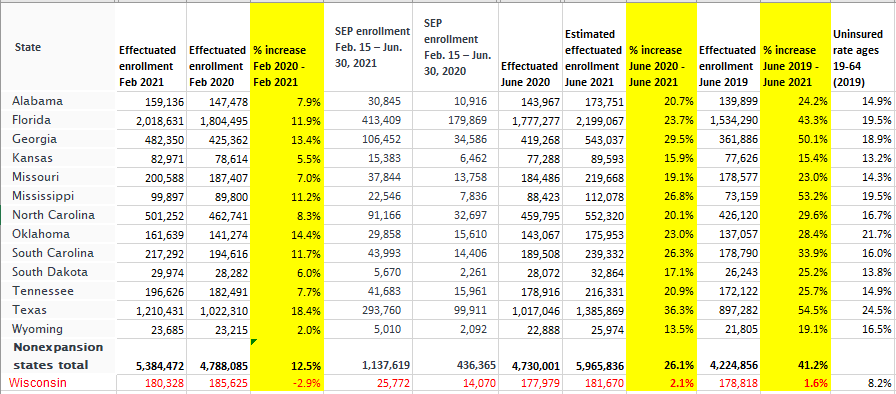
In Wisconsin, ACA marketplace enrollment as of June 30, 2021 had increased by less than two percentage since June 2019. In the other thirteen states that had not enacted the ACA Medicaid expansion as of June 30 of this year, enrollment increased by 41% over the same period.

What's the matter (or rather, what's right) with Wisconsin?

    Enrollment in nonexpansion states, 2019-2021

     Sources: CMS, Early Effectuated Enrollment Snapshot, 2020, 2021; SEP enrollment 7/14/21; KFF
     See the prior post for an explanation of how June 2021 enrollment is estimated.

A lot of factors affect marketplace enrollment, which varies widely by state. But the most salient factor would appear to be the fact that Wisconsin has no "coverage gap." 

Thursday, July 22, 2021

Obamacare enrollment in nonexpansion states is up 26% year-over-year and 41% since June 2019 (estimate)

Subscribe to xpostfactoid

Not to indulge in monomania, I want to offer a clearer snapshot than previously of really major marketplace enrollment gains in the pandemic period in states that had not enacted the ACA Medicaid expansion as of June 30 of this year.  As the uninsured rate in the nonexpansion states was nearly double the rate in expansion states as of 2019 (15.5% vs. 8.3%),  particularly rapid enrollment growth in those states -- most of it at low incomes -- is having a significant impact where help is most needed.

Every June, CMS publishes "effectuated" (i.e., paid-up) enrollment in each state as of February of that year. Those reports also break out monthly enrollment by state in the year prior. This year, that information is supplemented by monthly reports on off-season enrollment, stimulated this year by an emergency Special Enrollment Period (SEP), running from February 15 through August 15 in the 36 states using HealthCare.gov, which is the functional equivalent of a second Open Enrollment Period (the 15 states that run their own exchanges have also opened emergency SEPs.) The SEP reports provide enough data, or so I assume below, to estimate effectuated enrollment through June 30 of this year.

By my estimate, enrollment in 13 nonexpansion states as of June 30 -- excluding Wisconsin, for reasons discussed below -- is up 26% year-over-year, and 41% since in June 2019. That's a two-year increase of 1.74 million.  Enrollment is up by more than 50% since June 2019 in Texas, Georgia and Mississippi. It's up by almost 500,000 in Texas and by more than 650,000 in Florida.

Saturday, July 17, 2021

A huge increase in low-income ACA marketplace enrollment in nonexpansion states

Subscribe to xpostfactoid

This is a postscript to my last post tracking massive SEP enrollment in nonexpansion states from February 15-June 30 of this year.  

I want to try to take the full measure of the enrollment surge in nonexpansion states at the lowest subsidy-eligible income level -- first in Open Enrollment season for 2021, and then in the emergency Special Enrolment Period (SEP) launched by the Biden administration on Feb. 15. This week, CMS reported SEP enrollment through June 30.

(This post is all numbers; please see the last post (and its backlinks to past posts ) for context, definitions, explanations.)

By my estimate, enrollment at the 100-150% FPL income level in 13 nonexpansion states (Wisconsin excluded*) in OE 2021 and the SEP for the Feb. 15-June 30 period combined exceeded 2020 enrollment in those two periods by almost 800,000.  That would be an increase of about 29%.

Thursday, July 15, 2021

More than half of all ACA SEP enrollment is in nonexpansion states

Subscribe to xpostfactoid

CMS announced yesterday that ACA marketplace enrollment during the emergency Special Enrollment Period (SEP) that began on February 15 had passed 2 million by June 30. That's more than triple the total enrolled in the same period of 2019, the last year unaffected by the pandemic. By that standard, the emergency SEP, coupled with the subsidy boosts in the American Rescue Plan (ARP), has produced more than a million excess off-season enrollments. Mid-year on-exchange enrollment is certainly at an all-time high.

Let's look again (as I did in June) at emergency SEP enrollment in states that as of June 30* had not  enacted the ACA Medicaid expansion. In those states, eligibility for marketplace subsidies begins at an income of 100% FPL (as opposed to 138% FPL in expansion states), and more than a third of enrollees in normal times have incomes below 150% FPL -- which, as of ARP passage in March, now qualifies them for a free benchmark silver plan with low cost-sharing. 

As in the prior SEP report on enrollment through May 31, SEP enrollment in 13 nonexpansion states (excluding Wisconsin, which has no coverage gap**) accounts for 75% of enrollment in the 36 states that use the federal exchange, HealthCare.gov. These 13 states account for more than half of SEP enrollment nationally.  SEP enrollment in these states is more than quadruple enrollment in the same period in 2019, exceeding that year's total by more than 860,000.

Monday, July 12, 2021

Democrat to voters: "Friend, this past year, we saw just how important Medicaid expansion was to hard-working..."

Subscribe to xpostfactoid

Terry McAuliffe, once and would-be future governor of Virginia, is running on the ACA Medicaid expansion (which opponent Glenn Youngkin opposed) and building on the ACA.  Here's the lead in a weekend email to supporters: 

Friend, this past year, we saw just how important Medicaid expansion was to hard-working Virginians and to folks across the country. Before COVID-19 hit, 394,000 Virginians were enrolled in Medicaid. Now? It’s over 550,000.

That’s over 150,000 Virginians who had coverage during the worst global public health crisis in recent history because of Medicaid expansion. But our work is not over.

700,000 Virginians - including 100,000 children - don't have access to health insurance. We NEED to continue to expand coverage to make sure every single Virginian has great health care.

The language there is a little sloppy -- over 550,000 Virginians (562,530 if you're keeping score at home, up 43% since March 1, 2020)  were rendered eligible for Medicaid by the ACA expansion criteria.  In total, 1.86 million people in the state are enrolled in Medicaid, up from 1.54 million on March 1, 2020, an increase of 20%.  

That safety net performance at a time of mass (if partially temporary) unemployment and mortal danger to health is something for Democrats to be proud of, especially since they scripted the moratorium on Medicaid disenrollments (in the Families First Act of March 2020) that's largely enabled the increase. They should all run on it. Remember, Republicans came within a breath of repealing the ACA's core programs, chief among them the Medicaid expansion.

Saturday, July 03, 2021

Making the ACA work 2014-2016: Administrative roads not taken

Subscribe to xpostfactoid

The Obama administration stood up the ACA's core programs in the face of a never-ending shitstorm of Republican defamation, disinformation, noncooperation on the state level, total litigation warfare, and fiscal sabotage. For that they deserve our undying thanks. 

By the time Obama left office, the ACA had cut the ranks of the uninsured by about 40 percent, mainly through Medicaid expansion. The marketplace and the expansion proved resilient through the Trump years and provided a vital safety net when the pandemic struck. Since February 2020, Medicaid enrollment by those rendered eligible by the expansion has increased by about 5 million, and marketplace enrollment (with a large push by the Biden administration) by close to two million.

In administering the ACA, however, the Obama administration operated under self-imposed restraints. Pre-Trump, and before Republicans passed their $2 trillion tax giveaway to the wealthy in 2017, Democrats had yet to recognize -- or rather, acknowledge --  the full extent of Republicans' economic fraudulence. Without new appropriations by Congress that they knew would not be forthcoming,  Obama and administration officials were reluctant to increase spending on ACA programs and so increase the deficit. They declined to take several measures that would make coverage more affordable or credible. These included the following.

Monday, June 28, 2021

Nudging people out of the coverage gap, cont.

Subscribe to xpostfactoid

In my last post, I noted that on May 5 CMS finalized a rule that patches a bit of the coverage gap afflicting low-income people in 13 remaining states that have refused to implement the ACA Medicaid expansion.

In those states, eligibility for ACA premium subsidies begins at incomes above 100% of the Federal Poverty Level (FPL). State residents with incomes below that threshold who do not qualify for Medicaid under the states' restrictive criteria get no government help to pay for coverage. Some 2 million adults are in this gap.

Saturday, June 26, 2021

In May, CMS quietly moved to shrink the ACA's coverage gap in states that have refused to expand Medicaid

Note: All xpostfactoid subscriptions are now through Substack alone (still free), though I will continue to cross-post on this site. If you're not subscribed, please visit xpostfactoid on Substack and sign up!  

One of the most intractable of the holes in the ACA's implicit promise of affordable care for all is the so-called "coverage gap" opened up when the Supreme Court made the ACA Medicaid expansion optional for states in 2012, two years prior to scheduled full implementation. 

As originally enacted, the ACA provided Medicaid eligibility to adults in households with incomes up to 138% of the Federal Poverty Level (FPL). In the wake of the Supreme Court decision, just 25 states implemented this expansion upon the 2014 launch of the ACA's core programs. To date, thirteen holdout states have not enacted it. In those states, eligibility for ACA marketplace subsidies begins at 100% FPL, and some 2 million adults with incomes below that level get no help obtaining insurance.

There's no easy way for Democrats to plug this hole, as KFF's Larry Levitt recently explained on Twitter. They could make people in nonexpansion states with incomes below 100% FPL eligible for premium subsidies. But that might tempt states that have enacted the Medicaid expansion to rescind it, since the federal government pays 100% of marketplace premium subsidies and "only" 90% of Medicaid costs for expansion enrollees. They could create a new federally administered public option operating in nonexpansion states, but that's a heavy administrative lift, and very likely beyond the political capabilities of a Democratic party with razor-thin majorities.

As I mulled Levitt's thread, a partial and kludgy administrative response occurred to me: CMS could allow any applicant in a nonexpansion state to attest to an income over 100% FPL, without requiring documentation. In 2020, supplemental unemployment insurance provided by the CARES Act pushed a lot of incomes over the 100% FPL threshold, and enrollment for 2021 at 100-150% FPL in nonexpansion states soared 17%. Marketplace subsidy eligibility is based on an estimate of next year's income, and low income is notoriously uncertain and fluctuating. Why not open the door further?

I took a look at the statute setting the terms for marketplace subsidy eligibility and verification (42 U.S. Code § 18081) and the 2022 Notice of Benefit and Payment Parameters (NBPP) published May 5, 2021, seeking a way that current rules might be modified. It turns out that new rulemaking is unnecessary. 

As of now (effective May 5), CMS is declining to require verification of an income claimed to be above 100% FPL even if data sources tapped by CMS indicate that the applicant's income is below that threshold. The change is announced in the NBPP:

Elsewhere: the ACA survives and thrives

 For BlueWaveNJ, I've overviewed the legal threats to the ACA -- just overcome and still pending; the subsidy boosts enacted in the American Rescue Plan and their effects so far; and likely and unlikely next steps.  I covered similar ground at healthinsurance.org, with more attention to the remaining subsidy-eligible uninsured and measures to smooth and encourage enrollment.

Subscribe to xpostfactoid