Showing posts with label CBO. Show all posts

Thursday, June 05, 2025

Republicans poised to halve the ACA cake and eat it

Note: All xpostfactoid subscriptions are now through Substack alone (still free), though I will continue to cross-post on this site. If you're not subscribed, please visit xpostfactoid on Substack and sign up.

There’s a sad symmetry to the Congressional Budget Office’s final estimate of the coverage effects of the healthcare provisions in the monstrous megabill that passed the House with no Democratic votes on May 22.

In March 2011, CBO estimated that by 2021, the ACA would reduce the uninsured population by 34 million — 17 million via Medicaid, and 17 million via the subsidized ACA private-plan marketplace. (Below, note the net gain in the individual market: 24 million enrolled in the exchanges established by the ACA, minus 6 million in the off-exchange market and another 1 million in employer-sponsored plans.)

After waves of political upheaval, including a major boost to marketplace subsidies in 2021 (now apparently doomed to expire at year’s end), those estimates look pretty good. In Medicaid, 16.6 million enrollees as of June 2024 (the last available tally) were rendered eligible solely by the ACA expansion, and total Medicaid enrollment as of January 2025 is up by 22 million over the last pre-ACA total. As for the marketplace, enrollment as of the end of Open Enrollment 2025 was 24.3 million, with perhaps another 2 million off-exchange, compared to total individual market enrollment of 10.6 million pre-ACA, by KFF’s estimate.

Today, in a narrative breakdown of its estimates sent to ranking Democrats in the key House and Senate committees, CBO forecasts an increase of 16 million uninsured people triggered by the House bill coupled with Republican refusal to extend the ACA subsidy increases enacted in 2021 and funded only through 2025. Like the coverage gains triggered by the ACA, these coverage losses would split almost evenly between coverage losses triggered by the bill’s changes to Medicaid and its changes to rules governing the ACA marketplace. Here is the breakdown:

Changes to Medicaid are forecast to increase the uninsured population by 7.8 million, and changes to the ACA marketplace, by 8.2 million.

Thursday, January 09, 2025

ACA fulfills early forecasts

Note: All xpostfactoid subscriptions are now through Substack alone (still free), though I will continue to cross-post on this site. If you're not subscribed, please visit xpostfactoid on Substack and sign up.

CBO inside

As we near the end of the ACA marketplace’s Open Enrollment Period (OEP) for 2025, CMS is out with a new enrollment snapshot showing 23.6 million plan selections. As OEP has another week to go in the 32 states using HealthCare.gov, and up to 23 days more in some state-based marketplaces, Charles Gaba estimates final enrollment at 24.2 million*, up about 13% over OEP 2024 — and just about double the 12.0 million total in OEP 2021. That was the last year before the Democratic Congress and the Biden administration changed the game by radically boosting premium subsidies and expanding eligibility for them as part of the American Rescue Plan Act (ARPA), enacted in March 2021 (and effective immediately during an emergency Special Enrollment Period that had started on February 15).

The ARPA subsidy increases made benchmark silver coverage with strong Cost Sharing Reduction free to enrollees with income up to 150% FPL; removed the 400% FPL cap on subsidy eligibility; and reduced the percentage of income required for the benchmark silver plan at all income brackets in between. Enacted as a pandemic measure lasting only through 2022, the enhanced subsidies were extended through 2025 by the Inflation Reduction Act, enacted in August 2022. If the Republican Congress declines to extend the ARPA subsidy boosts, OEP 2025 will stand as the marketplace’s high-water mark, and millions will drop coverage beginning in 2026 (7.2 million according to the Urban Institute’s estimate).

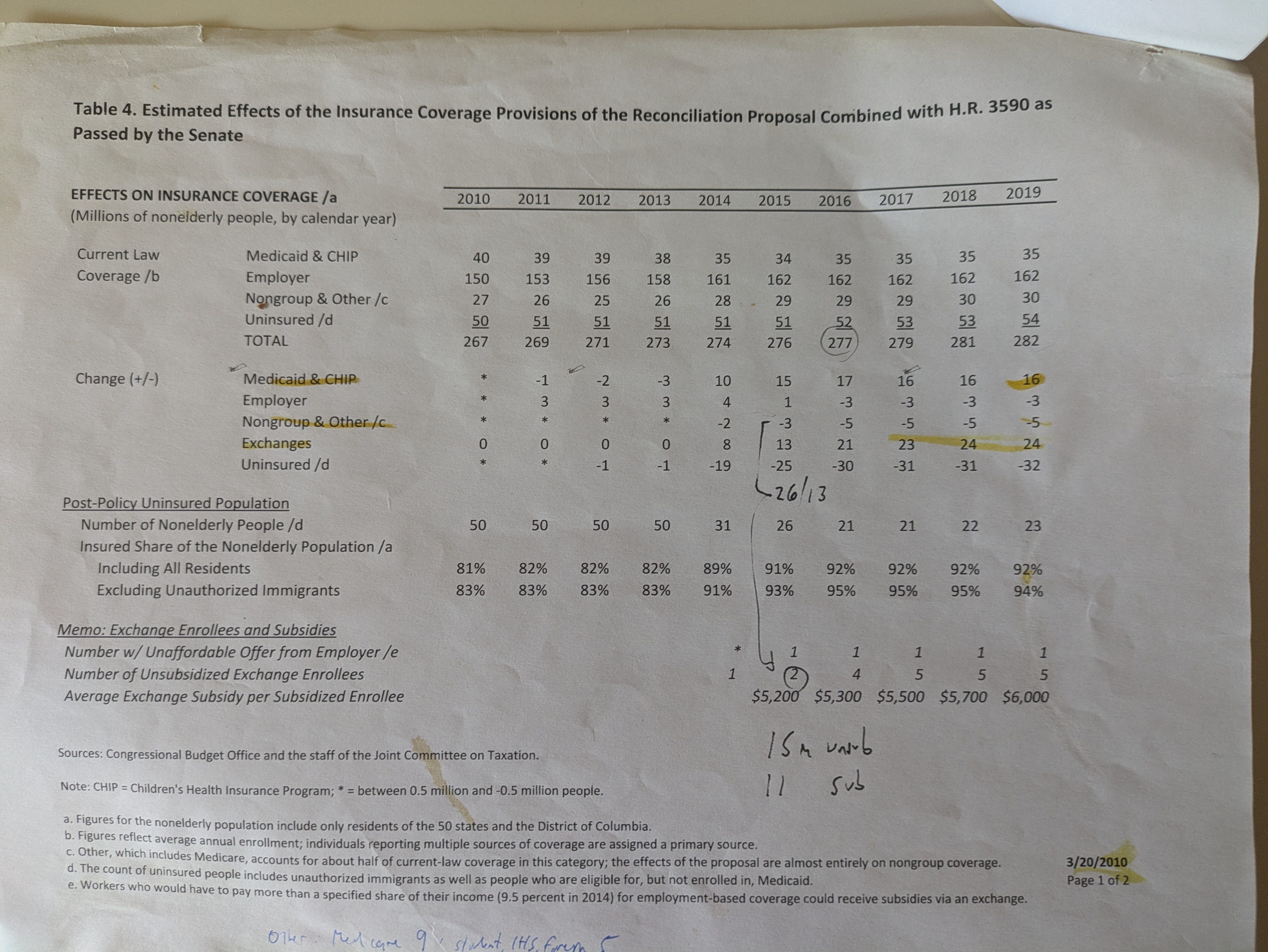
I have written more than once that the ARPA subsidy boosts brought the ACA within striking distance of fulfilling the mission expressed in its name (affordable coverage for all who lack access to pre-ACA sources of health insurance) and envisioned by its drafters — and by the Congressional Budget Office, e.g., in its final projection prior to enactment, on March 20, 2010. That is almost literally true now. Enrollment in the ACA’s core programs — the Medicaid expansion and the subsidized marketplace — is quite close to the 2010 CBO ten-year projections, albeit six years late (and just shy of four years after ARPA was enacted — when, in a sense, the clock restarted).


Top line, the CBO in 2010 was almost dead-on as to the ACA’s long-term effect on the uninsured rate, forecasting that 92% of the nonelderly U.S. population would be insured ten years in. That wasn’t true in 2019 (pre-pandemic, pre-ARPA), but it’s close to true now. The latest quarterly estimate from the National Health Interview Survey (NHIS), for Q2 2024, pegs the uninsured rate in the under-65 population at 9.1%. In 2010 CBO forecast 23 million uninsured as of 2019; the NHIS pegs the uninsured population (all ages) at 25.3 million in Q2 2024.**

I cannot locate the March 2010 CBO report on the ACA’s likely effects (updates from 2011 forward are readily available), so I’ll have to rely on an old printout. Forgive some old scribblings in the 2015 column.

Some notes as to the forecasts for 2019:

  • CBO anticipated the marketplace approaching full capacity with 23 million enrollees in 2017, its fourth year of operation, edging up to 24 million in 2018 and remaining at that level in 2019. Current enrollment is…24 million. (Add 1.8 million in the Basic Health Programs established in three states, which CBO did not anticipate — see the first note at bottom.)

  • CBO projected a net increase of 16 million in Medicaid enrollment from 2010 to 2019. There are a couple of ways to assess this projection. First, as of September 2019, total Medicaid enrollment was up 15.1 million from July-September 2013, the pre-ACA comparison point used by KFF.

  • Viewed another way, the total number of Medicaid enrollees rendered “newly eligible” by ACA expansion criteria (that is, adults with income up to 138% FPL who would not have been eligible by other criteria) was 16.6 million*** in June 2024 — the last month for which numbers are available. By that point, the “Medicaid unwinding” — resumption of disenrollments in May 2024 after a three-year pandemic-induced moratorium — was mostly over.

  • While getting the top line for increased Medicaid enrollment more or less right, CBO actually underestimated the ACA’s effects on Medicaid enrollment, as it expected the ACA expansion to be in effect in every state. In June 2012, the Supreme Court rendered the expansion optional for states, and initially only 24 enacted it. As of December 2019, 34 states had enacted the expansion; as of now, ten states, including Florida and Texas, still have not.

  • The persistence of “nonexpansion states” has inflated marketplace enrollment. In the ten remaining nonexpansion states, 5.8 million marketplace enrollees reported income in the 100-138% FPL range, which would have placed them in Medicaid had all states enacted the expansion.

  • In light of the points above, based on what it knew/assumed in 2010, CBO overestimated marketplace enrollment and underestimated Medicaid expansion (as about 6 million marketplace enrollees in nonexpansion states “ought” to be in Medicaid). Those misses more or less cancelled each other out as to the top line.

  • Medicaid enrollment increased by more than 20 million during the three-year moratorium on involuntary disenrollments enacted in March 2020 as part of the Families First Act, a pandemic relief bill. The “unwinding” — resumption of redeterminations and disenrollments — that began in spring 2023 was clumsy and cruel in many states, and too many children lost coverage. When the dust settled, however, enrollment was still 7.7 million higher in September 2024 than in March 2020, the eve of the pandemic, and the uninsurance rate may prove not to have risen. After a year-plus of unwinding, enrollment among those rendered eligible by ACA expansion criteria was up was 5.4 million higher in June 2024 than on the eve of the pandemic in March 2020.

  • CBO forecast a net drop in employer-sponsored insurance (ESI) of just 3 million over ten years. According the KFF’s annual survey based estimates, enrollment in employer-sponsored insurance was 3 million higher in 2010 (estimated at 157 million) than in 2024 (154 million). The labor force did increase by about 4.4 million from 2019 to 2024, perhaps suggesting a slight further shrinkage in ESI.

  • CBO also forecast a drop of 5 million from 2010 to 2019 in off-exchange “nongroup” insurance combined with “other” insurance — an opaque catch-all category that includes disability Medicare (about 7 million at present), student health plans, care at correctional facilities, and some other odds and ends. The drop was forecast to occur chiefly in off-exchange nongroup enrollment, and that drop was probably steeper than forecast, driven by a) a sharp rise in unsubsidized premiums in 2017-18, b) a steady fade-out of pre-ACA “grandfathered” and “grandmothered” (don’t ask…) plans, and c) by ARPA’s removal of the income cap on subsidies, which prompted a lot of new enrollment in the 400-600% FPL range. CBO probably underestimated the drop in off-exchange nongroup enrollment. In a 2019 brief, KFF estimated nongroup enrollment in 2011 (pre-ACA) at 10 million. By the first quarter of 2015, per KFF, off-exchange nongroup enrollment in ACA-compliant and noncompliant plans combined had dropped only modestly to 8.8 million, but after steep premium increases in 2017-2018 it plummeted to an estimated 3.3 million by Q1 2019. CBO estimates from June 2024 peg nongroup coverage bought outside the marketplace at a similar 3.1 million in 2024. That looks like a drop of about 7 million in off-exchange nongroup enrollment from the pre-ACA period to 2019 and beyond — perhaps 2 million more than forecast, though a lot of moving parts are involved.

It may seem somewhat dicey to compare 2025 totals to CBO’s 2010 projections for 2019. But I believe the comparison is instructive. The 2010 10-year forecast encompassed just six years of operation of the ACA’s core programs, which kicked off in January 2014 (though a few states started the Medicaid expansion early). Marketplace and Medicaid enrollment stalled, and in fact went into modest reverse, during the Trump years, until the pandemic struck. The ARPA subsidy enhancements, which have been in effect through four OEPs (2022-2025), represented a new beginning — and the premise here is that the enhanced subsidies enabled the marketplace to fulfill the function envisioned at the level envisioned.

ARPA made that fulfillment possible. In late 2009, as the ACA was writhing through multiple iterations in the Senate, it was plain to progressive advocates that the emerging subsidy schedule was inadequate to the marketplace’s purpose. In his 2011 book about the battle to pass the ACA, Richard Kirsch, national campaign manager from 2008-12 for Health Care for America Now (HCAN), an umbrella group formed by unions and progressive nonprofits to advocate for universal health care, took the inadequacy of the subsidies as a given:

In the President’s September address to Congress, the President not only made a concession on the public option. He also said, “the plan I’m proposing will cost around $900 billion over ten years.” Yet $900 billion was not enough money to make health care truly affordable to the uninsured. Why did the President make another, preemptive concession to the bill’s opponents, one that would significantly damage his core goal? An article co-authored by Robert Pear and The New York Times White House correspondent Jackie Calmes summarized the impact nicely: “The number suggests a political and fiscal calculation to avoid the sticker shock of the trillion-dollar threshold. But it probably means that Mr. Obama could fall short of his goal of providing universal coverage for all Americans because the lower cost may force lawmakers to reduce the subsidies needed to help more uninsured individuals and small businesses seeking coverage for employees.”...

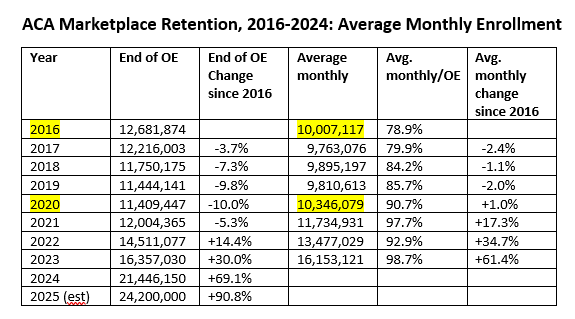
While the marketplace roughly met enrollment goals in its launch year, 2014, and enrollment increased substantially in 2015, CMS officials in the later Obama years knew that enrollment would not grow in line with CBO projections — and starting in OEP 2018, team Trump took steps to ensure that enrollment would not grow (e.g., gutting funding for enrollment assistance and outreach, shortening the OEP, and standing up an alternative market of ACA-noncompliant plans). Average monthly enrollment reached a peak in 2016 that would not be passed until the pandemic and resulting job layoffs stimulated off-season enrollment in 2020 (as highlighted in the Average Monthly Enrollment column below). In 2021, ARPA took over, and the rest is the history we’ve been examining.

Sources: Marketplace Open Enrollment Public Use Files and Full-Year and February Effectuated Enrollment tables, available via the 2024 Early Effectuated Enrollment Snapshot.

None of this is to suggest that the marketplace is an unproblematic program (and wait till team Trump 2.0 gets hold of it). I personally think that a market of private plans offered mostly by for-profit insurers paying modified commercial rates to providers and pushed by competition toward very narrow provider networks is a suboptimal way to offer health coverage to those who lack access to other sources of insurance. Out-of-pocket costs in the marketplace are way too high; networks are too narrow; and the proliferation of plan choices in each market, numbering over 100 on average in 2024, is nonproductive and bewildering. All that said, coverage is currently available and affordable to most of those who need it. That wasn’t true until ARPA, and it’s a BFD. It very likely won’t be true in 2026 or any time soon.

- - -

* Another 1.8 million people are enrolled in the Basic Health Programs offered in lieu of the ACA marketplace to low-income enrollees by New York, Minnesota and Oregon (1.6 million of them in New York*). BHPs, an alternative provided to states by the ACA statute, are standardized, Medicaid-like plans with low out-of-pocket costs. New York’s Essential Plan is technically no longer a BHP, as the state extended eligibility to enrollees with income up to 250% FPL in 2024. By statue, BHPs can only serve enrollees with income up to 200% FPL. New York reorganized the Essential Plan, preserving its federal funding, via an ACA Section 1332 “innovation waiver.”

** Since 2019, the population has grown by about 9.3 million, suggesting that if CBO’s estimate for that year had been on target and remained stable until now, another 760,000 people would be uninsured. So the modest gap between the CBO 2010 estimate and the current NHIS estimate of the absolute number of uninsured is roughly in line with the percentage gap.

*** CMS offers two measures of ACA expansion enrollment in Medicaid: those rendered eligible by ACA criteria (“Group VIII”), and those rendered newly eligible by those criteria. The distinction stems from a handful of states independently extending Medicaid eligibility to all adults with income up to a threshold of 100% FPL or higher; in those states, a number of Group VIII enrollees would presumably remain eligible if there were no ACA expansion. In June 2024, there were 20.9 million Group VIII enrollees, 16.7 million of them “newly eligible.”

- - -

Non sequitur: some writing from me in a different mode, for kids.

Thanks for reading xpostfactoid! Subscribe for free:

Friday, August 17, 2018

Tom MacArthur gutted ACA protections for people with pre-existing conditions. Can Andy Kim make the charge stick?

Axios offers an interesting first look at a battle that will play out in a lot of Congressional districts defended by Republicans who voted for the ACA repeal bill, the American Health Care Act (AHCA) as amended by Tom MacArthur (NJ-3).

Democrats will say the incumbent voted to gut protections for people with pre-existing conditions -- that is, the ACA rules forbidding insurers in the individual market to base premiums on an applicant's medical condition or history. Incumbents -- e.g. MacArthur, who introduced the amendment that opened the door to medical underwriting -- will say not so:
Sen. Heidi Heitkamp of North Dakota, one of the most vulnerable Democrats up for re-election this year, is out with a new ad that claims her opponent, Rep. Kevin Cramer, voted to gut protections on pre-existing conditions. Axios' Caitlin Owens has the lowdown:
  • Naturally, Cramer doesn't like the ad. The North Dakota GOP accused Heitkamp of telling "repeated lies" about his stance on pre-existing conditions.

Saturday, May 05, 2018

Will Trump's cutoff of CSR reimbursement boost ACA enrollment by 2-3 million, per CBO?

Trump's cutoff of federal funding for Cost Sharing Reduction subsidies (CSR) last October created discounts in bronze and gold plans for many subsidized enrollees in the ACA marketplace, as explained below.  The availability of these discounts partly offset other forms of sabotage, so that on-exchange enrollment was down a relatively modest 5%.

On May 3, CBO Director Keith Hall estimated in a blog post that the CSR cutoff has boosted or will boost marketplace enrollment by an astonishing 2-3 million. The verb tense and time frame is ambiguous, per below (my emphasis). The estimate surely does not apply to 2018 -- I doubt the enrollment boost this year exceeded 500,000, for reasons explained below.

Here's Hall's explanation of how the CSR discounts came about and their likely effects:
On the basis of an analysis of insurers’ rate filings, CBO and JCT estimate that gross premiums for silver plans offered through the marketplaces are, on average, about 10 percent higher in 2018 than they would have been if CSRs were funded through a direct payment. The agencies project that the amount will grow to roughly 20 percent by 2021.

Monday, November 20, 2017

The tax bill from hell

Let it not be said that I take forecasts as gospel. But three forecasts about the Senate tax bill from our appointed Congressional arbiters, the Joint Committee on Taxation and the Congressional Budget Office, do form a remarkable trifecta. Over ten years, the bill is forecast to
  • Increase the deficit by $1.4 trillion
  • Raise taxes on every income band up to $50-75,000
  • Uninsure 13 million people.
If they teach legislating in hell, this is what you'd learn to come up with.

Sunday, August 20, 2017

If I had $194 billion...spending the federal funds that CSR cutoff would waste

The CBO report on the effects of the federal government ceasing reimbursement of insurers for the Cost Sharing Reduction subsidies they are required to provide to qualifying ACA marketplace enrollees includes two projections tantalizing to Democrats.

First, if not executed until 2018, not mishandled by states and not coupled with other forms of sabotage (a lot of ifs!), CSR defunding need not harm individual market enrollees and will in fact provide a windfall to many (by about a million as of 2020, sustained through 2026).*

Second, this means of boosting coverage is colossally inefficient, in fact outright profligate. CBO projects that ending the CSR reimbursements will cost the Treasury $194 billion over ten years, $37 billion in 2026 alone (and so imagine the 20-year cost).

That's a lot of money for Republicans to spend to spite Democrats. To review, the ACA instructs the Treasury to reimburse insurers for CSR and built the cost of reimbursement into the funding baseline, though it quaintly leaves it to Congress to appropriate the money. Doing so has no impact on the deficit; refusing swells it by said $194 billion.

This suggests to me a rather perverse deal: Republicans, pay the money budgeted, and use the $194 billion in "savings" for tax cuts. The "savings"should just about cover the ACA's surtax on investment income for the wealthy, as CBO pegged the 10-year cost of repealing that tax at $172 billion). Sure, that's deficit-funded, but as Dick Cheney told us, deficits don't matter when Republicans are in control.

Of course, those who want the ACA to work and who want to expand coverage can think of better uses for the (otherwise wasted) money. We now have $194 billion in sugarplums dancing in our heads. I canvassed a handful of healthcare scholars as to what they'd do with the money.  A few possibilities:

Tuesday, August 15, 2017

Can Democrats afford to stand pat on the ACA?

A while back, I anticipated that Republicans would demand a steep price for passing legislation that would guarantee federal funding for the ACA marketplace's Cost Sharing Reduction (CSR) subsidies and possibly for a reinsurance program. I asked what Democrats should be willing to give up to secure those obviously necessary measures -- the first simply an end to sabotage, the second an individual market essential that Republicans bestowed liberally in their ACA replacement plans.

David Anderson counters that "this model of leverage is wrong" and that Democrats should be willing to give up...nothing.  The rationale is not "if you break it you own it" (i.e., Republicans will be blamed for market collapse),  but rather that forcing insurers to fund (and price for) the CSR subsidies as of 2018 would hand Democrats "an incredible policy victory."

Sunday, July 23, 2017

"Not losing, choosing"? - Avik Roy turns up the gaslight on the BCRA

Two weeks ago, I took on the argument of various BCRA proponents that most of the 22 million people forecast by CBO to lose insurance coverage should the bill become law would be "choosing, not losing." That write-off of legions of uninsured was founded on CBO's assertion that most of the first-year coverage loss of 15 million would occur "primarily because the penalty for not having insurance would be eliminated."  Expect to hear more of this, I forecast.

In brief, I suggested that argument depended on  1) conflating the forecast immediate effect of mandate repeal in 2018 with the ten-year effect; 2) ignoring the extent to which, in CBO's own telling, the mandate interacts with other changes in the marketplace and Medicaid; and 3) pooh-poohing the obvious and stated purpose of the mandate, which is to boost the ranks of the insured and reduce premiums by improving the risk pool -- which CBO clearly assumes it has accomplished in some measure.

Now here cometh Avik Roy, chief healthcare apologist for the Republican establishment, making the "choosing not losing" argument in detail.  Roy's addition to the argument hinges mainly on a rather breathlessly presented look at CBO's unpublished estimate of 10-year coverage losses attributable to mandate repeal under the BCRA (provided to Roy by a Congressional staffer). This estimate closely tracks CBO's published December 2016 analysis of the effects of repeal of the mandate alone, with the ACA left otherwise intact. CBO forecast that straight mandate repeal under the ACA would result in a ten-year coverage loss of 15 million, as compared to CBO's forecast that 22 million will lose coverage under the BCRA. Here's CBO's breakout of the losses under straight mandate repeal:

Saturday, July 08, 2017

Those uninsured by the BCRA "not losing, but choosing"? Get ready to hear it more.

Bloomberg reporter Steve Dennis flags a Republican talking point in favor of their latest travesty of a 'healthcare" bill that we're likely to hear more of in the next two weeks:
That's in response to:
This argument was first voiced byPaul Ryan, defending the first iteration of the House bill, and later by Tom MacArthur*, whose amendment undermining protections for people with pre-existing conditions secured that bill's House passage. As Cornyn, the Senate majority whip, has emerged as gaslighter-in-chief defending the Senate bill (the so-called Better Care Reconciliation Act, or BCRA), we should regard it as a kind of front-line defense. If the cabal now redrafting the BCRA in secret manages to improve the CBO score by throwing a couple hundred billion dollars back in the coverage pot -- reducing the forecast increase in the uninsured to, say, 15 or 12 million --expect to hear a lot more of it.

There is a ghost of truth in the allegation, which can be made to look more substantial by gaslight. so let's shine some stronger light,. A few points:

Friday, July 07, 2017

Info sources for healthcare wars

If I post this, I'll have an easier time finding it myself...an index of fact/stat sources for our current healthcare wars as well as for our current healthcare system. Will update continuously without notification.

Thursday, June 22, 2017

Quick thoughts before the bill hits the tape

The Senate iteration of the AHCA is due out in about 40 minutes. A couple of quick thoughts, brought into focus by David Anderson's "how to read the bill" cheat sheet:

1) Back-loaded per capita caps imposed on Medicaid can theoretically be repealed before they kick in. But if the bill's massive tax cuts are not similarly back-loaded (to improve the CBO score), new tax increases would have to be passed in concert with repeal.

2. The more Republicans fiddle around with and publicly fight over individual market subsidies and rules, the easier they'll likely find it to pass the massive cuts to Medicaid that are the bill's core feature.

3.I can't shake the feeling that McConnell has some trick up his sleeve to make the CBO score a positive shock that helps sweep the moderates into the yes column. A "positive shock" might be a forecast of,, say, a reduction of a mere 8 million in the number of people with insurance by 2026, which Republicans can explain away as a result of personal choices (no mandate coercion) or CBO error.

4. What could that shock be? A cap on the tax exclusion for employer-sponsored insurance? Hard to believe. A little coup within CBO? Don't know how that work. Something else? Nothing?

So much for idle speculation....

Monday, June 05, 2017

AHCA Reduces Federal Spending on Private Health Insurance by....4%

[originally posted May 30]  The Republican bill rejiggers subsidies for the individual market but barely reduces them on net. Almost all the real cuts are in Medicaid     

Hours before House Republicans introduced the American Health Care Act, their ACA partial repeal/replace bill, on March 6, former CMS director Andy Slavitt tweeted:
That remains true. In fact, it's truer than has been fully recognized.

The basic math of the AHCA, according to the Congressional Budget Office (CBO), is a $992 billion* reduction in federal revenue over ten years, offset by a $1.1 trillion reduction in spending on health insurance benefits. Most of that spending cut is in Medicaid, reduced by $834 billion over ten years, according to the updated CBO analysis released on May 24.

The rest of the spending reduction ostensibly comes from cuts in subsidies to private insurance. But that reduction is largely illusory -- - because two of the major tax cuts included in the AHCA subsidize privately purchased health insurance and medical care.

Thursday, May 25, 2017

CBO: Some states will kill protections for those with pre-existing conditions -- and oh yes, the AHCA still eviscerates Medicaid

In late April, Matthew Fiedler explained in a Brookings brief that the MacArthur amendment to the AHCA, which allowed states to subject people who fail to maintain continuous coverage to medical underwriting, would not just affect those who fail to maintain continuous coverage. Fiedler's summary:
...the framework created by the waiver would allow states to effectively eliminate community rating protections for all people seeking individual market coverage, including people who had maintained continuous coverage.

In brief, healthy people would have a strong incentive to “opt out” of the community-rated pool and instead pay a premium based on health status. With healthy enrollees opting out of the community-rated pool, community-rated premiums would need to be extremely high, forcing sicker individuals—including those with continuous coverage—to choose between paying the extremely high community-rated premium or being underwritten themselves. Either way, people with serious health conditions would face prohibitively high premiums. As a result, community rating would be eviscerated—and with it any meaningful guarantee that seriously ill people can access coverage.
The CBO analysis of the amended AHCA released yesterday reproduces this argument:

Sunday, March 19, 2017

AHCA vs. ACA: Total subsidized shares of costs at different income levels and ages

Late last year I cooked up a simple measure of the value of any given health insurance subsidy: the percentage of the premium paid multiplied by the actuarial value (AV) of the insurance obtained. AV is the estimated percentage of the average enrollee's medical costs paid for by the insurance.

In traditional Medicare, for example, for all but the highest-earning 5% of enrollees, the federal government pays about 85% of the combined premium for Parts A,B and D - which have a combined actuarial value a bit north of 80%. Hence the total subsided share of costs (can we call it TSS?) is about 69%.  Employers, according to the Kaiser Family Foundation, pay an average of 82% of the premium for individual insurance and 71% for family coverage. Given an average AV of 82% -- also a Kaiser estimate -- that yields a TSS of 66% for individual coverage and 58% for family.

I've previously estimated (see first link above) that the average subsidized ACA marketplace enrollee obtains a TSS of 59% -- with the federal government picking up an average of 73% of the premium for insurance with an average AV of 81%. Subsidies vary tremendously, however, ranging from 0% for the half of individual market enrollees who don't qualify for any help to over 90% for the lowest income enrollees obtaining silver plans enhanced with Cost Sharing Reduction.

Now, with the help of CBO analysis of the House repeal-and-replace bill, the American Health Care Act, it's possible to compare the federal TSS for people of varying income and ages under the ACA and the AHCA.

Wednesday, January 18, 2017

A good day for the ACA

While there will doubtless be many shifts and turns in the battle over the ACA, the road to repeal has seemingly got steeper for Republicans in the last couple of days. Some good developments:

1) Trump blew in with his promises to cover everyone, with low deductibles, and to enact his magic replacement at the same time as ACA repeal. That would seem to make it harder for Republicans in Congress to proceed with repeal-and-delay.

2) The Congressional Budget Office, traditionally the arbiter of the fiscal viability of proposed legislation, did the Urban Institute one better and estimated that the repeal-and-delay bill Republicans passed in late 2015 (vetoed by Obama) would un-insure 32 million people in a decade.

3) Media coverage pretty universally noted that the Jan. 15 rallies reflected deep support for the ACA and stiff resistance to repeal from its proponents. The NYT's Robert Pear, generally caustic about the ACA, put it this way:

Thursday, September 01, 2016

In 2016, CBO started counting Medicaid enrollment differently

CORRECTION, 6/6/17: Somehow, I missed an email response to my query from CBO (and asked them again twice after receiving the email). In 2016, they did not count partial benefit enrollees in their Medicaid totals; rather, the difference was that they counted people with multiple sources of coverage, including Medicaid, as Medicaid enrolled, whereas in past years they counted only the coverage source deemed primary. I was correct that in 2016 they started counting dual eligibles in both Medicaid and Medicare.

In a US News article by Kimberly Leonard about why the ACA private plan marketplace is not meeting enrollment expectations, while the ACA as a whole is reducing the ranks of the uninsured more or less on schedule, this claim did not compute:
Under Obamacare, states were allowed to expand the program to many more people, but many states have opted not to. Despite that, 16 million people more than expected enrolled in Medicaid and the Children's Health Insurance Plan, including in states that did not expand the program. Many people, it turns out, realized that they could have qualified for Medicaid even before the passage of the health care law.
Similarly, last March, when the Congressional Budget Office published its latest forecast of the ACA's effects, The New York Times' Robert Pear reported:

Thursday, July 21, 2016

Brookings bombshell: ACA lowered premiums, subsidies aside. Some caveats....

In a rigorous study of health insurance premiums in the individual market pre- and post-ACA, the Brookings Institution's Loren Adler and Paul Ginsburg come to a startling conclusion: in 2014, the year the ACA marketplace launched, average premiums were 10-21% lower than in 2013 -- leaving aside the subsidies accessed by over 80% of marketplace enrollees. Further: even accounting for the steep increases coming into effect in 2017, premiums will remain lower than they would have been if the ACA had not become law.

Based on CBO estimates and  projections of premiums from 2009 and later years, and data from the Medical Expenditure Panel Survey (MEPS), Adler and Ginsburg conclude:
According to our analysis, average premiums for the second-lowest cost silver-level (SLS) marketplace plan in 2014, which serves as a benchmark for ACA subsidies, were between 10 and 21 percent lower than average individual market premiums in 2013, before the ACA, even while providing enrollees with significantly richer coverage and a broader set of benefits. Silver-level ACA plans cover roughly 17 percent more of an enrollee’s health expenses than pre-ACA plans did, on average. In essence, then, consumers received more coverage at a lower price.

Thursday, March 24, 2016

CBO: Individual insurance market (including ACA marketplace) at about 83% capacity

In its yearly projections of the effect of the ACA on insurance coverage, CBO has always had a category called "nongroup and other" that I found frustratingly opaque. Included were  off-exchange individual (nongroup) market enrollees, people on disability Medicare, and a miscellany including student health plans and Indian Health Service coverage.

In new projections released today, CBO breaks out the major component parts of this grab-bag -- for the first time, as far as very close watchers whom I checked with can remember. The breakout is illuminating in a couple of respects.  Here are the numbers for 2016:


These tallies shed some light -- more or less by negation -- on CBO's past overestimates of the number of exchange enrollees.

Friday, March 04, 2016

Kaiser: ACA marketplace at 70% capacity among subsidy-eligible

The Kaiser Family Foundation has published an updated assessment of ACA marketplace enrollment to date and what full capacity would look like.  At present, total signups for private plans in the marketplace nationwide stands at 12.7 million, a total that's likely to drift down to somewhere between 10 and 11 million by year's end.  Kaiser estimates that if the national marketplace matched the performance of the 10 best-performing states to date, 16.3 million would be signed up by the end of open enrollment, drifting down to about 14.7 million by year's end.

There's a lot to unpack here. At the outset, I want to highlight a couple of noteworthy findings, discussed in more detail below. The first one is not actually spelled out in this report.
  • According to Kaiser's estimates, nationwide, at present about 70% of the subsidy-eligible potential marketplace customer base have signed up for marketplace plans. That will probably drift down to somewhere around 60% by year's end. Of 12.7 million total enrollees, 82%, or 10.4 million, were subsidized. According to Kaiser's Sept. 30, 2015 estimate, 14.8 million Americans were potentially eligible for premium subsidies at that time.

  • Kaiser's findings as to which income groups are cutting their uninsurance rates most dramatically* raise questions about the prevailing understanding of who finds the marketplace most attractive, at least by implication. Both Avalere Health and the Urban Institute have found that eligible marketplace shoppers with the lowest incomes have high takeup rates, which drop sharply and steadily with income. Kaiser finds that people in the lowest income bracket, below 150% FPL, have the second-lowest reduction in their uninsured rate among the income groups -- just an 18% reduction, compared to 33% reduction at 150-200% FPL, 23% at 200-300%, and 22% for those above 400% FPL (and so subsidy ineligible).

Sunday, November 01, 2015

How bronze plans offer fool's gold to the Treasury

I have more than once expressed frustration that HHS, when urging the uninsured to buy health plans in the ACA marketplace, emphasizes low premiums at the expense of good coverage. For example, CMS's snapshot of plan prices for the Open Season beginning today leads like this:
The next Open Enrollment period for the Health Insurance Marketplace begins on November 1, 2015 for coverage starting on January 1, 2016. According to an HHS analysis, about 8 out of 10 returning consumers will be able to buy a plan with premiums less than $100 dollars a month after tax credits; and about 7 out of 10 will have a plan available for less than $75 a month.
Only perhaps 5 out of ten returning customers will be able to buy a silver plan for under $100 per month, and many of those who slip beneath that round-number threshold by buying bronze plans will be forgoing the Cost Sharing Reduction (CSR) subsidies that are available only with silver plans.  Yet the messaging about CSR on healthcare.gov and in HHS's communications is confusing and underemphasized.

Perhaps the ambivalence or inattention to CSR stems in part from a financial conflict of interest between the federal government and shoppers on the ACA exchanges.  When a CSR-eligible shopper selects a bronze plan, the Treasury saves not only on the forgone CSR subsidy, but also, in some cases, on the premium subsidy. Bronze plans are in some regions priced so low that the full unsubsidized premium is less than the premium subsidy to which the buyer is entitled, which is calculated to leave her paying a fixed percentage of income for the second-cheapest silver plan available. That's likeliest to be the case for older buyers, for whom unsubsidized premiums can be up to three times as high as for young buyers

This pricing permutation is very much in play in California in 2016. In 2015, 53.5% of California's subsidized enrollees were between the ages of 45 and 64 -- and again, for older buyers, premium subsidies often cover the whole cost of a bronze plan, and then some.