Showing posts with label Charles Gaba. Show all posts

Wednesday, February 12, 2020

States seeking to reduce their uninsured populations must beware a Catch-22

By David M. Anderson, Charles Gaba, Louise Norris and Andrew Sprung
Note: this post is the third joint effort by David, Charles, Louise and me. Others here and here.
State policymakers have been prolific and creative in putting forward measures to strengthen their ACA marketplaces. Measures enacted since 2017 or in progress now include reinsurance programs, which reduced base premiums by an average of 20% in their first year in the first seven states to implement such programs; new or renewed state-based exchanges, which capture insurance user fees that can be used for advertising and outreach; state premium subsidies to supplement federal subsidies; and state-based individual mandates, which can provide funding for all of the above.
Policymakers must recognize, however, that these choices entail tradeoffs — and not just in budgetary constraints. Specifically, built into ACA marketplace architecture is a pricing dynamic that bedevils state attempts to improve ACA marketplace performance: reductions in premiums for unsubsidized enrollees tend to raise premiums for subsidized enrollees. Because premium subsidies are designed so that enrollees pay a fixed percentage of income for the benchmark (second cheapest silver) plan, premium increases also increase subsidies — and tend to increase the difference, or "spread," between the benchmark plan and cheaper plans.

Wednesday, July 31, 2019

Bernie Sanders is the Pied Piper of Healthcare Hamlin

Political battles can be semantic, but important. Such is the case with Democrats wrestling with the meaning of Medicare for all.

This week Kamala Harris came out with a healthcare reform plan that seems designed to resolve her past flip-flops as to whether private insurance should be phased out entirely. In brief, she proposed a 10-year path to "Medicare for all" that includes Medicare Advantage -- private plans reimbursed by the federal government and conforming to strict coverage rules. Employers could also offer "Medicare Advantage" plans.  Lots of question marks, but the intent to preserve the public/private hybrid of Medicare as we know it is clear.

Bernie's camp lit into the plan, claiming in effect that the his bill's title (Medicare for All) is politically trademarked. “Call it anything you want, but you can’t call this plan Medicare for All," Sanders' campaign manager Faiz Shakir said in a statement. Pramila Jayapal, lead sponsor of the House version, tweeted, "as lead sponsor of #MedicareForAll, I find it misleading when my fellow Democrats use the #M4A name to describe proposals that are NOT #MedicareForAll."

That's a straight trademark play: we own the hashtag, we own the name. The subtext is that the One True Path to Medicare for All is Sanders and Jayapal's Big Rock Candy Mountain in which a single government entity provides 100% coverage of everything for everyone, funded entirely by over $3 trillion per year in new taxes ($1.5 trillion according to Bernie).

Thursday, June 27, 2019

Elizabeth Warren is faking it on healthcare, part 2

Subscribe to xpostfactoid via box at top right (requires only an email address; you'll get 2-3 emails per week on average)

I was deeply disappointment by Elizabeth Warren's response to a question about Medicare for All in last night's debate. In brief, she went all in for Bernie's bill and Bernie's short path.

Charles Gaba usefully contrasts Warren's response last night to her response to a  question from a union member worried about losing good private insurance in a March Town Hall. There, Warren expressed openness to an incremental path either to Medicare for all (lower case "all," given the multiple paths she name-checked) or to universal coverage with a role for private insurance preserved (temporarily or permanently).

I don't think it's wise for Warren to leave herself no wiggle room to pursue health reform short of Medicare for All.  Last night she didn't:
There are a lot of politicians who say, oh, it's just not possible, we just can't do it, have a lot of political reasons for this. What they're really telling you is they just won't fight for it. Well, health care is a basic human right, and I will fight for basic human rights...
Fight, yes, but pick your battles and their pacing. If Warren fights all-out for Medicare for All -- Bernie's bill, which eliminates all other forms of insurance within four years and would require at least a doubling of federal revenue -- what happens to all those other plans she's got? Is she going to "fight for" universal childcare and free public college and near-total student loan forgiveness and a wealth tax and a sweeping new corporate charter -- all while making an industry that accounts for 1/6 of the country's economy in one fell swoop? And all with a razor-thin Senate majority -- if she's lucky.

Warren is doubtless aware of the extent to a drive to remake healthcare would absorb all political capital -- hence her earlier touting of multiple paths to universal coverage. I doubt Warren would disagree with this well informed liberal realist:

Promising to fight for M4A might be tactically justifiable in a Democratic primary -- particularly for someone promising to fight moneyed special interests on all fronts and fighting Bernie Sanders for the left-end vote. But as in the past, Warren's diagnosis of what's wrong with U.S. healthcare is one-dimensional -- and disingenuous.
WARREN: So, yes. I'm with Bernie on Medicare for all. And let me tell you why. I spent a big chunk of my life studying why families go broke. And one of the number-one reasons is the cost of health care, medical bills. And that's not just for people who don't have insurance. It's for people who have insurance.

Look at the business model of an insurance company. It's to bring in as many dollars as they can in premiums and to pay out as few dollars as possible for your health care. That leaves families with rising premiums, rising copays, and fighting with insurance companies to try to get the health care that their doctors say that they and their children need. Medicare for all solves that problem.
She added in a later interjection:
...the insurance companies last year alone sucked $23 billion in profits out of the health care system, $23 billion. And that doesn't count the money that was paid to executives, the money that was spent lobbying Washington. We have a giant industry that wants our health care system to stay the way it is, because it's not working for families, but it's sure as heck working for them. It’s time for us to make families come first
$23 billion! American payers (federal and state government, employers, individuals) spend $3.5 trillion per year on healthcare. Insurers are certainly part of the systemic problem -- but mainly because they pay too much to providers in our divide-and-conquer payer system.  Medicare for All is as much anathema to hospitals and doctors as it is to insurers, as it would radically cut their payments rates. Warren knows this, but she never mentions providers' role in making healthcare ruinously expensive and a source of constant financial threat in Americans' lives.  As I noted after hearing Warren speak about healthcare in January 2018:
...she also presented the unaffordability of healthcare in the U.S., and the huge out-of-pocket costs that many insured Americans face, as purely a product of insurance industry rapine. Not a word about pricing-gouging by hospitals and doctors; the fine science of upcoding; the loopholes allowing self-dealing; the privileging of expensive procedures; the outsourcing to hedge fund- and private equity-backed price maximizers; the predatory balance billing. Providers got a total pass. I sentence Senator Warren to read Elisabeth Rosenthal's An American Sickness, which meticulously documents all these cost inflators and their evolution
I am a Warren admirer. I have heard her deliver her capsule diagnosis of American economic and social woes -- we sold our birthright for a mass of Reaganite pottage -- and I think all her many plans are designed (many if not all well-designed)  to undo galloping oligarchy. But on her policy piano, healthcare gets her left hand.

Warren is willing to take on banks and the tech giants -- and health insurers -- but healthcare providers are spared from her rhetorical fire. That won't make them any the less anxious to defeat her if she remains all-in on Medicare for All.

Wednesday, January 02, 2019

When states expand Medicaid, is there a multi-year marketplace drain?

Happy New Year to the 200,000 Virginians who have gained Medicaid coverage through the state's Medicaid expansion, which went into effect today. Enrollment began on November 1. ACA marketplace enrollment in Virginia is accordingly down 18%, from 400,000 in 2018 to 328,000 this year. The vast majority of that drop is attributable to the Medicaid expansion, as Virginians with incomes in the 100-138% FPL range, previously eligible for marketplace coverage, are now eligible for Medicaid. [Update, 7/1/20: It's down another 18%, to 269,000 in 2020, while overall hc.gov enrollment was down 1.5%]

I had previously calculated that just shy of 100,000 Virginians who were enrolled in the ACA marketplace as of the end of open enrollment for 2018 would likely be eligible for Medicaid. the enrollment drop attributable to Medicaid is probably a bit more than half that number. That fits a pattern, I think, established in other states that enacted belated Medicaid expansions. Expansion appears to drive marketplace enrollment reductions for more than one year.

Monday, February 12, 2018

Health Policy Valentines 2018

Wait, no, this can't be my fifth year of #HealthPolicyValentines.* But yes: here is Love Knows No Repeal (2017),  Love in the Time of Obamacare (2016), love, 2015, and first love, 2014.

And who'd have thought we'd have at least two Trump-era V-days with the ACA unrepealed? But here we are...

Spite is served hot,
Revenge is served cold.
Trump cut off CSR,
We got cheap bronze and gold.

     *      *      *

Replace came up empty,
Repeal served up zeroes.
We love you, Little Lobbyists,
True national heroes.

     *      *      *

Heller was craven,
Capito, afraid.
Collins, McCain, Murkowski
saved our Medicaid.

*      *      *

Thursday, December 21, 2017

Christmas for ACA advocates

Healthcare Twitter was on edge today, as final open enrollment figures for HealthCare.gov were running a day late:


That triggered a bout of galloping Twitter procrastination on my part:

Twas the Friday before Christmas
and atop CMS
a late enrollment surge
was causing distress.

MEWAs were hung
on the chimney with care,
and Santa'd made the mandate
vanish in thin air.

And Seema in her kerchief,
and Price in his cap,
had worked to bend enrollment
until it would snap.

When all of a sudden I heard such a clatter
I sprang to my screen to see what was the matter.

Thursday, November 30, 2017

Late Days of Empire Edition: Health Wonk Review

We're addled on many fronts here in Trumpville, and this week's Health Wonk Review reflects that. We have snapshots of a country that continues to trail its peers in population health measures; an opioid vendor looking to short-circuit potential tobacco industry-level liability; an individual market for health insurance offering unaffordable plans to many of the unsubsidized, and freakish bargains to some of the subsidized; and, for a little futuristic relief, a human resources tech vendor that may chain healthcare data to a block, where it shall remain unaltered forever and ever.

At Workers' Comp Insider, Tom Lynch  looks at what the U.S. gets for spending 41% more on health care than our wealthy nation peers in the OECD and 81% more than the entire 35-nation OECD average. Spoiler: not much. We're "sort of like a big-market baseball team spending gazillions more for players than any other team, only to finish out of the running."

At Managed Care Matters, Joe Paduda notes that Purdue Pharma is trying to strike a deal to resolve all state claims relating to opioids. He warns:

Friday, October 27, 2017

CSR windfall: Will it have bronze or gold cast?

Those of us who have been anticipating the paradoxical effects for subsidized ACA marketplace shoppers of Trump's cutoff of CSR reimbursement have to split our gaze more between shiny objects.

Designed as an add-on benefit, CSR (Cost Sharing Reduction) radically reduces out-of-pocket costs for silver plan enrollees with incomes under 200% of the Federal Poverty Level (and much more modestly for enrollees in the 200-250% FPL range). Until this month, the federal government reimbursed insurers for the extra benefit. In 2018, insurers will price it in.

What excited folks like David Anderson, Charles Gaba and I* (though we're also appalled by the premium hikes for the unsubsidized) was the prospect that in many states and regions, gold plans would be cheaper than silver. That's because 38 states (according to Charles Gaba's tracking) instructed insurers to load the cost of CSR onto silver plans only, since CSR is only available in silver plans.

This has, um, panned out -- as we now know, since prices have been posted for almost all states. The cheapest gold plan is cheaper than the cheapest silver plan in Pennsylvania, Kansas, New Mexico, Wyoming, most of Texas and Wisconsin, much of Michigan and Florida (including Miami, which has the heaviest concentration of marketplace enrollees in the country), much of California, and parts of several other states. In other regions, the price of gold plans is closer to the price of silver plans than it used to be.

Wednesday, October 11, 2017

States vary in their responses to CSR uncertainty


Note: this post is a joint effort with colleagues who have closely tracked the CSR chaos induced by Trump and Republicans in Congress. Dave Anderson is a former health insurance analyst, now a healthcare scholar at Duke, and a blogger at Balloon Juice; Charles Gaba is the fabled chronicler and analyst of ACA enrollment, marketplace pricing, and healthcare policy; Louise Norris is co-owner with her husband Jay of a health insurance brokerage for individual market customers, and a top source of marketplace information and analysis at her own blog (link in byline) as well as at healthinsurance.org and elsewhere.

Note 2 Today, the Maryland and California exchanges opened their plan preview tools for 2018, with premiums listed. California has implemented its planned CSR surcharge, adding 12.4% to the premium of silver on-exchange plans only. In some regions, the cheapest gold plan is cheaper than the cheapest silver.

Update, 10/14: David Anderson has mapped out the choices states have made to cope with CSR uncertainty (and now, CSR cutoff) here, and Charles Gaba is charting them here.

The open enrollment period for the 2018 ACA Marketplace that begins on November 1, 2017 is likely to confront enrollees with more challenges than any open enrollment since the troubled launch of the ACA Marketplace in October 2013. The time period is shorter, the outreach will be far less robust, and the pricing of plans will behave in ways that people do not expect.  Much of the pricing variance will be a result of choices that states and insurers have made in response to the uncertainty over whether the federal government will continue to reimburse insurers for the Cost Sharing Reduction (CSR) subsidies that insurers are legally obligated to provide to qualified exchange enrollees.  

Tuesday, June 20, 2017

Amend the Senatized AHCA

To help Democrats introduce thousands of amendments before the (Senatized) AHCA comes to a vote, Indivisible is inviting all of us to add our own stories to their amendment*; they'll ask  our senators to make their constituents' testimonials part of the Congressional Record. Contribute here!

With Democratic senators being tasked with offering thousands of amendments, I thought I'd propose a few. Some are mutually exclusive, some would cost money, some would only work under current law, some may be unworkable. Brainstormer's licence...
  1. Nothing in this bill shall be construed to render anyone who was eligible for Medicaid under prior law ineligible.

  2. Congress shall not cap the federal contribution to Medicaid by any formula that reduces the Federal Medical Assistance Percentage (FMAP) in effect prior to enactment of this legislation.

  3. Any insurer that participates in a state's nongroup health insurance market must offer plans on the state Marketplace, in every area where it sells off-Marketplace.

Thursday, June 01, 2017

Alternative Facts, Alternative Realities Edition of Health Wonk Review

In a divided country and interconnected world, it often feels as if reality is fracturing before our eyes. When a spokesperson for the President asserts the administration's right to promulgate "alternative facts," it's a major challenge to convince a critical mass of people that verifiable facts are in fact verified. On the plus side, as ever more of the previously voiceless find or create a forum, we have the chance to see how differently a given law or trend may affect different people -- not alternative facts, but variant effects.  This week's Health Wonk blog reflects that variety, as well as battles over fact and interpretation.

First up is Harold Pollack in healthinsurance.org, tilting against alternative facts of the pure variety -- a.k.a. lies. In You can only lie about policy in Washington D.C., Pollack takes on four of Paul Ryan's assertions about the AHCA (delivered in short space) that the Congressional Budget Office (CBO) analysis of the bill directly contradict.  Most of them boil down to claims that the AHCA will make insurance and healthcare more affordable to more people, but Ryan also avers for the umpteenth time that the ACA marketplace is collapsing under its own weight.

At InsureBlog, conversely, Patrick Paule takes on CBO the old fashioned way -- with a factual critique rather than a go-team cry of fake news. Paule asserts "four reasons the CBO score is flawed."noting that CBO  1) pits AHCA individual market enrollment against CBO's 2016 baseline for the ACA, which overestimated enrollment by 4 million; 2) assumes that under current law, more states would embrace the ACA Medicaid expansion; 3) assumes (thanks to the MacArthur Amendment, allowing states to waive ACA coverage rules) that some health plan enrollees won't have comprehensive coverage, but does not define what coverage must be provided to make the cut; and 4) does not delve into the implications of its forecast that millions will voluntarily drop insurance in the absence of a mandate to obtain it.

Tuesday, April 11, 2017

New Jerseyans with pre-existing conditions, by Congressional District

Seeking to win buy-in from the Freedom Caucus for Paul Ryan's ACA repeal bill, the American Health Care Act, Republicans are considering removing protections for people with pre-existing conditions. According to an HHS analysis, over 130 million Americans, or 51% of the non-elderly population, have pre-existing conditions that could have made it impossible for them to obtain coverage in the pre-ACA individual market for health insurance -- or that, more precisely, "could have resulted in denial of coverage, exclusion of the condition, or higher premiums for individuals seeking individual market coverage before the ACA protections applied" (see Note 1 below).

Building on that analysis, which broke out the frequency of pre-existing conditions by age group, the Center for American Progress has produced estimates of the percentage and total number of people with such conditions in every Congressional District in the country (based on the age breakout in every district, not on regional health differences).

Charles Gaba has begun mapping the percentage with pre-ex conditions in each district (usually close to  50% ) to marketplace enrollment, estimating how many would be at risk from medical underwriting should guaranteed issue be repealed.  Since it will take the Gabacus a while to reach New Jersey, I've produced a breakout for the state, with a couple of methodological variations:

Saturday, July 09, 2016

Selling health insurance to young adults is inherently hard

Among the troubling aspects of the performance of the ACA private plan marketplace to date, the age distribution looms large. HHS officials hoped that 40% of enrollees would be in the 18-34 age range; they got 28%. The overall enrollee population in the marketplace is sicker than anticipated, leading to losses for most insurers and a sharp upward adjustment in premiums.

Some observers have argued that the ACA's subsidy structure is to blame. Jed Graham, for example, in his e-book Obamacare is a Great Mess, asserts:
While bronze plans are generally more appropriate for younger adults than older ones, the ACA pricing distortions likely account for part of the reason that enrollment has been so much more robust among older adults. For moderate-income, healthy young adults who get little to no subsidies, ACA age-rating rules have made health care significantly less affordable (Locations 656-658).
A multi-part argument is embedded above. First, reducing age-rating from the former industry standard of 5-to-1 to the ACA's 3-to-1 means higher premiums for unsubsidized young buyers. Second, the fact that unsubsidized premiums are much higher for older buyers, coupled with the pegging of income-adjusted subsidies to a silver-level plan, means that the subsidy often all but wipes out the premium for a bronze plan for an older buyer, but not for a younger one. Third, for those with low income and few or no assets, bronze plans are often close to worthless in any case.

That's all true. It's also true, though, that young adults are inherently less likely to fork out for health insurance than older adults, no matter how attractive the terms.  A recent report on employer-sponsored health insurance by the ADP Research Institute highlights this fact:

Friday, June 17, 2016

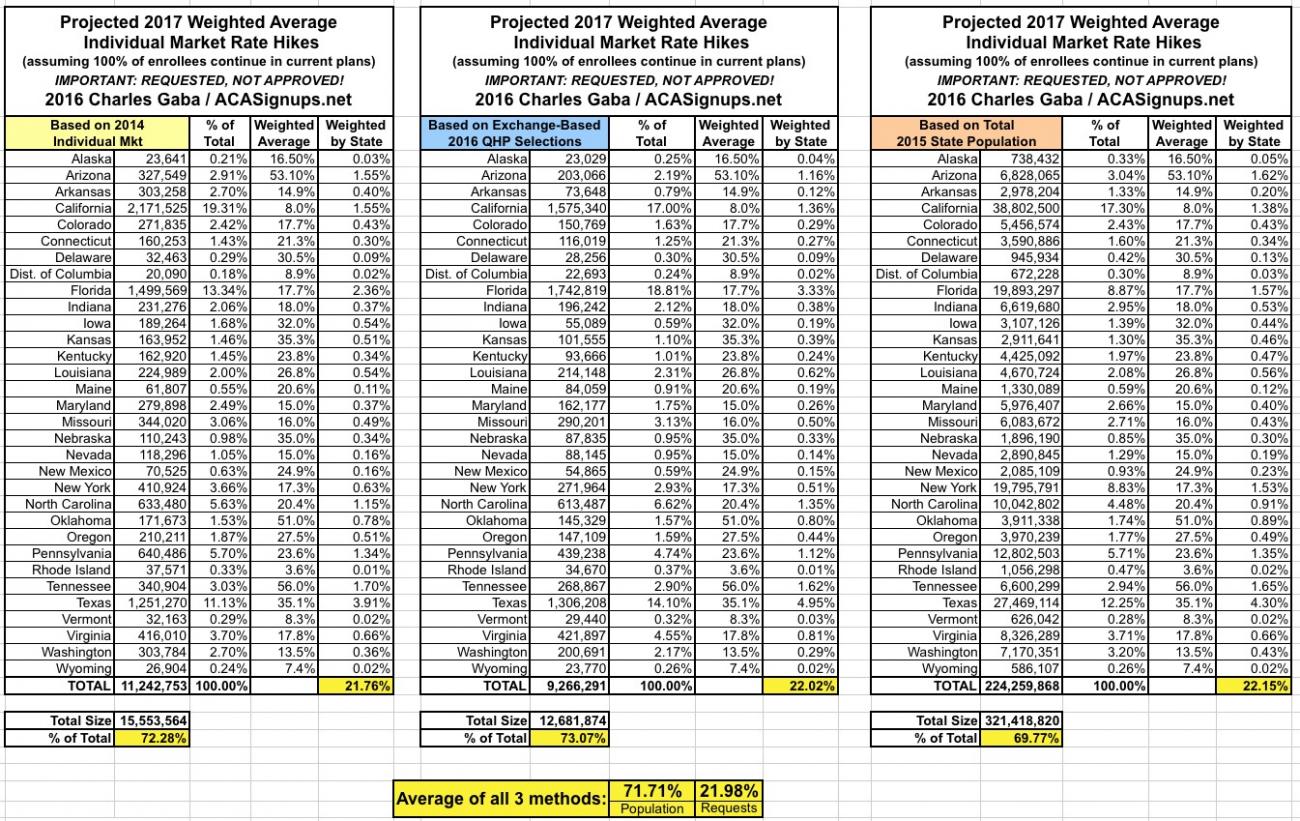
Forecast: Prices paid for health plans in the ACA marketplace to rise 12-15% in 2017

According to Charles Gaba's tracking of health insurers' rate requests for 2017 in the individual market, health insurers have thus far requested a weighted average rate increase of 22%. That's based on reporting from insurers serving 73% of current enrollees.

Rates requested are different from rates approved, however. And approved rates, weighted according to insurers' market share in the previous year, are different from the average rates that people (and the federal government, via subsidies) actually pay.  That's because enrollees gravitate toward the cheapest plans at each metal level, which pay the same percentage of costs as more expensive plans in the same metal level.

According to Gaba and HHS, here's how rates shook out in 2015, 2016 and thus far for 2017:

Thursday, March 10, 2016

Chewing over the future of health care reform

I've submitted a proposal to Netroots Nation for a panel on the future of healthcare reform, together with ACA Signups maven Charles Gaba, progressive activist and physician Paul Song,of the Courage Campaign, and Inside Heath Policy reporter Amy Lotven, a veteran of the ACA legislative wars.

The Netroots Nation conference is in St. Louis, July 14-17.  Sessions are chosen by member vote, at least in the first round; you can view sessions and vote (after a short signup if you're not a member) here.  Our session is Getting to Zero Percent Uninsured: Small Steps and Large Goals. Here's the pitch:

Panel Description

Obamacare has cut the uninsurance rate almost in half, but it's still left a bit more than 10% of the adult population uninsured, and a larger chunk underinsured. Where do we go from here? How can we make quality healthcare affordable to all without busting federal and state budgets?

That question suggests two others: what healthcare system would be ideal, and how can we move toward it given current US political realities? Combining long- and short-term thinking, we will consider healthcare reform 2.0 under the following circumstances:

1) What can a Democratic president do administratively? (more than you'd think)
2) What can be done with a GOP Congress?
3) What could be done with a Democratic Congress??
4) What could be done with a large Democratic majority?

Sunday, January 24, 2016

The chief fallout from killing Kynect

Articles about the plans of Kentucky's new Republican governor, Matt Bevin, to junk Kynect, the state's home-grown ACA exchange, and switch to Healthcare.gov don't always make it entirely clearly where the loss or risk lies.

There's the waste of some $290 million in federal grant money used to build Kynect, and  $23 million in one-time expenses that the outgoing Beshear administration estimated it would cost to move to the federal exchange. But since the choice of website does not in itself threaten the Medicaid expansion or change private plan offerings (though it may bump up prices, since HealthCare.gov charges insurers a higher assessment than Kynect has), wherein lies the operational damage?

Monday, October 26, 2015

More on Charles Gaba's "Two glaring errors in the WSJ anti-Obamacare editorial"

Charles Gaba has caught a couple of glaring errors in a Wall Street Journal editorial claiming that the ACA private plan marketplace is on the road to failure. The most important error misrepresents the state of the current and potential nongroup market -- that is, the pool of people who buy or could buy their health insurance on their own, with or without ACA subsidies.

Gaba captures the main point: that contra WSJ assertions, most of those who buy their insurance off-exchange are not subsidy eligible, and are mingled in the same risk pools as those who buy on-exchange. I'd like to further clarify, though, how much progress those markets have made toward full capacity, and to what extent those who are eligible for subsidies have so far enrolled.

Here's the WSJ editorial board's "state of the market" overview:

Tuesday, September 29, 2015

"You oughta be in Medicaid" revisited

Charles Gaba and I have at different times both taken a shot at estimating how many of the private plan buyers in the ACA Marketplace would have been eligible for Medicaid had their states not refused to implement the ACA Medicaid expansion. In 2015, slightly more than half of Marketplace customers were in states that had refused the expansion.

Our estimates were based on HHS's March 2015 report of the percentage of healthcare.gov buyers whose incomes were between 100% and 150% of the Federal Poverty Level (FPL). That's a frustratingly blurry frame, since it includes both buyers who would and would not have been eligible for Medicaid in "nonexpansion" states. Buyers up to 138% FPL would have been eligible for Medicaid (as they are in "expansion" states).

Now, the Commonwealth Fund has added an  equivocal hint. I'll get to that in a minute. First, the current estimates.

Saturday, September 12, 2015

Kaiser tracks modest premium increases for benchmark plans -- which means what to whom?

The Kaiser Family Foundation has updated an analysis of 2016 premium changes in 12 states and the District of Columbia, the only states (and, um, District) where complete information was available. Rather than focus on average rate increases across all plans, Kaiser focuses on the benchmark second-cheapest silver and cheapest silver plans This is useful in a number of ways, outlined below. Kaiser spotlights the largest city in each state.

The headline is a quite modest average increase in the benchmark plan -- 3.1% -- and a somewhat larger spike in the average cheapest silver plan in each city, 4.2%. The average covers a wide range of variation, from a 22.8% benchmark hike in Portland, OR to a 10.1% drop in Seattle, WA.

Prices changes in the ACA marketplace (including the off-exchange nongroup market) affect different constituencies is different ways -- as do different measures of price changes. I've outlined a few of the permutations below. Point #3 is most interesting, in my view (bury the lead, squawk squawk, bury the lead...).

First, here's Kaiser's flagship chart:

Sunday, April 19, 2015

New York to make health insurance *really* affordable for low-income residents

Very quickly, as I'm leaving the house in 40 minutes, big news (via Charles Gaba, natch)  from New York: it's becoming the second state to offer a Basic Health Plan (BHP) for lower-income insurance seekers, as enabled by the Affordable Care Act. A BHP is a low-cost, low-premium offering for buyers with incomes between the Medicaid eligibility cutoff (100% or 138% of the Federal Poverty Level*) and 200% FPL.   The premiums and cost-sharing compare very favorably with the mainstream private health plans offered on ACA exchanges as previously priced for low-income buyers. New York's BHP will have two tiers, with virtually no cost for plan holders with incomes between 100% and  150% FPL and just a $20 monthly premium and minimal cost-sharing for buyers in the 150-200% FPL range.

The 100% FPL starting point presumably means that the upper end prior Medicaid-eligibles (100-138% FPL) will be transitioned in. The benefit summary is below the jump. The plans will be available in 2016; enrollment will begin in November. The state will contract with private insurers to deliver the benefits.

While this is excellent news for New Yorkers with incomes under 200% FPL, it may raise challenges for the private insurance market in New York. In 2014, 53% of private health plan buyers had incomes under 200% FPL, so the market is being sliced more than in half. Minnesota, which has had a low-cost option for residents under 200% FPL since the launch of the ACA markets (and in somewhat similar form, before the launch), has struggled to meet enrollments targets. Enrollments are currently just under 62,000; the state is now aiming for 95,000 private plan enrollments by the end of next year, versus early projections at least twice as high.. The state's lowest-cost insurer in 2014 exited the market this year.