Note: Free xpostfactoid subscription is available on Substack alone, though I will continue to cross-post on this site. If you're not subscribed, please visit xpostfactoid on Substack and sign up.

Last week, Paige Cunningham at Notus reported* that effectuated ACA marketplace enrollment in April was down 21% from end-of-OEP plan selection totals in the 30 states using HealthCare.gov. For all states, April totals were 17% below end-of-OEP, as attrition was far lower in the 20 states that run their own marketplaces. * About half of the SBMs have somewhat mitigated the effect of the expiration of the enhanced subsidies that were funded only through 2025, offering either supplemental state subsidies, strict silver loading, or Basic Health Programs.
As Charles Gaba has highlighted, the end-of-OEP-to-April drop in 2026 was just about double the 2025 drop of 8.8%. Year-over-year, effectuated enrollment in April is down 13.5%, from 22.2 million in 2025 to 19.2 million this year.
One caveat about terminology that will be relevant going forward: Cunningham reports that 21% of end-of-OEP enrollees in the FFM were “dropped from coverage” after failing to pay their first premium. What she actually appears to have reported, though, is a net difference between total plan selections as of the end of OEP and effectuated enrollment in April. Every month, some people drop coverage and others newly obtain it via individually granted Special Enrollment Periods (SEPs), available after various types of life changes, such as losing employer-sponsored coverage. From February of 2022 to August of last year, SEPs were automatically granted to anyone who reported a qualifying income below 150% FPL. Trump’s CMS cut that automatic SEP off as of August 2025 (a change ratified in the Republican monster bill signed on July 4, 2025) - - and consequently, enrollment dropped from April to December last year for the first time since 2020. (In 2021, a pandemic-induced emergency SEP effectively kept enrollment open to all for more than half the year.)
The attrition to this point (13.5% y/y) makes Wakely’s estimate that average monthly enrollment in 2026 will come in 17-26% below the 2025 total look pretty on point. Just yesterday, CMS projected in its release of the final Notice of Benefit and Payment Parameters (NBPP) for the 2027 marketplace that average monthly enrollment (AME) in 2026 would come in at 18.861 million, a drop of 19.5% from OEP and 15.7% year-over-year. CMS has in fact raised its prior estimate published in the proposed rule, 17.71 million, “based on enrollee activity we have seen so far in 2026.” That rings a bit oddly, given that CMS also states that it does not yet have effectuated enrollment data — but apparently gave effectuated data to Cunningham at Notus.
One clue as to where average monthly enrollment (AME) land in 2026 is the historical relationship between effectuated enrollment in April and AME. The closest match to current conditions that might determine attrition throughout the rest of 2026, for reasons discussed below, is likely in the pre-pandemic years in the first Trump administration, 2017-2019.
Below are two scenarios: 2026a shows average monthly enrollment (AME) if its ratio to April enrollment matches the average of the years 2017-2019, and 2026b shows AME if the April-to-AME ratio resembles that of 2019.
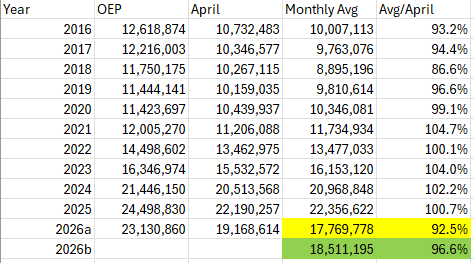
Scenario A suggests a year-over-year drop in AME of 20.6%; Scenario B, 17.3%. The range almost exactly matches CMS’s prior and current estimates.
Why should AME come in at something resembling the years 2017-2019? Attrition moderated throughout the Trump years, probably because a) the Trump-shortened OEP period weeded out less motivated enrollees, and b) silver loading, implemented beginning in 2018 after Trump cut off direct reimbursement of insurers for the value of CSR, increased the percentage of enrollees paying zero premium or very low premiums (mostly but not exclusively for bronze plans). Those factors remain in place now, with silver loading ramped up considerably by state action, particularly in Texas.
Enrollment from April through December turned positive in the Biden years — first, because of extensive year-round enrollment enabled by the pandemic SEP, and then by the under-150% FPL year-round SEP. It was further boosted by the Medicaid unwinding — that is, the resumption of Medicaid disenrollments in 2023 after a three-year pandemic-induced moratorium. After Trump’s CMS ended the low-income year-round SEP in August of last year, however, attrition resumed.
Why not compare attrition rates to those of 2025? Current enrollees likely to continue to drop coverage at higher rates than last year, as average net-of-subsidy premiums are up 58% (from $113/month to $178), while more than a million current enrollees lost subsidy eligibility entirely. With year-round enrollment for those with income under 150% FPL terminated as of last August, and the documentation required for individual SEPs ramped up, attrition from this point will revert likely to pre-pandemic levels (that is, before the emergency SEP of 2021**, the year-round low-income enrollment of 2022 to mid-2025, and the enhanced subsidies in place from March 2021 through 2025). Average net-of-subsidy premiums were actually slightly higher in 2019, at least in states using HealthCare.gov, at $191/month.
Factors not reflected in past patterns could of course push enrollment up or down. In a prior post, I outlined factors that might exacerbate or mitigate the loss of the enhanced subsidies in place from 2021-2025. These include, on the downside, the price shock for millions of enrollees and administrative barriers to enrollment that exceed those erected in the first Trump administration (the NBPP for 2027 is a horror show); and, on the upside, far wider availability of cheap gold plans, especially in Texas; wider awareness of ACA options; and, relatedly, more extensive broker participation than in the pre-Biden years.
- - -
* Cunningham had a scoop; CMS hasn’t published the numbers she reported.
** SEP enrollment was also elevated in 2020, as the state-based marketplaces enacted emergency SEPs in response to the pandemic, and even Trump's CMS eased administrative barriers to individual SEPs.


No comments:
Post a Comment