Showing posts with label benchmark silver. Show all posts

Friday, June 17, 2016

Forecast: Prices paid for health plans in the ACA marketplace to rise 12-15% in 2017

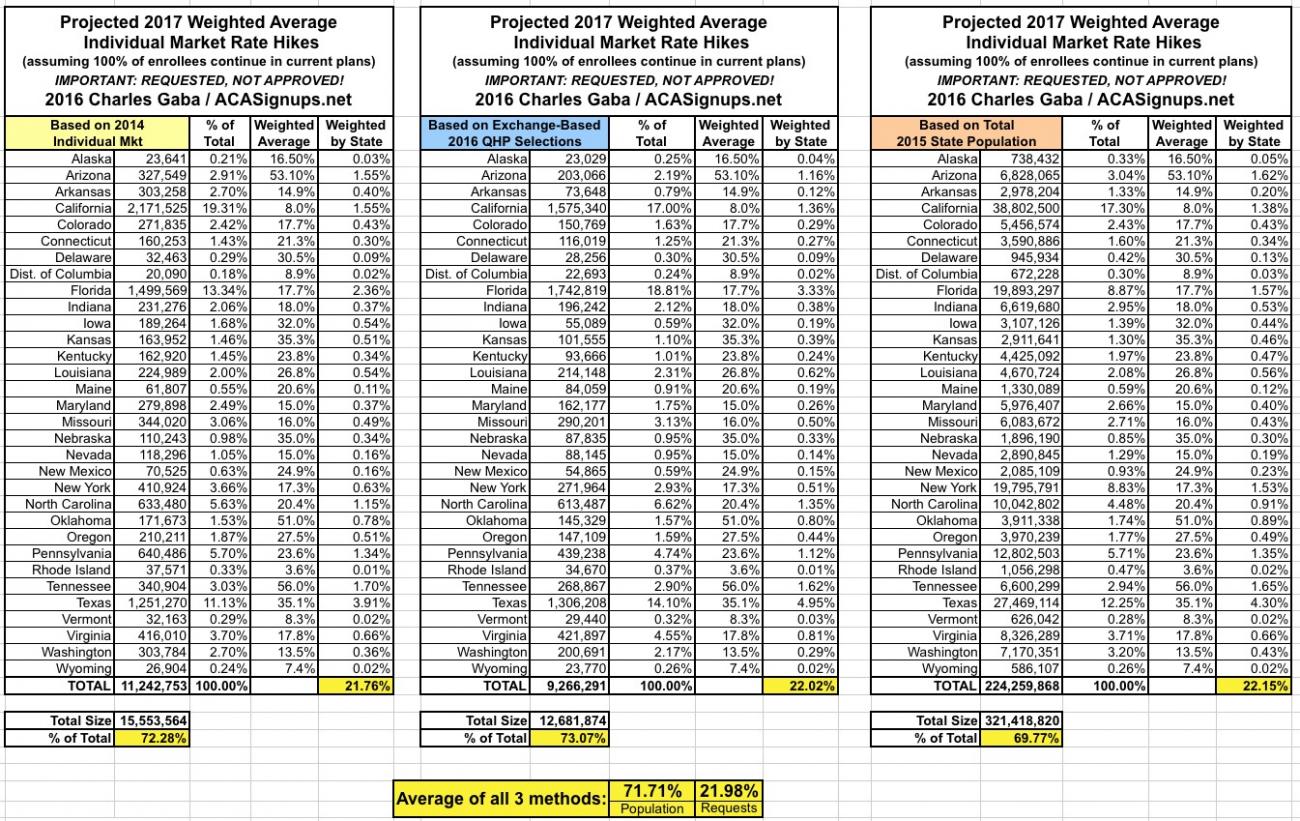
According to Charles Gaba's tracking of health insurers' rate requests for 2017 in the individual market, health insurers have thus far requested a weighted average rate increase of 22%. That's based on reporting from insurers serving 73% of current enrollees.

Rates requested are different from rates approved, however. And approved rates, weighted according to insurers' market share in the previous year, are different from the average rates that people (and the federal government, via subsidies) actually pay.  That's because enrollees gravitate toward the cheapest plans at each metal level, which pay the same percentage of costs as more expensive plans in the same metal level.

According to Gaba and HHS, here's how rates shook out in 2015, 2016 and thus far for 2017:

Monday, June 13, 2016

Silver plans to be available for less in ACA marketplace in 2017

Certainly not for everyone. And certainly not for the federal government, which foots the bulk of the premium bill for most marketplace enrollees. But for many and perhaps most subsidized buyers, a silver plan will available for less than they paid in 2016 (or would have paid, had they enrolled).

That's my takeaway from an Avalere Health analysis of rate request data in eight states plus Washington D.C., released last week.

Friday, November 20, 2015

Dollars to donut holes, Ambetter undercuts the competition (including UnitedHealthcare)

In late October, when Healthcare.gov first released plan prices for 2016, Jed Graham noted that Ambetter (parent company Centene) had "seized the pole position" in several of the federal exchange's largest markets, offering the cheapest bronze and the two cheapest silver plans in those markets.

Graham further pointed out, "By shrinking the cost of silver through its high-deductible strategy, Centene is lowering the subsidies available for all plans."  A few days later, Richard Mayhew wrote that Ambetter was "spamming" the exchanges by cramming a half-dozen barely-different silver plans into its lineup, all priced below the nearest competitor's cheapest silver. A managed Medicaid provider, Centene is fielding narrow networks in the ACA marketplace and probably paying very low rates to healthcare provides.

Yesterday I took a close look at the way Ambetter has combined sticker-shock silver deductibles (e.g., $6,400 for silver unenhanced by CSR in Chicago) with a relatively broad array of benefits that kick in before the deductible is reached. Swiss cheese coverage is apparently an ingredient in the secret sauce by which the insurer has calculated it can undersell its rivals.

In all Healthcare.gov markets taken together, we're told that on average the unsubsidized price of benchmark silver plans has gone up 7.5% (CMS), and for the cheapest silver plans in each market, 7% (Kaiser).  Not surprisingly, in markets in which Ambetter competes, the base price of the cheapest silver plan has generally gone down -- at the same time that most most of their competitors have felt compelled to raise their prices.

Thursday, January 01, 2015

Tapped out in Kentucky, cont.

Yesterday, I took a look at what induced David Elson, a 60 year-old advanced diabetic in Louisville, Kentucky earning $28,000 "in a good year,", to sign up for an ACA health plan with a $350 monthly premium. At that income level (which was almost surely overstated), a benchmark silver plan would have cost him about $180 per month. His tale has been recounted in depth twice by Abby Goodnough in The New York Times.

Why sign up for a plan that cost twice as much as the benchmark? The short answer was that Mr. Elson was trying to keep his doctors -- most importantly, his kidney specialist. That locked him into just one provider, Anthem Blue Cross, and the high premium plan he chose was an alternative to cheaper Anthem plans with higher deductibles and copay-coinsurance combinations that may have cost him more. The problem was that it was always obvious that he could not afford that premium -- one of his providers said as much in Goodnough's March 2014 article -- and he never paid it. His kidneys failed this fall, and he ended up first in charity care and then -- as of today, Jan. 1 -- on Medicare.

As I pointed out yesterday, not only an alternative silver plan offered by another insurer but even a handful of gold and platinum plans with lower premiums and deductibles than the one he selected were available to Mr. Elson in 2014. Trying to keep his doctors came at a price he could not pay.

Today I want to look at one more factor that framed the choices faced by Mr. Elson -- prompted once again by commenter Bob Hertz. That's age-rating.