Thursday, September 17, 2020

Medicaid expansion enrollment far outstrips marketplace enrollment and is the chief bulwark against huge spikes in uninsured population

Subscribe to xpostfactoid 

As millions lose jobs and health insurance during the pandemic, I have railed against ACA marketplaces for submerging information about Medicaid* and focusing their messaging almost exclusively on the private plan marketplace.

In expansion states, at least twice as many of the newly uninsured will be eligible for Medicaid as for subsidized marketplace coverage, according to estimates by the Urban Institute and Kaiser Family Foundation. You'd never know it to look at most state-based marketplaces, and to a lesser extent, HealthCare.gov.

The exchanges were conceived primarily as private-plan marketplaces and still view routing people to the ACA's Qualified Health Plans as their primary -- almost sole -- mission. But in expansion states, they also qualify or enroll applicants into Medicaid where appropriate, and it's high time they recognized Medicaid enrollment (or routing) as a core mission.

The Medicaid expansion has been the primary engine for ACA-triggered reductions in the nation's uninsured population. To illustrate the point, I've set ACA Medicaid expansion enrollment next to marketplace enrollment in the 34 states (including DC) that had enacted the expansion as of June 2019, the last month for which CMS has recorded expansion enrollment data. Nationally, Medicaid enrollees who fit the ACA's expansion enrollment criteria outnumber marketplace enrollees by a 3-to-1 margin, subject to a couple of caveats at bottom. Links to data sources are in the headings.

Wednesday, September 09, 2020

What's the matter with California? The mystery of flat Medi-Cal enrollment, revisited

Subscribe to xpostfactoid 

As part of a May budget revision in California, the state Department of Health Care Services (DHCS) projected that in response to job losses triggered by the Covid-19 pandemic, enrollment in Medi-Cal, the state Medicaid program, would increase  to 14.5 million by July -- roughly a 16% increase.

According to the state's current tally, from February to July enrollment in fact increased by just .02%, from 12.48 million to 12.50 million. Twenty-five other states that have reported enrollment through July show an 8.6% increase since February.  The Center for Medicare and Medicaid Service's most recent 50-state tally shows a 3.4% increase from February through May.

What gives? Why has Medicaid enrollment in California so far been essentially flat in the months since Covid-19 triggered mass unemployment?*

The DHCS cites several potential factors potentially inhibiting enrollment:

Wednesday, September 02, 2020

Pandemic Medicaid enrollment powers into August

Subscribe to xpostfactoid

Update, 10/4: see this post for 32-state enrollment through August (California included).

Update, 9/27: I'd like to venture a top-line estimate for Medicaid enrollment through August.  In the 25 states I can track through August (I've added Mississippi), enrollment is up 10.5% Aug-Feb. In tracking through July, California's near-flat enrollment drops total growth Feb-July by 1.9% percentage points. Assuming continued weak growth in CA in August, let's assume 8.6% enrollment growth since February. According to CMS's February tally, that would peg total enrollment through August at 77,293,798 -- call it 77.3 million, up about 6 million from February. (Preliminary August numbers for California are in, and they show a drop, which will probably be adjusted up to a very modest increase, based on recent history.)
      Of course, enrollment growth in the twenty states not tracked below could be different from the that of the tracked states. It's just occurred to me that I can tally the growth in those states through May, the last month tallied by CMS, and compare it to growth through May in the states tracked below. Then again, growth in many states surged after May -- but by definition this near-real-time tracking is tentative. Stay tuned. [Update: increase through May for the 20 states not included in my July chart is essentially identical to the 50-state increase excluding California -- 3.6% vs 3.7%. As of May, California pulled down the national average to 3.2%, from 3.7% excluding California. That's a 13.5% decrease in the increase, to put it awkwardly. Shaving the same percentage off the 10.5% August increase recorded for 25 states below suggests a 9.1% national increase since February and a national total upwards of 77.6 million enrolled in Medicaid.

Update, 9/22: California wrecks the average for July. Minus California, states below are up 8.8% through July; CA knocks that down to 6.9%. California has also posted a raw total for August that's below July's, but that total will doubtless be adjusted up, as July's has been. Also, South Dakota is up 1.3% July to August.
      The California monthly totals below were supplied by the state Dept. of Health Care Services. Raw totals recorded in two public state databases (1, 2) are slightly different from these totals. California deems the data preliminary for a full 12 months, and the state's monthly totals have changed considerably in the period in which I've been tracking. Growth remains surprisingly low, however.

Earlier updates at bottom.

------
Original post: (9/2/20): A handful of states have posted Medicaid enrollment totals as of the end August (or, in the case of New York, as of mid-August or beyond*). The main takeaway is that growth in Medicaid enrollment triggered by the pandemic does not appear to be slowing down.  In the states charted below, enrollment grew by 1.5% from June to July. In the four states that have reported through all or most of August below, enrollment also increased 1.5% over the prior month. [Update 9/4: Minnesota up 1.2%; 5 states up 1.4% July-August.]

The sustained Medicaid enrollment growth five months after the first pandemic-induced lockdowns  should not be a surprise. As I've noted before, Medicaid enrollment is a lagging indicator. A United Hospital Fund study found that in the Great Recession of 2007-2009, Medicaid enrollment in New York peaked seven months after unemployment peaked. Robin Rudowitz of the Kaiser Family Foundation tells me that Medicaid enrollment continued to climb nationwide after the Great Recession officially ended, and that state Medicaid directors whom Kaiser surveyed at the end of April anticipated increases extending throughout the year.

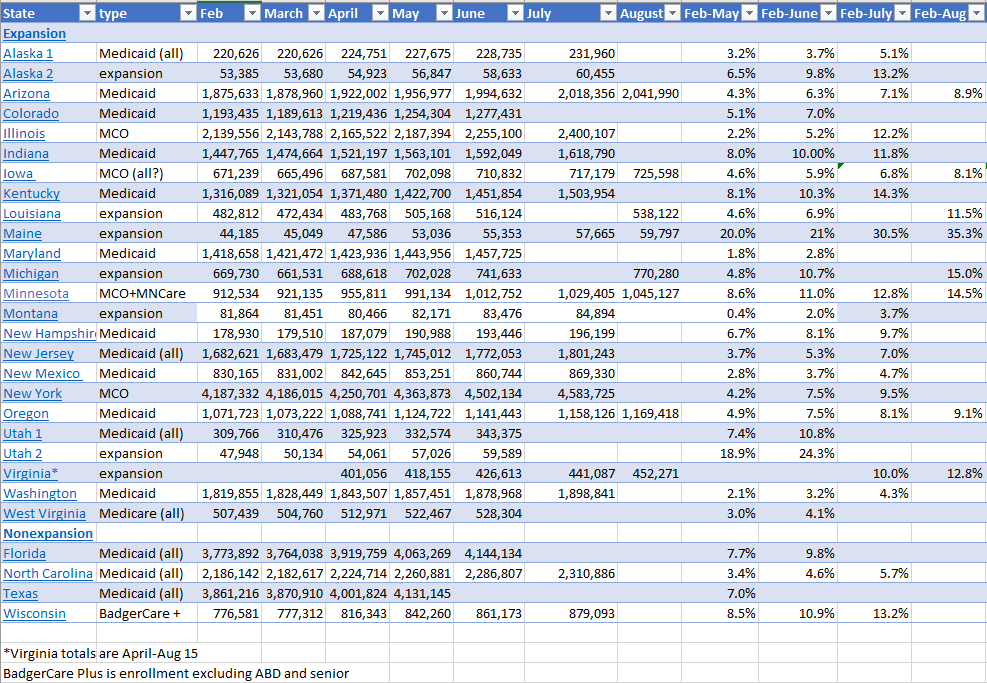
Pandemic Medicaid Enrollment in 31 States (updated 9/30)
February through July or August 2020
Expansion states in blue; nonexpansion states in red; Medicaid to 100% FPL in purple
Totals as of the end of each month


Friday, August 28, 2020

On Aaron Carroll's Coronavirus cap-and-trade

eating in restaurant

It feels odd for me to take issue with recommendations from Aaron Carroll on how to deal with the risk of coronavirus infection, individually and collectively. In March, Carroll was prescient on what we as a country needed to do (and, with Trump in charge, inevitably failed to do) after we'd already let community transmission run rampant -- reduce infections via shelter-in-place, and use the breathing room to ramp up testing. He is a trusted source on nutrition, medicine and healthcare policy, able to sift through piles of published studies and assess the evidence, as he did on core nutritional questions in The Bad Food Bible.

But I feel there's something off about Carroll's approach in today's column to risk balancing in response to the pandemic. No one should have any beef with the main point: when you give up one major form of risk mitigation (e.g, when you go back to school), don't give up all others (e.g., by congregating in basements). But how, then, to balance risks? Envisioning our individual conduct as "piles" of risk-mitigating and risk-enlarging decisions, Carroll writes:

Thursday, August 20, 2020

Obama's montage of American history darkens

Hey America, ICYMI:

Addressed to the summer's young protesters:
You can give our democracy new meaning. You can take it to a better place. You're the missing ingredient -- the ones who will decide whether or not America becomes the country that fully lives up to its creed.

That work will continue long after this election. But any chance of success depends entirely on the outcome of this election. This administration has shown it will tear our democracy down if that's what it takes to win. So we have to get busy building it up -- by pouring all our effort into these 76 days, and by voting like never before -- for Joe and Kamala, and candidates up and down the ticket, so that we leave no doubt about what this country we love stands for -- today and for all our days to come.

Stay safe. God bless.
That's the 44th president of the United States warning that the 45th president will end democracy in America if we let him.

That warning represents quite a journey for Obama. He rose to prominence and won election by telling us that we are not as divided as we seem, that we are forever in the process of making our union ever more perfect, that Americans at pivot points in our history bent the arc of the universe toward justice.

Tuesday, August 18, 2020

Has Medicaid enrollment reached 77 million? (updated)

Update, 9/2: Four states post reports in recent days that bring totals through August. Discusson in  this post. 

Update, 8/27: Texas has reported June enrollment, and it's up 9% since February.  June chart below is updated. Most recent July chart, last updated 8/23, is unchanged.

One note about the apparent flat enrollment in California: the percentage of Medi-Cal enrollment that is Latinx, 50% in 2018, is about double the national average. The Trump administration's changes to the public charge rule, suspended though the new rule is, are likely continuing to chill enrollment among legally present noncitizens, and the effect may be particularly strong in California.

8/24/20:  Today the big addition is California enrollment through June. The state is a major outlier among expansion states, in that enrollment is up just 1.1% since February (after a slight dip in March). Adding CA dropped the all-state enrollment increase from February through June from 7.0% to 5.6%. The weak growth is apparently a mystery to state officials and advocates. I'll have more to say about that later in the week. [Update, 9/1: California has now published a raw total for July that shows a drop of 74,000. I had noted the July drop in this database, but as California is notoriously slow to account for retroactive liability, the July total is likely to be adjusted up.]  

Subscribe to xpostfactoid

Pandemic Medicaid Enrollment in 29 States 
February through June 2020 (as of 8/27)
Expansion states in blue; nonexpansion states in red; Medicaid to 100% FPL in purple


California totals include about 850,000 enrollees in programs not counted by CMS, e.g., enrollees funded without a federal match rate. (As noted in the 8/23 update below, CMS state tallies now run through May 2020. The monthly totals for California listed above may yet be published online; they were sent to me. They are roughly congruent with eligible individuals tracked in this database.

UPDATED  9/2/20
Pandemic Medicaid Enrollment in 23 States 
February through July or August 2020
Expansion states in blue; nonexpansion states in red; Medicaid to 100% FPL in purple


Sunday, August 16, 2020

The ACA today: A mid-pandemic assessment

Subscribe to xpostfactoid


High-CSR coverage in Nebraska (top) vs. unsubsidized coverage in Alaska (bottom)

Enrollment in ACA marketplace plans totaled 12.7 million at the end of Open Enrollment 2016 and 11.4 million at the end of OE 2020.  Enrollment as of the end of OE has shrunk in every year since the 2016 peak.

Those top-line fact tend to shape basic perceptions of how the marketplace has fared. But in itself the top line is almost meaningless. The marketplace, and the U.S. healthcare system more generally, have undergone an array of changes, some of which mitigate the impression of modest, steady erosion, and some of which reinforce or even intensify it. Among the OTOHs:
  • Collapse in unsubsidized enrollment.  Enrollment in ACA-compliant health insurance plans by people who did not qualify for ACA premium subsidies stood at 6.7 million in the first quarter of 2016 and at 3.4 million in Q1 2019. * Huge premium increases in 2017 (triggered by a genuine market correction) and 2018 (in response to Republican attempts to repeal the ACA and sabotage the marketplace) appear to have driven half of unsubsidized enrollees out. The ACA's failure to provide affordable insurance to a large percentage of those who don't qualify for subsidies stands out as one of its core failures -- offset though it may be by the law's provision of subsidized insurance (mostly Medicaid) to some 20 million people who would otherwise have remained uninsured.

Friday, August 14, 2020

Medicaid enrollment in Utah could use a state push

Subscribe to xpostfactoid

Last week I noted that Utah's launch of full ACA Medicaid expansion in January of this year was fortunately timed to catch tens of thousands of Utah residents who have lost access to employer-sponsored health insurance during the pandemic.

Yesterday I spoke to Stacy Stanford and Sarah Leetham of the Utah Health Policy Project about Utah's Medicaid enrollment gains during the pandemic -- which might fairly be deemed moderate when the full context is considered. UHPP was in the thick of the successful fight to pass a referendum to enact the ACA Medicaid expansion in 2018 and works with a network of partners to provide enrollment assistance to Utahns seeking coverage.

To review the back story briefly: After the referendum passed, Utah's Republican legislature and governor enacted a partial expansion, offering Medicaid to state residents with income up to 100% of the Federal Poverty Level instead of to the ACA's stipulated  threshold of 138% FPL. The partial expansion launched in April 2019, while the state filed a federal waiver request seeking to apply the ACA's 90% federal match rate to the limited expansion population. When CMS rejected the waiver, the state went to Plan B -- full expansion -- effective Jan 1, 2020. A work requirement went into effect on Jan. 1 but was suspended in April 2020 -- before anyone who failed to comply with its reporting and job-seeking demands could be disenrolled -- in response to the pandemic.

Wednesday, August 12, 2020

Medicaid enrollment in a pandemic: 26-state snapshot

Subscribe to xpostfactoid

Update through 9/2 here

Update, 8/19: See this post for a somewhat cleaner comparison through July, reconciling states' different schedules for tallying and methods of labeling a given month.

Update, 8/15: Illinois Medicaid enrollment surged 6.4% from June to July and is up almost 10% since May. Enrollment in Indiana is up 11.8% since February. Of the twelve expansion states below that have reported enrollment in all or most Medicaid programs through July (excluding tallies for expansion population only), the average increase since February is 9.2%. 
---
It's time for a fresh post on pandemic Medicaid enrollment, instead of piling updates on my prior snapshot. While I'm focused primarily on states that enacted the ACA Medicaid expansion, I've started to also track nonexpansion states and will keep adding them as I find data.  I have a bunch of URLs to pick through, thanks to a very helpful overview of enrollment in 33 states through May and June  by Chris Frenier, Sayeh S. Nikpay, and Ezra Golberstein.

To review some basic context: the Urban Institute forecast that nationally just shy of half* of those who lose access to employer-sponsored insurance will enroll in Medicaid if severe unemployment lasts for "several months to a year." At 15% unemployment, Urban projects that between 8.2 million and 14.3 million people will enroll in Medicaid, an increase of 11%--20% over total enrollment in early 2020, or 16%--28% over the total of enrollees under age 65.   While the current national unemployment rate has dipped officially to 10%, it's likely to spike again as our public health failures lead to renewed shutdowns and our legislative failures result in cutoffs or sharp reductions in relief benefits.

Note that some of the the tallies below are for the ACA Medicaid expansion only -- that is, adults with incomes under 138% of the Federal Poverty Level. The federal government pays 90% of the cost for enrollees rendered eligible by the expansion. It's not surprising that the expansion population tallies reflect faster growth, since a large percentage of the nation's children were enrolled in Medicaid or CHIP pre-pandemic, enrollees over age 65 are in Medicare and usually not reliant on employer-sponsored insurance, and those eligible for disability Medicaid are also likelier to have been enrolled pre-pandemic.

       Medicaid enrollment in 26 states, February - August 2020
Medicaid enrollment in the Covid-19 pandemic

Wednesday, August 05, 2020

In a devilish pandemic, Medicaid expansion is Utah's cave up in the hills

Subscribe to xpostfactoid

In 2018, voters in Utah passed a referendum to enact the ACA Medicaid expansion, which would make Medicaid available to adults with incomes up to 138% of the Federal Poverty Level. Utah's Republican legislature and governor writhed, twisted, and enacted a partial expansion, to 100% FPL, effective in April 2019. When the federal government rejected a waiver to apply the ACA's 90% federal match rate to that limited expansion population, the state went to Plan B -- full expansion -- effective Jan 1, 2020. A work requirement was suspended in April 2020 in response to the pandemic.

Good timing. As the pandemic struck, jobless claims in Utah rose from 40,500 in February to 166,300 in April before falling back to 85,700 in June. The unemployment rate went from 2.5% to a peak of 10.4% in April to 5.1% in June. Medicaid enrollment responded:

Tuesday, August 04, 2020

Weak silver loading and state-based subsidies in New Jersey's ACA marketplace

Click here to subscribe to xpostfactoid

bronze bowls, bronze plans
weighing the value of low-AV bronze
New Jersey, as noted here last week, is poised to tack supplemental state subsidies onto federal premium subsidies for enrollees in the state's ACA marketplace in 2021. The revenue comes from a state Health Insurance Assessment that replaces the repealed federal tax of the same type, paid for the last time in 2020. 

Word is that the state subsidies will be available to all enrollees with incomes below 400% of the Federal Poverty Level (while the state's reinsurance program, also to be partly funded by the HIA, continues to reduce premiums for unsubsidized enrollees). It looks like the new state subsidies will be in the range of $40-60 per month for a single enrollee.

David Anderson points out that New Jersey might achieve much the same results -- spending federal rather than state dollars -- if it took steps to increase premium spreads between the benchmark (second cheapest silver) plan against which federal subsidies are set and plans cheaper than the benchmark -- i.e., bronze plans and the cheapest silver plan. These spreads are narrower than national averages in the New Jersey health insurance marketplace -- mainly, as Anderson has noted more than once, because the state requires bronze plans to offer higher actuarial values than federal rules allow (AV refers to the percentage of the average enrollee's costs the plan is designed to cover, using required formulas).

Wednesday, July 29, 2020

New Jersey poised to add state premium subsidies to federal in ACA marketplace

Click here to subscribe to xpostfactoid


New Jersey twitter icon
New Jersey's tweeter-in-chief

The New Jersey bill that would replace the ACA's repealed health insurance assessment with a similar state tax, S2676/A4389, has passed out of all committees and is scheduled for floor votes in the state Senate and Assembly tomorrow (July 30). Update, 7/31: the bill passed the New Jersey Assembly and Senate yesterday on a near-straight-party vote, after withstanding a late $1 million dark money assault. 

The bill levies a 2.5% tax on fully insured employer plans and individual market plans operating in New Jersey and deposits that revenue in a Health Insurance Affordability Fund devoted to
increasing affordability in the individual market and providing greater access to health insurance to the uninsured, including minors, with a primary focus on households with an income below 400 percent of the federal poverty level [FPL], expanding eligibility, or modifying the definition of affordability in the individual market, through subsidies, reinsurance, tax policies, outreach and enrollment efforts, buy-in programs, such as the NJ FamilyCare Advantage Program, or any other efforts that can increase affordability for individual policyholders or that can reduce racial disparities in coverage for the uninsured.
The bill was amended late to exempt the New Jersey small group market  -- which also means that that market is excluded from benefiting from the Affordability Fund (MEWAs and dental plans were also exempted).

In the immediate term, the New Jersey Department of Banking and Insurance (DOBI) has indicated that it plans to spend the entirety of an estimated $224.4 million* in revenue collected in 2021 on the New Jersey's individual health insurance market. $77 million would go toward the state's share of the reinsurance program implemented in 2018 (designed to reduce premiums to 15% below where they'd be without the fund). The remaining $147.4 million would be used to supplement ACA marketplace subsidies with state subsidies for all New Jersey marketplace enrollees with incomes below 400% FPL.** Those subsidies would be on offer during Open Enrollment this fall, when the state's new state-based marketplace is set to be unveiled and New Jersey bids farewell to HealthCare.gov, the federal exchange.

As of February 2020, 174,978 New Jerseyans were receiving premium subsidies in the New Jersey health insurance marketplace. Were the extra subsidies to boost enrollment at incomes below 400% FPL to 200,000, the per-person state supplemental subsidy would come to about $60 per month. DOBI has floated a lower estimate, $42 month [see update 4 below]. Supplemental subsidies in this range -- $40-60 per month -- could have a substantial impact.

Monday, July 27, 2020

Surprise/no surprise: ACA marketplace enrollment is UP in 2020 (on-exchange only)

Subscribe to xpostfactoid

Mystery of the ACA marketplace: every year since 2016, while total signups during Open Enrollment have ticked down, the percentage of those who effectuate their enrollment by making their first payment has risen.

On Friday CMS released 2020's first Effectuated Enrollment Snapshot, showing enrollment as of February. Enrollment is about 1% higher than in February 2019, though it was about 0.3% lower as of the end of Open Enrollment. It's also slightly higher than in February 2018.  The gap between total plan selections as of the end of Open Enrollment and effectuated enrollment after all first payments are due is the lowest ever.

Friday, July 24, 2020

Want a SEP? You'll have to schlep...CMS ends application streamlining on HealthCare.gov

Subscribe to xpostfactoid

Update, 7/29/20: CMS confirms that it has reverted to the standard pre-crisis SEP verification process,  "as part of its efforts to safeguard taxpayer funds, promote market stability, and ensure affordable premiums."  As noted below, insurers were not calling for this change -- they are not concerned that looser SEP verification at this point will worsen the risk pool. As for safeguarding taxpayer funds, inhibiting marketplace enrollment will always do that. Meanwhile, HHS has been showering billions in CARES Act relief funds on the nation's wealthiest hospital systems, many of which hold huge reserves, while safety net hospitals go begging.


In late March, as twelve of the thirteen state-based ACA marketplaces opened emergency Special Enrollment Periods in which anyone who lacked health insurance could enroll, CMS was rumored to be on the brink of following suit in HealthCare.gov, the federal exchange used by 38 states.

Ordinarily, enrollment in ACA marketplace health plans is only open to all during an Open Enrollment season, which on HealthCare.gov runs from November 1 to December 15.  Those seeking coverage at other times must apply for a Special Enrollment Period and provide documentation showing that they had a qualifying life change, most often loss of health insurance. The emergency SEPs in some states did away with that requirement, functioning as in Open Enrollment. Others required mere attestation by phone or box-checking of loss of coverage or other life change, without documentation. (I reviewed various emergency SEP processes and presentations here.)

HHS ultimately declined to open an emergency SEP in HealthCare.gov. Reportedly the agency was ready to do so, but the Trump White House - killed it. Putting the marketplace forward as a vital service in time of intense need was a bridge too far for Trump & Co.  CMS did, however, accept attestation of loss of coverage prior to enrollment, with documentation to be supplied later. That change occurred around April 20.

Now, that limited but important accommodation has ended. Jenny Hogue, a health insurance broker based in Murphy, Texas, got wind of the change early this week. Shelli Quenga, director of programs at the South Carolina-based Palmetto Project, which provides marketplace enrollment assistance as a nonprofit brokerage, confirmed this to me, as did Jodi Ray, Director of the Florida Covering Kids and Families Project at the University of South Florida. "We have had appointments in the past week where consumers were asked for documentation to be uploaded," Ray emailed.

Thursday, July 23, 2020

Testimony in support of a Health Insurance Assessment in New Jersey

Subscribe to xpostfactoid

The New Jersey Senate and Assembly are holding hearings this afternoon on a bill, S2676/A4389, that would replace the national ACA tax on health insurers repealed by Congress late last year with a state tax that would raise some $300 million per year. The bill dedicates the funds to improving health insurance affordability, focusing mainly on low-income New Jerseyans.

The bulk of the money will likely be used to add state subsidies to federal subsidies for health plans sold in the ACA marketplace -- possibly as early as 2021 --  with a portion going to fund the existing reinsurance program that reduces individual market premiums for those who earn too much to qualify for subsidies.

BlueWaveNJ, of which I am a member, submitted the testimony below on behalf of the bill.

Monday, July 20, 2020

How to boost Medicaid enrollment in a pandemic: Kentucky's Cara Stewart has an idea or eight

Click here to subscribe to xpostfactoid

Let's zoom in once more on Kentucky, the state that appears to be having the most success enrolling the newly unemployed in Medicaid. From February to July, Medicaid enrollment in the state rose by 14.3%.  That's the sharpest increase in the nation, I believe, in the period of mass job loss triggered by the pandemic. [Update, 9/17: Medicaid enrollment in Kentucky is now up 19.7% since early March.]

That's not an accident. Kentucky has probably been the most proactive state in reaching out to the uninsured and helping them find subsidized coverage if eligible. Yet American standards are low: ignorance about Medicaid and the ACA marketplace is rife throughout the land. Cara Stewart, a longstanding advocate for increased healthcare access in Kentucky, and currently director of policy advocacy at Kentucky Voices for Health, believes the state could be doing more to reach out to the uninsured. We'll get to those ideas shortly. First, some benchmarks.

Wednesday, July 15, 2020

How many newly uninsured? Families USA and the feds paint different pictures

Click here to subscribe to xpostfactoid

Families USA released a report this week estimating that 5.4 million adults newly unemployed by the pandemic as of May are also becoming uninsured.

The estimate is based on data and analyses concerning  1) the number of people who have lost jobs (BLS), 2) the likely percentage of newly unemployed who have lost access to health insurance, and 3) the percentage of newly unemployed in the ACA era (2014-2018) who have found other insurance, including Medicaid and marketplace (Urban Institute).

The analysis boils down to a fairly simple equation: about a quarter of those who lose jobs do not find their way to job-based insurance through a family member, Medicaid, marketplace coverage or COBRA. Much higher percentages of the newly unemployed are estimated to become uninsured in states that have refused the ACA Medicaid expansion (42.5%) than in expansion states (22.6%).

5.4 million uninsured adults equates to about a 2.6 percentage point increase in the uninsured rates for Americans aged 18-64.  Based on the most recent National Health Interview Survey (Jan-June 2019), that would suggest an uninsured rate of about 16.3% for ages 18-64. As I've noted recently, more immediate survey data seems to indicate less severe increases in the uninsured population. A Commonwealth Fund survey of about 2300 adults conducted May 13 through June 2 seemed to indicate that a bit less than 2% of the population had recently become uninsured.

More strikingly, the experimental new Household Pulse Survey updated weekly by the CDC -- a joint project of the Census Bureau and National Center for Health Statistics -- shows comparatively little movement since its launch in the week of April 23, when it recorded a national uninsured rate of 12.6%  for ages 18-64 -- more than a percentage point lower than the 2019 NHIS estimate. The weekly updates have been quite volatile but on the whole have ticked upward, reaching 13.5% in the week of June 25 (there'll be another update tomorrow).  Estimates for individual states, shown below, average three percentage points higher in Pulse than in the FUSA study, and vary widely.

Monday, July 13, 2020

Medicaid enrollment in a pandemic: 18-state snapshot (expansion only)

Subscribe to xpostfactoid

Update, 8/14: for all further updates please see the 26-state snapshot published August 12.

Update, 8/5/20:  Enrollment in Utah, which enacted full Medicaid expansion in Jan. 2020 following a partial expansion (for adults up to 100% FPL) launched in April 2019, increased 10.9% from February to June 2020. The population of enrollees rendered eligible by the expansion is up 25.5% in the same period. As the unemployed population in Utah was 45,000 higher in June than in February (largely recovered after a huge spike in April), the increase in Medicaid enrollees in the state since February (33,615) may exceed the increase in newly uninsured. 

Update, 8/4/20: Minnesota managed Medicaid/MinnesotaCare enrollment increased 1.5% July-August. It's now up 14.% since February. New York is up 9.5%, Feb-July; New Jersey is up 7.0% in the same period. Medicaid expansion population totals for Maine and Virginia are also update. 

Update, 8/2/20: I have updated the chart with July and/or June tallies for Illinois, Maryland, Oregon, and Washington. Noteworthy: a 3.1% surge in Illinois in June, and an Oregon update through July 27 that shows total enrollment up up 9.1% since February 3. Overall, enrollment in Medicaid programs charted by these 16 states (e.g., all Medicaid, managed Medicaid only, or ACA Medicaid expansion population only) was up 6.8% February through June. Colorado, newly added, was up 7.0%, Feb-June.


As mass unemployment appeared almost instantly in the wake of the pandemic-triggered shutdowns in March, and is likely to persist as the U.S. fails to contain the virus, I have focused almost all posts in recent weeks on increases in Medicaid enrollment in states that have enacted the ACA Medicaid expansion.

To repeat a baseline expectation, the Urban Institute forecast that if 15% unemployment lasts for "several months to a year," between 8.2 million and 14.3 million people would enroll in Medicaid, an increase of 11%--20% over total enrollment in early 2020, or 16%--28% over the total of enrollees under age 65.   While the current national unemployment rate has dipped officially to 11% (actually 12% when a categorization error acknowledged by BLS is added in), it's likely to spike again as our public health failures lead to renewed shutdowns and our legislative failures result in cutoffs or sharp reductions in relief benefits.

In Kentucky and Minnesota, Medicaid enrollment has already increased by double digits since February. In others, it's barely budged.  Myriad factors determine the rate of growth, including the extent of job losses in the state, the types of jobs lost, the mode/duration of layoff, and state per capita income.

I am more focused on factors within the states' control -- whether there is any effective outreach to inform the newly unemployed of their health insurance options and prompt them to apply -- for Medicaid (primarily) or marketplace insurance as appropriate.  Outreach can come via state-based ACA marketplaces (there are just 13; the federally administered HealthCare.gov serves the rest), advertising, governors' pandemic briefings, the state taxing authority (as in Maryland) or -- most promisingly, through the unemployment insurance division of state labor departments, as urged by Families USA and the Brookings Institute. As far as I know, Kentucky, where Medicaid enrollment is up 14%, is the only state that's fully exploiting this vital channel. Expanding presumptive eligibility (which Kentucky has also done) or accepting attestation of income can also have a strong impact.

Friday, July 03, 2020

Where is Medicaid enrollment surging? A June update

Click here to subscribe to xpostfactoid

7/9/20 -- see updates at bottom re strong July enrollment growth in Minnesota and Kentucky

A month ago, I spotlit a handful of states in which Medicaid enrollment was surging in response to the mass job losses triggered by the Covid-19 pandemic. Here, an update.

To review the context for enrollment growth recorded so far: the Urban Institute has forecast that if 15%* unemployment lasts for "several months to a year," between 8.2 million and 14.3 million people would enroll in Medicaid, an increase of 11%--20% over total enrollment in early 2020, or 16%--28% over the total of enrollees under age 65.  Joan Aiker and Tricia Brooks of Georgetown have tracked enrollment in 22 states that have reported through May and found an average increase of 5% over February.

Notes below track enrollment logged in June or as of July 1.  While the Georgetown scholars are tracking both expansion and nonexpansion states, I've limited myself to expansion states where growth is particularly strong.

As of the end of May, both Kentucky and Minnesota had reported increases exceeding 10% since February. I don't have an update yet for either. Among states with new data:

Tuesday, June 30, 2020

Washington's ACA exchange gets its priorities straight

I have criticized state-based ACA exchanges for submerging information about Medicaid, which is likely to insure about twice as many of the newly uninsured as the ACA marketplace.

Scratch that complaint for Washington' state's HealthPlanFinder!  The home page has its priorities right, if the messaging is still a little fuzzy:


Apple Health is the state's Medicaid program, as you'll learn if you click on it. That click will bring you to a page that links to the eligibility requirements. For individual adults, they're clear and clean, paired with a prompt to apply: