Showing posts with label ACA premium subsidies. Show all posts

Wednesday, August 13, 2025

Worse than forecast: Pending cost increases for ACA marketplace enrollees

 Note: All xpostfactoid subscriptions are now through Substack alone (still free), though I will continue to cross-post on this site. If you're not subscribed, please visit xpostfactoid on Substack and sign up.

KFF data and analysis is essential to anyone seeking to understand the U.S. healthcare system. It’s copious, reliable, and clearly presented. But inevitably, it’s not always up to date.

In late 2024, KFF posted a calculator estimating how much more ACA marketplace enrollees at any income, income and family size would pay for coverage in 2026 if the subsidy enhancements created by the American Rescue Plan Act (ARPA) are allowed to expire (they are funded only through 2025). If the ARPA subsidy schedule expires, which appears near-certain at this point, the subsidy schedule will revert to the pre-ARPA formula used through OEP 2021, adjusted by an annual inflation factor.

When the calculator was created, the subsidy schedule for 2026 was unpublished, and KFF used estimates created by CBO and the JCT in June 2024 (see p. 9 here). Last month, the IRS published the subsidy schedule for 2026, and the CBO estimates turn out to have been quite low. At higher incomes, the actual percentage of income required to buy the benchmark (second cheapest silver) plan is more than a full percentage point higher than CBO estimated (e.g., 9.96% of income at an income of 300% of the Federal Poverty Level (FPL) vs. the CBO estimate of 8.65%).

Percentage of income required to purchase a benchmark silver plan at different income levels in Plan Year 2026: Actual vs. KFF/CBO 2024 estimate
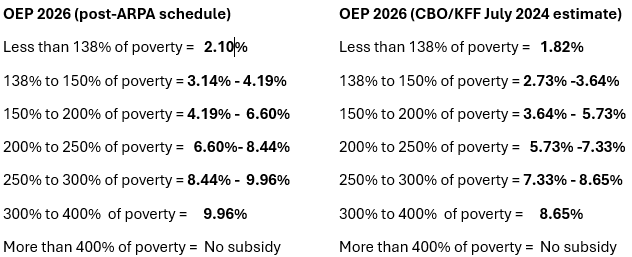
Sources: IRS, KFF, CBO. See note at bottom for the ARPA enhanced subsidy schedule.

Wednesday, May 18, 2016

How many Americans who buy their own insurance are unsubsidized?

One further footnote on the McKinsey & Co. report on the state of the post-ACA individual market for health insurance, discussed in my prior post.

McKinsey opines that the market is unlikely to enter a death spiral because ACA premium subsidies insulate most participants from premium hikes. The report estimates that 69% of current enrollees are subsidized. That strikes me as at least slightly exaggerated.

Kaiser, in its 2015 survey of non-group enrollees on- and of-exchange, found that just under half were subsidized -- or about 59% if you exclude those in grandfathered and grandmothered pre-ACA plans, which are a different risk pool (McKinsey's "methods" note indicates that they include enrollees in non-compliant plans in their estimate of off-exchange enrollees, though they may also assume that some of those in noncompliant plans are in subsidy range)*. UPDATE 5/20: Kaiser's 2016 individual market survey results, reported today, find that 64% of individual market enrollees are now in marketplace plans. 83% of marketplace enrollees are subsidized, suggesting that 53% of the individual market is subsidized.

The off-exchange market is something of a black box, so it's not surprising that estimates would differ. Also, Kaiser's estimate is from 2015, and the ACA marketplace grew modestly this year. Still, on McKinsey's own terms, I think their estimate is a bit inflated.  Here's its basis: