I think a lot of the criticism of this president is piffle. I think he's done an extraordinary job in foreign policy and has kept this country afloat economically in times as perilous as the 1930s. But his refusal to back a specific plan to save our finances, and to do so before the crisis deepens, in order to reverse a potentially devastating confidence collapse in Europe ... this is failure of an historic kind. I understand why, politically, this is difficult. But this is a moment for transcending political constraints. This is a "Yes We Can" moment. This is why we supported him - because he seemed someone who could at times transcend politics, for the greater good.Andrew is prone to apocalyptic thinking about the deficit. But at least from April on, I'm not sure what he's expected Obama to do about it that he hasn't done. I could certainly see hitting Obama for negotiating badly -- but that's not Sullivan's point; he wants a crusade. Some questions:
He still can. The super-committee will almost certainly fail. Once that happens, the US will be telling the world it is less capable of grappling with its debt than Greece or Italy. Then what? If Obama seeks re-election just by not being a scary Republican, he will deserve to lose. We need him to campaign for Bowles-Simpson (or his variation thereof) and radical tax reform, and promise he will work with any Republican prepared to help finalize the deal - but that he will do it with Democrats alone if needs be. If that means ceding Medicare as an electoral advantage, so be it. We did not elect him to be a reactive defender of the Democratic machine. We elected him precisely because he said he wasn't that.
I worry that he is going to run on fear. He must run on hope - and a plan that entails risk but promise. This is the moment that will make his presidency. It is no time to think small.
Tuesday, November 15, 2011
Running on hope and fear
As he has for nearly a year, Andrew Sullivan exhorts Obama to make a crusade of deficit reduction/tax reform:


Monday, November 14, 2011
Herman Cain on Libya: "The Spotted or Herbaceous Backson"?
I had deja vu when I listened to this exchange between the Milwaukee Journal Sentinel and Herman Cain:
Asked if he agrees with the president on Libya, Cain looks up and says, "OK, Libya." He then pauses for a moment.It was the "Specifically, what are you asking me" that triggered the prefiguration. It's in The House at Pooh Corner, Ch. 5, "In Which Rabbit has a Busy Day, and We Learn What Christopher Robin Does in the Mornings."
"President Obama supported the uprising, correct?" he asks, speaking carefully. "President Obama called for the removal of Qaddafi - just want to make sure we're talking about the same thing before I say yes I agree, or no I didn't agree. I do not agree with the way he handled it for the following reason - nope, that's a different one."
Cain then pauses for about five seconds.
"I gotta go back and see - um, I got all this stuff twirling around in my head," he says. "Specifically, what are you asking me. Did I agree or not disagree with Obama?"
Münchau to EU: Signal now that Eurobonds are forthcoming
Today, an eponymous Wolf Munch Rock award (so named because the truth is hard to swallow) to Wolfgang Münchau, for an op-ed that's at once a primer on the dynamics of the European sovereign debt crisis and a powerful brief (judged on its own terms) for issuing Eurobonds sooner and working out the political implications later.
First, for the uninitiated, Münchau spells out why it's so destabilizing for the solvency of member states to come in doubt -- and why the haircut for banks holding Greek debt may have exacerbated rather than relieved the markets' panic:
Next, why the European Financial Stability Facility (EFSF) is inadequate:
Saturday, November 12, 2011
A not-so-plain blog (post) about politics
Hmm. In a fit of absent-mindedness, Jonathan Bernstein may have just amended his theory of what makes democracy work, or what makes an elected democratic official a "good" one in a sense that goes beyond managing to stay in office a long time. Or perhaps he's just clarified a point that I don't believe was clarified before. Or just opened up a can of worms.
Let's start with the theory-qualifying snippet:
Let's start with the theory-qualifying snippet:
Where politicians and parties go wrong is when they adjust the policies they favor in order to be able to use the words that test well, and then mistakenly believe that the underlying policies are actually popular.Most of us would not have any problem with that statement. But under Bernstein's theory of representation, it's not entirely clear that it matters whether "underlying policies" are popular, if the "words that test well" get the speaker elected or reelected. So, for a second time, let me pick a bone with the joyous cynicism animating Bernstein's celebration of a purely contractual relationship between elected official and voters.
Thursday, November 10, 2011
Rick Perry's Book of Laughter and Forgetting
I am getting tired of reading that Perry is dealing with his debate melt-down with good humor. What he's doing is doubling down on the shtick that makes him capable of forgetting which federal government agency he'd do away with. As with all of Perry's humor, it pastes a genial face on bullying, belittling reflex.
Immediately following the debate, Perry approached reporters with some do-it-yourself-damage control:
Immediately following the debate, Perry approached reporters with some do-it-yourself-damage control:
Wednesday, November 09, 2011
Romney vs. Romney on the auto bailouts
In tonight's CNBC debate in Michigan, did Romney not tie himself in knots trying to differentiate the "managed bankruptcy he recommended for GM and Chrysler in November 2009 from the bankruptcies that the Obama administration in fact managed on their behalf? To the tape:
My view with regards to the bailout was that whether it was by President Bush or by President Obama, it was the wrong way to go. I said from the very beginning they should go through a managed bankruptcy process, a private bankruptcy process.
We have capital markets and bankruptcy, it works in the U.S. The idea of billions of dollars being wasted initially then finally they adopted the managed bankruptcy, I was among others that said we ought to do that.
And then after that, they gave the company to the UAW. They gave General Motors to the UAW and they gave Chrysler to Fiat. My plan, we would have had a private sector bailout with the private sector restructuring and bankruptcy with the private sector guiding the direction as opposed to what we had with government playing its heavy hand.
A president displeasing left and right
Well-wishers of Obama who seek consolation in the course of FDR's first term are not likely to find much. The most obvious difference is that GDP growth was in double digits from 1933 through 1936, essentially ensuring Roosevelt a second term as long as there was no formidable third-party challenge. Then too, FDR kicked off his term with a swift, dramatic success that staunched a catastrophe in progress: the bank rescue bill, which ended a panic and brought deposits flooding back into the banks. For all its many failures, too, the New Deal by 1936 had quite visibly put millions of people back to work and very visibly built out the country's infrastructure. Finally, because the economy had bottomed out by the time FDR took office and growth had been strong in 1933-34, the Democrats won overwhelming majorities in the House and Senate in 1934, empowering a wave of landmark legislation, including the Social Security Act, signed in August 1935.
Perhaps the whole difference is here (large size here):
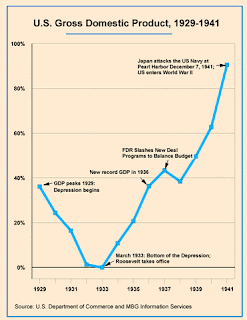
Nonetheless...the curve of economic freefall staunched and a raft of social welfare legislation passed while the President tacked back and forth between bold action and pulls back on the reins does lend an outline of faint resemblance to the two first terms. The history rhymes a bit -- and Michael Hiltzik, who just published his The New Deal: A Modern History this September, has got to be conscious of that. Hence the occasional eye-rubbing passage such as this, surveying FDR's political standing in January 1936:
Perhaps the whole difference is here (large size here):
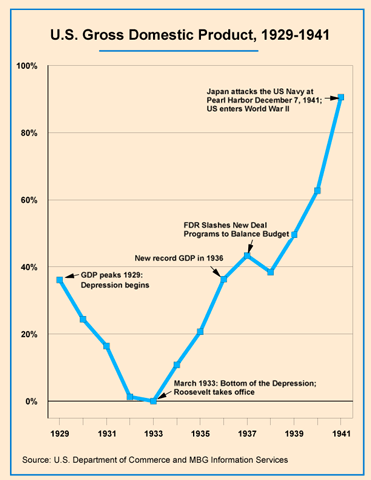
Nonetheless...the curve of economic freefall staunched and a raft of social welfare legislation passed while the President tacked back and forth between bold action and pulls back on the reins does lend an outline of faint resemblance to the two first terms. The history rhymes a bit -- and Michael Hiltzik, who just published his The New Deal: A Modern History this September, has got to be conscious of that. Hence the occasional eye-rubbing passage such as this, surveying FDR's political standing in January 1936:
Tuesday, November 08, 2011
Vernacular alert, OWS edition
Here's Erik Erikson, fuming that the GOP's apparent nominee only pretends to be insane but isn't really:
We have a new way of framing subsections of the national community: "the XX%." The 99%, the 1%...pithy. And heartwarming. We all have multiple percentile siblings. College grads: the 32% (more or less). The uninsured: the 17%. American children living in poverty: the 22%. Evangelicals: the 26%. Dog owners: the 37%. Nonvoters: the 45%. Residents of millionaire households: the 7%. People with IQs under 100: the 49.99999%. Above-average Lake Wobegon children: The 99.9999%.
Maybe a social network can take this up. Invite members to tick off percentile groups in which they claim membership. Virtual numeric communities! Who says that social cohesion is slipping away?
...once he loses, Republican establishment types will blame conservatives for not doing enough for Mitt Romney, never mind that Mitt Romney has never been able to sell himself to more than 25% of the GOP voters. It’s not his fault though, it is the 75%’s fault.Never mind Erikson's argument that Romney will lose the election because he's not a real conservative. I'm not convinced, but from his mouth to God's ears. What interests me is his turn of numerical phrase, "the 75%'s..."
We have a new way of framing subsections of the national community: "the XX%." The 99%, the 1%...pithy. And heartwarming. We all have multiple percentile siblings. College grads: the 32% (more or less). The uninsured: the 17%. American children living in poverty: the 22%. Evangelicals: the 26%. Dog owners: the 37%. Nonvoters: the 45%. Residents of millionaire households: the 7%. People with IQs under 100: the 49.99999%. Above-average Lake Wobegon children: The 99.9999%.
Maybe a social network can take this up. Invite members to tick off percentile groups in which they claim membership. Virtual numeric communities! Who says that social cohesion is slipping away?
Monday, November 07, 2011
A Kling-free future prosperity?
I sure hope Arnold Kling is wrong about the future of employment and wealth distribution in the U.S. -- and I suspect that he does too, as he seems gloomy about his own prognosis. Overviewing a long-range and recently accelerated squeeze on mid-level jobs,, he envisions an American society rather like that portrayed in Kurt Vonnegut's first novel, Player Piano (1952), in which a small uber-class of engineers rules a society in which the masses are consigned to "reeks and recs," a kind of permanent WPA for the superannuated.
Kling suggests that increases in productivity may no longer generate new kinds of jobs in sufficient numbers:
Kling suggests that increases in productivity may no longer generate new kinds of jobs in sufficient numbers:
Sunday, November 06, 2011
Stux chucks world into flux
Ever since I first encountered Jeffrey Goldberg crowing about Stuxnet, the cyber-weapon that reportedly set back Iran's nuclear program by 1-2 years, I've worried that by launching such weapons (or helping the Israelis launch them) the U.S. is sowing the wind and will reap the whirlwind. The same might be said for our ever-expanding drone deployments. David Rothkopf fleshes out such fears:
"America still hasn't quite understood that we are opening Pandora's box. Take drones. We feel we can use them anywhere, soon others will be using them against us. There are dozens of countries around the world developing their own drone technology or buying what is out on the market. The same is true for technologies like those associated with Stuxnet," said the former senior diplomat who has worked closely throughout his career with the military and intelligence communities. Or as another journalist friend of mine put it who has been covering the issue closely, "The day after Stuxnet was like the day after Hiroshima. We had the technology and no one else did. But within a matter of a few years that had changed." So had the nature of modern warfare...and by extension of modern diplomacy and that's what is going to happen here.
Saturday, November 05, 2011
In which Google quells a will to quibble
Funny thing happened on the way to a blog post:
I am reading (courtesy of Ezra Klein) William Easterly's wildly enthusiastic review of Nobelist economist Daniel Kahneman’s Thinking, Fast and Slow, about the workings of our unconscious and conscious thinking processes. I encounter a quick-summed conclusion that looks a little dicey to me:
Nah... Google experiment cfos forcast S&P next year 90 percent. And lo:
I am reading (courtesy of Ezra Klein) William Easterly's wildly enthusiastic review of Nobelist economist Daniel Kahneman’s Thinking, Fast and Slow, about the workings of our unconscious and conscious thinking processes. I encounter a quick-summed conclusion that looks a little dicey to me:
Even worse, we don’t know what we don’t know. In one experiment, chief financial officers of corporations were asked to forecast the return on the Standard & Poor’s index over the following year, giving one number they were 90 per cent sure was too high and another they were 90 per cent sure was too low. The true number was outside their intervals 67 per cent of the time.Wait, I think...what year? 2008, perhaps? To assess the 90% confidence level, wouldn't you want, say, 10 years? And do I need to buy the book to check this out?
Nah... Google experiment cfos forcast S&P next year 90 percent. And lo:
Friday, November 04, 2011
Move Your Money -- if convenient and profitable
In honor of Bank Transfer Day, a redux of this 1/7/10 post, with updates, seems to be in order:
---
There is some merit in Arianna Huffington's Move Your Money campaign to induce individuals to transfer their funds from the megabanks so many of us use to local community banks. The plan is greatly strengthened by providing an online tool by which we can all check the financial strength of local community banks [UPDATE - neither of the two tools now offered show financial ratings, though one only shows institutions ranked "B" or better by the provider, IRA Bank Ratings. For ratings on an A-E scale provided by Weiss Ratings, see this at TheStreet.com. Weiss's methodology is here. Disclosure: I have done media outreach work for Weiss.]
Like most Arianna productions, though, this one is an oversimplified morality play: big bank bad/small bank good. It's telling that one of her co-sponsors is a filmmaker and that she's openly inviting all of us to enact a real-life rerun of "It's a Wonderful Life." A few caveats:
---
There is some merit in Arianna Huffington's Move Your Money campaign to induce individuals to transfer their funds from the megabanks so many of us use to local community banks. The plan is greatly strengthened by providing an online tool by which we can all check the financial strength of local community banks [UPDATE - neither of the two tools now offered show financial ratings, though one only shows institutions ranked "B" or better by the provider, IRA Bank Ratings. For ratings on an A-E scale provided by Weiss Ratings, see this at TheStreet.com. Weiss's methodology is here. Disclosure: I have done media outreach work for Weiss.]
Like most Arianna productions, though, this one is an oversimplified morality play: big bank bad/small bank good. It's telling that one of her co-sponsors is a filmmaker and that she's openly inviting all of us to enact a real-life rerun of "It's a Wonderful Life." A few caveats:
- I thought we'd all got over "It's a Wonderful Life" rapture in the wake of the savings and loan crisis of the late eighties/early nineties, when over 700 S&Ls failed, costing U.S. taxpayers something like $150 billion. Thanks in part to deregulation in the early 80s that expanded S&Ls' lending authority and weakened accounting standards, many were subsequently run more by Potter principles than by George Bailey principles. For that matter, consider the movie itself. But for the extreme virtue and fortitude of the hero, the angelic Building and Loan would have been absorbed by Potter's bank (which might have remained a community bank to this day, unless Potter proved more able than a handful of SuperPotters).
- Community banks are not exactly politically unconnected Davids going up against the industry Goliaths. The industry's trade association, the Independent Community Bankers of America (ICBA) was very effective in weakening the Consumer Financial Protection Agency created by legislation passed in the House. The ICBA succeeded in exempting community banks from CFPA examination and in preventing the CFPA from mandating that community banks offer "plain vanilla" loan products.
I am tired of this game...
That is, the breathless monthly elephant-groping over the unemployment numbers. Here's Politico, via email alert:
"Well below"? Twenty percent is well within the range of the typical revision of prior month's numbers. September's number, for example, was revised up today from 103,000 to to 158,000 -- almost triple the "disappointment" triggered by the margin below consensus for this month, while August was revised up from 0 to 57,000. Those upward revisions exceed the alleged job growth this month.
There's plenty of intelligent deep diving, of course. Those who follow these numbers closely understand their ambiguities and uncertainties, and the cumulative nature of the light they shed. But the headline snapshots, the insta-hardening of snap perceptions, are not helpful.
The unemployment rate fell to 9 percent in October from 9.1 percent in September, but the country added a disappointing 80,000 jobs, well below expectations that as many as 100,000 jobs would be created last month, according to data released by the Labor Department on Friday.
"Well below"? Twenty percent is well within the range of the typical revision of prior month's numbers. September's number, for example, was revised up today from 103,000 to to 158,000 -- almost triple the "disappointment" triggered by the margin below consensus for this month, while August was revised up from 0 to 57,000. Those upward revisions exceed the alleged job growth this month.
There's plenty of intelligent deep diving, of course. Those who follow these numbers closely understand their ambiguities and uncertainties, and the cumulative nature of the light they shed. But the headline snapshots, the insta-hardening of snap perceptions, are not helpful.
Thursday, November 03, 2011
Another eurolesson in brinksmanship
Last week, I noted a rather painful contrast between Angela Merkel's brinksmanship (whatever you think of her policymaking) and Obama's lack thereof, lamenting that we couldn't substitute "Obama" and "Boehner" in this Times headline below:
Merkel Called Bankers’ Bluff to Win Europe a Debt PlanToday, add to the roster of EuroRussian Roulette-meisters Greek Prime Minister George Papandreou, who sent the Eurozone into panic mode with his call for a referendum on the EU's latest rescue plan -- apparently to scare his domestic opposition into line. From the FT's liveblog:
Wednesday, November 02, 2011
We may be half-drowning, but we're not stagnating
Some months ago, in an encounter with Tyler Cowen's ebook The Great Stagnation, I questioned Cowen's premise that technological transformation of human life has slowed down in recent decades, that is
whether we're living in an era in which transformative technological innovation is in short supply. Cowen does allow "the Internet" as the great exception, but points out that the leading-edge tech companies employ relatively few people, and that Internet innovation has been notoriously difficult to monetize. He is strangely silent, though, about the impact of interactive technology and computer technology more generally on production and commerce of all kinds -- just-in-time factory production, product customization, bar coding, all the incredible efficiencies of large-scale retail operations that wring out large profits on tiny margins -- and on interactive technology's role in globalizing production. He also doesn't consider transformative technologies hiding in plain sight: personal computers themselves (never mind the Internet) and cell phones. It's true, as Cowen says, that the basic physical components of middle class life in America don't look that much different than they did in the 1960s. But they are much different. And the differences have generated a lot of wealth, even if the U.S. middle class hasn't garnered as large a share as it did in he previous generation.That demurral is advanced at book length by MIT scholars Erik Brynjolfsson and Andrew McAfee in Race Against the Machine: How the Digital Revolution is Accelerating Innovation, Driving Productivity, and Irreversibly Transforming Employment and the Economy. Brynjolfsson and McAfee argue that computer and network technology is indeed, like the steam engine and electricity before them, a "general purpose technology" (GPT), that is, one that accelerates economic progress in a world-transforming way. IT's transformative power is an inevitable effect of Moore's Law: we have lived through a time of sustained exponential growth in processing power, which has brought us to the brink of self-driving cars, chap robots that function more or less as mini-factories, and viable automated translation and communication. While the landscape may not yet have been as visibly transformed as it was by prior GPTs, as Cowen argues, business processes have. Regarding the Web and enterprise resource planning and CRM software, for example:
Monday, October 31, 2011
Krugman, The Wire beat you to it....
Paul Krugman, desperate for a form of stimulus that Republicans can get behind, starts thinking like a disaffected detective in that epic of police and general government dysfunction, The Wire:
John Maynard Keynes...noted a curious “preference for wholly ‘wasteful’ forms of loan expenditure rather than for partly wasteful forms, which, because they are not wholly wasteful, tend to be judged on strict ‘business’ principles.” Indeed. Spend money on some useful goal, like the promotion of new energy sources, and people start screaming, “Solyndra! Waste!” Spend money on a weapons system we don’t need, and those voices are silent, because nobody expects F-22s to be a good business proposition.
To deal with this preference, Keynes whimsically suggested burying bottles full of cash in disused mines and letting the private sector dig them back up. In the same vein, I recently suggested that a fake threat of alien invasion, requiring vast anti-alien spending, might be just the thing to get the economy moving again.
Saturday, October 29, 2011
Voters sniff out Perry's dominant trait
It seems pretty obvious by now that the GOP debates have highlighted Perry's lack of ability to discuss policy with any cogency or nuance or even command of facts. As a big believer in multiple intelligences, I would not call the deficit "stupidity." Perry is plainly a clever son of a bitch. Like any party boss or dictator, he knows how to amass power and sell favors. He also has a good sixth sense for the zeitgeist and knows how to tell the voters he's pursuing what they want to hear.
Aside from a lack of policy competence and verbal facility, however, Perry has made another negative impression that may be hurting him with a still-free people. It was captured in a focus group of 12 Ohio voters -- Democrats, Republicans and independents -- recently conducted by pollster Peter Hart (as reported by the Washington Post's Dan Balz). At one point, participants were asked to imagine themselves in fifth grade and fit the candidates into a menu of class types. The result for Perry:
Aside from a lack of policy competence and verbal facility, however, Perry has made another negative impression that may be hurting him with a still-free people. It was captured in a focus group of 12 Ohio voters -- Democrats, Republicans and independents -- recently conducted by pollster Peter Hart (as reported by the Washington Post's Dan Balz). At one point, participants were asked to imagine themselves in fifth grade and fit the candidates into a menu of class types. The result for Perry:
Friday, October 28, 2011
The weight of (recent) history, cont.
The BBC has nailed down something I've vaguely wondered since reading in Arthur C. Clarke's 2001 that the dead outnumbered the living 30-to-1. Now, the ratio is more like 12-to-1! Some 83.2 billion have lived since the beginning of the species, and about 7 billion of them (us) are alive now.
Next question: how many people have lived/died in the last 100 years? 10 billion, according to the BBC. 200? 500? A disproportionate slice of human history, viewed in terms of hours lived by human beings, has happened quite recently. And as I've suggested before, it's quite right that kids read less of the classics and spend more of their educational time soaking up what's been written and discovered in recent times than they would have done 50 or 100 years ago -- since the percentage of literate people and those who have added to the permanent store of human knowledge or preserved human expression in the past 150 or 100 or 50 years must be many times that of the percentage of people who have lived within those time frames.
Next question: how many people have lived/died in the last 100 years? 10 billion, according to the BBC. 200? 500? A disproportionate slice of human history, viewed in terms of hours lived by human beings, has happened quite recently. And as I've suggested before, it's quite right that kids read less of the classics and spend more of their educational time soaking up what's been written and discovered in recent times than they would have done 50 or 100 years ago -- since the percentage of literate people and those who have added to the permanent store of human knowledge or preserved human expression in the past 150 or 100 or 50 years must be many times that of the percentage of people who have lived within those time frames.
In painful contrast
Alas that the U.S. prior to Aug. 1 could not have seen such a headline as this from today's Times, with some noun substitutions:
Yes, the European debt deal is inadequate and leaves core questions unresolved -- how the banks will recapitalize, how the bailout fund will be funded, how countries crippled by imposed austerity can grow and thus repay their debt. But given the imperative to get this minimum threshold demand across, Merkel didn't blink.
Merkel Called Bankers’ Bluff to Win Europe a Debt PlanOr a narrative about our president like this:
But Mrs. Merkel called the bankers’ bluff, said officials present at the discussions. Accept the 50 percent write-down, she told the bankers, or bear the consequences of default. In effect, she was willing to risk a credit event, and to place the blame for any fallout on them.The key words here are no, risk, and blame. Conspicuously absent from Obama's negotiating vocabulary and repertoire.
Yes, the European debt deal is inadequate and leaves core questions unresolved -- how the banks will recapitalize, how the bailout fund will be funded, how countries crippled by imposed austerity can grow and thus repay their debt. But given the imperative to get this minimum threshold demand across, Merkel didn't blink.
Thursday, October 27, 2011
Question for political scientists
Political scientists who descend to the blogosphere are at pains to make the rest of us understand that, to paraphrase Yogi Berra, 95 percent of electoral combat is half structural -- that is, national election results are driven mainly by the state of the economy, at least in peacetime. Candidates' skills and political strategy matter only at the margins -- though in a close election, the margin can be decisive.
This structural view escapes determinism only to the extent that a) an incumbent can, in fact, affect economic conditions, including via ultimately destructive short-term jolts such as Nixon's imposition of wage and price controls; or b) economic conditions are mixed enough, or other factors such as war are salient enough, to put an election up for grabs (as in, for example, the recession we didn't know we had entered in late 2000, or Americans' unease with the course of the Iraq War in 2004).
Of course conditions are often mixed and murky. Nonetheless, I'd like to test the determinism of political scientists struggling to educate journalists and the rest of us, such as Brendan Nyhan, Jonathan Bernstein, John Sides & friends -- and of those who taken their data to heart, such as Jonathan Chait, Ezra Klein, and Matthew Yglesias. Oh, and one who defies category, master of probability Nate Silver.
So here's the challenge: using an economic measure of your choice, such as growth or shrinkage of personal income, or GDP, or unemployment (often dismissed as a lagging indicator), is there a threshold below which you would be prepared to say that Obama cannot be reelected? Hedge it how you will: exclude military or environmental emergency or disaster, or terrorist attack, or Republican nomination of a nutcase...hell, make it "Obama can't beat Romney if..." if you like. And let's not make this too easy, as in Depression-level GDP shrinkage or unemployment. Hewing as close to our current bad-normal conditions as possible, what's the can't-win economic marker for Obama?
UPDATE 11/3: Nate Silver created for himself a more sophisticated version of this challenge, gaming out various 2012 scenarios while averaging out incumbent's approval rating, GDP growth (or lack thereof), and challenger's ideological rating (moderate to extreme). Given Obama's current approval rating, with a candidate in the historical middle of the ideology scale -- Romney -- Silver rates the challenger's odds at 83% if there's 0% GDP growth over the next year, and at 40% if there's 40% growth. That indicates almost a tossup given perhaps the likeliest scenario: 2-3% growth. I must say, I find Silver's 3-factor model for prediction intuitively satisfying, finely calibrated -- check it out.
This structural view escapes determinism only to the extent that a) an incumbent can, in fact, affect economic conditions, including via ultimately destructive short-term jolts such as Nixon's imposition of wage and price controls; or b) economic conditions are mixed enough, or other factors such as war are salient enough, to put an election up for grabs (as in, for example, the recession we didn't know we had entered in late 2000, or Americans' unease with the course of the Iraq War in 2004).
Of course conditions are often mixed and murky. Nonetheless, I'd like to test the determinism of political scientists struggling to educate journalists and the rest of us, such as Brendan Nyhan, Jonathan Bernstein, John Sides & friends -- and of those who taken their data to heart, such as Jonathan Chait, Ezra Klein, and Matthew Yglesias. Oh, and one who defies category, master of probability Nate Silver.
So here's the challenge: using an economic measure of your choice, such as growth or shrinkage of personal income, or GDP, or unemployment (often dismissed as a lagging indicator), is there a threshold below which you would be prepared to say that Obama cannot be reelected? Hedge it how you will: exclude military or environmental emergency or disaster, or terrorist attack, or Republican nomination of a nutcase...hell, make it "Obama can't beat Romney if..." if you like. And let's not make this too easy, as in Depression-level GDP shrinkage or unemployment. Hewing as close to our current bad-normal conditions as possible, what's the can't-win economic marker for Obama?
UPDATE 11/3: Nate Silver created for himself a more sophisticated version of this challenge, gaming out various 2012 scenarios while averaging out incumbent's approval rating, GDP growth (or lack thereof), and challenger's ideological rating (moderate to extreme). Given Obama's current approval rating, with a candidate in the historical middle of the ideology scale -- Romney -- Silver rates the challenger's odds at 83% if there's 0% GDP growth over the next year, and at 40% if there's 40% growth. That indicates almost a tossup given perhaps the likeliest scenario: 2-3% growth. I must say, I find Silver's 3-factor model for prediction intuitively satisfying, finely calibrated -- check it out.
Wednesday, October 26, 2011
George H.W. Bush's good son
It seems clear America has had its fill of Bushes -- hence Jeb's conspicuous absence from a weak field of GOP presidential candidates challenging a vulnerable incumbent.
Bush Pere does have an heir, though -- a good son intent on restoring the 50-year American foreign policy consensus of which GHWB was arguably the apotheosis (as Robert Gates presents him in his memoir, From the Shadows). His name is Barack Hussein Obama.
As Jay Leno put a bunch of softballs up on a tee for Obama last night, the President, while swatting a few victory drives, made it very clear that he saw himself restoring the old multilateral, America-first-among-equals tradition -- after a period of aberration presided over by Guess Who.
In fending off the "leading from behind" rap, Obama characterized the Libyan operation in terms that could be used to describe Bush Sr.'s conduct of the first Gulf War. My italics below (transcript here):
Bush Pere does have an heir, though -- a good son intent on restoring the 50-year American foreign policy consensus of which GHWB was arguably the apotheosis (as Robert Gates presents him in his memoir, From the Shadows). His name is Barack Hussein Obama.
As Jay Leno put a bunch of softballs up on a tee for Obama last night, the President, while swatting a few victory drives, made it very clear that he saw himself restoring the old multilateral, America-first-among-equals tradition -- after a period of aberration presided over by Guess Who.
In fending off the "leading from behind" rap, Obama characterized the Libyan operation in terms that could be used to describe Bush Sr.'s conduct of the first Gulf War. My italics below (transcript here):
Tuesday, October 25, 2011
Romney will be at pains not to "flatten" the middle class
Jamelle Bouie is confident that Romney will respond to Perry's flat tax proposal with one of his own:
Of course, with prominent Republicans pushing for a flat tax, it’s likely that Romney will relent and release his own proposal for instituting a single income tax rate. As The Times writes, “Lately…his tone has been more positive. ‘I love a flat tax,’ he said in August.”Jamelle, I'm going to have to bump Romney-readings with you.
Sunday, October 23, 2011
The Times leaves out the 'Waldorf' in Waldorf School portrayal
Matt Richtel, a technology reporter for the New York Times, has a front-page story about a school in Silicon Valley, popular among tech execs, that keeps computers out of the elementary school classroom. That's interesting as far as it goes -- if my children were elementary school age, I would be open to putting them in a computer-free classroom. Yet the article is quite odd, in that Richtel seems to have very little idea of what kind of school he is affording a 1500-word front-page article. The school is the Waldorf School of the Peninsula in Los Altos, California -- that is, per its name, a Waldorf School, i.e. a school based on the educational theory that the Anthroposophist sect founder Rudolph Steiner derived from his own idiosyncratic fusion theology, which combines elements of eastern mysticism (reincarnation, karma) with Christianity (overlaid by what C.S. Lewis called a "reassuring Germanic dullness") . That means that students' education is shaped by a set of religious beliefs quite as specific and literal-minded as those at an evangelical Christian school.
Friday, October 21, 2011
Perry lands an off-stage blow on Obamneycare
After each of the last two GOP debates (1, 2), I noted that no Romney rival managed to spell out the structural similarities between Romneycare and the Affordable Care Act. Now Perry has an ad that kin of does the job -- or rather, delivers a functional equivalent that appeals to Republican primary voters' emotions:
Mind you, the ad does not really spell out -- except for a brief allusion to exchanges -- how the ACA mirrors Romneycare. What it drives home is that Romney regarded them as similar and hoped that his program might be replicated nationally -- and also, of course that he's now lying about that.
Mind you, the ad does not really spell out -- except for a brief allusion to exchanges -- how the ACA mirrors Romneycare. What it drives home is that Romney regarded them as similar and hoped that his program might be replicated nationally -- and also, of course that he's now lying about that.
Thursday, October 20, 2011
Space invaders in politics
About that hand that Romney laid on Perry during their talk-over-each-other battle in the Vegas debate: the Washington Post's Ann Gerhart finds experts who claim that violating the other's space in a debate is always a no-no:
But the debate stage has its own set of rigid rules of engagement, the most important being: Keep your hands to yourself. You can shake hands before and clap a rival on the back after — and even kiss Rep. Michele Bachmann on the cheek — but never, ever make a move on the other guy.
Wednesday, October 19, 2011
New York Times warns Obama of phantom political risk
I'm sure I'm not the only reader who noticed that this article by the Times' Mark Landler about the alleged risks inherent in Obama's post-Labor Day political strategy failed to cite any evidence in support of this thesis:
While Mr. Obama’s partisan jabs appeal to his Democratic base, they may turn off independent voters, who flocked to him in 2008 in part because of his carefully cultivated image as a leader who rises above the partisan fray. With the jobless rate closer to 10 percent than 4 percent, they may start to tune out the president.
Tuesday, October 18, 2011
Once again, the attacks on Romneycare fall harmless
In this debate, finally, Romney's rivals tried to sustain a collective attack on the health insurance program he designed and implemented in Massachusetts. Someone (Gingrich, I think) charged that it jacked up healthcare costs in Massachusetts, which have indeed risen at faster than the national rate (as they did before the plan was implemented). Someone else (Perry, I think) charged that Romney had held the plan up as a model for the whole country -- rehashing an excision between editions of Romney's campaign book -- and others piled on.
Once again, however, what nobody managed to do was to spell out the extent to which the Affordable Care Act was modeled on Romneycare-- that the national plan borrows the subsidized exchanges composed of private health plans conforming to minimum coverage rules, with the whole structure made economically viable by the individual mandate and the employer mandate. Romney was again allowed to emphasize that he created a free market solution for the uninsured, though he didn't get around this time to the lie that the ACA is by contrast "government controlled," as if it weren't structured the same way. Gingrich even threw Romney a bone, asserting that Romneycare "wasn't as bad" as Obamacare without detailing how they were different, or similar.
Once again, however, what nobody managed to do was to spell out the extent to which the Affordable Care Act was modeled on Romneycare-- that the national plan borrows the subsidized exchanges composed of private health plans conforming to minimum coverage rules, with the whole structure made economically viable by the individual mandate and the employer mandate. Romney was again allowed to emphasize that he created a free market solution for the uninsured, though he didn't get around this time to the lie that the ACA is by contrast "government controlled," as if it weren't structured the same way. Gingrich even threw Romney a bone, asserting that Romneycare "wasn't as bad" as Obamacare without detailing how they were different, or similar.
The adminstration's last bullet against economic stagnation?
Back in 2008, as the mortgage crisis metastasized, FDIC chair Sheila Bair, a Bush appointee, was for it. John McCain, under tutelage of his economic advisor, former CBO director Douglas Holtz-Eakin, was for it (twice, in two forms). In early 2009, leading Senate Republicans were for it. Today, former Reagan Council of Economic Advisers Chair Martin Feldstein is for it. And we learn it today's FT that Glenn Hubbard, George W. Bush's Council of Economic Advisers chair, is also for it.
"It" is large-scale mortgage relief for underwater homeowners. Bair, McCain-Holtz-Eakin, and Feldstein called for principal writedowns. Hubbard wants interest rates reduced to today's low levels:
"It" is large-scale mortgage relief for underwater homeowners. Bair, McCain-Holtz-Eakin, and Feldstein called for principal writedowns. Hubbard wants interest rates reduced to today's low levels:
Monday, October 17, 2011
A not-entirely-false equivalence of blame between the parties
Primed by James Fallows, Greg Sargent, and Steve Benen, I'm on high alert for false equivalence -- reporter's language blaming government dysfunction equally on both parties, when it's Republicans who have taken the filibuster and other means of blocking legislative action to unprecedented extremes while opposing and demonizing a host of policies that they've historically supported. So the radar started blinking when I came across this in a Financial Times editorial:
But then, I was stopped by the actual "equivalence":
For the last three years, the country has been paralysed by a political gridlock that has put its future on the line. Both Republicans and Democrats are to blame –
But then, I was stopped by the actual "equivalence":
the Grand Old Party for its callous obstruction of all Democratic initiatives and President Barack Obama for his naïve neglect of the need for muscular leadership.
Sunday, October 16, 2011
Can Occupy Wall Street make Obama welcome some hatred?
My wife and I went into Times Square for the Occupy Wall Street rally held there Saturday evening. One of the lead chants was "Wall Street got bailed out; we got sold out." That's a half truth -- and a vague charge, as it leaves the nefarious deeds in the passive voice. Obama thus avoids the direct hit. But not everywhere:

Although that sign is more false than true, I'm glad it's out there. Obama did need to complete the bank bailout and engineer their recapitalization, but he did it with far too few strings attached, and without demanding reciprocal action from the banks in the form of mortgage relief. I want him pressured from the left -- as FDR was pressured.
Today people love to quote Roosevelt's October 31,1936 campaign speech in which he laid into powerful moneyed interests, who had been excoriating him for instituting a tax on a tax on undistributed corporate profits. Roosevelt responded by campaigning with increasing fervor, according to David M. Kennedy in Freedom from Fear, against "greed" and "autocracy." The Madison Square Garden speech was the climax:

Although that sign is more false than true, I'm glad it's out there. Obama did need to complete the bank bailout and engineer their recapitalization, but he did it with far too few strings attached, and without demanding reciprocal action from the banks in the form of mortgage relief. I want him pressured from the left -- as FDR was pressured.
Today people love to quote Roosevelt's October 31,1936 campaign speech in which he laid into powerful moneyed interests, who had been excoriating him for instituting a tax on a tax on undistributed corporate profits. Roosevelt responded by campaigning with increasing fervor, according to David M. Kennedy in Freedom from Fear, against "greed" and "autocracy." The Madison Square Garden speech was the climax:
Saturday, October 15, 2011
Rick Perry, philosopher king
A Perry spokesman, reacting to questions about the billions in state contracts awarded to clients of Perry's chief factotum, characterizes the governor's decision-making process like this:
Aides to the governor took issue with any suggestion that Mr. Perry did anyone’s bidding other than his own. “The governor bases his policy decisions on what his philosophical beliefs and policies are,” said a spokesman, Mark Miner.
Wednesday, October 12, 2011
The best liar in the field
It is a fact universally acknowledged that Romney crushed the opposition in the last debate -- in fact in all the debates so far. That's because he has facts and data at his fingertips, along with a bottomless willingness to twist them in support of current GOP nostrums. The others don't call him on his distortions, because they support the same policies he's advocating -- no new taxes, no bailouts, repeal Obamacare and Dodd-Frank, gut regulations. And they don't call him out when he creates false contrasts between his own past actions and Obama's, because doing so would imply that there's some virtue in Obama's policies.
The upshot is that Romney is free to propose impossible unions of his past pragmatism -- compromising with Massachusetts Democrats, supporting the TARP bailouts, designing subsidized health insurance exchanges -- with his current extremist positions. Here's how three of those unions played out in the last debate.
The upshot is that Romney is free to propose impossible unions of his past pragmatism -- compromising with Massachusetts Democrats, supporting the TARP bailouts, designing subsidized health insurance exchanges -- with his current extremist positions. Here's how three of those unions played out in the last debate.
Monday, October 10, 2011
Will debased politics hit the databases?
Politico's Kenneth P. Vogel today delves into the coopetition between the GOP fundraising empires of Karl Rove and the Koch brothers. When the account turned to rival databases, I suffered a free association so sharp it was almost comic, as if the keyword word flashed in front of my eyeballs. Here was the trigger:
The word was Stuxnet. And no, I don't expect the Koch and Rove empires to sabotage each others' databases. What I can easily imagine is Rove or other GOP operatives corrupting or stealing Democrats' data. It's so in keeping with the m.o. of the aging College Republicans who have directed GOP campaigns for a generation.
Earlier this year, operatives from both camps had conversations with the Republican National Committee about accessing its mega database of voter information, which is both a powerful organizing tool and a valuable asset used as collateral to secure bank loans and lines of credit.
“This is about getting a hold of the most valuable asset that the RNC has,” said former RNC Chairman Michael Steele, who asserted Rove’s allies have for years wanted to “get their hands on this list so bad they can taste it.”
The word was Stuxnet. And no, I don't expect the Koch and Rove empires to sabotage each others' databases. What I can easily imagine is Rove or other GOP operatives corrupting or stealing Democrats' data. It's so in keeping with the m.o. of the aging College Republicans who have directed GOP campaigns for a generation.
Sunday, October 09, 2011
Better Angels yield new angles
I am very much looking forward to reading Steven Pinker's The Better Angels of Our Nature: Why Violence has Declined, after reading a precis by Pinker and a review by Peter Singer. As a collector of evidence that human life and human beings are getting better, I am receptive to the copious evidence that Pinker has gathered to demonstrate that violence has diminished dramatically over the course of human history -- in the family, in the state, between states, and, perhaps now finally, within states.
Pinker's demonstration that human beings have gradually taught themselves to be more in control of their violent instincts, more amenable to reason, and more empathic seems to me to sync up nicely with Robert Wright's theory that God has evolved with human society--that as society grows more humane, so do concepts of God (this too I'm familiar with through the writer's shorter representations of his recent book, The Evolution of God).
Personally, though, I would prefer not to drag the God of Ages along on our pilgrim's progress. Notwithstanding frequent relapses such as the two world wars of the twentieth century, it looks to me as though Pinker shows moral advances in human history to be as verifiable as technological advance. For that reason, I am impatient with the concept of scripture, the investiture of any inherited text or law with authority that can't be superseded , after due process, by a text or law embodying the best wisdom of those living now. Less legalistically: if a thinker is groping toward new moral or ethical insight, why shackle that insight to an interpretation of God's law as embodied in ancient texts? Can we not acknowledge by now that gods are silent, except perhaps through our own intuition, and that that intuition is continually improving?
Pinker's demonstration that human beings have gradually taught themselves to be more in control of their violent instincts, more amenable to reason, and more empathic seems to me to sync up nicely with Robert Wright's theory that God has evolved with human society--that as society grows more humane, so do concepts of God (this too I'm familiar with through the writer's shorter representations of his recent book, The Evolution of God).
Personally, though, I would prefer not to drag the God of Ages along on our pilgrim's progress. Notwithstanding frequent relapses such as the two world wars of the twentieth century, it looks to me as though Pinker shows moral advances in human history to be as verifiable as technological advance. For that reason, I am impatient with the concept of scripture, the investiture of any inherited text or law with authority that can't be superseded , after due process, by a text or law embodying the best wisdom of those living now. Less legalistically: if a thinker is groping toward new moral or ethical insight, why shackle that insight to an interpretation of God's law as embodied in ancient texts? Can we not acknowledge by now that gods are silent, except perhaps through our own intuition, and that that intuition is continually improving?
Saturday, October 08, 2011
That sixties suburban sweet spot, revisited
My wife grew up on a leafy cul-de-sac in West Seneca, NY, a suburb of Buffalo. Her house, like I think most of the houses on the street, was a comfortable split-level (2500 sq feet, built 1954) with a good-sized yard.
Yesterday, at a family brunch, my wife started asking her fifty-something siblings what the parents of various friends on the block did for a living. Her brother had almost all the answers; her dad filled in a few more this morning. I am changing the names but perserving the ethnicities.
Mr. Grimm was a bricklayer. Mr. Wojick was a foreman at the Ford plant. Mr. Majewski worked in a bronze casting factory, as did one other neighbor. Mr. Cobb worked in product safety at Fisher-Price. Mr. Frank was a stockbroker. Tombari sold insurance. Panetta was a meat wholesaler. White was a concrete contractor working mainly on bridges. Carlotti was a dentist (and my father-in-law, an oral surgeon). The Murphys, husband and wife, were teachers, and so were the Stones. Burger was a roofer.
That is a pretty wide range of livelihoods, isn't it? Perhaps it's not so different today. The price of comparable homes in West Seneca today is $179k; metro Buffalo skipped both housing boom and housing bust. There are fewer factory workers, natch. And I suspect that the dentists and stockbrokers probably live elsewhere. The area has had its share of McMansion building, and you can get a castle in the outer burbs for under $350k.
Yesterday, at a family brunch, my wife started asking her fifty-something siblings what the parents of various friends on the block did for a living. Her brother had almost all the answers; her dad filled in a few more this morning. I am changing the names but perserving the ethnicities.
Mr. Grimm was a bricklayer. Mr. Wojick was a foreman at the Ford plant. Mr. Majewski worked in a bronze casting factory, as did one other neighbor. Mr. Cobb worked in product safety at Fisher-Price. Mr. Frank was a stockbroker. Tombari sold insurance. Panetta was a meat wholesaler. White was a concrete contractor working mainly on bridges. Carlotti was a dentist (and my father-in-law, an oral surgeon). The Murphys, husband and wife, were teachers, and so were the Stones. Burger was a roofer.
That is a pretty wide range of livelihoods, isn't it? Perhaps it's not so different today. The price of comparable homes in West Seneca today is $179k; metro Buffalo skipped both housing boom and housing bust. There are fewer factory workers, natch. And I suspect that the dentists and stockbrokers probably live elsewhere. The area has had its share of McMansion building, and you can get a castle in the outer burbs for under $350k.
Friday, October 07, 2011
Seeing beyond the trough we're in
Kevin Drum today takes on a meme gathering steam: that innovation has stalled, and we're in a period of relative technological stagnation. In particular, addressing the question of whether inventions in the last 50 years have been less transformative than those in the previous 50-odd, he argues:
Most of the best known inventions of the early 20th century were actually offshoots of two really big inventions: electrification and the internal combustion engine. By contrast, the late 20th century had one really big invention: digital computers. Obviously two is more than one, but still, looked at that way, the difference between the two periods becomes a bit more modest. The difference between the offshoots of those big inventions is probably more modest than we think too. Just as we once made better and better use of electrification, we're now making better and better use of digital computing. And to call all these computing-inspired inventions mere "improvements" is like calling TV a mere improvement of radio. These are bigger deals than we often think. We have computers themselves, of course, plus smartphones, the internet, CAT scans, vastly improved supply chain management, fast gene sequencing, GPS, Lasik surgery, e-readers, ATMs and debit cards, video games, and much more.Drum is responding in large part to Tyler Cowen's The Great Stagnation. I'd like to second his skepticism. In fact, some months ago I posed five questions for Cowen, e.g.:
Thursday, October 06, 2011
When MoDo drops the doo-doo...
When Maureen Dowd gathers every cliche that's been circulating about a public figure and assembles them in one spitball, it's a sign that a national caricature has hardened into granite. This week, that spells bad news for President Obama, set off as a foil to Chris Christie:
But now his asceticism seems more like a reflection of his cherished membership in the technocratic priesthood — and an unnerving mirror of our starving economy. He’s an egghead who surrounds himself with eggheads, even when they have helped wreck the economy he’s trying to save....
Wednesday, October 05, 2011
"Tell the truth, now, Nicolle..."
I wish I could find it. Circa 1998, Saturday Night Live ran a mock-interview between Monica Lewinsky and I think Barbara Walters (a.k.a. WaWa), in which the question is posed: "Tell the truth, now, Monica, did you give the President a hummer?" Answer: "No, Barbara." Almost immediately after, Monica whips out and displays her new book, How to Give the President a Hummer.
That's what came to mind as I glanced at a Time interview (by Claire Suddath) with former Bush communications director and McCain campaign adviser Nicolle Wallace focused on her new novel, It's Classified. Main character: Vice Presidential candidate Tara. Premise, according to Wallace:
That's what came to mind as I glanced at a Time interview (by Claire Suddath) with former Bush communications director and McCain campaign adviser Nicolle Wallace focused on her new novel, It's Classified. Main character: Vice Presidential candidate Tara. Premise, according to Wallace:
Tuesday, October 04, 2011
Better late than never? Obama ramps up the attack
Well, the transition is complete. Hope it ain't too late.
A few weeks ago, Democrats waited desperately for Obama to start calling out Republicans in Congress, instead of just "Congress" or "Washington," for blocking action on jobs and deficit -- or, back, then, on deficit and jobs. And the change did come, in the runup to the jobs bill rollout. On September 3, in the weekly address, it was the same old pablum: Congress failed to pass a clean extension of the transportation bill. On Labor Day, he named them that (till then) must not be named (when criticizing):
September 8, when he rolled out his jobs bill, he tweaked a Republican article of faith without naming names:
A few weeks ago, Democrats waited desperately for Obama to start calling out Republicans in Congress, instead of just "Congress" or "Washington," for blocking action on jobs and deficit -- or, back, then, on deficit and jobs. And the change did come, in the runup to the jobs bill rollout. On September 3, in the weekly address, it was the same old pablum: Congress failed to pass a clean extension of the transportation bill. On Labor Day, he named them that (till then) must not be named (when criticizing):
But we’re not going to wait for them. (Applause.) We’re going to see if we’ve got some straight shooters in Congress. We’re going to see if congressional Republicans will put country before party. (Applause.) We’ll give them a plan, and then we’ll say, do you want to create jobs? Then put our construction workers back to work rebuilding America. (Applause.) Do you want to help our companies succeed? Open up new markets for them to sell their products. You want -- you say you’re the party of tax cuts? Well then, prove you’ll fight just as hard for tax cuts for middle-class families as you do for oil companies and the most affluent Americans. (Applause.) Show us what you got. (Applause.)Since that moment, week by week, day by day, the attacks have grown more focused, more direct, more confrontational, more sustained.
September 8, when he rolled out his jobs bill, he tweaked a Republican article of faith without naming names:
Monday, October 03, 2011
Republicans for red tape
Who says Republicans are always hostile to strict regulation?
The New York Times' front-page review of efforts by Republican-controlled state governments to prevent "voter fraud" -- i.e., voting by people who in the good old days would have failed to meet property qualifications -- concludes with a snapshot of a law apparently designed to make all voting rights groups fear that they will share ACORN's fate:
The New York Times' front-page review of efforts by Republican-controlled state governments to prevent "voter fraud" -- i.e., voting by people who in the good old days would have failed to meet property qualifications -- concludes with a snapshot of a law apparently designed to make all voting rights groups fear that they will share ACORN's fate:
In Florida, a new law imposing restrictions on voter registration drives has led the state’s League of Women Voters, a nonpartisan group that had registered voters for 72 years, to call a moratorium on new registration drives in the state, citing the penalties that groups can face under the law.
Independent groups that register voters — like the league — face fines of $50 to $1,000 per applicant if they fail to turn in the applications to elections officials in a timely manner.
“It’s too cumbersome,” said Deirdre Macnab, the league’s president. “There is too much red tape and regulation.”
Sunday, October 02, 2011
Food for thought, and occasional light rations, in Richard Florida's The Great Reset
Credit Richard Florida putting forward a satisfying -- and I think mainly sound -- conceptual framework for understanding our current economic woes in The Great Reset: How the Post-Crash Economy Will Change the Way We Live and Work. Florida argues that major economic slumps correspond with major economic 'resets', in which new ways of generating wealth demand -- and ultimately shape -- new organizations of community, workspace and living space -- and new means of transportation that tie the new "spatial fix." From this perspective, to extrapolate a point that Florida leaves implicit, the bubbles that precede major economic contractions are more symptom than cause -- a kind of giddy last fling at priming the legacy infrastructure that's reached a kind of natural limit.
According to Florida, the two main examples of "reset" in U.S. history are 1) the urbanization of the late nineteenth and early twentieth century, which developed during and followed the "long depression" of 1873-1896; and 2) suburbanization, for which the way was "literally paved" by the New Deal and postwar infrastructure investments. Florida argues that we are in a third reset now -- an accelerating shift from a manufacturing to a service economy, demanding an "infrastructure fix" centered largely on high-speed rail tying together "megaregions" - clusters of large cities that strengthen their economic links and so pool resources.
According to Florida, the two main examples of "reset" in U.S. history are 1) the urbanization of the late nineteenth and early twentieth century, which developed during and followed the "long depression" of 1873-1896; and 2) suburbanization, for which the way was "literally paved" by the New Deal and postwar infrastructure investments. Florida argues that we are in a third reset now -- an accelerating shift from a manufacturing to a service economy, demanding an "infrastructure fix" centered largely on high-speed rail tying together "megaregions" - clusters of large cities that strengthen their economic links and so pool resources.
Thursday, September 29, 2011
Run, Sarah, Run!
If Dick Cheney can try to lure Hillary Clinton into the presidential race, why can't we progressives have a go at Sarah? Jonathan Bernstein:
Could Palin launch an independent bid for the presidency? Why not? What bridges would she be burning with Republicans that she hasn’t burned already? And if she did go that route, she certainly wouldn’t have problems raising a fair amount of money, and she would be able to mobilize enough volunteers to get her name on the ballot in quite a few states.
Wednesday, September 28, 2011
Roger Ailes sees "shoot," and swoons
A few posts back, while trying to articulate a warning that Rick Perry had implicitly endorsed an Israeli strike against Iran's nuclear installations, I wondered if this veiled threat might be written off as campaign bluster. A story about Andrew Jackson, which I had read in Robert Remini's biography, popped into my head at that point.
When Jackson was sitting as a Superior Court judge in Tennessee, "a great, hulking fellow named Russell Bean, who had been indicted for cutting off the ears of his infant child in a 'drunken frolic,' paraded before the court, cursed judge, jury and all assembled, and then marched out the door." Jackson ordered his arrest, but no one dared do it, as Bean threatened to shoot "'the first skunk who came within ten feet of him'." Jackson called a ten-minute recess and took matters into his own hands:
When Jackson was sitting as a Superior Court judge in Tennessee, "a great, hulking fellow named Russell Bean, who had been indicted for cutting off the ears of his infant child in a 'drunken frolic,' paraded before the court, cursed judge, jury and all assembled, and then marched out the door." Jackson ordered his arrest, but no one dared do it, as Bean threatened to shoot "'the first skunk who came within ten feet of him'." Jackson called a ten-minute recess and took matters into his own hands:
Tuesday, September 27, 2011
Fare and ballast
In what sense is Fox "fair and balanced"? Roger Ailes gives the game away:
Ailes has a blunt rejoinder to those who say he runs a biased outfit: “Every other network has given all their shows to liberals. We are the balance.”
Monday, September 26, 2011
Voters: compromise good, capitulation bad
When the first polls came in after the lopsided debt ceiling deal and subsequent stock market tumble, Jonathan Chait billed the budget deal Obama's Katrina.
That rang ominously true to me. Shortly afterward, my sister-in-law, a compassionate Democrat and social worker who stumped with my wife and me* for Obama in ''08, told me tenderly that people were wondering whether Obama was strong enough to be president. Oh oh... Hence, when apparently anomalous polls found that Americans disapproved of Obama's handling of the economy while approving of most of the proposals in his jobs plan, it seemed plain to me that Obama was being punished not for advocating the wrong policies but for failing to put his policies across.
Now here is Michael Tomasky quoting Democratic pollster Guy Molyneux affirming the notion that Obama is suffering from perceived weaknes. Citing Kaiser Family Foundation polling (though the article provides no actual data on this point), Molyneux tells Tomasky
That rang ominously true to me. Shortly afterward, my sister-in-law, a compassionate Democrat and social worker who stumped with my wife and me* for Obama in ''08, told me tenderly that people were wondering whether Obama was strong enough to be president. Oh oh... Hence, when apparently anomalous polls found that Americans disapproved of Obama's handling of the economy while approving of most of the proposals in his jobs plan, it seemed plain to me that Obama was being punished not for advocating the wrong policies but for failing to put his policies across.
Now here is Michael Tomasky quoting Democratic pollster Guy Molyneux affirming the notion that Obama is suffering from perceived weaknes. Citing Kaiser Family Foundation polling (though the article provides no actual data on this point), Molyneux tells Tomasky
Sunday, September 25, 2011
Please, Obama: stop talking like a hostage
A worrying signal in The President's Plan for Economic Growth and Deficit reduction, regarding the triggers in the deficit reduction deal, aka the Budget Control Act (BCA):
With approximately $1trillion in deficit reduction achieved over the next decade through the use of discretionary spending caps, it took a substantial step toward bringing down our deficit.Yet, with discretionary spending projected to reach historically low levels, we need to look at other parts of the budget for savings so that we pursue deficit reduction in a balanced way.This is not only critical to future economic growth, but if the Committee fails to achieve at least $1.2 trillion in deficit reduction, then a sequester would be triggered that could have devastating consequences for both defense and non-defense programs (pg. 2, pdf pg. 12).Here we are with Obama once again warning about "devastating consequences" if a deal is not struck, this time by the Supercommittee. That worked out great the last time, didn't it? When faced with economic disaster if they don't back off a maximalist position, Republicans always back off, right?
Saturday, September 24, 2011
"Michele doesn't comment on any of it"
In the last GOP debate, some participants say that the audience boos for a gay soldier asking a question about Don't Ask Don't Tell couldn't be heard clearly on the stage. Others admit otherwise. After the fact, ABC asked all the candidates for comment. Michele Bachmann's response leaps out:
Rep. Michele Bachmann’s spokeswoman Alice Stewart said in an email to ABC News, “There was booing and cheering throughout the debate – Michele didn’t comment on any of it.”Let's imagine equivalent responses in other situations that test a public figure's moral mettle.
Friday, September 23, 2011
Learning from experience
Jonathan Cohn is cheered that Obama is not only following through so far on his promise to take his jobs plan to the country, but that he's also sticking with calling out Republicans by name for their obstruction, instead of inveighing against "Washington" or "Congress":
Remember those days when he wouldn’t even utter the word “Republican”? Those days are gone. He's even naming names.As someone who was waiting on a hair trigger (with millions of other Democrats) for Obama to make this shift, which he made on Labor Day in a preview of the jobs proposal he unveiled on Sept. 8, I'm as thrilled as Cohn. On one level it's surprising, insofar as Obama was so all-in for so long on finding common ground, compromising, rising above partisan politics -- in fact, that approach a lifelong m.o. and was central to candidate Obama's brand. But in another way it's not surprising. Obama is probably still gunning for compromise and will probably praise Republicans effusively if they put through some subset of the proposals in his jobs bill -- though he will probably also remain in confrontational mode through the election. It's a change of tactics, and one in line with another core element of his brand and probably his self-concept: pragmatism. Here's what he told Ron Suskind about his approach to governing:
Thursday, September 22, 2011
Perry flubs a shot at Romney
In tonight's GOP presidential debate, Romney did a great job nailing Perry to the cross of his ridiculous pronouncements against Social Security -- it's unconstitutional, it's a ponzi scheme etc.-- and his recent attempts to unsay them. Unfortunately, when Perry had a chance to turn the tables, and highlight the disconnect between Romney's defense of Romneycare and denunciations of Obamacare, he flubbed it.
I forget the question, but Romney managed to say in one extended breath that Romneycare was great because "nothing's changed" for the 92% of Massachusetts people who already had coverage, while the uninsured were given a choice among "market-based private insurance" plans. Of course, the same is true of Obamacare. He then cast Obamacare as an abomination because it "puts someone between you and your doctor." In a clearing stands a boxer...lie lie lie, as Romney did every time he said anything about Obama. While the ACA empowers an independent board to cut Medicare costs on a national level, it puts absolutely no one between doctor and patient in any plan. In any case, Perry's opportunity was to point out that everything Romney said in praise of the Massachusetts plan was true of the ACA -- and then rip both.
I forget the question, but Romney managed to say in one extended breath that Romneycare was great because "nothing's changed" for the 92% of Massachusetts people who already had coverage, while the uninsured were given a choice among "market-based private insurance" plans. Of course, the same is true of Obamacare. He then cast Obamacare as an abomination because it "puts someone between you and your doctor." In a clearing stands a boxer...lie lie lie, as Romney did every time he said anything about Obama. While the ACA empowers an independent board to cut Medicare costs on a national level, it puts absolutely no one between doctor and patient in any plan. In any case, Perry's opportunity was to point out that everything Romney said in praise of the Massachusetts plan was true of the ACA -- and then rip both.
Wednesday, September 21, 2011
You can't fact-check a dog whistle
Factcheck.org is unduly literal-minded when it protests that Perry, contra his critics, never "advocated" for Texas seceding from the United States:
Of course Perry didn't 'advocate' secession. He just took advantage of the emotional valence the idea held for his audience. He left it floating as a pleasant fantasy or reserve contingency if current trends persist:
Some may question the prudence of Perry entertaining the suggestion of secession, or talking too loosely about such a radical idea, but any fair-minded reading of Perry's fuller quote, and its context, makes clear that Perry was not advocating for Texas to secede. And Perry has repeatedly said since then that he did not, and does not, advocate secession.
Of course Perry didn't 'advocate' secession. He just took advantage of the emotional valence the idea held for his audience. He left it floating as a pleasant fantasy or reserve contingency if current trends persist:
Perry letting slip the dogs of war?
Rick Perry's default modes of discourse are the smear, the lie and the threat. All three make repeat appearances in his speech outlining his Middle East policy. To sample briefly: the smear: Obama has pursued a policy of "appeasement" of the Palestinian authority and has given "equal standing" to Palestinian "orchestrators of terrorism." Lie: that unspecified U.S. actions during the Green uprising could have unseated Iran's current rulers. But let's spotlight in particular a noteworthy threat, cushioned though it is by some conventional policy recommendations and diplomatspeak. It's here:
Israel’s security is critical to America’s security. We must not forget it was Israel that took out the nuclear capabilities of Iraq in 1981 and Syria in 2007. In both instances, their actions made the free world safer.
Today, the greatest threat to the security of Israel and, by extension, a threat to America, is the Iranian government developing a nuclear arsenal. One thing is clear: we must stop Iran from acquiring nuclear weapons. Economic sanctions must be tightened and increased and all options must remain on the table to stop a brutally repressive regime from acquiring a nuclear capability.
Tuesday, September 20, 2011
Quote of the day
"Obama, to my mind, has successfully demonstrated he has been willing to compromise, and the GOP has successfully demonstrated they cannot." - Andrew Sullivan
That really boils it down, doesn't it?
Monday, September 19, 2011
The arguments haven't changed, but the opponent is named
Greg Sargent cheers Obama's newfound fighting spirit:
This has to be the clearest sign yet that Obama has taken a very sharp populist turn as he seeks to frame the contrast between the parties heading into 2012. During his remarks this morning, Obama directly responded to Republicans accusing him of “class warfare,” but rather than simply deny the charge, he made the critical point that the act of protecting tax cuts for the rich is itself class warfare, in effect positioning himself as the defender of the middle class against GOP class warriors on behalf of the wealthy.Sargent has put his finger on the key difference between Obama today and Obama this summer: direct confrontation. It's worth noting that Obama's arguments have not changed -- nor really have his proposed policies. All through the summer, he argued repeatedly tht deficit reduction had to be "balanced," that it was unfair to ask people to accept reduction in Medicare and Social Security without asking "millionaires and billionaires" to "pay their fair share" via higher taxes. He won that argument in the court of public opinion but lost the negotiation that produced the debt ceiling deal. Moreover, in his deficit reduction plan in April, Obama called for Medicare cost savings broadly similar to those proposed today. According to Ezra Klein, he called for roughly the same amount of increased tax revenue over today's rates -- $1.5 trillion over twelve years -- as he did today -- though the language in the plan outline was studiously vague and I never could see how it amounted to more than $1 trillion over twelve years, i.e., the amount gained by letting the Bush cuts for the top 2% expire.
About that veto promise...
It seems that the Times preview of Obama's deficit reduction plan was inaccurate in an important particular:
In laying out his proposal, aides said, Mr. Obama will expressly promise to veto any legislation that seeks to cut the deficit through spending cuts alone and does not include revenue increases in the form of tax increases on the wealthy.
The battle lines are drawn
From the New York Times' preview of Obama's deficit reduction plan:
But does that mean Obama is willing to pull the trigger (or see it pulled) if the supercommittee deadlocks? He'd better be.
In laying out his proposal, aides said, Mr. Obama will expressly promise to veto any legislation that seeks to cut the deficit through spending cuts alone and does not include revenue increases in the form of tax increases on the wealthy.Glory hallelujah. That has been the missing piece all along.
But does that mean Obama is willing to pull the trigger (or see it pulled) if the supercommittee deadlocks? He'd better be.
Sunday, September 18, 2011
Borrow and spend...
Is how metaphors become memes. Take one that's glided with swanlike grace into the stream of our economic discourse this summer:
With both parties competing for the mantle of austerity, they’re acting a bit like two crazed medeival (sic) doctors leeching a patient who’s already suffering from catastrophic blood loss.That's Adam Serwer on July 28 of this year, regarding the pending debt ceiling deal. Three days later, when the deal was announced, behold Paul Krugman:
So those demanding spending cuts now are like medieval doctors who treated the sick by bleeding them, and thereby made them even sicker.
A fair look at Obama, cont.
Yesterday, I wrote a post speculating about why polls show that Americans broadly approve of Obama's economic policies yet give him poor marks for his handling of the economy. Short answer: he's being punished for not executing, or not fighting hard enough. Today, the New York Times devotes its lead editorial to the same apparent anomaly, and comes to a similar conclusion:
He has wasted far too much time trying to puzzle out how he can shave policies down far enough to get the Republicans to cooperate. The answer has long been clear: He can’t. Since he was elected, the Republicans have openly said they would not work with him, and a year ago, Senator Mitch McConnell, the minority leader, said explicitly that the Republicans’ goal was simply to deny Mr. Obama a second term. The new Times poll showed that Americans do not believe bipartisanship is achievable. Six in 10 Democrats want the president to challenge Republicans more. He should not worry about voters thinking he is being mean. What he should worry about is that he is not showing them that he is fighting all out for their interests.
Qualifying the Wisdom of Crowds
For Sunday fun, a jump into the wisdom/unwisdom of crowds discussion. Re the oft-cited fact that when a roomful of people are each asked to guess the number of jellybeans in a jar, the average answer is usually spot-on, Ed Yong notes:
Saturday, September 17, 2011
Approve of his policies/disapprove of his performance: not a paradox
Greg Sargent wrestles with an apparent paradox in poll data: voters strongly approve of Obama's economic policies but disapprove of his handling of the economy to date. Methinks his explanation misses something rather basic:
What we’re seeing here, again, is more evidence that Republicans benefit from blocking policies Americans support. As long as the economy remains abysmal, the public is likely to strongly disapprove of Obama’s overall performance, even if Republicans are the ones blocking job-creation ideas the public itself thinks will reduce unemployment.Sargent assumes that voters are judging Obama solely on the basis of whether they agree with his current preferred policies, and that many of them are being duped: they like the policies individually, but buy a Republican branding of the whole package. That's probably true in some cases. But I suspect that a lot of people are judging Obama not for advocating the wrong policies but for failing to put his policies across.
Friday, September 16, 2011
Boehner supports Merkeley's call to score Supercommittee proposals for jobs impact
...only implicitly, of course.
Senator Jeff Merkley, as Greg Sargent has repeatedly broadcast with such enthusiasm, has a modest proposal for the Supercommittee charged with striking a deficit reduction deal:
Senator Jeff Merkley, as Greg Sargent has repeatedly broadcast with such enthusiasm, has a modest proposal for the Supercommittee charged with striking a deficit reduction deal:
He is calling on both parties to agree to submit every proposal offered by the supercommittee to the nonpartisan Congressional Budget Office, to be evaluated for the impact it will have — on jobs.
He doesn’t want the CBO to evaluate the proposals just for their budgetary impact. Rather, he wants the CBO to reach a conclusion on the impact the proposals will have on unemployment, whether positive, negative, or neutral.
“We need to have every proposal that the super-committee brings out to have it scored by its jobs impact,” Merkley told me in an interview this morning. He plans to urge Democratic and GOP leaders to agree to this standard, and hopes to build a campaign to make it happen...
Thursday, September 15, 2011
Our next Great Communicator
Having made something of a study of our current President's rhetoric, I owe some attention to that of the man perhaps likeliest to be our next President, Rick Perry. Time's Richard Stengel and Mark Halperin just posted an interview with Perry. Below, some thoughts on responses revel much about Perry's approach to policy, politics, and the rules and purposes of political discourse.
Now that you’ve been in the race for while, do you feel pressure to temper some of your rhetoric, like calling the Obama administration socialist?Let's grant Perry his definition of socialism -- he does have one -- and look at his signature method of characterizing opponents' policies. The Obama administration's education policy is embodied in Race to the Top, which invites states to compete for extra federal funding by submitting their own plans to raise performance according to standards that they propose. As for healthcare policy: the Affordable Care Act does create a template for states to achieve near-universal coverage by two means: expanded Medicaid, 80-90% financed by the Federal government, and healthcare exchanges composed of private plans that meet minimum coverage standards, made available to citizens via premium subsidies provided by the federal government. But it also grants waivers to the states to design their own plans, as long as they meet basic coverage standards, and Obama has proposed moving up the date for granting such waivers. In neither case do "all the answers emanate from Washington." A candidate minimally concerned with veracity would not "temper" the socialism charge with socialism thus defined -- he would eschew it. But that of course implies a by-now-Utopian reality standard for any GOP candidate. Let's move on to Perry's more specific m.o.
No, I still believe they are socialist. Their policies prove that almost daily. Look, when all the answers emanate from Washington D.C., one size fits all, whether it’s education policy or whether it’s healthcare policy, that is, on its face, socialism.
Monday, September 12, 2011
The party of treason (charges)
In the GOP debate tonight, Perry doubled down on his slimy insinuation that Ben Bernanke's attempts to stimulate the economy with monetary policy are treasonous. This time he used the classic demagogic method of asserting that we have no way of knowing that an outrageous smear isn't true. Of Bernanke's motive for intimating that further monetary easing may be coming, he said "we don't know if it was political or not" -- i.e., whether Bernanke is motivated by trying to help Obama get re-elected. Never mind that the being accused of treason for following a given policy course by the leading presidential candidate of one party would constitute a perfectly good motive for trying to maintain the other in office. Or that Bernanke is a Republican, and a Bush appointee, and a student of the Great Depression whose entire corpus of published writings support a more radical course of easing than he's pursued. From smearing motive to charging treason -- that's the GOP way.
What goes round comes round. Invited to respond, Romney agreed that Bernanke's policy is wrongheaded and didn't call out Perry for smearing Bernanke's motives and patriotism. And then, shockingly, the T-word was turned on Perry by the guy who's supposed to be the sane man in the asylum. On immigration, Perry in response to Santorum said it was not feasible to build a fence along the entire U.S.-Mexico border. He then delivered his own nostrums for "securing" the border - 4500 boots on the ground, air surveillance, etc. Then, Huntsman turned around and declared sententiously that for Perry to say that we can't secure the border was "near treasonous." (Never mind that Perry didn't say you can't secure the whole border; he said you can't fence the whole thing. And he lacked the verbal quickness to make that point himself.)
Treasonous! GOP culture makes Stalinists of them all. Disagreement with their favored policies -- tactics even -- is treason.
What goes round comes round. Invited to respond, Romney agreed that Bernanke's policy is wrongheaded and didn't call out Perry for smearing Bernanke's motives and patriotism. And then, shockingly, the T-word was turned on Perry by the guy who's supposed to be the sane man in the asylum. On immigration, Perry in response to Santorum said it was not feasible to build a fence along the entire U.S.-Mexico border. He then delivered his own nostrums for "securing" the border - 4500 boots on the ground, air surveillance, etc. Then, Huntsman turned around and declared sententiously that for Perry to say that we can't secure the border was "near treasonous." (Never mind that Perry didn't say you can't secure the whole border; he said you can't fence the whole thing. And he lacked the verbal quickness to make that point himself.)
Treasonous! GOP culture makes Stalinists of them all. Disagreement with their favored policies -- tactics even -- is treason.
Risk-free Republican rebranding
Hey, Republicans, I've got a winning strategy for you. Why not give Obama rope to hang himself?
This evening, the President will send up his jobs bill, with $440 billion in tax cuts and infrastructure spending. Next Monday, he'll send the White House proposal for the debt supercommittee, which will presumably add at least $440 billion to the $1.5 trillion in deficit reduction the committee is charged with putting together. In his speech on Sept. 8, that's how Obama proposed to pay for his jobs plan.
Republicans, why not carve out your favorite $440 billion in spending cuts from Obama's deficit reduction proposal, tack them to his jobs bill and pass the whole shebang -- leaving the remainder of the supercommittee's charge unchanged?
In one fell swoop you can lock in another near-half trillion in spending cuts with no tax increases, wipe out your reputation for intransigence, and get a chance to prove that a) the party is always in favor of tax cuts, b) the party recognizes the country's acute infrastructure needs, and c) Keynesian stimulus doesn't work. If you really believe the last, what harm can the package do? At the same time, you'll give yourself added space to stonewall in the supercommittee negotiations -- yielding on a little bit of stimulus spending can offset your implacability on tax hikes.
This evening, the President will send up his jobs bill, with $440 billion in tax cuts and infrastructure spending. Next Monday, he'll send the White House proposal for the debt supercommittee, which will presumably add at least $440 billion to the $1.5 trillion in deficit reduction the committee is charged with putting together. In his speech on Sept. 8, that's how Obama proposed to pay for his jobs plan.
Republicans, why not carve out your favorite $440 billion in spending cuts from Obama's deficit reduction proposal, tack them to his jobs bill and pass the whole shebang -- leaving the remainder of the supercommittee's charge unchanged?
In one fell swoop you can lock in another near-half trillion in spending cuts with no tax increases, wipe out your reputation for intransigence, and get a chance to prove that a) the party is always in favor of tax cuts, b) the party recognizes the country's acute infrastructure needs, and c) Keynesian stimulus doesn't work. If you really believe the last, what harm can the package do? At the same time, you'll give yourself added space to stonewall in the supercommittee negotiations -- yielding on a little bit of stimulus spending can offset your implacability on tax hikes.
Sunday, September 11, 2011
A fitting coda for 9/11/11
Leon Wieseltier implicitly acknowledges the many things that have gone wrong in the U.S. since 9/11 but affirms that we maintain our core virtue and ability to self-correct. Looking back at my brief lament, I appreciate his superior balance:
It has been a wounding decade. Our country is frayed, uncertain, inflamed. There is hardship and dread in the land. In significant ways we are a people in need of renovation. But what rouses the mourner from his sorrow is his sense of possibility, his confidence in the intactness of the spirit, his recognition that there is work to be done. What we loved and what we valued has survived the disaster, but it needs to be secured and bettered, and in that secure and better condition transmitted to our children. Our dream of greatness must be accompanied by an understanding of what is required for the maintenance of greatness. The obscenities of September 11, 2001 exposed the difference between builders and destroyers. We are builders. Let us agree, on this anniversary, that it is an honor to be an American and it is an honor to be free.
Saturday, September 10, 2011
A President confesses error and defends democracy
Let's say that you were a supporter of Barack Obama in 2008, now
disillusioned. You credit the main thrust of the liberal brief against
him and discount administration defenses. You believe that the 2009
stimulus was too small and too tax-heavy (and that a decisive leader
could have put through a much more effective package), that the
healthcare reform process took way too long (and that decisive
leadership could have radically foreshortened it), that the President
was eighteen months late in refocusing on jobs and let Republicans set
the agenda, and that he got disastrously rolled in the debt ceiling
deal. Should you then write him off as a failure, a disaster for
Democrats and the country, a man unequal to the challenges of his
historical moment?
No. All presidents err terribly. They err in emphasis, in tactics, and in overall direction. Theodore Roosevelt said he would be happy if he made the right decision 55% of the time. You have to weigh the successes against the failures (and the politically possible against the ideal) and determine which way the scales tip -- perhaps slightly. And given Obama's tendency to favor long-term priorities over short, you might have to wait a year or decade or two before making an assessment.
In a recent post, I noted that FDR not only tipped the U.S. into a brutal recession by cutting spending in 1937, as Krugman and others have been reminding us for years, but reversed course only halfheartedly and rather ineffectually -- both because of his own ambivalence about deficit spending and because he had squandered political capital on his court-packing scheme and a war on conservative Democrats. Moving the story along: by early 1939, the economy was perking up because the war machine was starting to crank. Roosevelt gave a memorable State of the Union address. I it, he implicitly confessed to two major errors over the previous several years -- though he cast those errors as collective ones, which they also were.
No. All presidents err terribly. They err in emphasis, in tactics, and in overall direction. Theodore Roosevelt said he would be happy if he made the right decision 55% of the time. You have to weigh the successes against the failures (and the politically possible against the ideal) and determine which way the scales tip -- perhaps slightly. And given Obama's tendency to favor long-term priorities over short, you might have to wait a year or decade or two before making an assessment.
In a recent post, I noted that FDR not only tipped the U.S. into a brutal recession by cutting spending in 1937, as Krugman and others have been reminding us for years, but reversed course only halfheartedly and rather ineffectually -- both because of his own ambivalence about deficit spending and because he had squandered political capital on his court-packing scheme and a war on conservative Democrats. Moving the story along: by early 1939, the economy was perking up because the war machine was starting to crank. Roosevelt gave a memorable State of the Union address. I it, he implicitly confessed to two major errors over the previous several years -- though he cast those errors as collective ones, which they also were.
Friday, September 09, 2011
A backdoor way to shore up the Affordable Care Act?
This post got buried beneath new ones a bit too quickly; excuse the re-post:
Before Obama's "grand bargain" with Boehner imploded, many progressives were appalled to learn that Obama had put (gradually) raising the Medicare retirement age to 67 on the table. Swampland suggests that Democrats on the supercommittee charged with proposing a deficit reduction package are doing the same:
Before Obama's "grand bargain" with Boehner imploded, many progressives were appalled to learn that Obama had put (gradually) raising the Medicare retirement age to 67 on the table. Swampland suggests that Democrats on the supercommittee charged with proposing a deficit reduction package are doing the same:
Democratic staffers on the Ways and Means Committee on Wednesday submitted a list of potential savings, including some $500 billion from Medicare through tweaks like raising the eligibility age to 67 from 65. The bipartisan task forces of months past have identified a menu of potential savings the supercommittee can mix and match from to reach its goal.
Can Obama raise the cost of GOP stonewalling?
Whatever alchemy goes into Moody's economist Mark Zandi's calculations, his simple declarative forecasts do have a way of framing political stakes. Here's the top line as served up in Mike Allen's Playbook:
MARK ZANDI for Moody's Analytics, "An Analysis of the Obama Jobs Plan": "President Obama's jobs proposal would help stabilize confidence and keep the U.S. from sliding back into recession. The plan would add 2 percentage points to GDP growth next year, add 1.9 million jobs, and cut the unemployment rate by a percentage point. The plan would cost about $450 billion, about $250 billion in tax cuts and $200 billion in spending increases. Many of the president's proposals are unlikely to pass Congress, but the most important have a chance of winning bipartisan support. ...
Thursday, September 08, 2011
So far so good, Obama...
Well, I think Obama accomplished step one of what he needs to do tonight. He took it to the Republicans. Without accusing them of deliberately blocking action to help the economy, he made it clear that that's what they're doing, since they're blocking consensus measures that they've supported and proposed in the past -- most notably for payroll tax cuts:
He was straightforward, too, about applying political pressure, appealing to listeners to pressure their reps:
I know some of you have sworn oaths to never raise any taxes on anyone for as long as you live. Now is not the time to carve out an exception and raise middle-class taxes, which is why you should pass this bill right away.He made the Republicans stand and cheer for infrastructure investment and payroll tax cuts and tax breaks for hiring the unemployed. Because he could credibly characterize all the measures as historically bipartisan ones, he was able to cast his injunction to "pass this bill" as a matter of responsibility and patriotism. The refrains were simple: "pass this bill and..." and "you should pass this jobs plan right away."
He was straightforward, too, about applying political pressure, appealing to listeners to pressure their reps:
A backdoor way to shore up the Affordable Care Act?
Before Obama's "grand bargain" with Boehner imploded, many progressives were appalled to learn that Obama had put (gradually) raising the Medicare retirement age to 67 on the table. Swampland suggests that Democrats on the supercommittee charged with proposing a deficit reduction package are doing the same:
Democratic staffers on the Ways and Means Committee on Wednesday submitted a list of potential savings, including some $500 billion from Medicare through tweaks like raising the eligibility age to 67 from 65. The bipartisan task forces of months past have identified a menu of potential savings the supercommittee can mix and match from to reach its goal.
A fair look at Obama
With a good deal of pain, I have read, and ruminated over, and sometimes pushed back against, a large number of assessments of Obama in this season of failure following the debt ceiling debacle. Today I think Joe Klein actually got the mix about right, providing some clarity:
In fact,the great conundrum of Obama’s presidency is that he has accomplished a hell of a lot–preventing a depression with his stimulus package, passing a plausible universal health care plan, fighting the good fight on financial regulatory reform, saving the auto companies–but it has worked to his political disadvantage. Dowd is correct about one of the reasons for this: the President simply isn’t a top-draw politician. If he were, we’d be talking about the Obama tax cuts–there have been two big ones–instead of the “failed” Obama stimulus package; the Obama Senior Citizen prescription drug benefit (he closed the donut hole), universal health coverage that you can never lose instead of death panels; the Detroit auto boom as a path to a revival of manufacturing. Most important, we’d be talking about jobs instead of deficits. We would never have played the Republican deficit follies these past nine months. He would be defining the political arena. Instead, the Republicans are.
Wednesday, September 07, 2011
A brief post-9/11 lament
I have been shying away from most of the 9/11 retrospectives, because when I think of what that day wrought in this country, all I feel is grief. Grief, that is, over what we in the United States have done to ourselves in response to the real and perceived threat.
The usually acute FT columnist Philip Stephens argued last week that in the grand scheme of things, 9/11 mattered not much of all. The main story of the last decade is "the rising states of Asia and Latin America"; 9/11 just accelerated the relative "rise of the rest." That may well be true. But to add as a corollary that "Bin Laden did not really change very much at all" is reverse myopia of the worst kind.
The usually acute FT columnist Philip Stephens argued last week that in the grand scheme of things, 9/11 mattered not much of all. The main story of the last decade is "the rising states of Asia and Latin America"; 9/11 just accelerated the relative "rise of the rest." That may well be true. But to add as a corollary that "Bin Laden did not really change very much at all" is reverse myopia of the worst kind.
Tuesday, September 06, 2011
Obama changes the subject
...that is, the grammatical subject of his sentences when he's calling out certain parties for obstructing his jobs agenda.
Jonathan Cohn has already made this point in brief. But I'm going to gild the lily, overemphasize it, put the obvious in boldface below, because this rhetorical turn goes to the heart of how Obama has driven his supporters mad in recent months via continued pursuit of compromise and bipartisan cooperation with those who keep drive-by shooting him.
On Labor Day, Obama moved away from his months-long practice of criticizing "Congress" for blocking formerly bipartisan, consensus measures to boost trade and growth and instead called out "congressional Republicans." Got that? The subject (or object) of the sentence is not "Congress" (sidelined as an adjective) but "Republicans." Way to call a spade a spade, Mr. President. It's been a long time coming.
Compare the pablum in Obama's Sept. 3 weekly address:
Jonathan Cohn has already made this point in brief. But I'm going to gild the lily, overemphasize it, put the obvious in boldface below, because this rhetorical turn goes to the heart of how Obama has driven his supporters mad in recent months via continued pursuit of compromise and bipartisan cooperation with those who keep drive-by shooting him.
On Labor Day, Obama moved away from his months-long practice of criticizing "Congress" for blocking formerly bipartisan, consensus measures to boost trade and growth and instead called out "congressional Republicans." Got that? The subject (or object) of the sentence is not "Congress" (sidelined as an adjective) but "Republicans." Way to call a spade a spade, Mr. President. It's been a long time coming.
Compare the pablum in Obama's Sept. 3 weekly address:
Subscribe to:
Posts (Atom)