Showing posts with label Drew Westen. Show all posts

Tuesday, January 22, 2013

Meet the new Obama -- same (mostly) as the Old Obama

Yesterday, I sought to demonstrate that Obama was simply reverting to form in his second inaugural address by equating liberal priorities with the nation's founding principles and historical development. He did so day in and day out in 2008; the notion that liberal policy prescriptions would enable the country to continue forming "a more perfect union" was the basis of his campaign. I professed myself astonished that anyone would be surprised by his using this framework -- grounding his policies in the Declaration of Independence -- in his Second Inaugural.

Lest anyone conclude that Obama the defender of liberal priorities went into remission for four years, let's extend the 'rhetoric retrospective' back from the most recent past. Take, for example, Obama's speech at the Democratic National Convention last September -- a widely panned speech that to my ear was more forceful, more caustic, and more conceptually resonant than yesterday's inaugural.  At the DNC, Obama grounded his defense of government action to expand opportunity and strengthen the safety net and stimulate enterprise in -- you guessed it -- the Declaration of Independence:
As Americans, we believe we are endowed by our Creator with certain inalienable rights – rights that no man or government can take away. We insist on personal responsibility and we celebrate individual initiative. We’re not entitled to success. We have to earn it. We honor the strivers, the dreamers, the risk-takers who have always been the driving force behind our free enterprise system – the greatest engine of growth and prosperity the world has ever known.

But we also believe in something called citizenship – a word at the very heart of our founding, at the very essence of our democracy; the idea that this country only works when we accept certain obligations to one another, and to future generations....

Sunday, October 28, 2012

Paul Krugman closes his own private enthusiasm gap

No one on the more or less mainstream left has been harder on Obama than Paul Krugman, who began tearing out his hair at the proposed size of the stimulus before Obama took office and did not let up for almost three years thereafter. The nadir came as details of the debt ceiling deal emerged last summer: Krugman's July 31, 2011 column was originally titled "Capitulation" and lives on online as The President Surrenders.  His bitterness reached this crescendo:
In fact, Republicans will surely be emboldened by the way Mr. Obama keeps folding in the face of their threats. He surrendered last December, extending all the Bush tax cuts; he surrendered in the spring when they threatened to shut down the government; and he has now surrendered on a grand scale to raw extortion over the debt ceiling. Maybe it’s just me, but I see a pattern here.

Yes, the debt ceiling deal was disillusioning, and droves of Democrats followed Krugman into the slough of despond.  Nine days later, the disgust peaked with Drew Westen's What Happened to Obama, a 3000-word screed on the front page of the New York Times Sunday Review that portrayed Obama as a craven conflict-averse surrender monkey while belittling his legislative accomplishments.  As I pointed out at the time, this rhetorical nuke dropped on ground zero in the liberal heartland relied almost entirely on Krugman's critique of the stimulus for its substantive attack on Obama's record.

Yet Krugman has had a change of heart over the past year. His esteem for the president has grown more swiftly than the economy -- to the point where, if Obama's base followed Krugman's lead, there would be no enthusiasm gap. Perhaps it's an accelerating case of 'you don't know what you've got till it's [almost] gone.

Wednesday, November 09, 2011

A president displeasing left and right

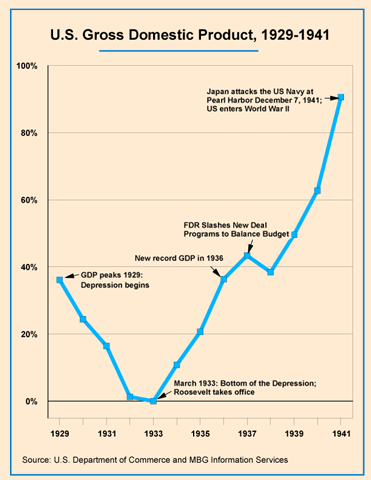
Well-wishers of Obama who seek consolation in the course of FDR's first term are not likely to find much. The most obvious difference is that GDP growth was in double digits from 1933 through 1936, essentially ensuring Roosevelt a second term as long as there was no formidable third-party challenge.  Then too, FDR kicked off his term with a swift, dramatic success that staunched a catastrophe in progress: the bank rescue bill, which ended a panic and brought deposits flooding back into the banks.  For all its many failures, too, the New Deal by 1936 had quite visibly put millions of people back to work and very visibly built out the country's infrastructure. Finally, because the economy had bottomed out by the time FDR took office and growth had been strong in 1933-34, the Democrats won overwhelming majorities in the House and Senate in 1934, empowering a wave of landmark legislation, including the Social Security Act, signed in August 1935.

Perhaps the whole difference is here (large size here):


Nonetheless...the curve of economic freefall staunched and a raft of social welfare legislation passed while the President tacked back and forth between bold action and pulls back on the reins does lend an outline of faint resemblance to the two first terms.  The history rhymes a bit -- and Michael Hiltzik, who just published his The New Deal: A Modern History this September, has got to be conscious of that. Hence the occasional eye-rubbing passage such as this, surveying FDR's political standing in January 1936:

Friday, August 12, 2011

An implacable conciliator

Drew Westen's full-fronted assault on President Obama's performance, rhetoric and character riveted liberal America.  To my mind, Westen core charges have been definitively refudiated. Westen idealized and mischaracterized FDR, vastly overestimated the power of presidential rhetoric, short-changed Obama's legislative accomplishments, ignored what he actually said in his speeches and impugned his motives without any meaningful discussion or evidence.

Westen did, however, touch a  raw nerve in progressives frustrated by Obama's refusal to acknowledge that Republicans have not dealt with him in good faith, and by his endlessly proffered willingness to engage with them under the assumption that they are willing to compromise to find solutions to the country's problems. Michael Tomasky offers a more substantive critique than Westen's of this conciliatory approach to leadership.  While acknowledging a variety of possible contributory causes, Tomasky focuses on Obama's political philosophy -- which is easily verifiable in his writing, speeches and engagement with Congress:

Thursday, August 11, 2011

An implacable conciliator

Drew Westen's full-fronted assault on President Obama's performance, rhetoric and character riveted liberal America.  To my mind, Westen core charges have been definitively refudiated. Westen idealized and mischaracterized FDR, vastly overestimated the power of presidential rhetoric, short-changed Obama's legislative accomplishments, ignored what he actually said in his speeches and impugned his motives without any meaningful discussion or evidence.

Westen did, however, touch a  raw nerve in progressives frustrated by Obama's refusal to acknowledge that Republicans have not dealt with him in good faith, and by his endlessly proffered willingness to engage with them under the assumption that they are willing to compromise to find solutions to the country's problems. Michael Tomasky offers a more substantive critique than Westen's of this conciliatory approach to leadership.  While acknowledging a variety of possible contributory causes, Tomasky focuses on Obama's political philosophy -- which is easily verifiable in his writing, speeches and engagement with Congress:

Monday, August 08, 2011

That sick "Obama's sliding" feeling

Bitterly disappointed as I was in Obama for letting himself be hijacked in the debt ceiling deal, I have been willing to reserve judgment through the next round -- the supercommittee negotiations -- and possibly through the endgame of the Bush tax cut expirations.  But this from Obama today triggered that "there he goes again" reflex:
Last week, we reached an agreement that will make historic cuts to defense and domestic spending.  But there’s not much further we can cut in either of those categories.  What we need to do now is combine those spending cuts with two additional steps:  tax reform that will ask those who can afford it to pay their fair share and modest adjustments to health care programs like Medicare (my emphasis).

Couple that with this warning from Panetta: