Sunday, December 21, 2025

To silver-load or not: Arkansas vs. New Jersey marketplace, 2026

Note: Free xpostfactoid subscription is available on Substack alone, though I will continue to cross-post on this site. If you're not subscribed, please visit xpostfactoid on Substack and sign up.

Does the NJ marketplace need a Huckabee-sting?

The looming expiration of the enhanced Premium Tax Credits in the ACA marketplace (ePTC) increases the salience of the extent to which different states encourage or enforce strict “premium alignment,” A.K.A. silver loading, the pricing of the full value of Cost Sharing Reduction (CSR) into silver plans.

Here, we’ll contrast current plan offerings in a state marketplace with some of the most extreme silver loading effects, Arkansas, with a state where the effects are among the weakest, New Jersey.

If you are unfamiliar with how silver loading works or why it exists, see the explanation at bottom.

To defend against the looming expiration of the enhanced ACA subsidies funded only through 2025, Arkansas implemented the nation’s strictest “premium alignment,” requiring insurers to price silver at 1.46 times what it would be priced at the baseline silver actuarial value of 70%. That is, Arkansas requires insurers to price silver plans as if all silver plan enrollees have income under 200% FPL and so obtain plans with actuarial value of 94% (the AV of CSR-enhanced silver for enrollees with income up to150% FPL) or 87% (silver AV for enrollees in the 150-200% FPL income bracket) — an average AV of 91%. For a convoluted tale of how Arkansas arrived at this point, see Charles Gaba.

Pricing silver as if all enrollees have income under 200% FPL is meant to be a self-fulfilling prophecy. A “CSR factor” like Arkansas’ ensures that gold plans will be cheaper than silver plans with the same provider network, making silver plans an illogical choice for enrollees with income over 200% FPL, since gold plans have a higher AV than silver for enrollees above that income threshold. That assumption has been borne out in the Texas marketplace, where in 2025, just 1% of the state’s 1.9 million silver plan enrollees had income over 200% FPL.* In 2025, 78% of silver plan enrollees in Arkansas obtained 94% AV or 87% AV. The average weighted AV for silver plan enrollees in the state was 86.8%. It’s not a great leap to assume average silver plan AV of 91% under the current pricing regime.

Thanks to this pricing formula for silver plans, Arkansas has the nation’s widest premium spread between the average lowest-cost bronze plan and the average benchmark (second cheapest) silver plan. On average, the premium for the lowest-cost bronze plan in Arkansas is just 57.8% of the benchmark silver premium. Gold coverage in Arkansas is also very cheap, averaging just 83.6% of the benchmark. On that front, Arkansas is tied with Pennsylvania for fourth-lowest in the nation.

Tuesday, December 16, 2025

Talking points for an electoral death march

Note: Free xpostfactoid subscription is available on Substack alone, though I will continue to cross-post on this site. If you're not subscribed, please visit xpostfactoid on Substack and sign up.

A man may smile, and smile (sort of)...

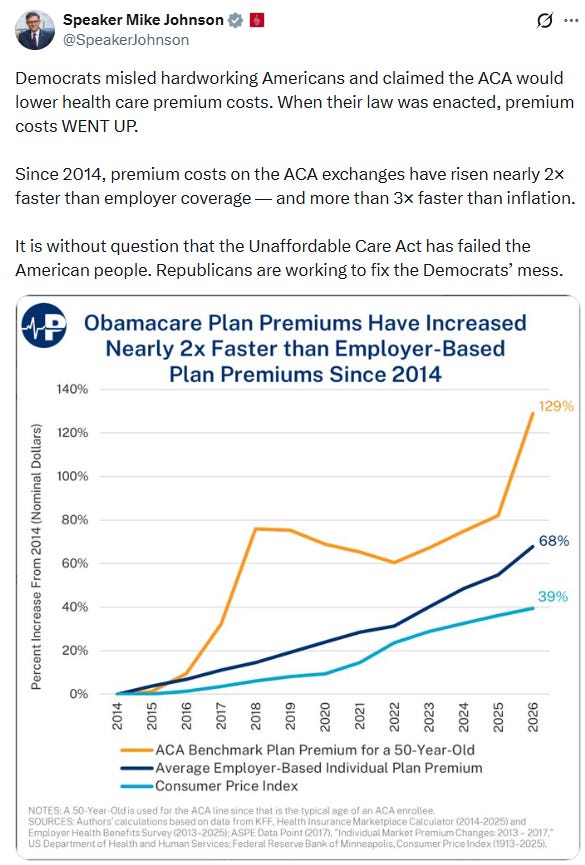
Multiple Republican senators and House reps, psyching themselves up for electoral suicide, are sharing this messaging from the Koch-funded Paragon Health Institute, where virtually all their ACA-related talking points originate:

There are of course lies, damned lies, statistics, and Koch-funded talking points designed to strip Americans of healthcare access to help fund tax cuts for the wealthy.

Look at the mid-section of Johnson chart above, from 2018 to 2025 (there should be a sharp spike from 2017 to 2018, but never mind). There is barely any premium increase in that long stretch, during which average premiums for employer-sponsored insurance rose far more quickly. Here is the comparison in the National Health Estimate Accounts, published in June of this year (see Table 17 in NHE Projections - Tables, here)


From 2018 through 2023, the last year for which the NHE has data, premiums in the individual market (“direct purchase” above) were up 13% — while premiums in the employer-sponsored market rose 29%. From 2023-2025, average ACA benchmark silver premiums rose 9% (from $456/month to $497/month), while average ESI premiums rose 11% (from $8,435/year to $9,325/year) for single coverage according to KFF’s annual employer benefits survey. As of 2025, ESI premiums remained considerably higher than marketplace premiums, though the difference is probably in line with differences in network quality and actuarial value (a measure of the level of out-of-pocket exposure).

Sunday, December 14, 2025

An icy reception for visitors to the immigrants detained at Delaney Hall in Newark

Note: Free xpostfactoid subscription is available on Substack alone, though I will continue to cross-post on this site. If you're not subscribed, please visit xpostfactoid on Substack and sign up.

The, um, visitor reception center at Delaney Hall

Please excuse a departure from our usual usual programming here at xpostfactoid, as I want to report on an ongoing, intentional, sustained abuse of physical and mental health imposed on New Jersey (and really, the entire nation) by our federal government.

On Saturday afternoon, I joined my wife Cindy to visit a detained young man at Delaney Hall, the Geo Group-run immigrant detention center opened this past spring in Newark’s most insalubrious industrial region. As readers here probably know, Geo Group’s treatment of visitors to Delaney detainees is designed to be abusive: Visitors are forced to wait outside, under an open metal canopy with cold metal benches, before being ushered through the gate to again line up outside to be processed through security.

Yesterday, as part of a group of 50-60 visitors, including about ten children and babies, we waited outside for 100 minutes in 35-degree weather.


Cindy and I are among the volunteers who regularly set up and staff a sort of comfort station for Delaney visitors on the sidewalk outside-- more on that ad hoc enterprise at bottom. We have witnessed what the visitors endure and gotten to know to some of them, but yesterday we had the chance to experience the abuse first-hand (Cindy has visited before, but not in freezing weather or at a crowded time). I am focused here only on the visitor experience at Delaney, respecting the privacy of our friend inside.

Where the 100 minutes went

We arrived for our visit one hour prior to the scheduled 4:30 visiting hour (as Geo Group requires) and joined a line then about 30 people long. The guard worked his way down the line, checking that people were there to visit a detainee scheduled for visiting in that hour. Every time a van or car arrived to go through the gate, he had to interrupt himself and walk back to manually open the gate. This particular guard was civil, which is not always the case.

At 4:15 we passed through the gate and lined up again in front of the security check-in area, a grim cubicle maybe 20 feet square. We waited there, still outside, while the door was opened at intervals and small groups were let in for processing. Each person had to be checked again against the visitor list, hand in their i.d., remove jackets and shoes, and pass through a metal detector. There were 3 Geo employees in the security box, but only one was checking people in. We waited out there for 55 minutes for our turn (and people behind us waited longer), entering security at 5 :10 pm.

Our group included one baby, a toddler and at least ten elementary school-aged children and young teens. After the first group (and largest) group was admitted, the guards did ask the visitors to allow the babies and children and their caregivers to go to the front of the line, which everyone did willingly, but most of those children waited outside as long as we did, as subsequent groups were only about 5-10 people. An elderly person who had to leave the security room to pass off her phone asked to be let in but was made to wait outside again.

The visit itself is not too restrictive. The visiting area is like a crowded school lunchroom, with benches running on both sides of long tables. Visitors are supposed to sit opposite detainees, but people are allowed to touch, and children went to sit with their detained fathers (or other detained relative). There was a fair amount of crying, and of laughter. We visited a young man who has seen too much and has no clear path to a better life, or even a safe life. We will be visiting him again.

The young man we visited told us that Senator Andy Kim was coming to Delaney the next day, and that turned out to be the case. Among New Jersey elected officials, Kim is truly the moral leader, on this as on many fronts.

New Jersey elected officials must act

Despite the federal government’s preemptive powers, New Jersey leaders must make it a priority to stop this abuse of their constituents. The pressure on Geo Group and DHS must be ramped up. Surely this abuse of wives, children, parents, and other loved ones of those detained at Delaney must violate multiple laws and civil rights.

About the volunteer effort at Delaney

Present throughout all visiting hours at Delaney (setting up at 6 a.m. on Saturdays and Sundays for the first visiting hour, which starts at 7:30), an ad hoc coalition of volunteers offers hats, gloves, scarves, blankets and handwarmers; coffee, hot chocolate and donuts; toys and art materials for children (though it’s now usually too cold for the latter); diapers and supermarket gift cards for those who have a breadwinner inside; a listening ear when needed; and information about more in-depth support services, along with a list of vetted immigration lawyers. Several nonprofits as well as individuals are involved in the effort, though I think they would not want me to name them here. Originally, as there was no seating, we set up rows of camp chairs, and we still have those on hand for those who can’t manage on the cold metal benches Geo Group has now set up outside, beneath an open metal canopy.

Delaney Hall, like the next-door Essex County Correctional Center, is located in a truly forbidding industrial region of New Jersey, surrounded by energy storage tanks, warehouses, trashy vacant lots, and industrial facilities. Across the street, a narrow freight railroad track is lined with yards-deep trash. The air often stinks. Behind it all, miles to the east, the Manhattan skyline stands like a vision of a different world. None of this matters directly to the detainees, who, according to our friend inside, have no outside view, though they do exercise outside and so get to breathe the insalubrious air. Delaney is within a mile of Newark’s Liberty International Airport, facilitating deportation. I will never fly into Newark again without seeking a glimpse and thinking about the barbarity we have institutionalized at Delaney and the prison next door.

Update: Via Pax Christie, video footage of the visitor line at Delaney on an even colder evening: https://www.instagram.com/p/DSEPgEKDbs9 

Thanks for reading xpostfactoid! Subscribe for free:


Tuesday, December 09, 2025

Bill Cassidy and the Sundowning Kid

Note: Free xpostfactoid subscription is available on Substack alone, though I will continue to cross-post on this site. If you're not subscribed, please visit xpostfactoid on Substack and sign up.


That shit-eating grin will eat your health coverage

I never set up to be a prophet of healthcare policy, or anything else. But when Senator Bill Cassidy floated a plan in early November to extend and modify the enhanced ACA marketplace subsidies that are funded only through 2025, I made a prediction that’s shocked me by its rapid fulfillment:

…if Cassidy reverts to form, he may well embrace plans far more toxic than his current sketch. In 2017, as noted above, he co-sponsored the first and least-bad ACA repeal/replace plan, in March. In September 2017, he co-sponsored the last and worst such plan, Graham-Cassidy, which would have liquidated both the ACA marketplace and the Medicaid expansion, replacing both with inflation-capped block grants to states, inequitably distributed to favor red states (penalizing blue states for expanding Medicaid). Then as now, Cassidy unctuously claimed he was advancing a “nonpartisan” approach— which likely would have increased the uninsured population by more than 30 million, with losses increasing over time as per capita caps on block grants bit progressively deeper.

The plan Cassidy announced last month, which never made it into a bill, would have ended the enhanced premium tax credits (ePTC) in their current form but used the $26 billion estimated cost to fund Flexible Spending Accounts (FSAs) for subsidy-eligible ACA enrollees — that is, funds to spend directly on out-of-pocket costs.

Well lo, less than a month later, Cassidy, along with Senator Crapo, is out with a far more toxic plan, this time written into legislation, that would end ePTC funding and use multiple channels to push ACA marketplace enrollees into plans with actuarial values in the 50-60% range — while also, inevitably, radically cutting enrollment and adding complexity to a marketplace that already presents prospective enrollees with a numbingly complex set of choices. The bill would


  • Fund HSAs for enrollees in bronze plans (60% AV) or catastrophic plans ( ~ 57% AV) worth $1,000 if they are age 18-49 or $1,500 if they are age 50-64.

  • Open catastrophic plans (here co-named “copper” plans) to all enrollees, instead of primarily to enrollees under age 30 as in the original ACA (CMS has already widened access, but retained a cumbersome exemption application process).

  • Fund the Cost Sharing Reduction (CSR) subsidies that attach to silver plans for low-income enrollees through direct reimbursement of insurers for its value, as it was funded before Trump cut off those payments in October 2017, instead of pricing it into plan premiums as at present. In most states, CSR is priced into silver plans only, as CSR is available only with silver plans. Since premium subsidies are structured so that enrollees pay a fixed percentage of income for a benchmark silver plan, raising silver plan premiums also increases subsidies, creating effective discounts in bronze and gold plans for subsidized enrollees. The bill would end this silver loading, reducing the value of enrollees’ premium subsidies in addition to the loss of ePTC.

At present, slightly less than half of marketplace enrollees, about 11.6 million are in CSR-enhanced silver plans with an actuarial value of 94% or 87%. Another 13% are in gold plans with an AV of 80% — which, thanks to silver loading, are available below the cost of a benchmark silver plan in 20 states. By ending ePTC and raising silver plan premiums at low incomes, while adding a modest first-dollar benefit to bronze and catastrophic plans, the Cassidy-Crapo bill would push millions of low-income enrollees into bronze plans. Ending silver loading would push millions more from gold into bronze — and likely drive additional millions out of the market entirely, as the advent of silver loading (before the Democrats created ePTC in the Biden years) made zero-premium bronze plans available to millions of prospective enrollees. The marketplace — what’s left of it— would be converted largely, if not all but entirely, into a market in which most enrollees obtain just 57-60% AV, leaving them exposed to thousands of dollars in additional out-of-pocket costs. While that exposure would be mitigated for many in some years by the HSA funding, every year a significant minority of low-income enrollees would be exposed to thousands of dollars in extra out-of-pocket costs.

Low-AV coverage as a default option for low-income people is a perpetual Republican goal, the party’s favored alternative to the ACA marketplace. The House and Senate ACA “repeal/replace” bills of 2017 also would have pushed most enrollees into bronze or sub-bronze coverage. Republicans are wed to the discredited premise that high out-of-pocket exposure will reduce waste in healthcare spending and make smart shoppers of people in need of medical care. In fact, Democrats also bought into this canard enough to expose millions of marketplace enrollees to damagingly high out-of-pocket costs. Republicans’ only consistent healthcare “reform” idea is to make those costs even higher, exposing ever more Americans to ever more medical debt.

The bill also picks up where OBBBA left off by gratuitously penalizing states that have enacted the ACA Medicaid expansion (further radically cutting high-AV coverage for low-income people); penalizes states that use their own funds to provide coverage to select undocumented populations; prohibits federal Medicaid funding for gender transition services and bars states from including gender transition in EHBs; bars CSR funding for plans that cover abortion, as mandated in many blue states (federal funds already can’t be used to fund abortion coverage, which must be offered for a separate, small premium). In other words, in addition to increasing the ranks of the uninsured and the underinsured, the bills takes vicious swipes at undocumented, trans, and female human beings. For a more detailed provision-by-provision rundown, see Charles Gaba.

The etiology of this steaming pile of legislative aggression is somewhat mysterious. On the one hand, the Republican plans diverting ACA funds to HSAs multiplied like hydra heads in response to Trump’s seemingly incoherent babble on Truth Social in mid-November, calling on Congress to “Take from the BIG, BAD Insurance Companies, give it to the people, and terminate, per Dollar spent, the worst Healthcare anywhere in the World, ObamaCare.” The Cassidy-Crapo fact sheet fawningly boasts that the bill “sends money to patients instead of insurance companies” (so much for the fond Democratic dreams of circa 2007-2009 of defanging Republican opposition to reducing the uninsured population by centering their plans on a market of private insurance plans).

At the same time, Trump’s sudden turn on insurers and apparently nonsensical call to make healthcare more affordable neither through government-run insurance nor through private insurance looks like his senile transcription of longstanding Republican plans to fund healthcare through tax-favored individual spending accounts. Specifically, the Cassidy-Crap crap, which the whole Republican party now looks to align behind, is essentially the plan floated by Trump whisperer Brian Blase of the Paragon Institute, originally in 2022 and recently updated. Cassidy’s earlier iteration, as I noticed in the prior post, was essentially Blase lite. Blase’s proposal, like the Cassidy-Crapo bill, would end ePTC funding and instead use the funding earmarked for Cost Sharing Reduction (CSR) in the original ACA to fund HSA accounts linked to bronze plans — ending ePTC and silver loading in one fell swoop, and pushing most of the shrunken ranks in marketplace coverage into bronze plans (Blase specifically looks forward to cutting the ranks of the CSR eligible by more than half — see my prior post on this). As is so often the case, Trump’s policy choices are a debased version of already-debased versions of longstanding Republican policy.

You can’t change how much sleep you need by going to bed earlier, and you can’t change how much medical attention people need by reducing the actuarial value of their coverage. You can choose how much healthcare people access by cutting AV, but faced with wildly unaffordable out-of-pocket costs, enrollees they will cut down on desperately needed as well as unnecessary care — and go into debt to boot. In fact, the relatively slow rise of U.S. healthcare spending from about 2013-2023 was mostly likely driven mainly by Americans’ terror of being saddled with unaffordable medical bills. Republicans would cut federal spending by cutting AV along with premium subsidies — increasing the underinsured as well as the uninsured population. By so doing, they will degrade Americans’ physical as well as financial health. Par for the course for a party of corrupt oligarchic-serving thieves and autocrats.

Cassidy, let us not forget, cast the deciding vote allowing confirmation of RFK Jr. as HHS director and the resulting destruction of public health administration by the federal government. He is a cowardly go-along who purports to care for his constituents and offer nonpartisan solutions while in the end always partnering with party hardliners to undermine public welfare. I’m not happy that he’s made a prophet of me. But he is…predictable.

Thanks for reading xpostfactoid! Subscribe for free: