Showing posts with label gold plan selection. Show all posts

Friday, July 22, 2022

A Midas touch on New Mexico's ACA exchange, revisited

Subscribe (free) to xpostfactoid

Kudos to health insurance analyst and advocate Stan Dorn and actuary Greg Fann for selling the New Mexico Office of the Superintendent of Insurance on strict silver loading in advance of Open Enrollment for 2022.   

In brief, the Superintendent required marketplace insurers to price silver plans on a par with platinum, since silver plans, thanks to Cost Sharing Reduction (CSR) subsidies, do have platinum-equivalent actuarial value for enrollees with incomes up to 200% FPL. The directive is meant to be a self-fulfilling prophecy: if gold plans are cheaper than silver plans -- and in New Mexico in 2022, gold plans were 10% cheaper on average -- no one with income over 200% FPL should buy silver plans, which have a lower AV than gold plans. In that case, the average AV for silver plan enrollees will indeed be platinum equivalent. 

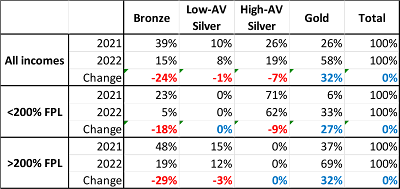
New Mexico didn't quite get there, but came close. In Health Affairs this week, Stan Dorn analyzed the results, spotlighting a massive decrease in enrollment in bronze plans, which have deductibles averaging more than $7,000:

Dorn argues forcefully that New Mexico's pricing directive should be adopted nationally, explaining in detail the flaws in CMS's risk adjustment formula for marketplace plans that favors silver plans, incentivizing insurers to underprice them, and urging a fix.

All that said, while metal level selection at incomes above 200% FPL in New Mexico is an unbridled triumph, there's a caveat to the drop in bronze plan enrollment at incomes below 200% FPL (the middle row above).  Bronze plan takeup at low incomes would have dropped significantly in any case -- and did drop nationally -- because the Open Enrollment Period for 2022 was the first (and possibly the only) OEP in which the premium subsidy enhancements provided by the American Rescue Plan were in effect. Those subsidy boosts made benchmark silver coverage free at incomes up to 150% FPL and available for 0-2% of income for enrollees in the 150-200% FPL range. In HealthCare.gov states, bronze plan selection dropped by 2 percentage points in the 100-150% FPL income range and by 8 percentage points at 150-200% FPL from OEP 2021 to OEP 2022. 

The bronze selection decrease at low incomes in New Mexico was much sharper. But far too many enrollees at income below 200% FPL switched into gold plans rather than silver, which have far lower out-of-pocket costs than gold plans at incomes below 200% FPL.  This is no knock on New Mexico pricing practices, but rather on presentation flaws on the newly minted state exchange, BeWellNM.  The New Mexico exchange does not emphasize the availability of CSR at low incomes. The display, uniquely among ACA exchanges, buries the annual out-of-pocket maximum for each plan (you have to go two clicks in from the top-line display for each plan to find the OOP max) -- and OOP max is where the silver advantage is sharpest, topping out at $2,900 for high-CSR silver compared to $8,700 for gold. 

Worst, the site has a malfunctioning total cost estimation tool, which apparently uses the unsubsidized premium to estimate "costs in a bad year," completely obscuring silver plans OOP max advantage.  (I described these flaws and their effects, with screenshots, in this post.)

The result: silver plan selection at incomes below 200% FPL was just 62% in New Mexico in 2022, compared to 81.5% nationally and 80% in the thirteen state-based exchanges that enroll people with incomes under 200% FPL and provide metal level choices broken out by income. (Those totals are based on my calculations from CMS's Public Use Files and omit the 1.6% of enrollees with income below 100% FPL). 

The 5% bronze selection in New Mexico at incomes below 200% FPL is a sterling accomplishment. But most of the 33% of enrollees in that income bracket who selected gold plans should be in silver. For some, getting a cheaper gold plan from a desired insurer might be worth the extra out-of-pocket exposure, which might be in the $5,000-6,000 range (as discussed here). But most would be better off in silver.

ACA metal level structure is confusing, as bronze, gold and platinum actuarial value is fixed at all incomes whereas as silver plans come with no less than four different AVs, depending on income.  The fact that silver plans can be worth more than gold -- as they are for slightly more than half of marketplace enrollees -- is deeply counterintuitive. Display matters. For enrollees with income under 200% FPL, silver plans should be displayed at the top of results. OOP maxes should always be clearly visible, and defined via mouseover. The availability of CSR and its impact should be heavily signposted. 

Gold plans should be consistently cheaper than silver plans nationally, as Dorn argues (and as David Anderson and I have also done). If metal levels are priced as in New Mexico, plans with an AV of at least 80% (gold) should be available at a premium at or below the benchmark against which subsidies are set. To maximize the value available, however, decision support on most exchanges also needs to be improved.

Update from Stan Dorn (click through for essential gif):

Replying to
...In yet another brilliant, creative NM policy innovation, they are labeling all high-AV products as “turquoise,” a favorite NM color that will easily signal the highest value options for each consumer

Subscribe (free) to xpostfactoid

Friday, February 04, 2022

In 2022, New Mexicans grabbed the gold in the ACA marketplace

Back in mid-October, I devoted a handful of posts (1, 2, 3) to New Mexico's great ACA marketplace experiment: instructing insurers to price silver plans as platinum-value in 2022 -- that is, as if no one with an income over 200% FPL would buy a silver plan. Below that income threshold, silver plans, enhanced by strong Cost Sharing Reduction (CSR), actually are platinum-equivalent, having an actuarial value of 94% (at incomes up to 150% FPL) or 87% at 150-200% FPL). The instructions were adhered to: throughout the state gold plans offered for 2022 were priced well below the benchmark silver plan.

The results were largely as planned, and can fairly be deemed a success. At incomes over 200% FPL, two thirds of enrollees chose gold plans, compared to 35% last year. At incomes in the 138-200% FPL range, comprising most enrollees eligible for strong CSR,  65% of enrollees chose silver plans -- and just 4% chose bronze, generally a bad choice for low income people, with single-person deductibles averaging about $7,000.  Among all enrollees, 57% chose gold plans.

Enrollment was up modestly, from 42,984 in Open Enrollment 2021 to 45,973 this year, a 7% increase. That's below the 11.5% average increase this year for states that have expanded Medicaid, as New Mexico has. But New Mexico launched a new state-based exchange, bewellnm, in the Open Enrollment Period for 2022, and that transition has often triggered enrollment losses for other states.

Here are the metal level choices broken out by income (courtesy of bewellnm, at the first link above):

Friday, January 12, 2018

Choosing a metal level in the CSR-addled Maryland marketplace: Not bad, enrollees!

In Maryland's ACA marketplace, as in much of the country, Trump's cutoff of reimbursement to insurers for Cost Sharing Reduction (CSR) drove huge premium increases for unsubsidized buyers -- but also bizarre bargains for the subsidy-eligible.

Throughout the state, all subsidy-eligible* enrollees with incomes below 200% of the Federal Poverty Level (FPL) could obtain an bronze plan for under $20 per month. Most at this income level -- e.g., everyone over 30 -- could get a bronze plan for under $4 per month. In the state's most populous counties, subsidy-eligible buyers could get a gold plan for just a few dollars more than a silver one.  And in several rural counties, an enormously expensive benchmark (second cheapest) silver plan, which determines subsidy size, rendered silver and gold plans as well as bronze plans free for many enrollees.

The effects of these pricing anomalies on the subsidized were mostly beneficial, as you might expect. Discounted (not to mention free) gold plans are a real boon to enrollees with incomes over 200% FPL, for whom silver plans have high out-of-pocket costs (sharply reduced for those up to 200% FPL by strong CSR). And free bronze plans are better than nothing, even with the $6200 deductible they carry in the most populous counties.

But anomalous pricing also can create problems. Some enrollees eligible for strong CSR might be tempted to choose  bronze plans (deductible $6200) over silver (deductible $0). Some enrollees under 200% FPL might also have been tempted by gold plans that cost slightly more than the cheapest silver -- not recognizing that CSR-enhanced silver plans cover more of their out-of-pocket costs than gold (i.e., are just straight-out more valuable).

So how did enrollees' choices shake out? Courtesy of the Maryland Health Connection, I have a breakout of enrollees metal level choices at different income levels, posted below.  And they look pretty good:


A few observations:

Tuesday, September 08, 2015

Some low-income ACA shoppers bought gold plans*

* But not enough to cover Avalere's estimate of CSR-forfeiters

On August 19, Avalere Health published an analysis spotlighting ACA private plan buyers who failed to access the Cost Sharing Reduction (CSR) subsidies that are available to applicants with incomes up to 250% of the Federal Poverty Level (FPL) -- but only if they buy silver plans. Avalere estimated that about 27% of CSR-eligible buyers forfeited the subsidy by buying plans in metal levels other than silver -- usually the cheapest bronze plans, which carry very high deductibles.

In a response, I argued that Avalere had somewhat lowballed CSR takeup by overestimating the number of private plan buyers who were eligible for CSR. The numerator of the equation is not in doubt: an ACA enrollment update published by CMS in June pegged total CSR enrollment at 5,850,936 as of March 31. But the denominator (CSR-eligibles) is based on extrapolations from incomplete income breakouts of ACA private plan customers, provided by HHS in March for healthcare.gov states alone. Avalere assumed that 8.1 million of those still enrolled as of March 31 were CSR-eligible; I estimate that about 7.7 million enrollees were eligible, and that therefore, about 76% of CSR-eligibles accessed the benefit.

The difference stems from two factors: what you assume about the roughly 6% of enrollees for whom income data was unavailable, and how you estimate the percentage of CSR-eligibles in state-based exchanges, for whom income data was not included in federal enrollment reports. I assume that income distribution in the SBMs is closer to that of those healthcare.gov states that accepted the Medicaid expansion than to the overall average for healthcare.gov states, which is dominated by states that refused to expand Medicaid.

CSR-eligibles who bought neither silver nor bronze

I was struck today by additional evidence that Avalere somewhat overestimated the number of private plan holders who are eligible for CSR. According to their analysis, 2.2 million plan holders renounced the benefit by buying non-silver plans. The assumption is that those who leave CSR on the table mostly buy bronze plans, which have lower premiums. But the total number of bronze plan buyers is a known quantity: 2,164,116.  And we know that bronze plan buyers are more concentrated at higher income levels. Among buyers eligible for any kind of subsidy (not all of whom were CSR-eligible), 19% bought bronze. Among those who earned too much to qualify for subsidies, 35% chose bronze.