Showing posts with label special enrollment period. Show all posts

Wednesday, February 23, 2022

New Jersey launches year-round marketplace enrollment at incomes below 200% FPL

Subscribe (free) to xpostfactoid


My last post delved into CMS's motives and goals in establishing continuous year-round enrollment for ACA marketplace enrollees with income up to 150% FPL, as long as benchmark silver coverage remains free to that income level.

New Jersey has gone the feds one better, today announcing year-round enrollment on GetCoveredNJ, the state exchange, for enrollees with income up to 200% FPL ($25,760 annually for an individual; $53,000 for a family of four). 

Various state-specific conditions suggest motives for going that high:

1. Supplemental state subsidies provided in New Jersey make silver coverage free all the way to the 200% FPL threshold. In finalizing its rule establishing continuous enrollment to 150% FPL, CMS suggested (pp. 91-92 here) that limiting the open enrollment to those for whom benchmark coverage is free limits the risk of adverse selection. For that reason, CMS conditions extending the continuous SEP beyond this year on extension of the enhanced subsidies provided through 2022 by the American Rescue Plan.

2. New Jersey is one of a handful of states that imposed a state-level individual mandate after the Republican Congress zeroed out the penalty for the federal mandate. There has been a degree of buyer's remorse about the mandate among progressive groups. It was enacted in 2018 to partly fund a state reinsurance program (about two thirds-funded by the federal government), which reduced premiums for unsubsidized (i.e., mostly affluent) enrollees. Most people who pay the mandate penalty are low income. Continuous enrollment, along with the targeting of uninsured taxpayers described below, would reduce low-income exposure to the mandate.

Sunday, February 20, 2022

Why HealthCare.gov is offering year-round enrollment at low incomes


CMS has soft-launched a new "monthly special enrollment period" (SEP) for health insurance seekers with incomes below 150% of the Federal Poverty Level in states that use the federal exchange, HealthCare.gov. This new rule, finalized last fall, effectively creates continuous enrollment for the lowest-income enrollees. At present, the SEP can be accessed by calling the HealthCare.gov help center (1-800-318-2596); it will be available online on HealthCare.gov by late March. State-based exchanges can implement this continuous enrollment at their option. 

Louise Norris covers every nuance of the rule's operation here. I will focus on CMS's stated motives and goals, and the likely impact.

The rule stipulates that the monthly SEP will only be operative as long as benchmark silver coverage remains free to enrollees with income up to the 150% FPL threshold. Boosts to ACA marketplace subsidies provided by the American Rescue Plan Act (ARPA) created that free coverage through 2022. While Democrats clearly intended and have been expected to extend the ARPA subsidies beyond this year, that is no longer certain now that the Build Back Better legislation has stalled.

Continuous enrollment in coverage available free at low incomes is of a piece with Medicaid enrollment practices, as well as with enrollment in the Basic Health Programs established under the ACA by Minnesota and New York. BHPs offer free or low-premium coverage with low-out-of-pocket costs -- rather like Medicaid -- to residents with incomes up to 200% FPL. 

In its September 27, 2021 update to ACA rules, CMS spelled out the rationale for the new monthly low-income SEP. The broad context, cited in the executive summary, is President Biden's January 28, 2021 Executive Order 14009, “Strengthening Medicaid and the Affordable Care Act," which declares:

millions of people who are potentially eligible for coverage under the ACA or other laws remain uninsured, and obtaining insurance benefits is more difficult than necessary. For these reasons, it is the policy of my Administration to protect and strengthen Medicaid and the ACA and to make high-quality healthcare accessible and affordable for every American. 

Thursday, December 30, 2021

The ACA as pandemic safety net, Chapter 2 (2021)

Subscribe (free) to xpostfactoid


As xpostfactoid is devoted mainly to tracking the implementation and metamorphosis of the Affordable Care Act, for the past two years I've focused mainly on ACA programs' performance as a safety net during the pandemic, as millions of people lost job-based health coverage for varying lengths of time. 

In 2020, the uninsured rate appears to have remained basically flat, though pandemic-related surveying challenges rendered Census and NHIS findings somewhat tentative. In 2021, the uninsured rate may actually prove to have downticked a bit, once the data is in. By kludgy American standards, the health insurance safety net -- Medicaid and the ACA marketplace -- have performed well, bolstered by several doses of emergency legislation and administrative action:

  • The Families First Act, which added six percentage points to the federal government's share of Medicaid costs -- contingent on states pausing Medicaid "redeterminations" and disenrollments for the duration of the COVID-19 emergency (still in effect).
  • Belated ACA Medicaid expansions that went live in Idaho, Utah and Nebraska in 2020 and in Oklahoma and Missouri in 2021.

Tuesday, September 28, 2021

Rapid marketplace enrollment growth in nonexpansion states, revisited

Subscribe to xpostfactoid

I don't know whether ACA marketplace observers have fully fathomed the extent to which the nonexpansion states drove the enrollment surge during the emergency Special Enrollment Period that ran from Feb. 15 to August 15 on HealthCare.gov -- and indeed, over the past two years.

Also not fully fathomed: the extent of total enrollment growth in all states during the pandemic.

Thursday, September 16, 2021

Notes from the SEP: On record marketplace enrollment in August 2021

Subscribe to xpostfactoid

CMS today released a final enrollment report for the emergency Special Enrollment Period that ran in HealthCare.gov states from Feb. 15--Aug. 15 this year, and for mostly comparable lengths in the 15 state-based marketplaces. 

The top line: 2.8 million new enrollments nationally in that period. A few quick notes:

  1. Effectuated enrollment in August 2021, 12,199,393, is up 14.6% over 2020, the previous high (10,642,088*), and 22% over enrollment in August 2016, the peak prior to 2020.  Caveat: off-exchange enrollment in ACA-compliant plans dropped by about 3 million from 2016 to 2019, according to KFF estimates. On-exchange enrollment is about 2.2 million above the August 2016 total.

  2. While 2.8 million people newly enrolled in marketplace coverage during the SEP, total enrollment has risen by only 900,000 since February, when effectuated enrollment stood at 11.3 million.  That's steeper attrition than I anticipated when I estimated total enrollment at 12.7 million through July.

Friday, July 23, 2021

A Wisconsin window on the ACA coverage gap in pandemic time

Subscribe to xpostfactoid

To pick up a thread from deep in the prior post...

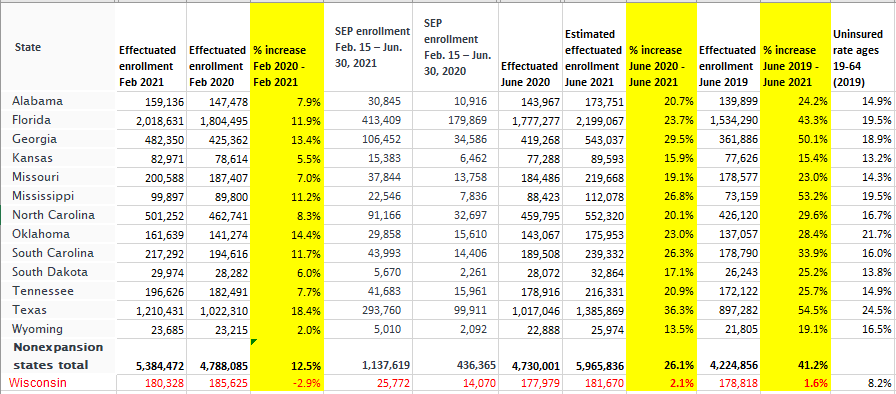
In Wisconsin, ACA marketplace enrollment as of June 30, 2021 had increased by less than two percentage since June 2019. In the other thirteen states that had not enacted the ACA Medicaid expansion as of June 30 of this year, enrollment increased by 41% over the same period.

What's the matter (or rather, what's right) with Wisconsin?

    Enrollment in nonexpansion states, 2019-2021

     Sources: CMS, Early Effectuated Enrollment Snapshot, 2020, 2021; SEP enrollment 7/14/21; KFF
     See the prior post for an explanation of how June 2021 enrollment is estimated.

A lot of factors affect marketplace enrollment, which varies widely by state. But the most salient factor would appear to be the fact that Wisconsin has no "coverage gap." 

Tuesday, June 22, 2021

In 2021, will attrition in the ACA marketplace go negative?

Subscribe to xpostfactoid

Until the pandemic struck, enrollment attrition throughout the coverage year in the ACA marketplace was an established norm. Every year, effectuated enrollment (i.e. paid-up enrollment) as of the first month after the end of Open Enrollment (OE) was between 6% and 15% lower than the "plan selection" total as of the end of OE. From February through December, enrollment would downtick by 600-800,000.

Attrition was reduced throughout the Trump years; possible causes are discussed here. (In brief, the Trump administration made it harder to enroll, weeding out less motivated enrollees, while silver loading made coverage much cheaper for a significant number of enrollees.) Last spring, as the pandemic triggered tens of millions of layoffs, 12 state exchanges opened emergency Special Enrollment Periods (SEPs) in which anyone who needed insurance could enroll with relatively little friction (varying somewhat by exchange).  The Trump administration declined to open an emergency SEP for the 36 states using HealthCare.gov, but did reduce red tape for those who sought individual SEPs due to a qualifying "life change," usually loss of employer insurance. 

The net result was a steady reduction in attrition from 2017-2019 and a sharp reduction last year. In 2016, the year of peak plan selections as of the end of OE, average monthly enrollment (AME) was 79% of end-of-OE "plan selections." In 2019, AME was 86% of initial plan selections. In 2020, AME reached 92% of the end-of-OE tally.

Saturday, June 19, 2021

ACA marketplace enrollment in 2020 exceeded the 2016 peak (on-exchange)

Subscribe to xpostfactoid

Every June, the first "effectuated enrollment snapshot" of the ACA marketplace for February includes month-by-month and average monthly enrollment for the previous year.

Though I had been eagerly awaiting this year's snapshot, having inferred last December that marketplace enrollment in June 2020 was probably at all-time mid-year high, I missed its release on June 5. But it's out, and it's official: average monthly enrollment in 2020 was the highest ever, exceeding the 2016 peak by 5.2%. 

That's notwithstanding the fact that initial "plan selections" as of the end of Open Enrollment for 2016 exceeded the 2020 end-of-OE tally by almost 1.2 million (12,681,874 vs. 11,444,141). Here are the official average monthly enrollment tallies by year:

Average monthly enrollment: ACA marketplace, 2016-2020

2016     10,007,113
2017       9,763,076
2018       9,895,197
2019       9,810,613
2020     10,531,978

Although end-of-OE plan selections were 9.8% higher in 2016 than in 2020, average monthly enrollment was 5.2% higher in 2020 than in 2016 (and 7.4% higher than in 2019).  Why? 

Thursday, June 10, 2021

Obamacare mid-year enrollment is likely up 19% over past peak

Subscribe to xpostfactoid

see 6/18/21 update at bottom

Charles Gaba estimates current enrollment in the ACA marketplace at 12.4 million. That's based on effectuated enrollment as of February of 11.3 million, plus about 1.6 million new enrollments during the emergency Special Enrollment Period (SEP) commenced on Feb. 15, minus an estimate of monthly attrition based on last year's monthly totals. Attrition may be a bit higher, but this is a good estimate.

A lot of people who pay attention to marketplace enrollment patterns have imprinted a number: 12.7 million. That was the (rounded) national total of signups for coverage as of the end of Open Enrollment  season (OE) in 2016 -- long understood to be the peak year for marketplace enrollment. Plan selections declined in subsequent years, probably due in part both to soaring premiums in 2017 and 2018 and Trump administration sabotage (which contributed to 2018 premium hikes though not to the correction of 2017).

Plan selections as of the end of OE is a very different metric, however, from effectuated enrollment, which measures people who are paid up on their premiums. Attrition was high in 2016: effectuated enrollment peaked at 10.8 million in March, and average monthly enrollment for the year was 10.0 million. Attrition fell in the Trump years, for reasons we'll touch on below, and fell further last year, as the pandemic triggered high SEP enrollment. 

This year, the emergency SEP, coupled with massive boosts to premium subsidies enacted in the American Rescue Plan, has triggered SEP enrollment that's 3.5 times higher than in 2019, the last pre-pandemic year. The SEP enrollments logged to date have almost certainly outpaced normal attrition as experienced in the pre-pandemic years.  The ARP subsidy boosts have likely reduced disenrollments as well as stimulating new enrollment.

Bottom line: marketplace enrollment growth is larger than meets the eye, at least for those who measure "12.4 million" against the 2016 end-of-OE peak. June enrollment as estimated by Gaba is 20% higher than June enrollment in 2016, and 19% higher than in June 2020, when SEPs triggered by the pandemic pushed mid-year enrollment to a new high. 

Tuesday, June 01, 2021

HHS devotes $4.8 billion to COVID-test the uninsured. P.S. How about insuring them?

Subscribe to xpostfactoid


HHS announced today that it is dedicating $4.8 billion in American Rescue Plan funds to reimburse providers for providing Covid-19 testing to the uninsured, at no cost to the uninsured patient. That's a continuation of a program initiated last spring. So far, $2.5 billion has been allocated by the Health Resources and Services Administration (HRSA) for such reimbursement.

Am I letting a current preoccupation distort my vision in seeing something of a lost opportunity (and irony) in this HHS statement?

There are approximately 29 million uninsured individuals living in the United States. While this administration has been focused on decreasing the uninsured rate, as evidenced by the more than 1 million people who have enrolled into quality health coverage through the Special Enrollment Period (SEP), much work remains. By ensuring programs like the HRSA COVID-19 Uninsured Program remains adequately funded, this administration is removing cost impediments so anyone exposed to COVID-19 may seek appropriate testing and care.

The funding announced today is dedicated to COVID-19 testing. HRSA also helps uninsured individuals’ access COVID-19 treatment and vaccinations through the COVID-19 Uninsured Program.  The program reimburses providers at national Medicare rates for providing these services.

Tuesday, February 09, 2021

Under Covid relief bill, no Obamacare enrollee should have coverage less than valuable than gold

Subscribe to xpostfactoid

It's here! After five years in which progressives have dreamed of boosting the generosity of subsidies in the ACA marketplace, the framework for half the Covid relief bill released by the House Ways and Means yesterday would do so temporarily, for 2021 and 2022. The subsidy schedule is even more generous than that of the Affordable Care Enhancement Act passed by the House last June (and left to die in the Senate, natch). Here are the percentages of income required to purchase a benchmark (second cheapest) silver plan (Part 7, beginning on p. 83):Enhanced ACA subsidy framework

Keep in mind that Cost Sharing Reduction (CSR) raises the actuarial value of a silver plan from a baseline of 70% (which leaves very high out-of-pocket costs) to 94% at incomes up to 150% FPL (where it's free) and to 87% -- better than most employer-sponsored plans at incomes ranging from 150-200% FPL.  This radical change may happen fast, and be effective immediately. The implications are kind of dizzying. Three notes:

Thursday, October 08, 2020

ACA marketplace enrollment in Covid-19 season: Flat? Up a million? Both?

Subscribe to xpostfactoid 

 As millions of Americans lose job-based health insurance during the pandemic months, Medicaid, bolstered by the ACA Medicaid expansion, has served as a far more potent protection against becoming uninsured than the ACA marketplace, for several reasons:

  1. As family incomes crash, about twice as many newly unemployed and uninsured become eligible for Medicaid as for subsidized marketplace coverage, according to Urban Institute calculations (2.4 times as many in expansion states; 1.6 times as many in nonexpansion states).  Medicaid eligibility is determined on a current monthly basis, while marketplace subsidies are calculated on the basis of estimated annual income.

  2. The emergency extra $600/week unemployment insurance provided for up to four months (now expired) by the CARES Act does not (did not) count with respect to Medicaid eligibility, but did count in calculation of marketplace subsidies, severely weakening them (it continues to count, since the relevant measure is annual income).

Wednesday, October 07, 2020

Estimate: Between 42 million and 50 million people have enrolled in ACA-compliant plans since 2014

Subscribe to xpostfactoid 

While only about 5% of the nonelderly U.S. population is insured through the ACA-compliant individual market for health insurance, a far larger percentage of us are likely to access the market at some point in our lives (if it survives). At healthinsurance.org, I've estimated that between 42 million and 50 million people have accessed the ACA marketplace since its launch in January 1, 2014.

I've referred readers of that post here for more explanation of the basis of that estimate. CMS does not provide a simple count, yearly or cumulatively, of unique enrollees at all times and venues: during the annual Open Enrollment, via Special Enrollment Period year-round, and off- as well as on-exchange. So here is what I have pieced together:

1. New enrollment on-exchange during Open Enrollment

In its reports and Public Use Files tallying annual marketplace enrollment, CMS breaks out the number of new enrollees (as opposed to renewals). Each year, after reporting on total signups during the Open Enrollment period, CMS later reports on effectuated enrollment  -- that is, the number of enrollees who have paid their premiums. Effectuated enrollment at its peak each year has averaged about 89% of initial signups.  In the right column below, I have estimated effectuated new enrollment in each year and in total.

Total New ACA marketplace enrollment, 2014-2020

    Source: CMS Public Use Files (see note at bottom for adjustments)

From 2014 through this year, approximately 27.7 million people have purchased plans during the annual Open Enrollment period and paid their first premiums, effectuating coverage ("approximate" because I'm applying the overall effectuated percentage to the new enrollees specifically).  Some "new" enrollees may have dropped out and returned.

Friday, July 24, 2020

Want a SEP? You'll have to schlep...CMS ends application streamlining on HealthCare.gov

Subscribe to xpostfactoid

Update, 7/29/20: CMS confirms that it has reverted to the standard pre-crisis SEP verification process,  "as part of its efforts to safeguard taxpayer funds, promote market stability, and ensure affordable premiums."  As noted below, insurers were not calling for this change -- they are not concerned that looser SEP verification at this point will worsen the risk pool. As for safeguarding taxpayer funds, inhibiting marketplace enrollment will always do that. Meanwhile, HHS has been showering billions in CARES Act relief funds on the nation's wealthiest hospital systems, many of which hold huge reserves, while safety net hospitals go begging.


In late March, as twelve of the thirteen state-based ACA marketplaces opened emergency Special Enrollment Periods in which anyone who lacked health insurance could enroll, CMS was rumored to be on the brink of following suit in HealthCare.gov, the federal exchange used by 38 states.

Ordinarily, enrollment in ACA marketplace health plans is only open to all during an Open Enrollment season, which on HealthCare.gov runs from November 1 to December 15.  Those seeking coverage at other times must apply for a Special Enrollment Period and provide documentation showing that they had a qualifying life change, most often loss of health insurance. The emergency SEPs in some states did away with that requirement, functioning as in Open Enrollment. Others required mere attestation by phone or box-checking of loss of coverage or other life change, without documentation. (I reviewed various emergency SEP processes and presentations here.)

HHS ultimately declined to open an emergency SEP in HealthCare.gov. Reportedly the agency was ready to do so, but the Trump White House - killed it. Putting the marketplace forward as a vital service in time of intense need was a bridge too far for Trump & Co.  CMS did, however, accept attestation of loss of coverage prior to enrollment, with documentation to be supplied later. That change occurred around April 20.

Now, that limited but important accommodation has ended. Jenny Hogue, a health insurance broker based in Murphy, Texas, got wind of the change early this week. Shelli Quenga, director of programs at the South Carolina-based Palmetto Project, which provides marketplace enrollment assistance as a nonprofit brokerage, confirmed this to me, as did Jodi Ray, Director of the Florida Covering Kids and Families Project at the University of South Florida. "We have had appointments in the past week where consumers were asked for documentation to be uploaded," Ray emailed.

Wednesday, April 22, 2020

CMS answers a $600 question

Subscribe to xpostfactoid via box at top right. You'll get 2-3 posts per week, mostly re ACA.

While CMS has declined to open an emergency Special Enrollment Period for all comers on HealthCare.gov, the agency is taking steps to smooth the enrollment path for the newly uninsured. Here's a roundup of some constructive moves, some of which I've noted in recent posts:
  • The $600/week extra unemployment benefit provided in the CARES Act is income that counts toward the level of subsidy eligibility in the ACA marketplace but does not count toward Medicaid and CHIP eligibility. That seems a recipe for potential enrollment confusion on a platform that enrolls people in both programs. In response to a query, however, CMS tells me, "HealthCare.gov will be updated to apply logic to ensure federal pandemic UC is counted correctly and unemployed consumers receive the accurate eligibility determination." That is, applicants should report their full UI income in the application, and HealthCare.gov will be able to discount it for the purposes of determining Medicaid eligibility. That's good news, if the "logic" holds up as intended. [Update, 4/24: just to highlight the verb tense above, CMS says that they will add this capability, which means that it's not yet operative.]

  • CMS also says that if an applicant's year-to-date income or projected full-year income exceeds the Medicaid eligibility threshold, but current monthly income is below the monthly threshold ($1468 for an individual, $3013 for a family of four), HealthCare.gov will recognize Medicaid eligibility and "transfer the consumer’s information to the state Medicaid or CHIP agency as appropriate." As I've noted in prior posts, in this situation navigators generally prefer to apply directly to state agencies for Medicaid. But whether or not it's difficult in practice to report both annual (or projected annual) and current monthly income on hc.gov and get the right result if one is over and the other is under the threshold, it's possible.

  • As noted in my last post, those who apply for a Special Enrollment Period on grounds that they recently lost health coverage (usually after job loss) will not have to document the loss of coverage -- only attest to it. I am not sure whether that is true for other SEP causes, such as marriage.

Friday, March 20, 2020

The ACA as recession insurance, revisited

Subscribe to xpostfactoid via box at top right.

Almost a year ago, I noted that the ACA marketplace has never operated in a shrinking employment market -- job growth has been steady since the marketplace launched in January 2014.  That's created a (fortunate) headwind for enrollment, and
Conversely, the marketplace -- along with the ACA Medicaid expansion -- stands in reserve as a shock absorber when the next recession or financial crisis hits.
That's now. Goldman Sachs projects that after a 30% spike in jobless claims last week, to 281,000, new claims will hit 2.25 million this week -- an unprecedented surge. Mnuchin, Trump's Treasury Secretary, warned Republican senators this week that unemployment could go to 20%, a level not seen since the Great Depression. In the Great Recession of 2008-9, 9 million people lost their jobs; losses this time around could far exceed that total.

Millions of people are going to lose access to employer-sponsored insurance. The ACA machinery to get them insured is knobbly, but functional and funded. I have a post at healthinsurance.org to help the newly uninsured navigate their options. The basics:

Monday, March 09, 2020

Coronavirus alert: How about an emergency Special Enrollment Period for the ACA marketplace?

Subscribe to xpostfactoid via box at top right

Update, 3/12: As noted in the updates at bottom, as of now five state-based marketplaces are running Special Enrollment Periods open to all, two of them triggered by the coronavirus emergency. CMS should do it for the healthcare.gov states. 3/14: Rhode Island makes six. 3/16: New York comes on board. 3/17: Nevada is in. 3/18: Connecticut announces SEP. And Colorado will announce imminently. 3/20: Covered California, already open via a tax-season SEP, available to anyone who affirms they were not aware of the state's new individual mandate, today makes it unconditional with an emergency SEP open to all. And it's open through June 30, by far the longest emergency SEP. 3/20 II: MNSure announces a SEP running March 23 - April 1. 3/20 III: Vermont comes on board, sort of.

Every SBE except Idaho now has enrollment open to the uninsured.

If the coronavirus causes major economic disruption, as now seems likely, the ACA marketplace (including Medicaid enrollment) is likely to get a major stress test.

As I've noted previously, the marketplace has never experienced a recession; the unemployment rate has dropped steadily since it launched in 2014, and enrollment has been basically flat since 2016. It stands ready as a shock absorber when people are laid off.  Those who lose insurance through their jobs are eligible for a Special Enrollment Period.  The machinery for processing SEP requests had better be smooth.

Since subsidy eligibility depends on annual income, the earlier in the year layoffs begin, the more people will qualify for marketplace subsidies (annual income up to $49,960 for an individual) or Medicaid ($17,236). In Medicaid expansion states, even those who have crossed those earnings thresholds should be eligible for Medicaid one month forward if their income is below the monthly Medicaid threshold.* Under various emergency authorities, governors and the president can extend Medicaid eligibility and expedite enrollment, as was done in the wake of 9/11, Hurricane Katrina, and the Flint water crisis.

The marketplace also might be put to more immediate use.  CMS should declare a national Special Enrollment Period for the marketplace (Medicaid enrollment is year-round).

Tuesday, January 12, 2016

What's a healthcare article without a touch of Levitty?

It is a fact universally acknowledged among healthcare reporters that there are two ways to structure an article.

The first is to give Kaiser's Larry Levitt the lead quote to articulate or validate an asserted trend.

The second is to use other authorities to assert said trend -- and deploy Levitt about two-thirds down to inject a note of skepticism or a reality check. Today offers a perfect specimen of plan b: Gaming Obamacare, by Politico's Paul Demko.  The thesis is brought to you by the nation's insurers:
Obamacare customers are gaming the system, buying coverage only after they find out they’re ill and need expensive care — a trend insurers warn is destabilizing the fledgling health law marketplaces and spiking premiums for everyone.
700 words in, we're well prepped for the Levitt Reality Check:

Wednesday, October 01, 2014

ACA Signups: "Over 9.5 million served"?*

Charles Gaba has been tracking ACA enrollments during the off-season, as he did during open season. He estimates that approximately 9,000 people per day are signing up for private plans via "special enrollment" periods, with net attrition of about 2% per month as people drop plans for a variety of reasons.

Tonight Gaba estimates that there have been about 9.5 total private plan (QHP, for Qualified Health Plan) signups to date That's a number that most people will mentally offset, as HHS recently announced that about 7.3 million are currently enrolled in QHPs. Perhaps a bit less than half of that 2.2 million difference is comprised of people who never paid, the rest dropping plans at various points.

It's natural and to a degree fitting to focus on the number of current enrollees. That number is important in that a) the ACA has a long way to go to full takeup -- CBO forecasts 25 million exchange users by in 2018 --  and b) the states' risk pools need to maintain critical mass to establish a viable market. Still, the total number served since the outset -- discounting, perhaps, most of those who never paid -- is also significant.

Thursday, April 03, 2014

The health insurance market is an ocean, endlessly churning

Long, long ago, back on March 22, I noted of the ACA signup count that it ain't over when it's over. Medicaid enrollment, including those newly eligible under the ACA expansion, is open all year. And in this interval between open enrollment periods, many people will become eligible for a two-month "special enrollment period" if they experience a "qualifying event" such as job loss, divorce, marriage (if, say, one of the couple has no income), or childbirth. I also noted with some wonder how fluid health insurance markets are: according to an estimate by healthcare scholars Rick Curtis and John Graves, less than half the people who will be eligible for ACA enrollment at the end of 2014 will have been eligible a year prior. [Update, 4/4: Graves has just made the case anew with Jonathan Gruber.]

Today's news brought several further snapshots of this fluidity. The LA Times' Chad Terhune noted another large category of pending special enrollments -- college graduates:
it's estimated that several hundred thousand more Californians could qualify for a special enrollment period as college students graduate, families move and workers change jobs.
In the short term, also in California, extended enrollment for those who started but could not complete applications before 3/31 is going to be huge, reports Marketwatch's Russ Britt: